
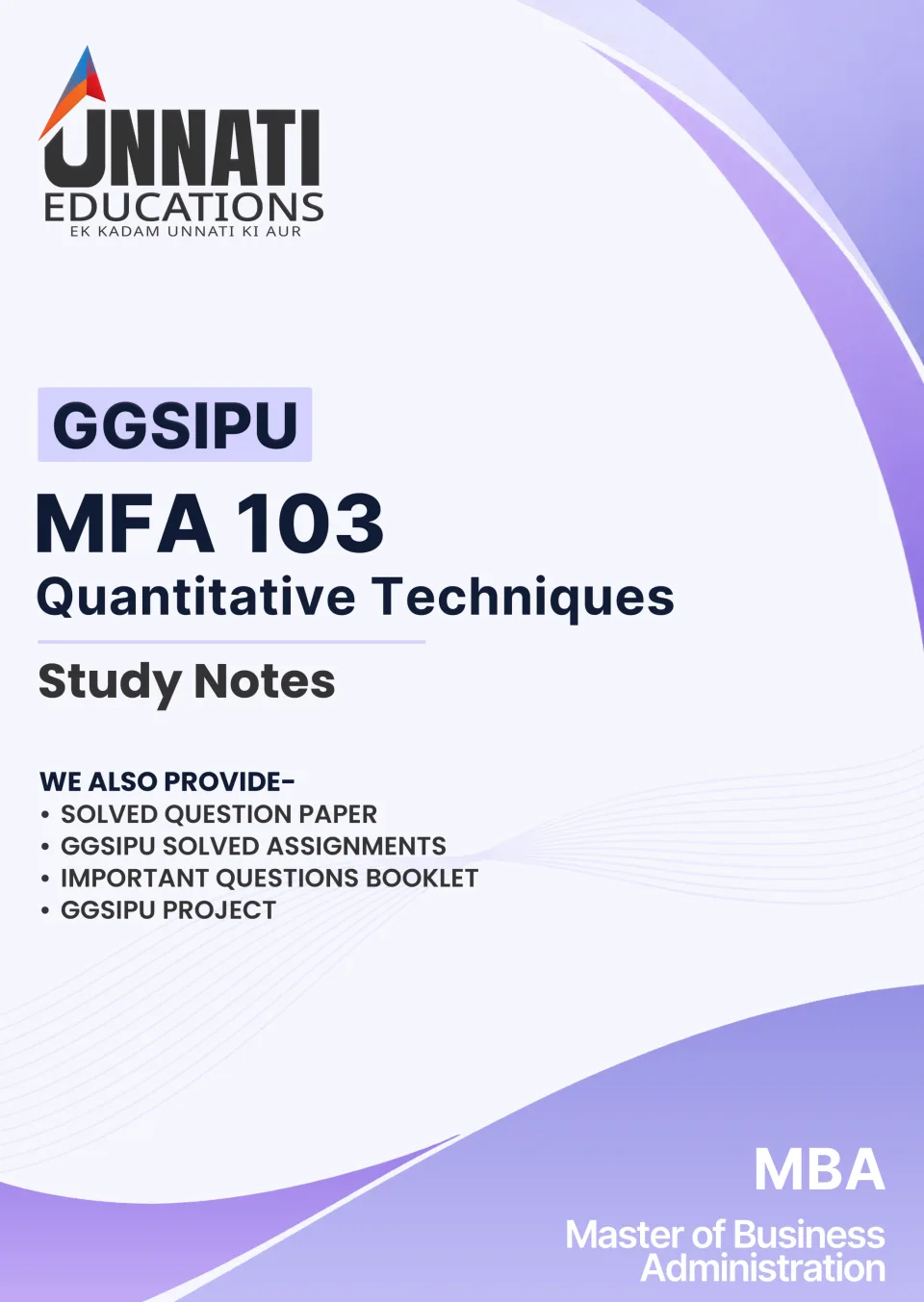
MFA 103 Quantitative Techniques Notes cover all 4 units of the GGSIPU MBA (Financial Analysis) Semester 1 paper in 63 pages: 52 solved illustrations, 29 figures, 42 short-answer and 27 long-answer exam questions, and an Excel section in every unit. They follow the scheme that applies from the 2021-22 academic session onwards.
Written by Prateek Talwar, Founder, Unnati Educations (ACS, ICSI) · Reviewed by Sheetal Kirola, M.Ed., Academic Head (academic review) · Checked against MBA (Financial Analysis) Scheme and Syllabus 2021-22 onwards on 28 October 2026 · Updated 28 October 2026 · Editorial policy
Scheme: MBA (FA) Scheme and Syllabus 2021-22 onwards | Applies to: academic session 2021-22 onwards | Verified against: notice nt0722536 (9), ipu.ac.in, checked 28 Oct 2026
MFA 103 Quantitative Techniques at a glance: GGSIPU MBA (FA) Sem 1 credits, units and exam pattern
MFA-103 lists 42 teaching hours (12 + 10 + 10 + 10) and sits with nine other GGSIPU MBA (FA) Semester 1 papers worth 28 credits.
| Item | Official detail |
|---|---|
| Code and title | MFA-103 Quantitative Techniques |
| Course and semester | MBA (Financial Analysis), Semester 1 |
| Category and credits | Core · L-3, no T/P · 3 credits |
| Marks | 100: 50 internal + 50 end-term |
| Internal split | Class Test-I 15 + Class Test-II 15 + assignments, viva or participation 20 |
| End-term pattern | 50-mark written university exam; question pattern not printed in the official PDF |
| Applies to | Academic session 2021-22 onwards |
| Units | 4 |
| Paired lab | None |
| Pass and re-appear rules | GGSIPU Ordinance 11 |
MFA 103 snapshot from the MBA (FA) scheme and syllabus, 2021-22 onwards
- Item
- Code and title
- Official detail
- MFA-103 Quantitative Techniques
- Item
- Course and semester
- Official detail
- MBA (Financial Analysis), Semester 1
- Item
- Category and credits
- Official detail
- Core · L-3, no T/P · 3 credits
- Item
- Marks
- Official detail
- 100: 50 internal + 50 end-term
- Item
- Internal split
- Official detail
- Class Test-I 15 + Class Test-II 15 + assignments, viva or participation 20
- Item
- End-term pattern
- Official detail
- 50-mark written university exam; question pattern not printed in the official PDF
- Item
- Applies to
- Official detail
- Academic session 2021-22 onwards
- Item
- Units
- Official detail
- 4
- Item
- Paired lab
- Official detail
- None
- Item
- Pass and re-appear rules
- Official detail
- GGSIPU Ordinance 11
MFA 103 Quantitative Techniques Notes unit-wise: 52 solved illustrations and 29 figures across 4 units
Each unit follows the GGSIPU syllabus order and ends with a Quick Revision table, an exam question list and an Excel guide. These MFA 103 Quantitative Techniques IPU notes are summarised below. For the other papers: GGSIPU MBA (FA) notes.
MFA 103 Unit 1: Descriptive Statistics
Also covered as "Descriptive Statistics, Correlation and Regression", pages 4 to 23. Averages, dispersion (QD, SD, CV), skewness, kurtosis, Karl Pearson's and Spearman's correlation, regression lines, OLS, R2 and beta estimation. In the notes: 8 sections, 14 solved illustrations, 10 figures, 11 short-answer and 7 long-answer questions.
Quick look: which stock is less risky? (from page 10)
| Stock | Mean return | SD | CV |
|---|---|---|---|
| A | 12% | 6% | 50% |
| B | 18% | 12% | 66.7% |
Quick look: coefficient of variation for two stocks (from page 10)
- Stock
- A
- Mean return
- 12%
- SD
- 6%
- CV
- 50%
- Stock
- B
- Mean return
- 18%
- SD
- 12%
- CV
- 66.7%
MFA 103 Unit 2: Probability Analysis
Pages 24 to 36. Approaches, the addition and multiplication theorems, conditional probability, Bayes' theorem, binomial, Poisson and normal distributions, and expected value in project choice. In the notes: 10 sections, 17 solved illustrations, 7 figures, 10 short-answer and 7 long-answer questions.
Quick look: bank complaints, Poisson with m = 2 per hour (from page 31)
| In one hour | Working | Probability |
|---|---|---|
| No complaint | e−2 | 0.1353 |
| Exactly 1 | 0.1353 × 2 | 0.2707 |
| Exactly 2 | 0.2707 × 2 ÷ 2 | 0.2707 |
| 3 or more | 1 − sum of the above | 0.3233 |
Quick look: Poisson probabilities for bank complaints (from page 31)
- In one hour
- No complaint
- Working
- e−2
- Probability
- 0.1353
- In one hour
- Exactly 1
- Working
- 0.1353 × 2
- Probability
- 0.2707
- In one hour
- Exactly 2
- Working
- 0.2707 × 2 ÷ 2
- Probability
- 0.2707
- In one hour
- 3 or more
- Working
- 1 − sum of the above
- Probability
- 0.3233
MFA 103 Unit 3: Linear Programming
Pages 37 to 50. Formulation, graphical and simplex methods with shadow prices, Hungarian assignment, travelling salesman, transportation (NWCR, LCM, VAM), MODI, trans-shipment and LP in portfolio selection. In the notes: 10 sections, 10 solved illustrations, 7 figures, 11 short-answer and 6 long-answer questions.
Quick look: one transportation problem, four costs (from pages 46 and 47)
| Method | Total cost |
|---|---|
| North-West Corner Rule | ₹1,015 |
| Least Cost Method | ₹814 |
| Vogel's Approximation Method | ₹779 |
| VAM improved by MODI (optimal) | ₹743 |
Quick look: cost of the 3-plant, 4-market problem by method (from pages 46 and 47)
- Method
- North-West Corner Rule
- Total cost
- ₹1,015
- Method
- Least Cost Method
- Total cost
- ₹814
- Method
- Vogel's Approximation Method
- Total cost
- ₹779
- Method
- VAM improved by MODI (optimal)
- Total cost
- ₹743
MFA 103 Unit 4: Decision Theory
Also covered as "Decision Theory and Game Theory", pages 51 to 62. Uncertainty criteria (maximax to Laplace), EMV, EOL and EVPI, a two-stage decision tree, saddle points, dominance and mixed games by algebraic, graphical and simplex methods. In the notes: 10 sections, 11 solved illustrations, 5 figures, 10 short-answer and 7 long-answer questions.
Quick look: plant-size decision, P(S1, S2, S3) = 0.3, 0.5, 0.2 (from page 53)
| Act | EMV | EOL |
|---|---|---|
| A1 Large | 102 (highest) | 23 (lowest) |
| A2 Medium | 101 | 24 |
| A3 Small | 69 | 56 |
Quick look: EMV and EOL for three plant sizes, ₹ lakh (from page 53)
- Act
- A1 Large
- EMV
- 102 (highest)
- EOL
- 23 (lowest)
- Act
- A2 Medium
- EMV
- 101
- EOL
- 24
- Act
- A3 Small
- EMV
- 69
- EOL
- 56
Bayes' theorem for revising business probabilities: excerpt from page 28 of the MFA 103 notes
Excerpt from page 28
Four steps from prior to posterior
Bayes' theorem is used when new evidence arrives and an earlier estimate must be updated. First, write the prior probabilities P(Ai), the belief about each cause before the new information. Second, write the conditional probabilities P(B | Ai), how likely the evidence is under each cause. Third, multiply them to get the joint probabilities and add the joints to get P(B).
Fourth, divide each joint by P(B) to get the posterior probabilities P(Ai | B), the revised belief.
Worked case: which machine made the defective item?
A factory runs three machines. M1 makes 50% of output, M2 30% and M3 20%. Their defect rates are 2%, 3% and 5%. One item picked at random is defective. Where did it most likely come from?
| Machine | Prior P(Mi) | P(D | Mi) | Joint | Posterior P(Mi | D) |
|---|---|---|---|---|
| M1 | 0.50 | 0.02 | 0.010 | 0.010 ÷ 0.029 = 0.345 |
| M2 | 0.30 | 0.03 | 0.009 | 0.009 ÷ 0.029 = 0.310 |
| M3 | 0.20 | 0.05 | 0.010 | 0.010 ÷ 0.029 = 0.345 |
| Total | 1.00 | P(D) = 0.029 | 1.000 |
Excerpt from page 28: prior, joint and posterior probabilities for three machines
- Machine
- M1
- Prior P(Mi)
- 0.50
- P(D | Mi)
- 0.02
- Joint
- 0.010
- Posterior P(Mi | D)
- 0.010 ÷ 0.029 = 0.345
- Machine
- M2
- Prior P(Mi)
- 0.30
- P(D | Mi)
- 0.03
- Joint
- 0.009
- Posterior P(Mi | D)
- 0.009 ÷ 0.029 = 0.310
- Machine
- M3
- Prior P(Mi)
- 0.20
- P(D | Mi)
- 0.05
- Joint
- 0.010
- Posterior P(Mi | D)
- 0.010 ÷ 0.029 = 0.345
- Machine
- Total
- Prior P(Mi)
- 1.00
- P(D | Mi)
- Joint
- P(D) = 0.029
- Posterior P(Mi | D)
- 1.000
What the answer tells a manager
The joint column adds to 0.029, so 2.9% of all output is defective. The posteriors then show what the priors hide: M3 makes only a fifth of the output, yet it accounts for 34.5% of the defects, the same share as M1, which makes half. The reason is its higher defect rate. A quality manager would inspect M3 first, even though M1 is the busier machine.
The page also draws the problem as a probability tree (Figure 2.4): one branch per machine carrying its prior, then a defective and a good branch carrying the conditional probability, with each joint written at the tip. In an exam, drawing the tree and then the table is the clearest way to show the working, because the examiner can follow every multiplication and the final division by P(D).
MFA 103 exam corner: 42 short-answer and 27 long-answer questions by unit
Each unit lists Short Answer Questions (2–5 Marks) and Long Answer Questions (10–15 Marks), without printed model answers.
| Unit | Short (2–5 Marks) | Long (10–15 Marks) | Solved illustrations |
|---|---|---|---|
| 1 | 11 | 7 | 14 |
| 2 | 10 | 7 | 17 |
| 3 | 11 | 6 | 10 |
| 4 | 10 | 7 | 11 |
MFA 103 exam questions and solved illustrations by unit
- Unit
- 1
- Short (2–5 Marks)
- 11
- Long (10–15 Marks)
- 7
- Solved illustrations
- 14
- Unit
- 2
- Short (2–5 Marks)
- 10
- Long (10–15 Marks)
- 7
- Solved illustrations
- 17
- Unit
- 3
- Short (2–5 Marks)
- 11
- Long (10–15 Marks)
- 6
- Solved illustrations
- 10
- Unit
- 4
- Short (2–5 Marks)
- 10
- Long (10–15 Marks)
- 7
- Solved illustrations
- 11
- Unit 1: Regression lines are 8X − 10Y + 66 = 0 and 40X − 18Y = 214. Find the means and r. Pointer: X̄ = 13, Ȳ = 17, r = √(0.8 × 0.45) = +0.6 (page 19).
- Unit 2: If 20% of loans default, find P(at least 2 of 6 default). Pointer: 1 − (0.2621 + 0.3932) = 0.3446 (page 30).
- Unit 3: Max Z = 40x1 + 30x2; 2x1 + x2 ≤ 100; x1 + x2 ≤ 80; x1 ≤ 40, graphically. Pointer: optimum at corner (20, 60), Z = ₹2,600 (pages 39 and 40).
- Unit 4: Solve the game [1 7 ; 6 2]. Pointer: no saddle point; p1 = 0.4, q1 = 0.5, V = 4 (page 58).
The MFA 103 notes list 42 short-answer and 27 long-answer exam questions across 4 units, plus 52 solved illustrations.
Practise with the MFA 103 important questions.
Who writes and checks the MFA 103 QT notes?
- Prateek Talwar, author. Founder, Unnati Educations. Associate Company Secretary (ACS), ICSI, membership no. 58704, since 15 May 2019; B.Com, University of Delhi (School of Open Learning), 2012. Author profile
- Sheetal Kirola, reviewer (academic review). Academic Head, M.Ed., 7 years of experience. Reviewer profile
The 2026-27 edition is Quantitative Techniques notes in English, mapped to the MBA (FA) Scheme and Syllabus 2021-22 onwards. Updated 28 October 2026 under our editorial policy.
The same team prepares GGSIPU important questions for every course.
Do the MFA 103 notes cover the full GGSIPU syllabus?
Yes. Every official MFA-103 topic has its own section; Unit 4 also adds uncertainty criteria and EMV, EOL and EVPI.
| Official unit | Official topics | Where in the notes | Status |
|---|---|---|---|
| Unit I (12 hours) | Central tendency, dispersion (absolute and relative), skewness, kurtosis, correlation, regression lines, OLS assumptions, regression coefficients (standardized and unstandardised), decision making based on regression | Sections 1-8, pages 4-21 | Covered |
| Unit II (10 hours) | Probability concept, addition and multiplication theorems, Bayes' theorem, binomial, Poisson and normal distributions, probability in decision making | Sections 1-10, pages 24-35 | Covered |
| Unit III (10 hours) | LP meaning, assumptions, formulation, graphical and simplex methods, Hungarian assignment, travelling salesman, transportation, initial feasible solution and optimality, trans-shipment | Sections 1-10, pages 37-48 | Covered |
| Unit IV (10 hours) | States of decision making, decision tree analysis, game theory concepts and types, dominance, algebraic, graphical and simplex methods | Sections 1-10, pages 51-60 | Covered |
MFA 103 official topics mapped to the notes
- Official unit
- Unit I (12 hours)
- Official topics
- Central tendency, dispersion (absolute and relative), skewness, kurtosis, correlation, regression lines, OLS assumptions, regression coefficients (standardized and unstandardised), decision making based on regression
- Where in the notes
- Sections 1-8, pages 4-21
- Status
- Covered
- Official unit
- Unit II (10 hours)
- Official topics
- Probability concept, addition and multiplication theorems, Bayes' theorem, binomial, Poisson and normal distributions, probability in decision making
- Where in the notes
- Sections 1-10, pages 24-35
- Status
- Covered
- Official unit
- Unit III (10 hours)
- Official topics
- LP meaning, assumptions, formulation, graphical and simplex methods, Hungarian assignment, travelling salesman, transportation, initial feasible solution and optimality, trans-shipment
- Where in the notes
- Sections 1-10, pages 37-48
- Status
- Covered
- Official unit
- Unit IV (10 hours)
- Official topics
- States of decision making, decision tree analysis, game theory concepts and types, dominance, algebraic, graphical and simplex methods
- Where in the notes
- Sections 1-10, pages 51-60
- Status
- Covered
Source: MBA (Financial Analysis) Scheme and Syllabus, 2021-22 onwards (ipu.ac.in). It also prints the scheme of examination.
The PDF numbers units without separate titles, so our unit headings use its opening words. Every course in GGSIPU notes is mapped to its official PDF the same way.
How to write MFA 103 answers: formula-first numericals, payoff tables and long theory answers
MFA 103 papers mix definitions with numericals, and the four exam tips in the notes point at one habit: show the method before the number. A clean, step-by-step layout earns credit even when one figure goes wrong, and it lets the examiner see exactly where a slip happened.
Numericals (Units 1 and 2). Write the formula in symbols, then the working table (f, d, fd, fd2 for SD; x, y, xy for r), then the answer with its unit, such as ₹ thousand or %. For any "at least" probability, use the complement: P(X ≥ 1) = 1 − P(0). It is shorter and cuts slips.
Interpretation lines. End each numerical with one sentence of meaning. After a correlation, give a business reason before claiming cause and effect; the notes warn that ice-cream sales and drowning cases are correlated only because both rise in summer.
LP and game answers (Units 3 and 4). Define each variable with its unit, for example "x1 = tables produced per week"; the notes say examiners give marks for this even if the arithmetic slips. In games, write the row minima and column maxima before declaring a saddle point.
Worked example: Spearman's rank correlation (pages 15 and 16). Two rating agencies rank six mutual funds, and ΣD2 = 8. Then ρ = 1 − 6ΣD2 ÷ [n(n2 − 1)] = 1 − 48 ÷ 210 = +0.771. Last line: "There is high positive agreement between the two agencies."
Long answers (10–15 Marks). These join theory and a numerical, such as "Explain dispersion and calculate SD and CV". Give the definition, a short merits-and-limits table, the solved working, and close with the Quick Revision formula. Practise this format on GGSIPU MBA (FA) important questions.
MFA 103 and the GGSIPU MBA (FA) Sem 1 papers it connects to
MFA 103 has no lab of its own; the full paper list with credits is in the GGSIPU MBA (FA) syllabus.
Papers reusing what these GGSIPU MBA (FA) Sem 1 Quantitative Techniques notes teach:
- Unit 1 regression → MFA-105 Managerial Economics, Unit II demand forecasting.
- Unit 1 SD, CV and beta (page 21) → MFA-109 Personal Finance, Unit II risk-return tradeoff.
- Units 3 and 4 → MFA-101 Accounting for Management, Unit IV decision making techniques.
- The four Excel guides → MFA-107 Information Technology Management (Unit II, data analysis using Excel) and MFA-119 Information Technology Management - Lab.
Also in Semester 1: MFA-111 Financial Markets and Institutions, MFA-113 Management Process and Organizational Behaviour, MFA-115 Legal aspects of Business and MFA-117 Communication in Organizations.
MFA 103 QT notes FAQs
How do I get the full MFA 103 notes?
Tap "Get Full Notes" to message us on WhatsApp at 9899436384. The full MFA 103 notes come only as a printed book, not as a PDF. Delivery takes a maximum of 5 to 7 days, and the rest depends on your location. The book has all 4 units in 63 pages.
Is MFA 103 a theory paper, or does it have a lab?
MFA 103 is a core theory paper with 3 lecture hours a week and 3 credits; the scheme gives it no tutorial or practical hours and no paired lab. The only Semester 1 lab, MFA-119, belongs to Information Technology Management. The notes still add an Excel guide to each unit for checking regression, probability and LP answers.
What is the passing mark for MFA 103?
MFA 103 is marked out of 100: 50 internal and 50 end-term. The MBA (FA) scheme and syllabus PDF does not print a pass percentage for the paper, so we do not quote one. Minimum end-term marks, the overall pass rule and re-appear chances are set by the university's Ordinance 11 on ipu.ac.in, or ask your institute.
Do the MFA 103 notes show how to solve problems in Excel?
Yes. Each MFA 103 unit ends with an Excel guide. Unit 1 (page 22) uses SLOPE, INTERCEPT, RSQ, STEYX and the Data Analysis regression tool; Unit 2 (page 35) uses BINOM.DIST, POISSON.DIST and NORM.DIST; Unit 3 (page 48) sets up an LP in Solver; Unit 4 (page 61) builds maximax, maximin and regret tables with MAX and MIN, then solves a game with Solver.
Which MFA 103 unit has the most solved illustrations?
Unit 2, Probability Analysis, has the most: 17 solved illustrations across pages 24 to 36, from selecting a committee to choosing between two projects. Unit 1 has 14, Unit 4 has 11 and Unit 3 has 10. Unit 3's illustrations run longer, though, because one transportation problem is carried through NWCR, LCM, VAM and MODI.
Do the MFA 103 notes follow the current MBA (FA) syllabus?
Yes. The MFA 103 notes follow the MBA (Financial Analysis) Scheme and Syllabus for 2021-22 onwards, the PDF linked in the syllabus map above. All four official units are covered topic by topic. If the university issues a revised MBA (FA) syllabus, we re-check the notes against it and update the date on this page.
Get the full MFA 103 Quantitative Techniques Notes on WhatsApp
| Unit | Pages | Solved illustrations |
|---|---|---|
| 1 Descriptive Statistics | 20 (4-23) | 14 |
| 2 Probability Analysis | 13 (24-36) | 17 |
| 3 Linear Programming | 14 (37-50) | 10 |
| 4 Decision Theory | 12 (51-62) | 11 |
| Whole book | 63 with cover and index | 52 |
MFA 103 printed book: pages per unit
- Unit
- 1 Descriptive Statistics
- Pages
- 20 (4-23)
- Solved illustrations
- 14
- Unit
- 2 Probability Analysis
- Pages
- 13 (24-36)
- Solved illustrations
- 17
- Unit
- 3 Linear Programming
- Pages
- 14 (37-50)
- Solved illustrations
- 10
- Unit
- 4 Decision Theory
- Pages
- 12 (51-62)
- Solved illustrations
- 11
- Unit
- Whole book
- Pages
- 63 with cover and index
- Solved illustrations
- 52
Format: printed book in English, not a PDF. Delivery: maximum 5 to 7 days; the rest depends on your location.
Order the MFA 103 Quantitative Techniques Notes book on WhatsApp (4 units, 63 pages)Unnati Educations is an independent education provider based in Vikaspuri, Delhi. We are not affiliated with, authorised by, or endorsed by Guru Gobind Singh Indraprastha University (GGSIPU). 'GGSIPU' and 'IPU' are used only to describe the syllabus our notes follow. For official information, visit ipu.ac.in.
Ready for the full notes?
Discuss coverage and delivery with our team.