
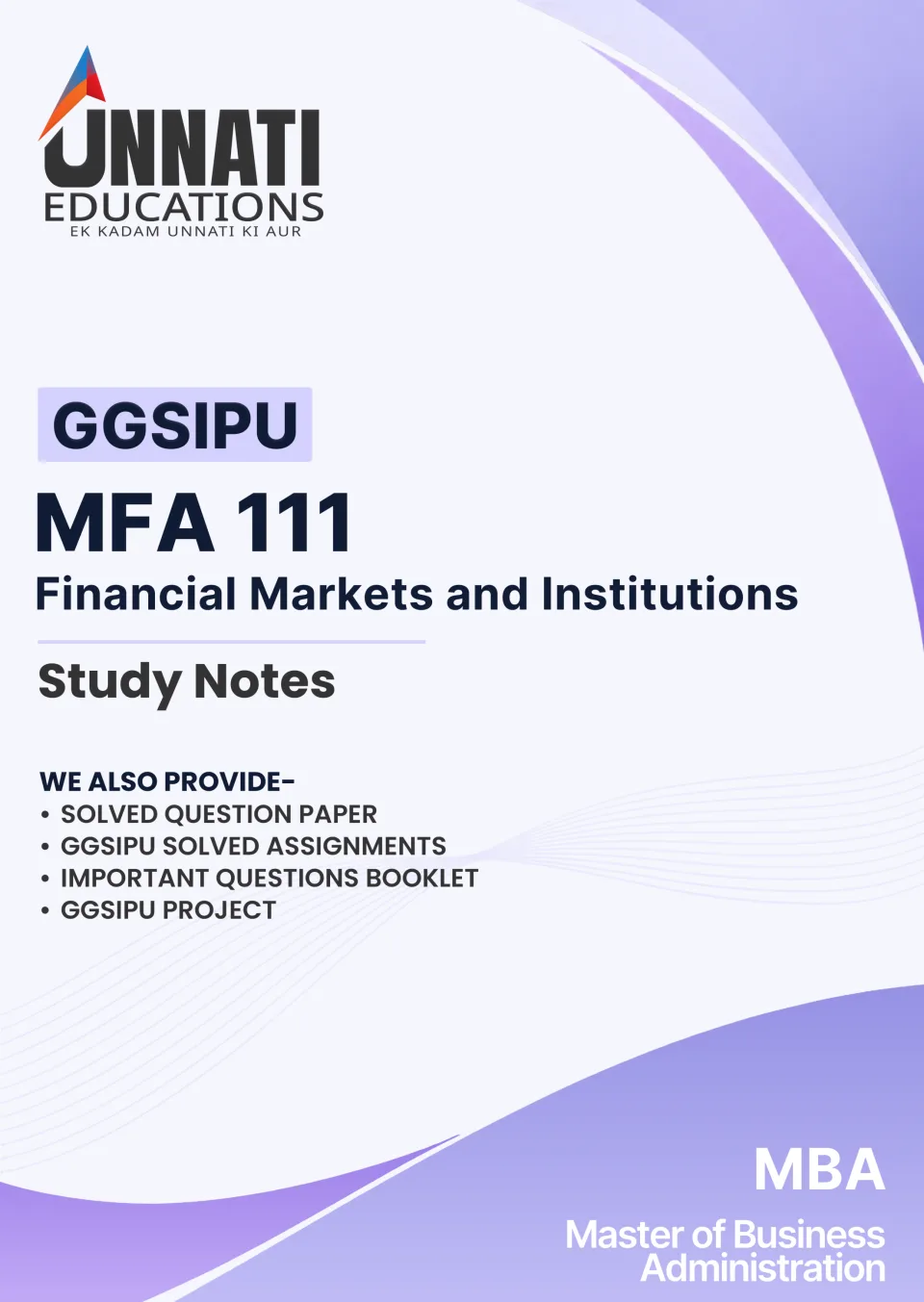
MFA 111 Financial Markets and Institutions Notes cover all 4 units of the GGSIPU MBA (Financial Analysis) Semester 1 paper in an 80-page printed book: 34 topic sections, 21 diagrams, 17 solved numericals and 112 exam questions, mapped to the syllabus that applies from 2021-22 onwards.
Written by Prateek Talwar, Founder, Unnati Educations (ACS, ICSI) · Reviewed by Sheetal Kirola, Academic Head, M.Ed. (academic review) · Checked against GGSIPU MBA (Financial Analysis) Scheme and Syllabus, 2021-22 onwards · Updated 28 October 2026 · Editorial policy
Scheme: MBA (FA) 2021-22 onwards | Applies to: batches from 2021-22 | Verified against: GGSIPU MBA (FA) Scheme and Syllabus PDF (ipu.ac.in, November 2022)
MFA 111 Financial Markets and Institutions at a glance: GGSIPU MBA (FA) Sem 1 credits, units and exam pattern
MFA 111 is a Semester 1 core paper that gives a basic knowledge of financial markets, institutions and major financial services in India. These MFA 111 Financial Markets and Institutions IPU notes follow that aim unit by unit. The paper sits with nine other GGSIPU MBA (FA) Semester 1 papers.
| Code and title | MFA-111 Financial Markets and Institutions |
|---|---|
| Type and credits | Core · L 3, T/P 0 · 3 credits |
| Marks | 100: 50 internal + 50 end-term |
| Internal split | Class Test I 15 + Class Test II 15 + assignments or viva 20 |
| End-term pattern | University written exam; question pattern not printed in the official PDF |
| Units and teaching hours | 4 units: 10 + 12 + 10 + 10 = 42 hours |
| Paired lab | None |
Unit II, banking, gets the most teaching time (12 hours). End-term minimums and re-appear rules sit in Ordinance 11 on ipu.ac.in.
MFA 111 Financial Markets and Institutions Notes unit-wise: 17 solved numericals and 112 exam questions across 4 units
Topics follow syllabus order; each unit ends with a quick revision table and exam questions. Notes for every other paper sit under GGSIPU MBA (FA) notes.
MFA 111 Unit 1: Financial Markets
Pages 4 to 23. The five components of the financial system, money market instruments and RBI's role, capital market reforms, book building, the corporate debt market, markets and growth, and SEBI. 8 topics, 6 diagrams, 2 solved numericals, 28 exam questions.
| Instrument | Issued by | Maturity | Key feature |
|---|---|---|---|
| Treasury Bill | RBI for the Centre | 91, 182, 364 days | Zero-coupon, issued at a discount |
| Commercial Paper | Companies, NBFCs, AIFIs | 7 days to 1 year | Unsecured; needs a rating |
| Certificate of Deposit | Banks, AIFIs | Banks: 7 days to 1 year | Negotiable term deposit |
| TREPS | CCIL (since 2018) | Overnight to 1 year | Tri-party repo |
Quick look: money market instruments (from page 8)
- Instrument
- Treasury Bill
- Issued by
- RBI for the Centre
- Maturity
- 91, 182, 364 days
- Key feature
- Zero-coupon, issued at a discount
- Instrument
- Commercial Paper
- Issued by
- Companies, NBFCs, AIFIs
- Maturity
- 7 days to 1 year
- Key feature
- Unsecured; needs a rating
- Instrument
- Certificate of Deposit
- Issued by
- Banks, AIFIs
- Maturity
- Banks: 7 days to 1 year
- Key feature
- Negotiable term deposit
- Instrument
- TREPS
- Issued by
- CCIL (since 2018)
- Maturity
- Overnight to 1 year
- Key feature
- Tri-party repo
MFA 111 Unit 2: Banking Sector
Pages 24 to 42. Banking structure and RBI, commercial bank functions and balance sheets, Narasimham committees, NPAs, growth and trends, shadow banking, fintech and CBDC, payments banks, then risks, stability and monetary policy. 8 topics, 5 diagrams, 3 solved numericals, 28 exam questions.
| Requirement | India (RBI) | Basel global minimum |
|---|---|---|
| Minimum CRAR | 9% | 8% |
| CRAR with conservation buffer | 11.5% | 10.5% |
| CET1 (minimum) | 5.5% | 4.5% |
| LCR and NSFR | 100% | 100% |
Quick look: Basel III capital and liquidity norms (from page 39)
- Requirement
- Minimum CRAR
- India (RBI)
- 9%
- Basel global minimum
- 8%
- Requirement
- CRAR with conservation buffer
- India (RBI)
- 11.5%
- Basel global minimum
- 10.5%
- Requirement
- CET1 (minimum)
- India (RBI)
- 5.5%
- Basel global minimum
- 4.5%
- Requirement
- LCR and NSFR
- India (RBI)
- 100%
- Basel global minimum
- 100%
MFA 111 Unit 3: Financial Institutions
Pages 43 to 61. NBFCs, scale-based regulation, DFIs from IFCI to NaBFID, mutual funds and their performance, life and non-life insurance, IRDAI, MCA and PFRDA, and housing finance. 8 topics, 4 diagrams, 5 solved numericals (NAV, Sharpe, Treynor, Jensen's alpha, EMI), 28 exam questions.
| Point | Bank | NBFC |
|---|---|---|
| Governing law | Banking Regulation Act, 1949 | Companies Act + RBI Act, 1934 |
| Demand deposits | Can accept | Cannot accept |
| Cheques | Issues cheques | Cannot issue cheques |
| CRR | Must maintain | Not required |
Quick look: bank versus NBFC (from page 44)
- Point
- Governing law
- Bank
- Banking Regulation Act, 1949
- NBFC
- Companies Act + RBI Act, 1934
- Point
- Demand deposits
- Bank
- Can accept
- NBFC
- Cannot accept
- Point
- Cheques
- Bank
- Issues cheques
- NBFC
- Cannot issue cheques
- Point
- CRR
- Bank
- Must maintain
- NBFC
- Not required
MFA 111 Unit 4: Financial Services
Pages 62 to 80. The longest topic list: merchant banking, VC and PE, factoring and forfaiting, credit rating, underwriting, portfolio management, project financing, stock broking, leasing and hire purchase, recent developments. 10 topics, 6 diagrams, 7 solved numericals (factoring, underwriting liability, DSCR, hire purchase), 28 exam questions.
| Point | Finance lease | Operating lease |
|---|---|---|
| Period | Most of the asset's life | Short period |
| Cancellation | Non-cancellable | Cancellable |
| Risk and maintenance | Lessee | Lessor |
| Purpose | Financing | Renting |
Quick look: finance lease versus operating lease (from page 76)
- Point
- Period
- Finance lease
- Most of the asset's life
- Operating lease
- Short period
- Point
- Cancellation
- Finance lease
- Non-cancellable
- Operating lease
- Cancellable
- Point
- Risk and maintenance
- Finance lease
- Lessee
- Operating lease
- Lessor
- Point
- Purpose
- Finance lease
- Financing
- Operating lease
- Renting
Non-performing assets in Indian banking: excerpt from page 31 of the MFA 111 notes
Excerpt from page 31 (Unit 2, topic 04)
Classification of NPAs and provisioning
A loan becomes a non-performing asset when interest or an instalment stays overdue for more than 90 days. Once it slips, RBI's prudential norms place it in a category, and each category needs a minimum provision on the secured portion.
- Standard asset: regular, or overdue up to 90 days; provision 0.25% to 1% depending on the sector.
- Sub-standard: an NPA for up to 12 months; provision 15% (25% if unsecured).
- Doubtful D1: sub-standard for up to one more year; 25% of the secured part plus 100% of the unsecured part.
- Doubtful D2: doubtful for 1 to 3 years; 40% of the secured part plus 100% of the unsecured part.
- Doubtful D3: doubtful for more than 3 years; 100%.
- Loss asset: identified as uncollectible by the bank, the auditor or RBI; 100%, written off.
Gross NPA versus net NPA: a worked example
Total advances are Rs 10,000 crore, gross NPAs Rs 400 crore and provisions held Rs 300 crore. The gross NPA ratio is 400 / 10,000 × 100 = 4%. Net NPA is 400 − 300 = Rs 100 crore, so the net NPA ratio is 100 / (10,000 − 300) × 100 = 1.03%. The provision coverage ratio is 300 / 400 × 100 = 75%.
Why loans turn bad
Six causes recur: wilful default, where borrowers divert funds; poor credit appraisal and evergreening; an economic slowdown that hits sectors such as steel, power and telecom; project delays from land and clearance problems; weak legal recovery before the IBC; and governance failures, from political interference to fraud.
What NPAs do to a bank
Profit falls because interest stops and provisions eat into earnings. Capital erodes, so public sector banks need recapitalisation. Banks turn risk-averse and lend less to new businesses, honest borrowers pay higher rates, and depositor confidence weakens, which puts financial stability at risk.
Do the MFA 111 notes cover the full GGSIPU syllabus?
Yes. Every topic the official MFA-111 syllabus lists across its 4 units has its own section in the notes; we found no gaps.
| Official unit | Official topics | Where in the notes | Status |
|---|---|---|---|
| I: Financial Markets | Financial system; money market, instruments, regulation, role of central bank; capital markets, reforms; primary market, book building; corporate debt market; markets and economic development; SEBI and recent reforms | Topics 01 to 08, pages 5 to 20 | Covered |
| II: Banking Sector | Banking in India, RBI; commercial banks, committees, assets and liabilities; NPAs; growth; shadow banking, fintech, CBDC; e-banking, payment banks, inclusion; risks, stability, monetary policy, trends | Topics 01 to 08, pages 25 to 40 | Covered |
| III: Financial Institutions | NBFCs; DFIs; mutual funds, growth and performance; life and non-life insurance; IRDA and reforms; MCA; PFRDA; housing finance | Topics 01 to 08, pages 44 to 59 | Covered |
| IV: Financial Services | Merchant banking; VC and PE; factoring and forfaiting; credit rating; underwriting; portfolio management; project financing; stock brokerage; leasing and hire purchase; recent developments | Topics 01 to 10, pages 63 to 78 | Covered |
MFA 111 official syllabus topics mapped to the notes
- Official unit
- I: Financial Markets
- Official topics
- Financial system; money market, instruments, regulation, role of central bank; capital markets, reforms; primary market, book building; corporate debt market; markets and economic development; SEBI and recent reforms
- Where in the notes
- Topics 01 to 08, pages 5 to 20
- Status
- Covered
- Official unit
- II: Banking Sector
- Official topics
- Banking in India, RBI; commercial banks, committees, assets and liabilities; NPAs; growth; shadow banking, fintech, CBDC; e-banking, payment banks, inclusion; risks, stability, monetary policy, trends
- Where in the notes
- Topics 01 to 08, pages 25 to 40
- Status
- Covered
- Official unit
- III: Financial Institutions
- Official topics
- NBFCs; DFIs; mutual funds, growth and performance; life and non-life insurance; IRDA and reforms; MCA; PFRDA; housing finance
- Where in the notes
- Topics 01 to 08, pages 44 to 59
- Status
- Covered
- Official unit
- IV: Financial Services
- Official topics
- Merchant banking; VC and PE; factoring and forfaiting; credit rating; underwriting; portfolio management; project financing; stock brokerage; leasing and hire purchase; recent developments
- Where in the notes
- Topics 01 to 10, pages 63 to 78
- Status
- Covered
Check the official file: GGSIPU MBA (Financial Analysis) Scheme and Syllabus, 2021-22 onwards (MFA-111 on page 17, scheme table on page 5).
Every course in GGSIPU notes is mapped to its official PDF this way before print.
How to write MFA 111 answers: definition first, a structure chart, dated facts and one short numerical
MFA 111 is mostly descriptive, so structure earns the marks. Each unit's exam page in the notes gives one writing plan: a definition, the classification or structure as a chart or table, points under headings, current facts with month and year, a small numerical where it fits, and a conclusion.
Topic pages give a sequence per long answer. Venture capital, for example: meaning, features, stages table, 6-step process chart, VC versus PE table, AIF rules.
Three habits from the notes save marks: write committees as a table (committee, year, recommendations) with at least five points each for Narasimham I and II; compare paired topics in a table (factoring and forfaiting, lease and hire purchase, bank and NBFC); and end a Unit IV answer with two or three recent developments.
Worked example (5 marks, Unit I): cut-off price. Issue: 10 lakh shares. Bids: Rs 60 for 2 lakh, Rs 58 for 3 lakh, Rs 56 for 5 lakh, Rs 54 for 6 lakh. Cumulative demand from the top: 2, 5, then 10 lakh at Rs 56. The issue is first fully covered at Rs 56, so that is the cut-off price. Always show the cumulative column.
Practise this format on GGSIPU MBA (FA) important questions.
MFA 111 exam corner: 32 ten-to-fifteen-mark, 40 five-mark and 40 two-mark questions by unit
| Unit | 10–15 Marks | 5 Marks | 2 Marks | Numericals |
|---|---|---|---|---|
| Unit 1 | 8 | 10 | 10 | 2 |
| Unit 2 | 8 | 10 | 10 | 3 |
| Unit 3 | 8 | 10 | 10 | 5 |
| Unit 4 | 8 | 10 | 10 | 7 |
| Total | 32 | 40 | 40 | 17 |
MFA 111 exam questions and solved numericals per unit
- Unit
- Unit 1
- 10–15 Marks
- 8
- 5 Marks
- 10
- 2 Marks
- 10
- Numericals
- 2
- Unit
- Unit 2
- 10–15 Marks
- 8
- 5 Marks
- 10
- 2 Marks
- 10
- Numericals
- 3
- Unit
- Unit 3
- 10–15 Marks
- 8
- 5 Marks
- 10
- 2 Marks
- 10
- Numericals
- 5
- Unit
- Unit 4
- 10–15 Marks
- 8
- 5 Marks
- 10
- 2 Marks
- 10
- Numericals
- 7
- Unit
- Total
- 10–15 Marks
- 32
- 5 Marks
- 40
- 2 Marks
- 40
- Numericals
- 17
The MFA 111 notes list 32 long-answer, 40 five-mark and 40 two-mark exam-style questions across 4 units, plus 17 solved numericals. One per unit, with pointers:
- Unit 1 (5 Marks): Calculate the yield of a 182-day T-bill issued at Rs 97.50 (face value Rs 100). Pointer: discount Rs 2.50; yield = (2.50 / 97.50) × (365 / 182) × 100 = 5.14% a year.
- Unit 2 (10–15 Marks): What are payments banks? Discuss their role in financial inclusion in India. Pointer: Nachiket Mor Committee, a "can do / cannot do" table, then PMJDY, JAM and business correspondents.
- Unit 3 (5 Marks): Calculate NAV: securities Rs 300 crore, cash Rs 20 crore, liabilities Rs 8 crore, units 24 crore. Pointer: (300 + 20 − 8) / 24 = Rs 13 per unit.
- Unit 4 (5 Marks): Compute DSCR: PAT Rs 45 crore, depreciation Rs 25 crore, interest Rs 20 crore, instalment Rs 40 crore. Pointer: (45 + 25 + 20) / (20 + 40) = 90 / 60 = 1.5.
More practice sits in the MFA 111 important questions.
Who writes and checks the MFA 111 financial markets notes?
- Prateek Talwar, author. Founder, Unnati Educations. Associate Company Secretary (ACS), ICSI, since 15 May 2019; B.Com, University of Delhi (School of Open Learning), 2012. Author profile
- Sheetal Kirola, academic reviewer (language, structure, syllabus fit). Academic Head, M.Ed., 7 years of experience. Reviewer profile
As GGSIPU MBA (FA) Sem 1 Financial Markets and Institutions notes, the 2026-27 edition is mapped to the MBA (FA) scheme that applies from 2021-22 onwards. Figures that change often, such as policy rates and mutual fund data, carry their month and year so you can recheck them. Last updated 28 October 2026. See our editorial policy.
The same team prepares GGSIPU important questions for every course.
MFA 111 and the GGSIPU MBA (FA) Sem 1 papers it connects to
MFA 111 has no paired lab; credits for every paper are on the GGSIPU MBA (FA) syllabus page. These Sem 1 papers connect most closely:
- MFA-109 Personal Finance: MFA 111 Unit 3 funds, insurance and NPS are the products it plans with.
- MFA-105 Managerial Economics: Unit 2 monetary policy rests on its macro-economics unit.
- MFA-103 Quantitative Techniques: Unit 3 Sharpe and Treynor ratios use its dispersion measures.
- MFA-115 Legal Aspects of Business: its tribunals unit helps with DRTs, NCLT and SEBI's quasi-judicial powers.
Also in Sem 1: MFA-101 Accounting for Management, MFA-107 Information Technology Management, MFA-113 Management Process and Organizational Behaviour, MFA-117 Communication in Organizations, MFA-119 Information Technology Management Lab.
MFA 111 financial markets notes FAQs
How do I get the full MFA 111 notes?
Send us a message on WhatsApp at 9899436384 with the code MFA 111, or tap the "Get Full Notes" button. The full notes come only as a printed book; there is no PDF edition. Delivery takes a maximum of 5 to 7 days, and the exact time depends on your location. Price and payment details are shared on WhatsApp.
What is the passing mark for MFA 111 in GGSIPU MBA (FA)?
MFA 111 is marked out of 100: 50 internal and 50 end-term, as the MBA (FA) scheme sets for every theory paper. The scheme and syllabus PDF prints no pass percentage, so we do not state one. End-term minimum marks and re-appear rules come from GGSIPU Ordinance 11 on ipu.ac.in; check it or ask your institute.
Which MFA 111 unit has the most numericals?
Unit 4, Financial Services, has 7 of the 17 solved numericals: factoring cash, underwriting liability, DSCR and other service-based sums. Unit 3 follows with 5 (NAV, Sharpe, Treynor, Jensen's alpha and EMI work). Units 1 and 2 are mostly theory, with 2 and 3, so most MFA 111 calculation practice sits in the second half.
Do the MFA 111 notes match the current GGSIPU MBA (FA) syllabus?
Yes. The MFA 111 notes follow the MBA (Financial Analysis) scheme and syllabus that GGSIPU applies from the 2021-22 academic session onwards. Every official topic in the 4 units has a section, and the map on this page shows the page for each. If the university revises the syllabus, we update the book and the date on this page.
How are the MFA 111 internal 50 marks split?
The MBA (FA) scheme splits MFA 111's 50 internal marks into two compulsory class tests of 15 marks each and 20 marks for assignments, presentations, viva-voce, group discussion or class participation. The unit-end revision tables in the notes suit a quick revision the night before each class test, and the 40 two-mark questions work well for viva practice.
Does MFA 111 have a lab or practical component?
No. MFA 111 is a 3-credit core theory paper with 3 lecture hours a week and no tutorial or practical hours in the MBA (FA) scheme. The only Semester 1 lab is MFA-119 Information Technology Management Lab, which carries 1 credit. For MFA 111, your preparation is written answers plus the 17 numericals in the notes.
Get the full MFA 111 Financial Markets and Institutions Notes on WhatsApp
| Unit | Pages | Topic sections | Exam questions |
|---|---|---|---|
| Unit 1 | 20 (pp. 4–23) | 8 | 28 |
| Unit 2 | 19 (pp. 24–42) | 8 | 28 |
| Unit 3 | 19 (pp. 43–61) | 8 | 28 |
| Unit 4 | 19 (pp. 62–80) | 10 | 28 |
Inside the full MFA 111 printed book
- Unit
- Unit 1
- Pages
- 20 (pp. 4–23)
- Topic sections
- 8
- Exam questions
- 28
- Unit
- Unit 2
- Pages
- 19 (pp. 24–42)
- Topic sections
- 8
- Exam questions
- 28
- Unit
- Unit 3
- Pages
- 19 (pp. 43–61)
- Topic sections
- 8
- Exam questions
- 28
- Unit
- Unit 4
- Pages
- 19 (pp. 62–80)
- Topic sections
- 10
- Exam questions
- 28
80 pages, 21 diagrams, 17 solved numericals and a revision table per unit. These Financial Markets and Institutions notes in English come only as a printed book, not a PDF. Delivery takes a maximum of 5 to 7 days, depending on your location; price and payment details are shared on WhatsApp.
Order the MFA 111 notes book on WhatsApp (4 units, 80 pages)Unnati Educations is an independent education provider based in Vikaspuri, Delhi. We are not affiliated with, authorised by, or endorsed by Guru Gobind Singh Indraprastha University (GGSIPU). 'GGSIPU' and 'IPU' are used only to describe the syllabus our notes follow. For official information, visit ipu.ac.in.
Ready for the full notes?
Discuss coverage and delivery with our team.