
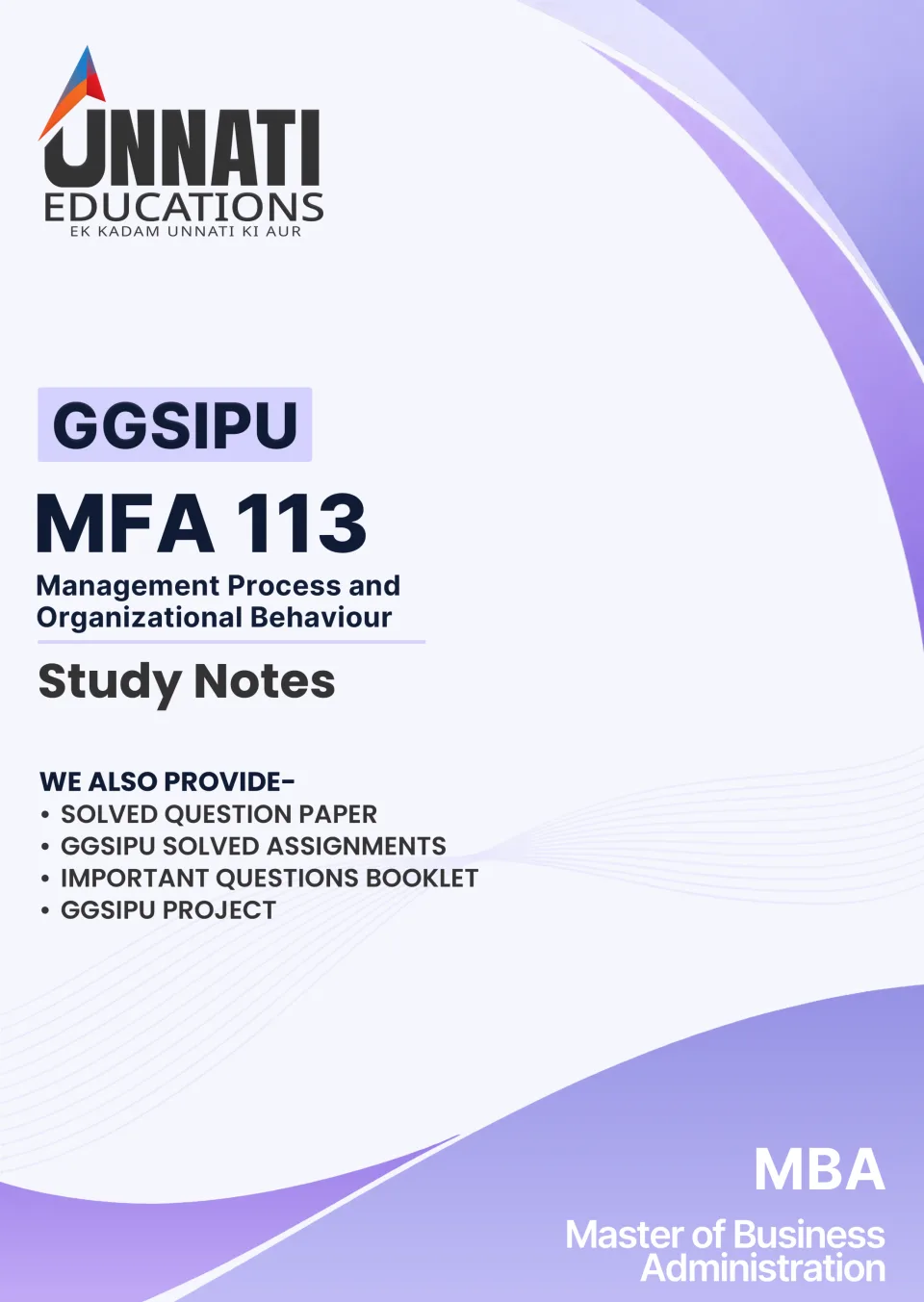
MFA 113 Management Process and Organizational Behaviour Notes cover all 4 units of the GGSIPU MBA (Financial Analysis) Semester 1 paper in a 68-page printed book: 28 diagrams, 5 case studies with suggested answer points, and 86 important exam questions (52 short, 34 long). They follow the scheme and syllabus that applies from the 2021-22 session onwards.
Written by Prateek Talwar, Founder, Unnati Educations (ACS, ICSI) · Reviewed by Sheetal Kirola, Academic Head, M.Ed., 7 years · Checked against the official MBA (FA) syllabus PDF · Updated 28 October 2026 · Editorial policy
Scheme: MBA (FA) Scheme and Syllabus 2021-22 onwards | Applies to: 2021-22 session onwards | Verified against: MBA (FA) Scheme and Syllabus 2021-22 onwards, 28 Oct 2026
MFA 113 Management Process and Organizational Behaviour at a glance: GGSIPU MBA (FA) Sem 1 credits, units and exam pattern
MFA 113 is a Core paper in the first semester of MBA (Financial Analysis). It is one of ten GGSIPU MBA (FA) Semester 1 papers.
| Code and title | MFA-113 Management Process and Organizational Behaviour |
|---|---|
| Course and semester | MBA (Financial Analysis), Semester 1 |
| Type and credits | Core · L 3, T/P 0 · 3 credits |
| Marks | 100: 50 internal + 50 end-term (written examination by the University) |
| Internal 50 split | Class Test I 15 + Class Test II 15 + assignments, presentation, viva or class participation 20 |
| Applies to | w.e.f. the 2021-22 academic session |
| End-term pattern | Paper-setter instructions not printed in the official PDF |
| Units and hours | 4 units: 8 + 8 + 16 + 10 = 42 hours |
| Paired lab | None. The Semester 1 lab, MFA-119, belongs to Information Technology Management |
The scheme prints no pass percentage; end-term minimums and re-appear rules sit in GGSIPU Ordinance 11.
MFA 113 Management Process and Organizational Behaviour Notes unit-wise: 86 exam questions and 5 finance case studies across 4 units
These GGSIPU MBA (FA) Sem 1 Management Process and OB notes run from page 4 to 67, with a revision table and question list per unit. Notes for every other MBA (FA) paper sit under GGSIPU MBA (FA) notes.
MFA 113 Unit 1: Introduction to Management
Pages 4 to 19 (16 pages). Definitions, science-art-profession debate, levels and POSDC; evolution from Taylor, Fayol and Weber through Hawthorne to systems, contingency and TQM, Drucker's tasks, Mintzberg's ten roles, Katz's skills and MBO. 7 diagrams, 1 case, 12 short and 8 long questions.
| Skill | What it means | Most needed at |
|---|---|---|
| Technical | Using the tools of a field, such as financial analysis or Excel modelling | Lower level |
| Human | Working with, understanding and motivating people | All levels |
| Conceptual | Seeing the organisation as a whole and thinking strategically | Top level |
Quick look: Katz's managerial skills and where each matters most (from page 14)
- Skill
- Technical
- What it means
- Using the tools of a field, such as financial analysis or Excel modelling
- Most needed at
- Lower level
- Skill
- Human
- What it means
- Working with, understanding and motivating people
- Most needed at
- All levels
- Skill
- Conceptual
- What it means
- Seeing the organisation as a whole and thinking strategically
- Most needed at
- Top level
MFA 113 Unit 2: Process of Management
Pages 20 to 34 (15 pages). Planning (hierarchy of plans, eight-step process, ten techniques from SWOT to PERT), directing (nine principles, five-step process), controlling (three control types, traditional and modern techniques) and decision making (seven models, rational to garbage-can). 8 diagrams, 1 NBFC case, 12 short and 7 long questions.
Quick look: break-even point as a control technique (from page 28)
- Fixed costs = Rs. 2,00,000; selling price = Rs. 70 per unit; variable cost = Rs. 30 per unit.
- Contribution per unit = 70 minus 30 = Rs. 40.
- BEP (units) = 2,00,000 ÷ 40 = 5,000 units.
- BEP (sales) = 5,000 × 70 = Rs. 3.5 lakh: no profit, no loss.
MFA 113 Unit 3: Fundamentals of Organizational Behaviour
Pages 35 to 54 (20 pages). OB nature and scope, five OB models, personality from Type A/B to MBTI, perception and attitude, four learning theories, eight motivation theories, stress, structure types, mechanistic and organic design, culture and climate, and Hofstede's six dimensions. 8 diagrams, 2 cases, 15 short and 12 long questions.
| Basis | Mechanistic | Organic |
|---|---|---|
| Span of control | Narrow | Wide |
| Centralisation and rules | High | Low |
| Suits | Stable environment, cost focus | Dynamic environment, innovation |
| Example | Large PSU, government department | FinTech start-up, R&D lab |
Quick look: mechanistic and organic organisations compared (from page 48)
- Basis
- Span of control
- Mechanistic
- Narrow
- Organic
- Wide
- Basis
- Centralisation and rules
- Mechanistic
- High
- Organic
- Low
- Basis
- Suits
- Mechanistic
- Stable environment, cost focus
- Organic
- Dynamic environment, innovation
- Basis
- Example
- Mechanistic
- Large PSU, government department
- Organic
- FinTech start-up, R&D lab
MFA 113 Unit 4: Groups, Work Teams, Leadership and Organizational Justice
Pages 55 to 67 (13 pages). Groups and cohesiveness, work teams and Belbin's roles, Tuckman's five stages with the leader's role at each, four classic leadership styles and nine theories from trait to path-goal, then organisational justice with Leventhal's rules and the fair process effect. 5 diagrams, 1 case, 13 short and 7 long questions.
| Type | Fairness of | Example |
|---|---|---|
| Distributive | Outcomes: pay, bonus, promotion | Two analysts with equal output get very different bonuses |
| Procedural | The process behind the decision | Clear appraisal criteria with a right to appeal |
| Interactional | Treatment while the decision is carried out | A manager politely explains why a promotion was not given |
Quick look: types of organisational justice with workplace examples (from page 64)
- Type
- Distributive
- Fairness of
- Outcomes: pay, bonus, promotion
- Example
- Two analysts with equal output get very different bonuses
- Type
- Procedural
- Fairness of
- The process behind the decision
- Example
- Clear appraisal criteria with a right to appeal
- Type
- Interactional
- Fairness of
- Treatment while the decision is carried out
- Example
- A manager politely explains why a promotion was not given
Perceptual errors and job attitudes in organisational behaviour: excerpt from page 40 of the MFA 113 notes
Excerpt from page 40 (Unit III, sections 4 and 4.2), rewritten for the web.
Shortcuts that distort how we judge others
Managers rarely judge people with complete information, so they fall back on shortcuts. The halo effect builds an overall impression from one trait, as when a well-dressed candidate is assumed to be competent. Stereotyping judges a person by the group they belong to ("young employees are not loyal"). Selective perception means seeing only what fits our own background, so a finance head reads every problem as a cost problem.
The contrast effect makes an average candidate look strong after two weak ones, and projection leads an honest manager to assume everyone is honest. Attribution errors complete the list: the fundamental attribution error blames internal factors for other people's failure, while self-serving bias takes credit for success and blames luck for failure. A fund manager who credits skill for gains and the market for losses shows exactly this.
Kelley's attribution theory explains how we decide whether behaviour is caused internally or externally. It uses three cues: distinctiveness, consensus and consistency.
Attitude and its three components
An attitude is a learned tendency to respond favourably or unfavourably to a person, object, idea or situation. Attitudes are evaluative statements such as "I like my job"; they are learned, fairly stable and they shape behaviour. The ABC model splits an attitude into a cognitive part (belief: "my supervisor promoted a less deserving colleague"), an affective part (feeling: "I dislike my supervisor") and a behavioural part (intention: "I am looking for another job").
Job attitudes and cognitive dissonance
The major job attitudes are job satisfaction, job involvement, organisational commitment (affective, continuance and normative), employee engagement and perceived organisational support.
Leon Festinger's cognitive dissonance is the discomfort felt when attitude and behaviour do not match, for example when an employee who values honesty is asked to mis-sell a product. People reduce it by changing the attitude, changing the behaviour or justifying it. Managers can change attitudes through new information, peer influence, co-opting and training.
MFA 113 exam corner: 52 short-answer and 34 long-answer questions plus 5 case studies by unit
The unit-end questions are practice questions without model answers; the 5 case studies come with suggested answer points.
| Unit | Short-answer | Long-answer | Case studies | Pages |
|---|---|---|---|---|
| I Introduction to Management | 12 | 8 | 1 | 18-19 |
| II Process of Management | 12 | 7 | 1 | 34 |
| III Fundamentals of OB | 15 | 12 | 2 | 53-54 |
| IV Groups, Teams, Leadership, Justice | 13 | 7 | 1 | 66-67 |
| Total | 52 | 34 | 5 |
MFA 113 exam questions and case studies per unit in the notes
- Unit
- I Introduction to Management
- Short-answer
- 12
- Long-answer
- 8
- Case studies
- 1
- Pages
- 18-19
- Unit
- II Process of Management
- Short-answer
- 12
- Long-answer
- 7
- Case studies
- 1
- Pages
- 34
- Unit
- III Fundamentals of OB
- Short-answer
- 15
- Long-answer
- 12
- Case studies
- 2
- Pages
- 53-54
- Unit
- IV Groups, Teams, Leadership, Justice
- Short-answer
- 13
- Long-answer
- 7
- Case studies
- 1
- Pages
- 66-67
- Unit
- Total
- Short-answer
- 52
- Long-answer
- 34
- Case studies
- 5
- Pages
The MFA 113 notes list 52 short-answer and 34 long-answer exam-style questions across 4 units, plus 5 case studies with suggested answer points.
Four exam-style questions, one per unit:
- Unit I (long): What is Management by Objectives? Explain its process, advantages and limitations. How can MBO be made effective? Pointer: Odiorne's definition, the six-step cycle, then an advantages and limitations table.
- Unit II (short): What is management by exception? Pointer: only significant deviations reach top management; SMA loan buckets are a banking example.
- Unit III (short): Explain Vroom's expectancy theory. Pointer: M = E × I × V; if any term is zero, motivation is zero.
- Unit IV (short): What is social loafing? How can it be reduced? Pointer: less effort in a group than alone; make each contribution visible.
More practice sits in the MFA 113 important questions.
Who writes and checks the MFA 113 Management Process and OB notes?
- Prateek Talwar, author: Founder, Unnati Educations; Associate Company Secretary (ACS), ICSI, since 15 May 2019; B.Com, University of Delhi (School of Open Learning), 2012. Author profile.
- Sheetal Kirola, reviewer (academic review of language, structure and answer format): Academic Head, Unnati Educations; M.Ed.; 7 years of experience. Reviewer profile.
These MFA 113 Management Process and OB IPU notes (2026-27 edition) are mapped to the 2021-22 onwards scheme, with finance examples such as SMA loan buckets and fund-house psychometric tests. Last updated 28 October 2026 under our editorial policy.
The same team prepares GGSIPU important questions for every course it covers.
Do the MFA 113 notes cover the full GGSIPU syllabus?
Yes. Every official topic in Units I to IV has its own section, and the case studies the syllabus asks for in Units I to III are all in the book.
| Official unit | Official topics | Where in the notes | Status |
|---|---|---|---|
| Unit I (8 hours) | Meaning and nature, evolution of management, tasks and responsibilities of a professional manager, MBO, case study | Sections 1-6, pages 5-17 | Covered |
| Unit II (8 hours) | Planning, directing, controlling, decision making, case study | Sections 1-5, pages 21-33 | Covered |
| Unit III (16 hours) | OB nature and scope, OB models, personality, perception and attitude, learning, motivation, stress, organisation structure, case studies; organisational design, culture and climate, cross-cultural OB | Sections 1-12, pages 36-52 | Covered |
| Unit IV (10 hours) | Groups and dynamics, work teams, stages of team building, leadership, organisational justice | Sections 1-6, pages 56-65 | Covered |
MFA 113 official syllabus topics mapped to sections and pages of the notes
- Official unit
- Unit I (8 hours)
- Official topics
- Meaning and nature, evolution of management, tasks and responsibilities of a professional manager, MBO, case study
- Where in the notes
- Sections 1-6, pages 5-17
- Status
- Covered
- Official unit
- Unit II (8 hours)
- Official topics
- Planning, directing, controlling, decision making, case study
- Where in the notes
- Sections 1-5, pages 21-33
- Status
- Covered
- Official unit
- Unit III (16 hours)
- Official topics
- OB nature and scope, OB models, personality, perception and attitude, learning, motivation, stress, organisation structure, case studies; organisational design, culture and climate, cross-cultural OB
- Where in the notes
- Sections 1-12, pages 36-52
- Status
- Covered
- Official unit
- Unit IV (10 hours)
- Official topics
- Groups and dynamics, work teams, stages of team building, leadership, organisational justice
- Where in the notes
- Sections 1-6, pages 56-65
- Status
- Covered
Check it yourself: MBA (Financial Analysis) Scheme and Syllabus 2021-22 onwards on ipu.ac.in. MFA-113 is on page 18 of that PDF.
Every course in GGSIPU notes is mapped to its official PDF in the same way.
How to write MFA 113 answers: definition-led theory answers, labelled diagrams and finance case analysis
The notes build each section in one order: an author-wise definition table, a features table, a diagram, then merits and limitations. Copy that order in your MFA 113 answers.
For short answers, open with one credited definition (Robbins for OB), add three or four points and one example. Answer "distinguish between" questions as a comparison table, like the book's single-use vs standing plans.
For long answers, draw the matching figure early: the planning process (Figure 2.2), Maslow's pyramid (Figure 3.4) or Tuckman's stages (Figure 4.2).
For case studies, tie every point to a named concept. Worked example (Unit I case, page 17): a bank branch manager switches to MBO and deposits grow 22%. For "which MBO steps did she follow?", write: zonal goals → branch objectives → joint SMART targets → resources → monthly review → appraisal. Then name the hidden limitation: targets raised mid-year without discussion.
For Taylor vs Fayol, use the table on page 11. Practise this format on GGSIPU MBA (FA) important questions.
MFA 113 and the GGSIPU MBA (FA) Sem 1 papers it connects to
MFA 113 has no lab paper. All four semesters are listed on the GGSIPU MBA (FA) syllabus page.
Three Semester 1 papers build on MFA 113. MFA-101 Accounting for Management expands budgetary control and break-even analysis from Unit II. MFA-117 Communication in Organizations extends directing and group communication networks. MFA-103 Quantitative Techniques teaches the decision trees Unit II lists.
The other Semester 1 papers are MFA-105 Managerial Economics, MFA-107 Information Technology Management, MFA-109 Personal Finance, MFA-111 Financial Markets and Institutions, MFA-115 Legal Aspects of Business and MFA-119 Information Technology Management Lab.
MFA 113 Management Process and OB notes FAQs
How do I get the full MFA 113 notes?
Message Unnati Educations on WhatsApp at 9899436384 and ask for the MFA 113 notes. The full notes come only as a printed book of 68 pages covering all 4 units; there is no PDF edition. The book is delivered within a maximum of 5 to 7 days, and the exact time depends on your location. Price and payment are shared on WhatsApp.
Are the MFA 113 notes available as a PDF?
No. The MFA 113 notes are sold only as a printed book.
How is MFA 113 marked, and what is the passing mark?
MFA 113 is marked out of 100: 50 internal and 50 end-term. The internal 50 is Class Test I (15), Class Test II (15) and assignments, presentation, viva-voce or class participation (20). The MBA (FA) scheme PDF does not state a pass percentage, so we do not quote one. End-term minimums and re-appear rules are in GGSIPU Ordinance 11 on ipu.ac.in.
Which MFA 113 unit needs the most preparation?
Unit III, Fundamentals of Organizational Behaviour. The syllabus gives it 16 of the paper's 42 teaching hours, and the notes give it 20 pages, 15 short-answer and 12 long-answer questions, and 2 case studies. It runs from personality and eight motivation theories to stress, structure, culture and Hofstede's dimensions, so start it early and revise it twice.
Do the MFA 113 notes match the current MBA (FA) syllabus?
Yes. The MFA 113 notes follow the MBA (Financial Analysis) Scheme and Syllabus that applies from the 2021-22 academic session, and every listed topic in all four units has a section in the book. The syllabus map on this page shows the section and page for each unit, with a link to the official PDF on ipu.ac.in so you can check it yourself.
Are the MFA 113 case studies solved?
Yes, partly. The MFA 113 notes have 5 case studies set in Indian finance firms: a private bank branch, an NBFC, a mutual fund distributor, a bank merger and an investment research team. Each has 3 or 4 questions with suggested answer points. The 86 exam questions at the end of the units are practice questions without model answers.
Get the full MFA 113 Management Process and Organizational Behaviour Notes on WhatsApp
| Unit | Pages | Diagrams | Exam questions | Case studies |
|---|---|---|---|---|
| I Introduction to Management | 16 | 7 | 20 | 1 |
| II Process of Management | 15 | 8 | 19 | 1 |
| III Fundamentals of OB | 20 | 8 | 27 | 2 |
| IV Groups, Teams, Leadership, Justice | 13 | 5 | 20 | 1 |
What is inside the MFA 113 printed notes book
- Unit
- I Introduction to Management
- Pages
- 16
- Diagrams
- 7
- Exam questions
- 20
- Case studies
- 1
- Unit
- II Process of Management
- Pages
- 15
- Diagrams
- 8
- Exam questions
- 19
- Case studies
- 1
- Unit
- III Fundamentals of OB
- Pages
- 20
- Diagrams
- 8
- Exam questions
- 27
- Case studies
- 2
- Unit
- IV Groups, Teams, Leadership, Justice
- Pages
- 13
- Diagrams
- 5
- Exam questions
- 20
- Case studies
- 1
These are Management Process and OB notes in English: 68 pages with a 2-page index and a Quick Revision table per unit. Format: printed book only, not available as a PDF. Delivery: maximum 5 to 7 days; the exact time depends on your location.
Order the MFA 113 printed notes on WhatsApp (4 units, 68 pages)
Unnati Educations is an independent education provider based in Vikaspuri, Delhi. We are not affiliated with, authorised by, or endorsed by Guru Gobind Singh Indraprastha University (GGSIPU). 'GGSIPU' and 'IPU' are used only to describe the syllabus our notes follow. For official information, visit ipu.ac.in.
Ready for the full notes?
Discuss coverage and delivery with our team.