
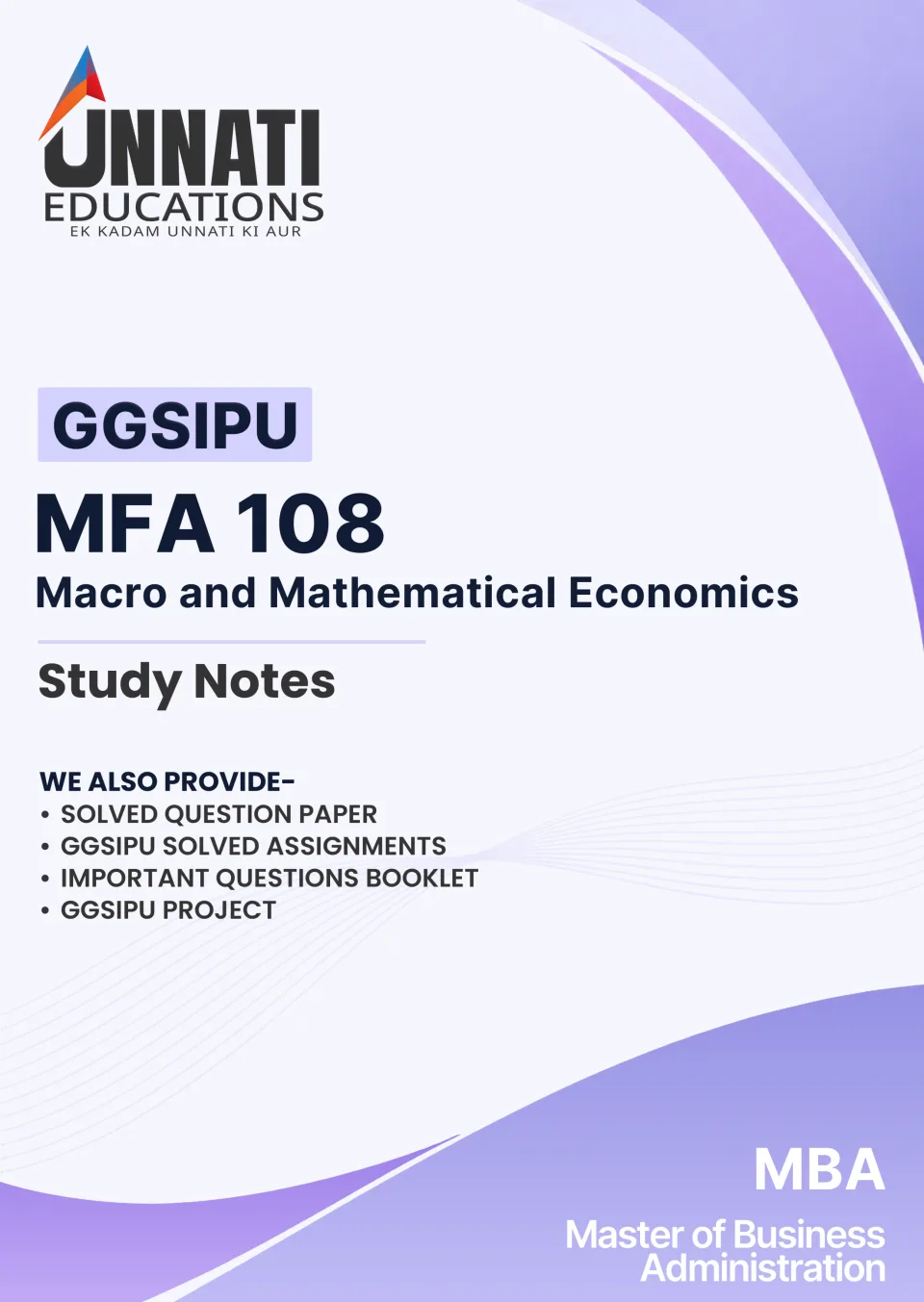
MFA-108 Macro and Mathematical Economics Notes cover all 4 units of the GGSIPU MBA (Financial Analysis) Semester 2 paper in a 78-page printed book: 22 solved illustrations, 31 figures, 96 practice questions and a revision table per unit, mapped to the MBA (FA) scheme for batches from 2021-22.
Written by Prateek Talwar, Founder, Unnati Educations (ACS, ICSI) · Reviewed by Sheetal Kirola, Academic Head, M.Ed. (academic review) · Checked against the MBA (FA) Scheme and Syllabus 2021-22 onwards (ipu.ac.in) · Updated 28 October 2026 · Editorial policy
Scheme: MBA (FA) 2021-22 | Applies to: batches admitted 2021-22 onwards | Verified against: MBA (Financial Analysis) Scheme and Syllabus, ipu.ac.in, 28 October 2026
MFA-108 Macro and Mathematical Economics at a glance: GGSIPU MBA (FA) Sem 2 credits, units and exam pattern
MFA-108 is a Core paper that sits with ten other GGSIPU MBA (FA) Semester 2 papers, and the only one that runs from GDP to Cramer's rule.
| Code and title | MFA-108 Macro and Mathematical Economics |
|---|---|
| Course and semester | MBA (Financial Analysis), Semester 2 |
| Category and credits | Core · L 3, no T/P · 3 credits |
| Marks | 100: 50 internal + 50 end-term |
| End-term pattern | 50-mark written exam; question pattern not printed |
| Pass rules | Not printed in the MBA (FA) PDF; see GGSIPU Ordinance 11 |
| Applies to | Batches admitted 2021-22 onwards |
| Units | 4 (official PDF prints lead labels only) |
| Paired lab | None (MFA-120, the Sem 2 lab, belongs to MFA-106) |
MFA-108 Macro and Mathematical Economics Notes unit-wise: 22 solved illustrations, 31 figures and 96 exam questions across 4 units
These MFA-108 Macro and Mathematical Economics IPU notes follow the official unit order: three macro units, then one of matrices. Other papers are on GGSIPU MBA (FA) notes. The official PDF gives units only lead labels, so headings use the notes' titles.
MFA-108 Unit 1: Introduction to Macroeconomics
Official label "Introduction"; pages 5 to 25. A 10-point micro versus macro table, three GDP methods and the deflator, 12 alternatives to GDP, nine schools of thought, stabilisation, national income aggregates, the impossible trinity and India's managed float. Has 5 solved illustrations, 11 figures and 25 practice questions.
| Aggregate | Working | Result |
|---|---|---|
| GNPMP | GDPMP 5,000 + NFIA (−100) | 4,900 |
| NNPMP | 4,900 − depreciation 400 | 4,500 |
| Net indirect taxes | Indirect taxes 600 − subsidies 150 | 450 |
| NNPFC (national income) | 4,500 − 450 | 4,050 |
Quick look: GDP to national income, Rs crore (from page 17)
- Aggregate
- GNPMP
- Working
- GDPMP 5,000 + NFIA (−100)
- Result
- 4,900
- Aggregate
- NNPMP
- Working
- 4,900 − depreciation 400
- Result
- 4,500
- Aggregate
- Net indirect taxes
- Working
- Indirect taxes 600 − subsidies 150
- Result
- 450
- Aggregate
- NNPFC (national income)
- Working
- 4,500 − 450
- Result
- 4,050
MFA-108 Unit 2: Keynesian Economics
Pages 26 to 45. Classical theory against Keynes, Z = φ(N) and D = f(N), effective demand, C = a + bY, MEC, the Keynesian cross and multiplier, nine types of unemployment, underemployment equilibrium, the liquidity trap, IS-LM, and Keynes, Hayek and Marx compared. Has 3 solved illustrations, 9 figures, a 2008 case study and 24 practice questions.
| Round | Rise in income | Rise in consumption | Rise in saving |
|---|---|---|---|
| 1 (new investment) | 100 | 80 | 20 |
| 2 | 80 | 64 | 16 |
| 3 | 64 | 51.2 | 12.8 |
| All rounds | 500 | 400 | 100 |
Quick look: multiplier rounds, MPC 0.8, investment up Rs 100 crore (from page 33)
- Round
- 1 (new investment)
- Rise in income
- 100
- Rise in consumption
- 80
- Rise in saving
- 20
- Round
- 2
- Rise in income
- 80
- Rise in consumption
- 64
- Rise in saving
- 16
- Round
- 3
- Rise in income
- 64
- Rise in consumption
- 51.2
- Rise in saving
- 12.8
- Round
- All rounds
- Rise in income
- 500
- Rise in consumption
- 400
- Rise in saving
- 100
MFA-108 Unit 3: Inflation, Trade Cycles and Monetary Policy
Official labels "Inflation" and "Trade Cycles"; pages 46 to 62. Types and causes of inflation, index formulas, CPI versus WPI, who gains and loses, RBI's 4% ± 2% target, deflation, stagflation, ten trade cycle theories, M0 to M4 and the limits of monetary policy. Has 4 solved illustrations, 7 figures and 24 practice questions.
Quick look: how a CRR rise shrinks money supply (from page 58)
m = (1 + c) / (c + r)with c = 0.2, r = 0.1: m = 1.2 / 0.3 = 4.- Reserve money Rs 50 lakh crore × 4 = Rs 200 lakh crore.
- CRR raised, r = 0.15: m = 1.2 / 0.35 = 3.43; money supply falls.
MFA-108 Unit 4: Introduction to Mathematical Economics
Pages 63 to 77, the most numerical unit. Following Chiang: model ingredients, equilibrium and comparative statics, linear, quadratic and two-commodity market models, the income model, matrices, determinants, the inverse, Cramer's rule and a Leontief model. Has 10 solved illustrations, 4 figures and 23 practice questions.
Quick look: equilibrium in a linear market model (from page 67)
Qd = 24 − 2P,Qs = −5 + 7P; set Qd = Qs: 9P = 29, so P* = 3.22.- Q* = 24 − 2(29/9) = 158/9 = 17.56.
- Check:
Q* = (ad − bc) / (b + d)= (168 − 10) / 9 = 158/9.
Short-run and long-run Phillips curve in macroeconomics: excerpt from page 53 of the MFA-108 notes
Excerpt from page 53
Short-run Phillips curve: the trade-off
The original Phillips curve slopes downwards and is convex to the origin. It suggests a trade-off: the government can bring unemployment down only by accepting higher inflation, and can bring inflation down only by accepting higher unemployment. The reason is simple. When demand is strong, labour markets are tight, wages rise fast and firms pass the higher wage cost on as higher prices.
Long-run Phillips curve: Friedman and Phelps
In 1967-68, Milton Friedman and Edmund Phelps argued that this trade-off exists only in the short run. Over time people adjust their expectations of inflation, and unemployment returns to its natural rate (u*) whatever the inflation rate is. So the long-run Phillips curve is vertical at the natural rate of unemployment.
- Point A: the economy is at u* with 2% inflation, and people expect 2%.
- A to B: the government raises demand, actual inflation rises, real wages fall and firms hire more, so unemployment drops below u* along the first short-run curve.
- B to C: workers realise inflation is higher and ask for higher money wages. Expected inflation rises to 5%, the short-run curve shifts up, and unemployment returns to u* at a higher rate of inflation.
The conclusion is that any attempt to hold unemployment below u* only produces accelerating inflation. This is the natural rate hypothesis, also called NAIRU (non-accelerating inflation rate of unemployment). In equation form, the expectations-augmented curve is π = πᵉ − β(u − u*), plus any supply shocks.
How the schools read the curve
Keynesians in the 1960s saw a stable trade-off from which policy makers could choose a point. Monetarists accepted a trade-off only in the short run.
New Classical economists such as Lucas and Sargent argued that with rational expectations even the short-run curve is vertical for anticipated policy. New Keynesians keep a short-run trade-off because prices are sticky, and add that a credible central bank can lower inflation at a smaller unemployment cost.
The curve broke down in the 1970s, when the USA and the UK saw high inflation and high unemployment together, and that stagflation is what pushed economists to the expectations-augmented version.
MFA-108 exam corner: 60 two-and-a-half-mark and 36 twelve-and-a-half-mark practice questions by unit
Each unit of the GGSIPU MBA (FA) Sem 2 Macro and Mathematical Economics notes ends with short (2.5 Marks) and long (12.5 Marks) practice questions, without written answers.
| Unit | Short answer (2.5 Marks) | Long answer (12.5 Marks) | Solved illustrations |
|---|---|---|---|
| Unit 1 | 16 | 9 | 5 |
| Unit 2 | 15 | 9 | 3 |
| Unit 3 | 15 | 9 | 4 |
| Unit 4 | 14 | 9 | 10 |
| Total | 60 | 36 | 22 |
MFA-108 questions and illustrations by unit
- Unit
- Unit 1
- Short answer (2.5 Marks)
- 16
- Long answer (12.5 Marks)
- 9
- Solved illustrations
- 5
- Unit
- Unit 2
- Short answer (2.5 Marks)
- 15
- Long answer (12.5 Marks)
- 9
- Solved illustrations
- 3
- Unit
- Unit 3
- Short answer (2.5 Marks)
- 15
- Long answer (12.5 Marks)
- 9
- Solved illustrations
- 4
- Unit
- Unit 4
- Short answer (2.5 Marks)
- 14
- Long answer (12.5 Marks)
- 9
- Solved illustrations
- 10
- Unit
- Total
- Short answer (2.5 Marks)
- 60
- Long answer (12.5 Marks)
- 36
- Solved illustrations
- 22
- Unit 1 (2.5 Marks, page 25): "Explain the impossible trinity." Pointer: a fixed rate, free capital flows and independent monetary policy cannot all coexist; choose two.
- Unit 2 (2.5 Marks, page 44): "Define the investment multiplier. If MPC = 0.8, find the multiplier." Pointer: k = 1/(1 − 0.8) = 5.
- Unit 4 (2.5 Marks, page 76): "Find the equilibrium price and quantity: Qd = 50 − 3P, Qs = 6P − 4." Pointer: P* = 6, Q* = 32.
The MFA-108 notes set 60 short and 36 long practice questions across 4 units, plus 22 solved illustrations.
More practice sits in the MFA-108 important questions.
Who writes and checks the MFA-108 Macro and Mathematical Economics notes?
- Prateek Talwar (author): Founder, Unnati Educations; ACS, ICSI (membership no. 58704, since 15 May 2019); B.Com, University of Delhi (SOL), 2012. Author profile
- Sheetal Kirola (academic reviewer): Academic Head, Unnati Educations; M.Ed.; 7 years of experience. She checked unit order and definitions against the syllabus. Reviewer profile
Mapped to the MBA (FA) scheme w.e.f. 2021-22. The 2026-27 edition uses MoSPI's February 2026 GDP and CPI base-year series. Updated 28 October 2026. See our editorial policy.
The same team prepares GGSIPU important questions for each course.
Do the MFA-108 notes cover the full GGSIPU syllabus?
Yes. Every official MFA-108 topic has a matching section in the notes, in the official order. Unit 4 adds determinants, Cramer's rule and an input-output model.
| Official unit | Official topics | Where in the notes | Status |
|---|---|---|---|
| Unit I: Introduction | Macroeconomics vs Microeconomics, Measurement of GDP, Alternatives to GDP in Measuring Economies, Branches of Macroeconomic theory, Macroeconomic Models, Stabilizations, National Income Accounting, Capital Mobility, Exchange Rate Systems | Sections 1-9, pp. 5-23 | Covered |
| Unit II: Keynesian Economics | Aggregate Demand and Supply Functions, Theory of Income and Employment, Voluntary Unemployment, Underemployment, Money Market and Keynesian Demand for Money, Introduction to IS-LM Model, Keynes vs. Hayek vs. Marx | Sections 2-8, pp. 27-43 | Covered |
| Unit III: Inflation and Trade Cycles | Concept, Types, Causes and Measurement, Effects of Inflation, Measures to Control Inflation, Concepts of Phillips Curve, Deflation and Stagflation; Trade Cycles: Concept, Causes and Phases; Money Supply, Effectiveness and ineffectiveness of Monetary Policy | Sections 1-10, pp. 46-60 | Covered |
| Unit IV: Introduction to Mathematical Economics | The Nature of Mathematical Economics, Economic Models; Static (or Equilibrium) Analysis: Equilibrium Analysis in Economics, Introduction to Linear Models and Matrix Algebra | Sections 1-9, pp. 63-75 | Covered |
MFA-108 official topics mapped to the notes
- Official unit
- Unit I: Introduction
- Official topics
- Macroeconomics vs Microeconomics, Measurement of GDP, Alternatives to GDP in Measuring Economies, Branches of Macroeconomic theory, Macroeconomic Models, Stabilizations, National Income Accounting, Capital Mobility, Exchange Rate Systems
- Where in the notes
- Sections 1-9, pp. 5-23
- Status
- Covered
- Official unit
- Unit II: Keynesian Economics
- Official topics
- Aggregate Demand and Supply Functions, Theory of Income and Employment, Voluntary Unemployment, Underemployment, Money Market and Keynesian Demand for Money, Introduction to IS-LM Model, Keynes vs. Hayek vs. Marx
- Where in the notes
- Sections 2-8, pp. 27-43
- Status
- Covered
- Official unit
- Unit III: Inflation and Trade Cycles
- Official topics
- Concept, Types, Causes and Measurement, Effects of Inflation, Measures to Control Inflation, Concepts of Phillips Curve, Deflation and Stagflation; Trade Cycles: Concept, Causes and Phases; Money Supply, Effectiveness and ineffectiveness of Monetary Policy
- Where in the notes
- Sections 1-10, pp. 46-60
- Status
- Covered
- Official unit
- Unit IV: Introduction to Mathematical Economics
- Official topics
- The Nature of Mathematical Economics, Economic Models; Static (or Equilibrium) Analysis: Equilibrium Analysis in Economics, Introduction to Linear Models and Matrix Algebra
- Where in the notes
- Sections 1-9, pp. 63-75
- Status
- Covered
Official source: MBA (Financial Analysis) Scheme and Syllabus, 2021-22 onwards (ipu.ac.in), page 27.
Every course in GGSIPU notes is mapped this way.
How to write MFA-108 answers: diagram-led macro theory and matrix-method numericals
MFA-108 mixes two answer styles, and the notes coach both. For the macro units, the exam tips ask for a named economist's definition, a labelled diagram and an Indian example. Draw every diagram with labelled axes and a marked equilibrium point, because most macro answers in this paper rest on one. The tip on page 7 builds a 12.5-mark micro versus macro answer from Boulding's definitions, a difference table, their interdependence and the paradox of thrift, with examples such as the repo rate.
For underemployment equilibrium, page 37 asks for the ADF-ASF diagram and the Keynesian AS curve, ending on public investment as the remedy.
For Unit 3, page 60 answers "effectiveness and ineffectiveness of monetary policy" through IS-LM from Unit 2: monetary policy works best when LM is steep and IS is flat, and fails in a liquidity trap. Adding India's move to external benchmark lending rates in October 2019 shows the examiner you understand how transmission works in practice.
For Unit 4 numericals, page 75 gives a four-step routine: write the system in matrix form, find |A| and state that it is not zero, apply the method step by step, then verify by substituting the answer back into the original equations.
Worked example: Cramer's rule for a two-commodity market (page 73)
- System:
5P₁ − P₂ = 12and−P₁ + 3P₂ = 16. - |A| = (5)(3) − (−1)(−1) = 14, not zero, so a unique solution exists.
- Replace column 1 with the constants: |A₁| = 36 + 16 = 52, so P₁* = 52/14 = 3.71.
- Replace column 2: |A₂| = 80 + 12 = 92, so P₂* = 92/14 = 6.57.
- Verify: 5(3.71) − 6.57 ≈ 12, the same prices the notes get by substitution in section 5.
Practise this format across subjects on GGSIPU MBA (FA) important questions.
MFA-108 and the GGSIPU MBA (FA) Sem 2 papers it connects to
MFA-108 has no paired lab. To see where it sits in the programme, open the GGSIPU MBA (FA) syllabus.
- Units 1 and 3 → MFA-102 Financial Management (economic environment, Unit I).
- Unit 3 and the bond price illustration → MFA-104 Investment Analysis and Portfolio Management (bond valuation).
- Unit 4 linear models → MFA-106 Business Analytics regression and its lab MFA-120; also MFA-110 Business Research.
Also in Sem 2: MFA-112 Marketing Management, MFA-114 Human Resource Management, MFA-116 Minor Project, MFA-118 Professional Skill Development (NUES) and MFA-122 MOOC/Open Elective.
MFA-108 Macro and Mathematical Economics notes FAQs
How do I get the full MFA-108 notes?
Tap "Get Full Notes" or the WhatsApp button below and send the pre-filled message. Our desk replies on WhatsApp with the order details. The MFA-108 book is printed, covers all 4 units in 78 pages and reaches you within 5 to 7 days at most, depending on your location.
Are the MFA-108 notes available as a PDF?
No. The full MFA-108 Macro and Mathematical Economics notes are sold only as a printed book. The printed book is delivered within 5 to 7 days at most, depending on where you live.
What is the passing mark for MFA-108?
MFA-108 is marked out of 100: 50 internal and 50 end-term. The internal 50 comes from two class tests of 15 each plus 20 for assignments, presentations, viva and participation. The MBA (FA) scheme PDF does not state a pass percentage, so check end-term minimums and re-appear rules in Ordinance 11 on ipu.ac.in or with your examination cell.
Which MFA-108 unit has the most numericals?
Unit 4. It holds 10 of the 22 solved illustrations in the MFA-108 notes: linear, quadratic and two-commodity market models, the income model, 2 × 2 and 3 × 3 determinants, Cramer's rule with two and three variables, and a two-sector input-output model. Unit 1 comes next, with 5 illustrations on GDP, the deflator and national income aggregates.
How much maths does MFA-108 need?
School algebra is enough to start. Unit 4 uses linear and quadratic equations, matrices, determinants up to 3 × 3, the inverse and Cramer's rule, and the notes show every step. Calculus appears in just one comparative-statics line, where differentiating equilibrium income gives the multiplier. Units 1 to 3 need formulas such as k = 1/(1 − MPC).
Do the MFA-108 notes follow the current MBA (FA) syllabus?
Yes. They follow the MBA (Financial Analysis) Scheme and Syllabus that applies from the 2021-22 session, and we checked them topic by topic against page 27 of that official PDF on 28 October 2026. All four units match in the same order, with no gaps, and the data uses the 2026 CPI and GDP base-year releases.
Get the full MFA-108 Macro and Mathematical Economics Notes on WhatsApp
| Unit | Pages | Solved illustrations | Practice questions |
|---|---|---|---|
| Unit 1 | 5 to 25 | 5 | 25 |
| Unit 2 | 26 to 45 | 3 | 24 |
| Unit 3 | 46 to 62 | 4 | 24 |
| Unit 4 | 63 to 77 | 10 | 23 |
Inside the printed MFA-108 book
- Unit
- Unit 1
- Pages
- 5 to 25
- Solved illustrations
- 5
- Practice questions
- 25
- Unit
- Unit 2
- Pages
- 26 to 45
- Solved illustrations
- 3
- Practice questions
- 24
- Unit
- Unit 3
- Pages
- 46 to 62
- Solved illustrations
- 4
- Practice questions
- 24
- Unit
- Unit 4
- Pages
- 63 to 77
- Solved illustrations
- 10
- Practice questions
- 23
These Macro and Mathematical Economics notes in English run to 78 printed pages with 31 figures and 6 Indian economy boxes. Printed book only, no PDF; delivery within 5 to 7 days at most, depending on location.
Order the full MFA-108 notes book on WhatsApp (4 units, 78 pages)Unnati Educations is an independent education provider based in Vikaspuri, Delhi. We are not affiliated with, authorised by, or endorsed by Guru Gobind Singh Indraprastha University (GGSIPU). 'GGSIPU' and 'IPU' are used only to describe the syllabus our notes follow. For official information, visit ipu.ac.in.
Ready for the full notes?
Discuss coverage and delivery with our team.