
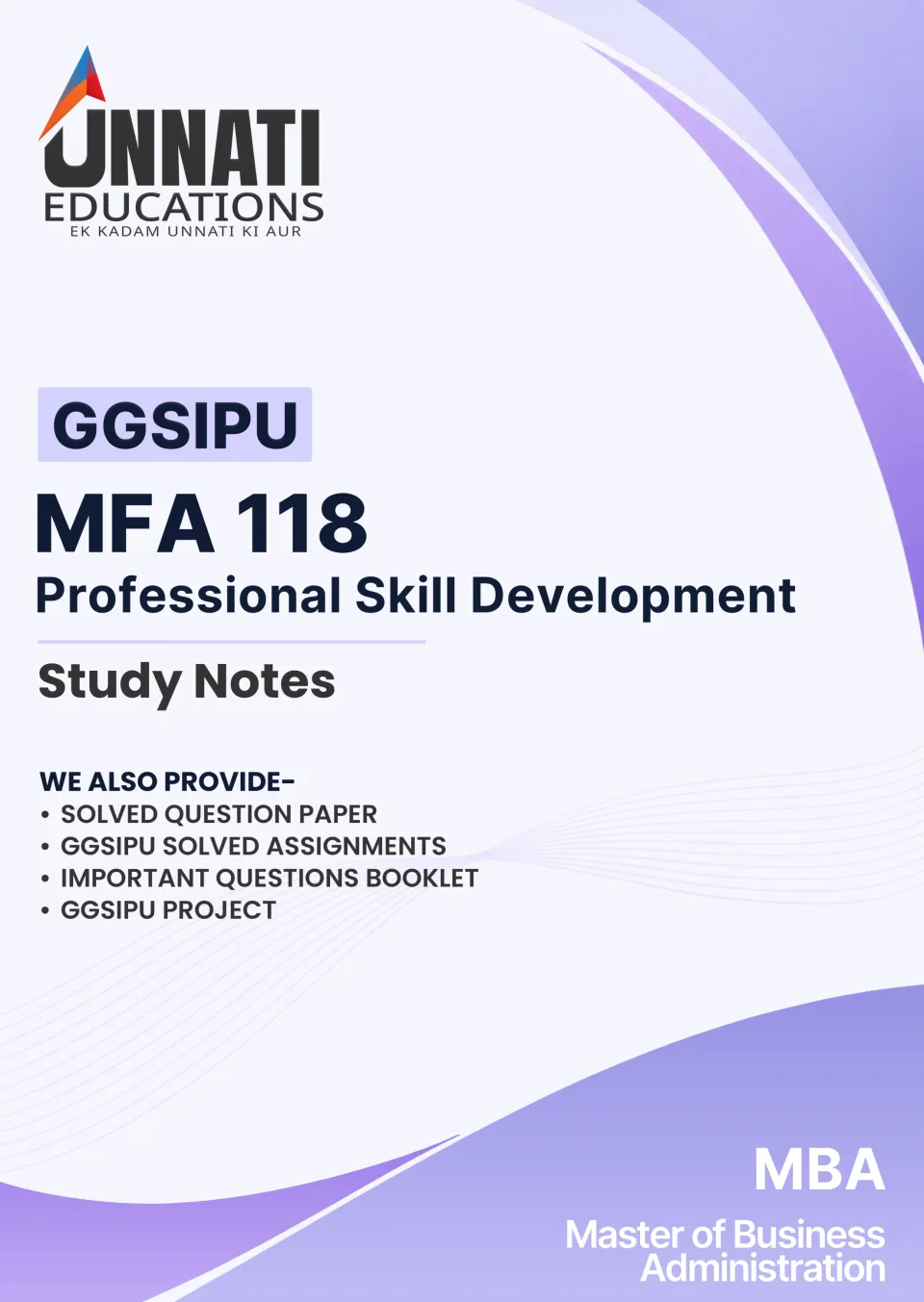
MFA 118 Professional Skill Development Notes cover all 4 units of this GGSIPU MBA (FA) Semester 2 NUES paper in 76 pages, with 50 figures, 4 case studies, 10 class exercises and 91 practice questions (60 short, 31 long). They follow the official MBA (FA) scheme and syllabus that applies from the 2021-22 academic session onwards.
Written by Prateek Talwar, Founder, Unnati Educations (ACS, ICSI) · Reviewed by Sheetal Kirola, Academic Head, M.Ed. · Checked against the GGSIPU MBA (FA) Scheme and Syllabus 2021-22 onwards (ipu.ac.in) · Updated 28 October 2026 · Editorial policy
Scheme: MBA (FA) Scheme and Syllabus 2021-22 onwards | Applies to: batches from the 2021-22 academic session onwards | Verified against: nt0722536 (9).pdf on ipu.ac.in, 28 October 2026
MFA 118 Professional Skill Development at a glance: GGSIPU MBA (FA) Sem 2 credits, units and exam pattern
MFA 118 works on you rather than on a balance sheet: self-awareness, relationships, placement skills and spreadsheet readiness. As a NUES paper it is evaluated internally, with no end-term exam. These MFA 118 Professional Skill Development IPU notes follow its official units; the paper sits with ten other codes on the GGSIPU MBA (FA) Semester 2 papers page.
| Code and title | MFA 118 Professional Skill Development (NUES); MFA-118 in the scheme table |
|---|---|
| Course and semester | MBA (Financial Analysis), Semester 2 |
| Category and credits | Skill Enhancement, NUES · 3 credits · L 2, T 1 a week |
| Evaluation | Internal, by the institute; no end-term exam |
| Units and hours | 4 units: 10 + 11 + 11 + 10 = 42 hours |
| Paired lab | None (MFA 120 Business Analytics Lab pairs with MFA 106) |
MFA 118 Professional Skill Development Notes unit-wise: 50 figures, 4 case studies and 91 practice questions across 4 units
Each unit ends with a revision table and a question list. Other MBA (FA) papers are under GGSIPU MBA (FA) notes.
MFA 118 Unit 1: Life Skills
Unit 1 starts from WHO's ten core life skills and turns inward: Core Self-Evaluation, Rokeach's values, the Big Five and MBTI, stress through the Yerkes-Dodson curve and Selye's GAS, then Dweck's growth mindset, PERMA, the Eisenhower matrix and eight mindfulness drills.
Pages 5 to 23 · 9 sections · 14 figures · 2 case studies · 15 short and 9 long questions.
| Technique | What you do |
|---|---|
| Pomodoro (Cirillo) | 25 minutes of focus, 5-minute break |
| Pareto 80/20 | Do the few tasks that give most results first |
| Eat the frog (Tracy) | Finish the hardest task in the morning |
| Two-minute rule (Allen) | Under two minutes? Do it now |
Quick look: four time tools (from page 17)
- Technique
- Pomodoro (Cirillo)
- What you do
- 25 minutes of focus, 5-minute break
- Technique
- Pareto 80/20
- What you do
- Do the few tasks that give most results first
- Technique
- Eat the frog (Tracy)
- What you do
- Finish the hardest task in the morning
- Technique
- Two-minute rule (Allen)
- What you do
- Under two minutes? Do it now
MFA 118 Unit 2: Relating to Others
Unit 2 turns to other people: Levinger's ABCDE stages, Schutz's FIRO-B and a full Transactional Analysis chapter (ego states, transactions, strokes, life positions, Karpman's drama triangle), then Albrecht's S.P.A.C.E. model, Thomas-Kilmann conflict styles and Brownell's HURIER listening model.
Pages 24 to 42 · 8 sections, the Johari Window included · 13 figures · 1 case study · 15 short and 8 long questions.
Quick look: Robbins' five-stage conflict process (from page 36)
- Potential opposition: communication, structure or personal variables.
- Cognition and personalisation: conflict perceived, then felt.
- Intentions: compete, collaborate, avoid, accommodate or compromise.
- Behaviour: visible statements and actions.
- Outcomes: functional or dysfunctional.
MFA 118 Unit 3: Campus to Corporate
Unit 3 treats placement as three filters: resume, group discussion, interview. It covers GD roles and evaluation, resume formats, the XYZ bullet formula, ATS-friendly layouts, a specimen MBA (FA) fresher resume, interview stages, Aristotle's ethos, pathos and logos, and the PREP frame for extempore.
Pages 43 to 59 · 7 sections · 11 figures · 2 business examples · 15 short and 7 long questions.
Quick look: a STAR answer from a finance project (from page 52)
- Situation: a valuation report due in 10 days; two of four members not contributing.
- Task: as coordinator, deliver on time.
- Action: one meeting, tasks split by strength, two check-in calls.
- Result: submitted two days early with the top score in class.
MFA 118 Unit 4: Job Readiness
Unit 4 is the digital half: four types of analytics, then Excel (cell references, XLOOKUP, pivot tables, what-if tools, an Analysis ToolPak regression), chart choice and Stephen Few's dashboards, online simulations, and a dream job analysis using RIASEC, Ikigai and a skill-gap score.
Pages 60 to 75 · 7 sections · 12 figures · 1 case study · 15 short and 7 long questions.
Quick look: Goal Seek for an affordable loan (from page 64)
B1  500000                 loan (Rs)
B2  9%                     annual rate
B3  60                     months
B4  =PMT(B2/12,B3,-B1)     EMI 10,379.18

Goal Seek: B4 to 8000 by changing B1Output: a loan of about Rs 3,85,387 keeps the EMI at Rs 8,000.
Johari Window quadrants in interpersonal skills: excerpt from page 33 of the MFA 118 notes
Excerpt from page 33
Luft and Ingham's Johari Window divides what is known about a person into four panes. Each pane answers two questions: do I know this about myself, and do others know it? Figure 2.8 in the notes draws the window; the table below sets out each quadrant with an example an MBA (FA) student will recognise.
| Quadrant | Known to | Meaning | Example |
|---|---|---|---|
| I. Open Area (Arena) | Self: yes · Others: yes | Behaviour, skills, attitudes and facts that both you and others know | "I am an MBA (FA) student and good at Excel" |
| II. Blind Area (Blind Spot) | Self: no · Others: yes | What others see in you that you do not see yourself | "I interrupt people often; I sound rude on calls" |
| III. Hidden Area (Facade) | Self: yes · Others: no | What you know about yourself but keep from others | A fear of public speaking, personal problems |
| IV. Unknown Area | Self: no · Others: no | What neither side knows yet: hidden talents, potential, deep feelings | An untested leadership ability that shows up in a crisis |
The four quadrants of the Johari Window (excerpt, page 33)
- Quadrant
- I. Open Area (Arena)
- Known to
- Self: yes · Others: yes
- Meaning
- Behaviour, skills, attitudes and facts that both you and others know
- Example
- "I am an MBA (FA) student and good at Excel"
- Quadrant
- II. Blind Area (Blind Spot)
- Known to
- Self: no · Others: yes
- Meaning
- What others see in you that you do not see yourself
- Example
- "I interrupt people often; I sound rude on calls"
- Quadrant
- III. Hidden Area (Facade)
- Known to
- Self: yes · Others: no
- Meaning
- What you know about yourself but keep from others
- Example
- A fear of public speaking, personal problems
- Quadrant
- IV. Unknown Area
- Known to
- Self: no · Others: no
- Meaning
- What neither side knows yet: hidden talents, potential, deep feelings
- Example
- An untested leadership ability that shows up in a crisis
Reading the quadrants
The Open Area is where easy teamwork happens. When a manager and a new analyst both know the analyst is strong in Excel, work gets assigned without guesswork. The Blind Area is the uncomfortable one: a habit like cutting colleagues off on calls can damage relationships for months while the person has no idea it is happening.
The Hidden Area is the facade a person keeps up, often for good reasons. A student who hides a fear of public speaking may avoid presenting the group project, and the team never learns why. The Unknown Area holds abilities nobody has tested yet, which is why a crisis sometimes reveals a leader no one expected.
Why the open area matters
The aim of the model is to make the Open Area larger, because people work best where there is openness and trust. A small open pane means colleagues are working on assumptions; a large one means fewer surprises, faster feedback and better use of each person's strengths. The notes go on to show the two ways of enlarging it, and an exercise that lets a class map its own windows.
MFA 118 question corner: 60 short-answer and 31 long-answer practice questions by unit
Each unit ends with a list headed "Important Exam Questions". As MFA 118 is assessed internally, use them for whatever tests or viva your institute holds. The lists give questions only; answers come from the unit text.
| Unit | Short-answer | Long-answer | Figures |
|---|---|---|---|
| 1 Life Skills | 15 | 9 | 14 |
| 2 Relating to Others | 15 | 8 | 13 |
| 3 Campus to Corporate | 15 | 7 | 11 |
| 4 Job Readiness | 15 | 7 | 12 |
MFA 118 practice questions and figures by unit
- Unit
- 1 Life Skills
- Short-answer
- 15
- Long-answer
- 9
- Figures
- 14
- Unit
- 2 Relating to Others
- Short-answer
- 15
- Long-answer
- 8
- Figures
- 13
- Unit
- 3 Campus to Corporate
- Short-answer
- 15
- Long-answer
- 7
- Figures
- 11
- Unit
- 4 Job Readiness
- Short-answer
- 15
- Long-answer
- 7
- Figures
- 12
- Unit 1: Distinguish between terminal and instrumental values. Terminal values are end-states; instrumental values are the means. Rokeach lists 18 of each.
- Unit 2: Distinguish between complementary and crossed transactions. Complementary replies come from the ego state addressed and talk flows; crossed ones come from another state and talk breaks.
- Unit 3: Explain ethos, pathos and logos. Aristotle's modes of persuasion: the speaker's credibility, the appeal to emotion and the appeal to logic.
- Unit 4: Which chart shows a trend, a share and a relationship? Line for trend, pie or stacked for part-of-whole, scatter for relationship.
The MFA 118 notes list 60 short-answer and 31 long-answer practice questions across 4 units, supported by 50 figures and 4 case studies.
More practice: the MFA 118 important questions.
Who writes and checks the MFA 118 Professional Skills notes?
- Prateek Talwar, author. Founder, Unnati Educations. Associate Company Secretary (ACS), ICSI, membership no. 58704, since 15 May 2019. B.Com, University of Delhi (School of Open Learning), 2012. Author profile.
- Sheetal Kirola, academic reviewer. Academic Head, Unnati Educations. M.Ed. 7 years of experience. Reviewer profile.
Prateek wrote these GGSIPU MBA (FA) Sem 2 Professional Skill Development notes for finance students: an analyst resume, EMI and regression illustrations, a dream job example in equity research. Sheetal's review matters most in Units 1 and 2: self-evaluation, Transactional Analysis, listening drills.
The 2026-27 edition is mapped unit by unit to the 2021-22 onwards scheme; last updated 28 October 2026, under our editorial policy.
The same team prepares GGSIPU important questions for every course.
Do the MFA 118 notes cover the full GGSIPU syllabus?
Yes. Every official MFA 118 topic in Units I to IV has its own section; class exercises are explained step by step.
| Official unit | Official topics | Where in the notes | Status |
|---|---|---|---|
| I Life Skills | Understanding oneself (core self-evaluation, values, ethics, personality assessment), stress management, building positive mindset, time management, work life balance, exercises on personality development and mindfulness | Sections 2 to 9, pp. 6 to 21 | Covered |
| II Relating to others | Interpersonal relationship assessment, management and transactional analysis, social intelligence, Johari window, conflict management, exercise on relationship management and active listening | Sections 1 to 8, pp. 24 to 40 | Covered |
| III Campus to Corporate | Success at group discussion, resume writing and feedback on resumes, success in personal interviews, public speaking and extempore | Sections 2 to 7, pp. 43 to 57 | Covered |
| IV Job Readiness | Introduction to analytics using spreadsheets, introduction to data visualization, simulation exercises through online platforms, dream job analysis | Sections 2 to 7, pp. 60 to 73 | Covered |
MFA 118 official topics mapped to the notes
- Official unit
- I Life Skills
- Official topics
- Understanding oneself (core self-evaluation, values, ethics, personality assessment), stress management, building positive mindset, time management, work life balance, exercises on personality development and mindfulness
- Where in the notes
- Sections 2 to 9, pp. 6 to 21
- Status
- Covered
- Official unit
- II Relating to others
- Official topics
- Interpersonal relationship assessment, management and transactional analysis, social intelligence, Johari window, conflict management, exercise on relationship management and active listening
- Where in the notes
- Sections 1 to 8, pp. 24 to 40
- Status
- Covered
- Official unit
- III Campus to Corporate
- Official topics
- Success at group discussion, resume writing and feedback on resumes, success in personal interviews, public speaking and extempore
- Where in the notes
- Sections 2 to 7, pp. 43 to 57
- Status
- Covered
- Official unit
- IV Job Readiness
- Official topics
- Introduction to analytics using spreadsheets, introduction to data visualization, simulation exercises through online platforms, dream job analysis
- Where in the notes
- Sections 2 to 7, pp. 60 to 73
- Status
- Covered
Official source: GGSIPU MBA (Financial Analysis) Scheme and Syllabus, 2021-22 onwards (MFA 118 on PDF page 32; Semester 2 scheme on page 6).
Every course in GGSIPU notes is mapped to its official PDF the same way.
How to write MFA 118 answers: model-based theory answers, labelled diagrams and STAR stories
MFA 118 answers win on structure, not length. The notes' tips repeat one pattern: define with the source (Robbins for personality, Kabat-Zinn for mindfulness, Rogers for listening), draw the model, tabulate comparisons, close with a workplace use. Assessment is internal, so confirm the format with your faculty.
Slips to avoid, from the notes' own explanations: treating values and ethics as one idea; calling MBTI a measure of ability, when it measures preferences; telling a STAR story with no measurable result.
Worked example: "What is stress? Explain its causes and suggest strategies to manage it."
- Define it with Selye and Robbins.
- Eustress vs distress in a table, then the labelled Yerkes-Dodson curve.
- Stressors under four heads: environmental, organisational (role conflict, overload), personal (EMIs, Type A), student-specific (placements).
- Strategies in two lists: individual (time management, exercise, cognitive restructuring) and organisational (role clarity, job redesign, flexi-time).
- Close with burnout, which WHO's ICD-11 lists as an occupational phenomenon.
Practise this format across papers on GGSIPU MBA (FA) important questions.
MFA 118 and the GGSIPU MBA (FA) Sem 2 papers it connects to
MFA 118 has no paired lab; every MBA (FA) paper and lab is listed by semester on the GGSIPU MBA (FA) syllabus page.
- Unit 4 spreadsheets and dashboards: the base for MFA 106 Business Analytics and the MFA 120 lab.
- Unit 2 conflict, listening and FIRO-B: the people side of MFA 114 Human Resource Management.
- Unit 3 resume and interviews, Unit 4 dream job analysis: preparing for the summer training the scheme sets after Semester 2.
Other Semester 2 codes: MFA 102 Financial Management, MFA 104 Investment Analysis and Portfolio Management, MFA 108 Macro and Mathematical Economics, MFA 110 Business Research, MFA 112 Marketing Management and MFA 122 MOOC/Open Elective.
MFA 118 Professional Skills notes FAQs
Is MFA 118 an end-term exam paper or a NUES paper?
MFA 118 is a NUES paper: your institute evaluates it internally and there is no end-term exam. The official MBA (FA) scheme lists it as Skill Enhancement with 3 credits, taught as 2 lecture hours and 1 tutorial hour a week. Much of the work happens in class: mindfulness exercises, listening drills, mock GDs, resume feedback and simulations.
What are the passing rules for MFA 118?
MFA 118 is evaluated internally as a NUES paper, and the MBA (FA) scheme PDF prints no marks split or pass percentage for it, so we do not quote a figure. For the university's rules on evaluation, minimum requirements and re-appear, read GGSIPU Ordinance 11 on ipu.ac.in, and ask your institute how it records your MFA 118 result.
Which MFA 118 unit is the longest in the notes?
Units 1 and 2 of MFA 118 are the longest, at 19 pages each. Unit 1 Life Skills has the most figures (14) across 9 sections, from Core Self-Evaluation to mindfulness drills, while Unit 2 carries 13, mostly Transactional Analysis diagrams. Unit 3 runs 17 pages and Unit 4 runs 16, with Unit 4 carrying the Excel work.
Do I need Excel for MFA 118 Unit 4?
Yes, MFA 118 Unit 4 is built around spreadsheets. The notes cover cell references, COUNTIF, SUMIFS, XLOOKUP, PMT, NPV and IRR, pivot tables, Goal Seek, Data Tables, Scenario Manager, Solver and the Analysis ToolPak, each with a finance illustration. Practising them in a spreadsheet also helps in MFA 106 Business Analytics and the MFA 120 lab.
Do the MFA 118 notes give written answers to the 91 practice questions?
No. The 60 short and 31 long questions at the end of each MFA 118 unit are listed without model answers. Each question maps to a section of that unit, so read the section first; the Quick Revision table just before the list gives the one-line points to build each answer from, starting with a definition.
How do I get the full MFA 118 notes?
The full MFA 118 notes come only as a printed book; they are not available as a PDF. Tap "Get Full Notes" or message 9899436384 on WhatsApp with the code MFA 118 and the team will share the details. Delivery takes 5 to 7 days at most, and the exact time depends on your location.
Get the full MFA 118 Professional Skill Development Notes on WhatsApp
These Professional Skill Development notes in English run to 76 pages and come as a printed book only, not a PDF.
| Unit | Pages | Practice questions |
|---|---|---|
| 1 Life Skills | 5 to 23 (19) | 24 |
| 2 Relating to Others | 24 to 42 (19) | 23 |
| 3 Campus to Corporate | 43 to 59 (17) | 22 |
| 4 Job Readiness | 60 to 75 (16) | 22 |
Inside the printed MFA 118 book
- Unit
- 1 Life Skills
- Pages
- 5 to 23 (19)
- Practice questions
- 24
- Unit
- 2 Relating to Others
- Pages
- 24 to 42 (19)
- Practice questions
- 23
- Unit
- 3 Campus to Corporate
- Pages
- 43 to 59 (17)
- Practice questions
- 22
- Unit
- 4 Job Readiness
- Pages
- 60 to 75 (16)
- Practice questions
- 22
Order on WhatsApp 9899436384. Delivery: 5 to 7 days at most, depending on your location.
Order the printed MFA 118 Professional Skill Development Notes book on WhatsApp (4 units, 76 pages)Unnati Educations is an independent education provider based in Vikaspuri, Delhi. We are not affiliated with, authorised by, or endorsed by Guru Gobind Singh Indraprastha University (GGSIPU). 'GGSIPU' and 'IPU' are used only to describe the syllabus our notes follow. For official information, visit ipu.ac.in.
Ready for the full notes?
Discuss coverage and delivery with our team.