
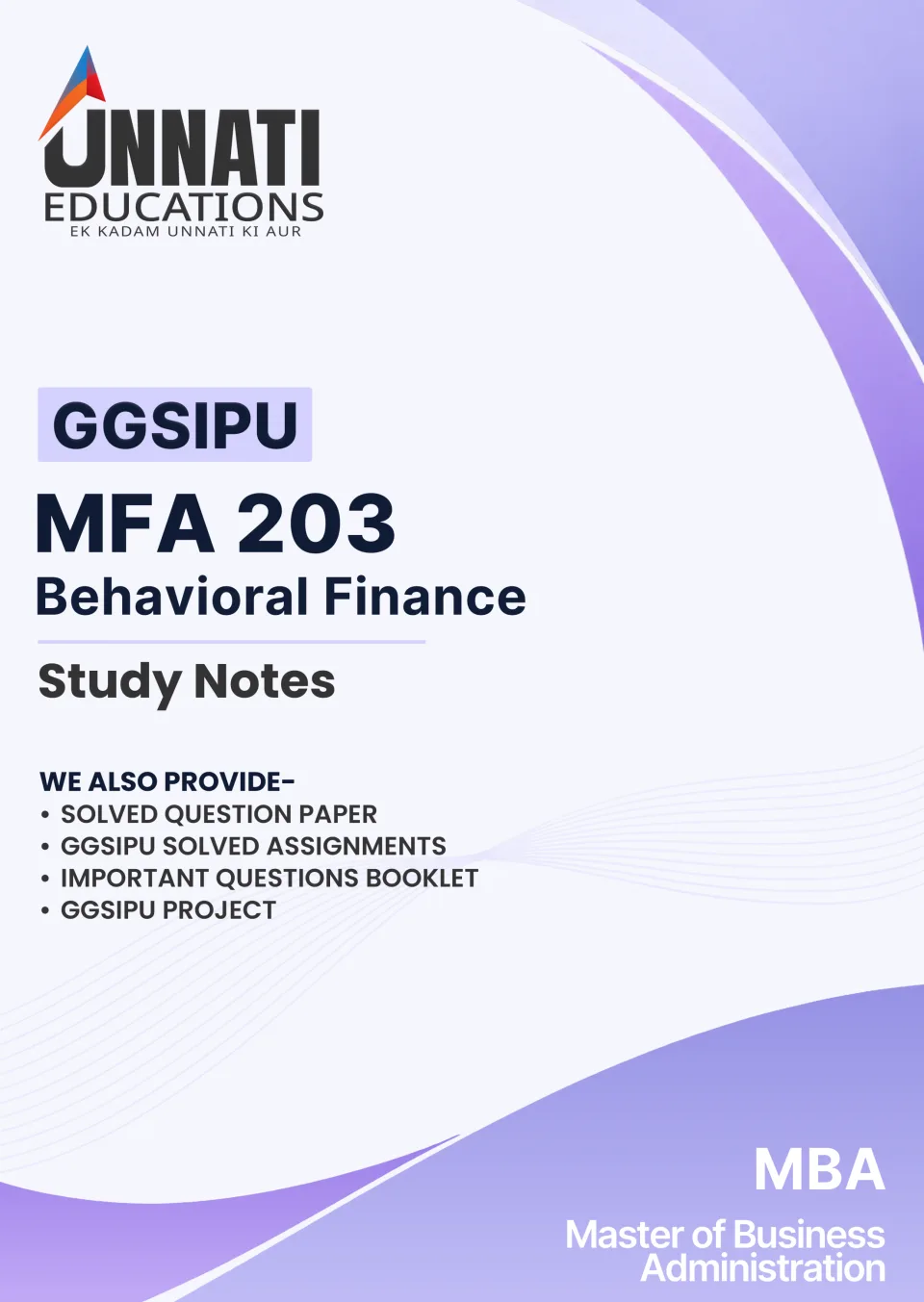
MFA-203 Behavioral Finance Notes from Unnati Educations cover all 4 units of the GGSIPU MBA (Financial Analysis) Semester 3 core paper in a 62-page printed book: 21 diagrams, 7 worked rupee illustrations, 5 case studies, 82 exam-practice questions and a revision table per unit, mapped to the MBA (FA) scheme that applies from the 2021-22 session onwards.
Written by Prateek Talwar, Founder, Unnati Educations (ACS, ICSI) · Reviewed by Sheetal Kirola, Academic Head, M.Ed. (academic review) · Checked against the MBA (FA) Scheme and Syllabus 2021-22 onwards · Updated 30 October 2026 · Editorial policy
Scheme: MBA (FA) 2021-22 | Applies to: batches admitted 2021-22 onwards | Verified against: MBA (Financial Analysis) Scheme and Syllabus, ipu.ac.in, 30 October 2026
MFA-203 Behavioral Finance at a glance: GGSIPU MBA (FA) Sem 3 credits, units and exam pattern
MFA-203 is a compulsory core paper among the GGSIPU MBA (FA) Semester 3 papers.
| Course and semester | MBA (Financial Analysis), Semester 3 |
|---|---|
| Category and credits | Core · L 3, no T/P · 3 credits |
| Teaching hours | 10, 10, 11 and 11 by unit (42) |
| Marks | 100: 50 internal + 50 end-term |
| Internal split | Two class tests (15 each) + assignments and participation (20) |
| End-term | 50-mark University written exam; paper-setter pattern not printed |
| Pass rules | Not printed; see GGSIPU Ordinance 11 |
| Applies to | Scheme w.e.f. 2021-22 |
| Paired lab | None |
MFA-203 Behavioral Finance Notes unit-wise: 21 diagrams, 7 worked illustrations and 82 exam questions across 4 units
These MFA-203 Behavioral Finance IPU notes keep the official unit order; each unit ends with a revision table and a question bank. Other papers are on the GGSIPU MBA (FA) notes page.
MFA-203 Unit 1: Foundations of Behavioral Finance
Pages 4 to 18. Micro and macro behavioural finance vs standard finance, then the models it questions: EMH and anomalies, Expected Utility Theory, agency theory and limits to arbitrage. Prospect Theory is built up to the loss-aversion model. 7 figures, 3 illustrations, 2 case studies, 21 questions.
Quick look: why an investor turns down a bet with positive expected value (from page 15)
- Bet: 50% win ₹200, 50% lose ₹100. Expected value = +₹50.
- v(200) = 2000.88 = 105.90.
- v(−100) = −2.25 × 1000.88 = −129.47.
- Prospect value = 0.5 × 105.90 + 0.5 × (−129.47) = −11.79, so the bet is rejected.
MFA-203 Unit 2: Investor Behavior
Pages 19 to 32. Investor types, objectives and traits of successful investors, then risk: tolerance vs capacity, ten types of risk, and the standard view (variance, beta) against fear of falling below a reference point. Ends with profiling tools, three personality models and contrarian strategies. 7 figures, 1 illustration, 1 case study, 20 questions.
| Type | Risk and main biases | Advisor's approach |
|---|---|---|
| Passive Preserver | Low; loss aversion, status quo | Explain goals, build trust |
| Friendly Follower | Low to moderate; herding, recency | Use data against trends |
| Independent Individualist | Moderate to high; conservatism, confirmation | Give evidence |
| Active Accumulator | High; overconfidence, illusion of control | Take charge firmly |
Quick look: Pompian's Behavioral Investor Types (from page 28)
- Type
- Passive Preserver
- Risk and main biases
- Low; loss aversion, status quo
- Advisor's approach
- Explain goals, build trust
- Type
- Friendly Follower
- Risk and main biases
- Low to moderate; herding, recency
- Advisor's approach
- Use data against trends
- Type
- Independent Individualist
- Risk and main biases
- Moderate to high; conservatism, confirmation
- Advisor's approach
- Give evidence
- Type
- Active Accumulator
- Risk and main biases
- High; overconfidence, illusion of control
- Advisor's approach
- Take charge firmly
MFA-203 Unit 3: Behavioral Biases and Irrational Investing
Pages 33 to 47. Heuristics vs biases, System 1 and System 2, then Pompian's split into 8 cognitive and 7 emotional biases, each with an example and a fix, summed up on page 41. De-biasing, over-reaction, herding and mean reversion follow, with the 1992 Harshad Mehta bull run as the case. 4 figures, 2 illustrations, 21 questions.
Quick look: conservatism vs representativeness with Bayes' rule (from page 37)
- 20% of firms are high-quality; they beat estimates 80% of the time, others 30%.
- Company X beats estimates: P(beat) = 0.2 × 0.8 + 0.8 × 0.3 = 0.40.
- P(high-quality | beat) = 0.16 ÷ 0.40 = 40%, the rational answer.
- A conservative investor stays near 20%; a representativeness-driven one jumps to 80%.
MFA-203 Unit 4: Recent Advances in Behavioral Finance
Pages 48 to 61. Neuro finance first: brain areas, seven brain secretions from dopamine to oxytocin, and fMRI. Then noise trading, BAPM, Behavioral Portfolio Theory and sentiment, and board psychology: groupthink, contract theory and governance, with the ICICI Bank and Videocon case. 3 figures, 1 illustration, 20 questions.
| Basis | CAPM | BAPM |
|---|---|---|
| Investors | All rational | Information plus noise traders |
| Risk measure | Market beta | Behavioral beta |
| Worked case | 6% + 1.2 × (13% − 6%) = 14.4% | |
Availability, affect and similarity heuristics in investing: excerpt from page 35 of the MFA-203 notes
Excerpt from page 35 (Unit III), rewritten for the web.
3. Availability heuristic
The availability heuristic is the habit of judging how likely an event is by how easily examples come to mind. Recent, vivid, emotional or widely reported events feel more likely than they really are.
- After heavy media coverage of a market crash or a big fraud, investors overestimate the chance of another crash and stay away from equity.
- Investors buy stocks that are in the news or heavily advertised and ignore less-known but better companies. Barber and Odean (2008) called these "attention-grabbing" stocks.
- Local and familiar companies feel safer because information about them is easy to find. This is home bias.
- Retrievability errors: people believe more stocks start with "S" than with "T" simply because S-names are easier to recall.
How to overcome: use a structured research checklist, read long-term statistics rather than headlines, and look at the full universe of options, not only the familiar ones.
4. Affect heuristic
The affect heuristic (Paul Slovic and colleagues) means judging by the feeling attached to something instead of by analysis. A good feeling makes the benefits look high and the risks look low; a bad feeling does the opposite.
- An investor who loves a car or phone brand believes its shares are both low-risk and high-return, even though risk and return normally move together.
- Admired companies are seen as good investments, while unpopular industries such as tobacco or mining are under-rated.
- Companies with exciting stories (EV, AI) attract extra buying.
How to overcome: separate feelings from facts, write down the numbers behind every purchase, and get an independent opinion.
5. Similarity heuristic
The similarity heuristic compares a new situation with a similar past one and assumes the same result. It is close to representativeness: when something resembles a past success, people expect the same success.
- A new IPO from the same sector as a recent hit listing is expected to give similar listing gains.
- A fund is judged good because its name, fund house or packaging looks like a top performer.
- Investors expect today's market to repeat a past crash or boom because the charts "look similar".
MFA-203 exam corner: 50 two-and-a-half-mark and 32 twelve-and-a-half-mark exam questions by unit
| Unit | 2.5 Marks | 12.5 Marks | Illustrations · cases |
|---|---|---|---|
| I | 13 | 8 | 3 · 2 |
| II | 12 | 8 | 1 · 1 |
| III | 13 | 8 | 2 · 1 |
| IV | 12 | 8 | 1 · 1 |
MFA-203 exam-practice questions by unit (marks labels as printed)
- Unit
- I
- 2.5 Marks
- 13
- 12.5 Marks
- 8
- Illustrations · cases
- 3 · 2
- Unit
- II
- 2.5 Marks
- 12
- 12.5 Marks
- 8
- Illustrations · cases
- 1 · 1
- Unit
- III
- 2.5 Marks
- 13
- 12.5 Marks
- 8
- Illustrations · cases
- 2 · 1
- Unit
- IV
- 2.5 Marks
- 12
- 12.5 Marks
- 8
- Illustrations · cases
- 1 · 1
The MFA-203 notes list 50 two-and-a-half-mark and 32 twelve-and-a-half-mark exam questions across 4 units, plus 7 worked illustrations and 5 case studies. Answers come from each unit's sections. One long question per unit:
- Unit I (page 18): Explain the limits to arbitrage with real-world examples. Pointer: six limits on page 12, then Royal Dutch/Shell and LTCM.
- Unit II (page 32): Compare the standard and behavioural views of risk. Pointer: variance and beta vs fear of loss; add the semi-variance numbers on page 24.
- Unit III (page 47): Discuss strategies to overcome behavioural biases. Pointer: page 41; pair each tool with a bias.
- Unit IV (page 61): Compare Behavioral Portfolio Theory with Modern Portfolio Theory. Pointer: the pyramid of mental accounts and the table on page 54.
Short questions for all four units are grouped in the MFA-203 important questions.
Who writes and checks the MFA-203 Behavioral Finance notes?
- Prateek Talwar, author · Founder, Unnati Educations · Associate Company Secretary (ACS), ICSI, membership no. 58704, since 15 May 2019 · B.Com, University of Delhi (SOL), 2012 · author profile
- Sheetal Kirola, academic reviewer · Academic Head · M.Ed. · 7 years of experience · checks structure, clarity and syllabus order, not the finance content · reviewer profile
The 2026-27 edition is mapped to the MBA (FA) scheme from 2021-22 and uses Indian examples such as F&O losses, IPO listings and the Satyam case. Updated 30 October 2026 under our editorial policy.
The same team prepares GGSIPU important questions for every course.
Do the MFA-203 notes cover the full GGSIPU syllabus?
Yes. Every MFA-203 topic in the official MBA (FA) syllabus has its own section in the notes; no gaps were found.
| Official unit | Official topics | Where in the notes | Status |
|---|---|---|---|
| I Foundations of Behavioral Finance | Definition, micro and macro, contributors, components; anomalies; EUT; agency; limits to arbitrage; Prospect Theory; loss aversion; gambler and hot hand fallacy | Sections 1 to 11, pages 4 to 16 | Covered |
| II Investor Behavior | Investor types, objectives, personality factors; risk attitude, types, views, perception; tools, models, contrarian investor | Sections 1 to 12, pages 19 to 30 | Covered |
| III Behavioral Biases and Irrational Investing | Four heuristics; 15 named biases; strategies to overcome biases; over-reaction and optimism; herding and mean reversal | Sections 1 to 11, pages 33 to 45 | Covered |
| IV Recent Advances in Behavioral Finance | Neuro finance, secretions, neurotechnology; noise trading, BAPM, BPT, sentiment; board psychology, contract theory, governance | Sections 1 to 11, pages 48 to 59 | Covered |
MFA-203 official syllabus mapped to the notes
- Official unit
- I Foundations of Behavioral Finance
- Official topics
- Definition, micro and macro, contributors, components; anomalies; EUT; agency; limits to arbitrage; Prospect Theory; loss aversion; gambler and hot hand fallacy
- Where in the notes
- Sections 1 to 11, pages 4 to 16
- Status
- Covered
- Official unit
- II Investor Behavior
- Official topics
- Investor types, objectives, personality factors; risk attitude, types, views, perception; tools, models, contrarian investor
- Where in the notes
- Sections 1 to 12, pages 19 to 30
- Status
- Covered
- Official unit
- III Behavioral Biases and Irrational Investing
- Official topics
- Four heuristics; 15 named biases; strategies to overcome biases; over-reaction and optimism; herding and mean reversal
- Where in the notes
- Sections 1 to 11, pages 33 to 45
- Status
- Covered
- Official unit
- IV Recent Advances in Behavioral Finance
- Official topics
- Neuro finance, secretions, neurotechnology; noise trading, BAPM, BPT, sentiment; board psychology, contract theory, governance
- Where in the notes
- Sections 1 to 11, pages 48 to 59
- Status
- Covered
Official source: GGSIPU MBA (Financial Analysis) Scheme and Syllabus, 2021-22 onwards (MFA-203 is on pages 37 and 38).
Every course in our GGSIPU notes is checked against its official PDF the same way.
How to write MFA-203 answers: theory answers backed by a diagram, a comparison table and one rupee illustration
MFA-203 is a theory paper, but a long answer (12.5 Marks in the notes) scores better with three parts an examiner can check in seconds: a labelled diagram, a comparison table and a small numerical. A bare list of points rarely fills the space.
- Draw the model. The notes' tips ask for the BB&K two-axis grid (Figure 2.6) in investor-model answers and the BPT pyramid (Figure 4.2) in portfolio answers. Use the S-shaped value function (Figure 1.6) for Prospect Theory.
- Use a table for every "compare" question. Standard vs behavioural finance, CAPM vs BAPM and MPT vs BPT are all tables in the notes; aim for six rows.
- Add the formula. For loss aversion write v(x) = xα for gains and −λ(−x)β for losses, with α = β = 0.88 and λ = 2.25, then solve the ₹200 / ₹100 bet.
- Match, don't list. In de-biasing answers, pair each strategy with the bias it treats, and quote Pompian's rule: correct cognitive biases, adapt to emotional ones.
- Classify correctly. In the notes' 15-bias table, overconfidence, regret aversion and status quo are emotional; conservatism, hindsight and mental accounting are cognitive.
Worked example (page 9): certainty equivalent. An investor with U(W) = √W (₹ lakh) faces ₹25 lakh or ₹81 lakh at 50% each. Expected value = 0.5 × 25 + 0.5 × 81 = ₹53 lakh. Expected utility = 0.5 × 5 + 0.5 × 9 = 7 utils. Certainty equivalent: √CE = 7, so CE = ₹49 lakh. Risk premium = 53 − 49 = ₹4 lakh, which shows a concave, risk-averse investor. Close by linking it to Prospect Theory in one line.
Practise this format on GGSIPU MBA (FA) important questions.
MFA-203 and the GGSIPU MBA (FA) Sem 3 papers it connects to
MFA-203 has no lab of its own; for the full programme, open the GGSIPU MBA (FA) syllabus.
These GGSIPU MBA (FA) Sem 3 Behavioral Finance notes connect to other papers here:
- MFA-104 Investment Analysis and Portfolio Management (Sem 2): its CAPM, EMH and Markowitz theory are what Units I and IV challenge.
- MFA-227 Finance Lab-I (Sem 3): its Excel risk-return work fits Unit II's downside-risk illustration.
- MFA-205 International Financial Management (Sem 3 core): home bias and ambiguity aversion (Unit III) explain low foreign holdings.
- Also in Semester 3: MFA-201 Summer Training Report, a MOOC and four electives from MFA-207 Financial Econometrics, MFA-209 Project Management, MFA-211 Fixed Income Securities, MFA-213 Emerging Technologies in Finance, MFA-215 Direct and Indirect Taxes, MFA-217 Central Banking, MFA-219 Commercial Banking, MFA-221 Financial Journalism, MFA-223 Entrepreneurial Development and Start-up Finance and MFA-225 Financial Service Marketing.
MFA-203 Behavioral Finance notes FAQs
How do I get the full MFA-203 notes?
Tap "Get Full Notes" or the WhatsApp button at the end of this page and send the pre-filled message. The full MFA-203 notes come as a printed book with all 4 units on 62 pages, and our team shares the order details on WhatsApp. Delivery takes a maximum of 5 to 7 days, depending on your location.
Are the MFA-203 notes available as a PDF?
No. The full MFA-203 Behavioral Finance notes are sold only as a printed book. The only PDF here is the watermarked sample behind the "View Sample PDF" button, which shows the cover, the index and one page from each unit so you can judge the diagrams, tables and simple English before you order the book on WhatsApp.
What is the passing mark for MFA-203 Behavioral Finance?
MFA-203 is marked out of 100: 50 internal (two class tests of 15 each plus 20 for assignments and participation) and 50 for the end-term exam. The MBA (FA) scheme PDF does not print a pass percentage, so we do not state one. Minimum marks and re-appear rules come from GGSIPU Ordinance 11 on ipu.ac.in.
Is MFA-203 a theory paper or a numerical paper?
MFA-203 is mainly theory with numerical support. The notes carry 7 worked illustrations: certainty equivalent, two loss-aversion bets, standard deviation vs downside risk, Bayes' rule for conservatism, the cost of mental accounting and expected return under BAPM. Adding one of these to a long answer shows the examiner you understand the model, not just its definition.
Which MFA-203 unit needs the most time?
Unit III usually takes longest: it names 15 biases plus four heuristics, de-biasing, herding and mean reversion, across 15 pages with a one-page summary table on page 41. Unit I is just as long and holds 3 of the 7 worked illustrations, on Expected Utility and loss aversion, so plan extra revision and practice time for both units.
Do the MFA-203 notes follow the current GGSIPU MBA (FA) syllabus?
Yes. They are mapped to the MBA (Financial Analysis) Scheme and Syllabus from the 2021-22 session onwards, the ipu.ac.in version that lists MFA-203 as a Semester 3 core paper with 3 credits. Every topic in Units I to IV has a matching section, and the syllabus map above gives the page range for each unit.
Get the full MFA-203 Behavioral Finance Notes on WhatsApp
| Unit | Pages | Figures | Questions |
|---|---|---|---|
| I | 4 to 18 | 7 | 21 |
| II | 19 to 32 | 7 | 20 |
| III | 33 to 47 | 4 | 21 |
| IV | 48 to 61 | 3 | 20 |
What the full MFA-203 notes book contains
- Unit
- I
- Pages
- 4 to 18
- Figures
- 7
- Questions
- 21
- Unit
- II
- Pages
- 19 to 32
- Figures
- 7
- Questions
- 20
- Unit
- III
- Pages
- 33 to 47
- Figures
- 4
- Questions
- 21
- Unit
- IV
- Pages
- 48 to 61
- Figures
- 3
- Questions
- 20
Format: printed book only (no PDF), 62 pages, with 7 worked illustrations, 5 case studies and 4 revision tables. These are Behavioral Finance notes in English. Delivery: maximum 5 to 7 days after your order is confirmed, depending on your location.
Order the full MFA-203 notes book on WhatsApp (4 units, 62 pages)
Unnati Educations is an independent education provider based in Vikaspuri, Delhi. We are not affiliated with, authorised by, or endorsed by Guru Gobind Singh Indraprastha University (GGSIPU). 'GGSIPU' and 'IPU' are used only to describe the syllabus our notes follow. For official information, visit ipu.ac.in.
Ready for the full notes?
Discuss coverage and delivery with our team.