
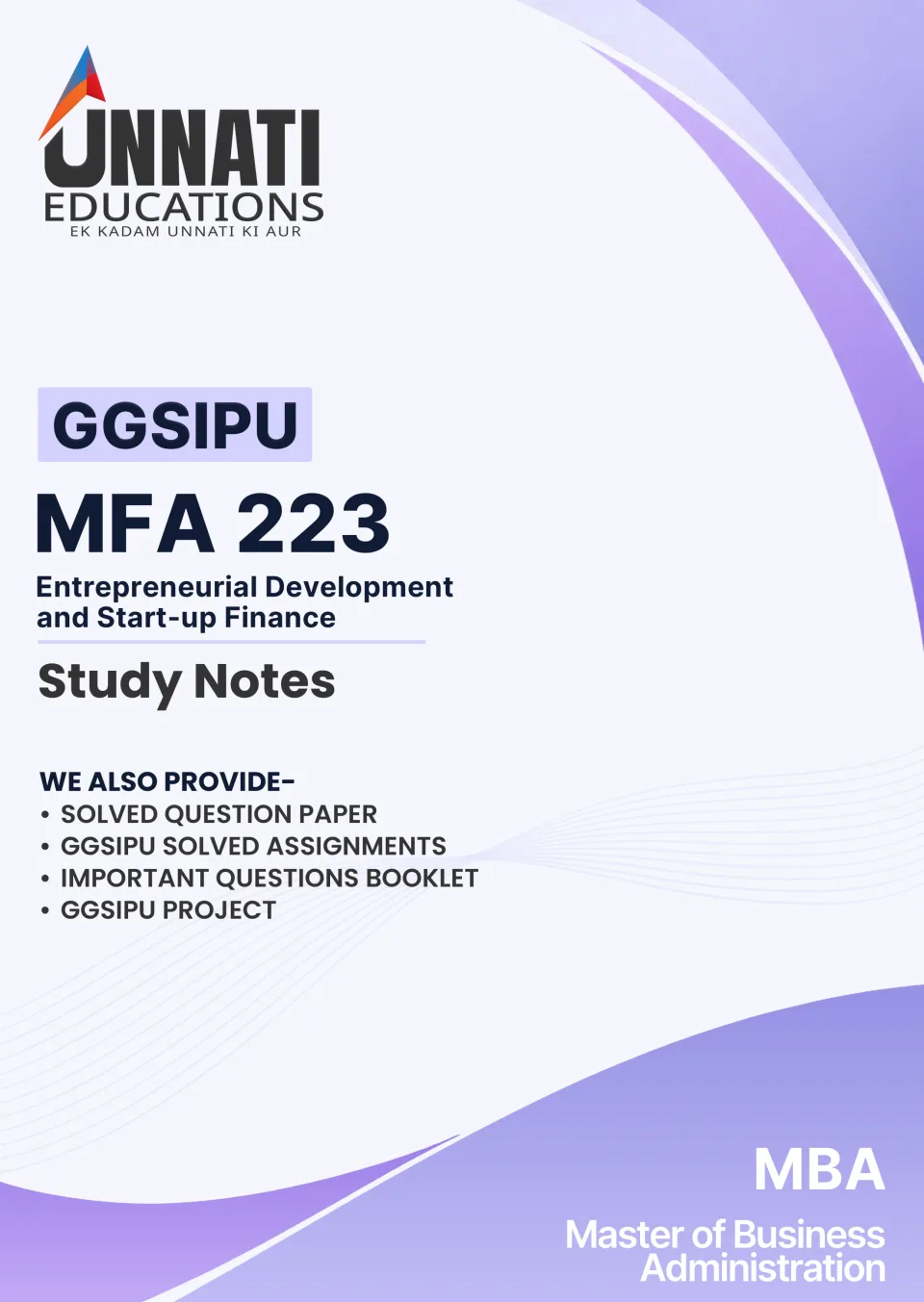
MFA-223 Entrepreneurial Development and Start-up Finance Notes by Unnati Educations cover all 4 units of this GGSIPU MBA (Financial Analysis) Semester 3 elective in a 67-page printed book: 28 worked illustrations, 7 case studies, 33 figures and 68 exam questions, mapped to the MBA (FA) scheme that applies from the 2021-22 session onwards.
Written by Prateek Talwar, Founder, Unnati Educations (ACS, ICSI) · Reviewed by Sheetal Kirola, M.Ed., Academic Head (academic review) · Checked against the MBA (FA) Scheme and Syllabus 2021-22 onwards (ipu.ac.in) · Updated 30 October 2026 · Editorial policy
Scheme: MBA (FA) Scheme and Syllabus 2021-22 onwards | Applies to: batches from the 2021-22 academic session | Verified against: official MBA (FA) syllabus PDF on ipu.ac.in, checked 30 October 2026
MFA-223 Entrepreneurial Development and Start-up Finance at a glance: GGSIPU MBA (FA) Sem 3 credits, units and exam pattern
MFA-223 follows a venture from the first idea to funding, growth and a crowdfunding campaign. It is one of ten electives among the GGSIPU MBA (FA) Semester 3 papers; students pick four.
| Course and semester | MBA (Financial Analysis), Semester 3 |
|---|---|
| Category and credits | Discipline Specific Elective · L 3, no T/P · 3 credits |
| Teaching hours | Unit I 12 · Units II, III and IV 10 each (42 in all) |
| Marks | 100: 50 internal + 50 end-term |
| Internal 50 | Class Test I 15 · Class Test II 15 · assignments, presentation, viva-voce, group discussion, participation 20 |
| End-term pattern | 50-mark written exam by the University; paper-setter instructions are not printed in the official PDF |
| Pass rules | Not printed in the MBA (FA) PDF; see GGSIPU Ordinance 11 (examinations and results) |
| Paired lab | None (MFA-227 Finance Lab I is a separate paper) |
MFA-223 Entrepreneurial Development and Start-up Finance Notes unit-wise: 28 worked illustrations, 7 case studies and 68 exam questions across 4 units
These MFA-223 Entrepreneurial Development and Start-up Finance IPU notes follow the official unit order and the Barringer and Ireland textbook, with Indian schemes and rupee numericals. Notes for every other MBA (FA) paper sit on the GGSIPU MBA (FA) notes page.
MFA-223 Unit 1: Introduction to Entrepreneurship
Pages 5 to 21, 8 sections. Covers the entrepreneur from Cantillon to Drucker, Shapero's model, Danhof's four types and the factors behind entrepreneurship, including Startup India.
Then idea generation, feasibility analysis, the business plan and the Business Model Canvas. 6 worked illustrations, 1 case study (Zerodha), 9 figures, 17 exam questions.
| Step | Working | Result |
|---|---|---|
| Gross profit per customer a month | ₹1,200 × 40% | ₹480 |
| Lifetime value at 8% monthly churn | 480 ÷ 0.08 | ₹6,000 |
| Customer acquisition cost | ₹12,00,000 ÷ 1,500 | ₹800 |
| LTV ÷ CAC; payback | 6,000 ÷ 800; 800 ÷ 480 | 7.5 times; 1.7 months |
Quick look: unit economics of a meal-kit subscription (from page 20)
- Step
- Gross profit per customer a month
- Working
- ₹1,200 × 40%
- Result
- ₹480
- Step
- Lifetime value at 8% monthly churn
- Working
- 480 ÷ 0.08
- Result
- ₹6,000
- Step
- Customer acquisition cost
- Working
- ₹12,00,000 ÷ 1,500
- Result
- ₹800
- Step
- LTV ÷ CAC; payback
- Working
- 6,000 ÷ 800; 800 ÷ 480
- Result
- 7.5 times; 1.7 months
MFA-223 Unit 2: Idea to an Entrepreneurial Firm
Full official title: "Idea to an Entrepreneurial Firm: Growth Opportunities". Pages 22 to 37, 6 sections. After growth mind-set and vision come ownership forms and a founders' agreement with vesting.
The finance block is the heaviest: pro forma statements, burn and runway, funding sources, the VC process, valuation and the cap table. 7 worked illustrations, 2 case studies, 9 figures, 17 exam questions.
Quick look: valuation by the VC method (from page 34)
- Exit value in year 5: PAT ₹20 crore × P/E of 15 = ₹300 crore.
- Discount at a 50% target return: 1.55 = 7.594, so post-money = 300 ÷ 7.594 = ₹39.5 crore.
- Pre-money = 39.5 − 8 (the ₹8 crore raised) = ₹31.5 crore.
- Ownership = 8 ÷ 39.5 = 20.25%; with 20% future dilution, ask for 20.25% ÷ 0.80 = 25.31% today.
MFA-223 Unit 3: Developing Organizational Capabilities
Pages 38 to 51, 5 sections. Covers start-up marketing on a small budget (STP, pricing, guerrilla promotion), then intellectual property under Indian law and the IP audit.
Growth follows: the Penrose effect, Greiner's phases, Ansoff's matrix and franchise economics. With 10 worked illustrations it is the most numerical unit, plus 2 case studies, 8 figures and 17 exam questions.
| Item | Working | Result |
|---|---|---|
| ROE by DuPont | 8% × 1.5 × 1.667 | 20% |
| Retention ratio b | 1 − 40% payout | 0.6 |
| SGR (beginning / ending equity) | 20% × 0.6; 0.12 ÷ 0.88 | 12% / 13.6% |
| Planned growth 30% | Above SGR | Needs new equity, debt or better margins |
Quick look: sustainable growth rate check (from page 45)
- Item
- ROE by DuPont
- Working
- 8% × 1.5 × 1.667
- Result
- 20%
- Item
- Retention ratio b
- Working
- 1 − 40% payout
- Result
- 0.6
- Item
- SGR (beginning / ending equity)
- Working
- 20% × 0.6; 0.12 ÷ 0.88
- Result
- 12% / 13.6%
- Item
- Planned growth 30%
- Working
- Above SGR
- Result
- Needs new equity, debt or better margins
MFA-223 Unit 4: Global Aspects of Entrepreneurship and Crowdfunding
Pages 52 to 66, 8 sections. The global half compares the Uppsala model with born-global firms, ranks export payment methods by risk, then covers trade barriers, the WTO and India's trade agreements up to the 2025 India-UK CETA.
The crowdfunding half explains pledges, campaigns, equity and P2P models, and crowdsourcing. 5 worked illustrations, 2 case studies, 7 figures, 17 exam questions.
Quick look: setting a minimum crowdfunding goal (from page 62)
- Fixed money needed for moulds and tooling: ₹4 lakh.
- Deductions per rupee pledged: fees 8%, rewards and shipping 45%.
- Minimum goal = 4 ÷ (1 − 0.08 − 0.45) = ₹8.51 lakh, so set it at about ₹9 lakh.
Lean start-up, MVP and pivots in venture strategy: excerpt from page 24 of the MFA-223 notes
Excerpt from page 24 (Unit 2, sections 2.1 to 2.3)
The Build-Measure-Learn loop
A lean start-up treats its business model as a set of guesses to test, not a plan to execute. The loop has four moves. Ideas become a build: a Minimum Viable Product made with the least effort. The product goes out to early customers to measure real behaviour through actionable metrics. The data turns into learning: was the hypothesis right? Then the founder decides to persevere with the strategy or pivot, which means changing one element of the business model.
Lean terms you must define in an answer
- Minimum Viable Product (MVP): the simplest version that gives the most validated learning for the least effort, such as a landing page, a prototype or a service run on WhatsApp.
- Validated learning: learning proven by what customers do, not by what they say.
- Actionable metrics: numbers that show cause and effect, such as cohort retention or conversion, instead of vanity figures like total downloads.
- Split (A/B) testing: two versions offered to different customers to see which works better.
- Product-market fit: being in a good market with a product that satisfies it (Marc Andreessen); retention curves flatten and organic referrals rise.
Customer development (Steve Blank)
Four stages run in order: customer discovery (do customers have the problem?), customer validation (will they pay, and is there a repeatable sales model?), customer creation (build demand and scale marketing) and company building (move from learning to an execution organisation).
Types of pivots
| Pivot | What changes | Illustration |
|---|---|---|
| Zoom-in | One feature becomes the whole product | A check-in app's photo feature becomes the main product |
| Customer segment | Same product, different customer | B2C app re-targeted to businesses |
| Customer need | A more important problem for the same customer | Restaurant listing to food delivery |
| Value capture | How money is earned | One-time sale to subscription; free to freemium |
| Channel | How the product reaches customers | Retail stores to direct-to-consumer online |
Pivot types with what changes (excerpt, page 24)
- Pivot
- Zoom-in
- What changes
- One feature becomes the whole product
- Illustration
- A check-in app's photo feature becomes the main product
- Pivot
- Customer segment
- What changes
- Same product, different customer
- Illustration
- B2C app re-targeted to businesses
- Pivot
- Customer need
- What changes
- A more important problem for the same customer
- Illustration
- Restaurant listing to food delivery
- Pivot
- Value capture
- What changes
- How money is earned
- Illustration
- One-time sale to subscription; free to freemium
- Pivot
- Channel
- What changes
- How the product reaches customers
- Illustration
- Retail stores to direct-to-consumer online
The notes list four more: zoom-out, platform, business architecture and technology pivots.
MFA-223 exam corner: 40 two-to-five-mark and 28 ten-to-fifteen-mark questions by unit
Each unit ends with a practice list of short (2–5 Marks) and long (10–15 Marks) questions; answer matter sits in that unit's sections.
| Unit | Short Answer (2–5 Marks) | Long Answer (10–15 Marks) | Worked illustrations |
|---|---|---|---|
| Unit I | 10 | 7 | 6 |
| Unit II | 10 | 7 | 7 |
| Unit III | 10 | 7 | 10 |
| Unit IV | 10 | 7 | 5 |
| Total | 40 | 28 | 28 |
MFA-223 exam questions and worked illustrations by unit
- Unit
- Unit I
- Short Answer (2–5 Marks)
- 10
- Long Answer (10–15 Marks)
- 7
- Worked illustrations
- 6
- Unit
- Unit II
- Short Answer (2–5 Marks)
- 10
- Long Answer (10–15 Marks)
- 7
- Worked illustrations
- 7
- Unit
- Unit III
- Short Answer (2–5 Marks)
- 10
- Long Answer (10–15 Marks)
- 7
- Worked illustrations
- 10
- Unit
- Unit IV
- Short Answer (2–5 Marks)
- 10
- Long Answer (10–15 Marks)
- 7
- Worked illustrations
- 5
- Unit
- Total
- Short Answer (2–5 Marks)
- 40
- Long Answer (10–15 Marks)
- 28
- Worked illustrations
- 28
The MFA-223 notes list 40 short-answer and 28 long-answer exam questions across 4 units, plus 28 worked illustrations and 7 case studies. Four exam-style questions with answer pointers:
- Unit I: Distinguish between an entrepreneur and an intrapreneur. The entrepreneur owns the venture and bears full risk; the intrapreneur is an employee innovating with the firm's resources (page 6).
- Unit II: Cash ₹2.4 crore, monthly expenses ₹30 lakh, collections ₹10 lakh. Find the runway. Net burn = ₹20 lakh a month; runway = 240 ÷ 20 = 12 months (page 29).
- Unit III: Distinguish between a patent and a trade secret. A patent is disclosed and lasts 20 years from filing; a trade secret lasts while it stays secret but is lost to leaks or reverse engineering (pages 41 and 42).
- Unit IV: Distinguish between a free trade area and a customs union. FTA members remove tariffs among themselves but keep their own external tariffs; a customs union adds a common external tariff (page 58).
More practice will sit in the MFA-223 important questions.
Who writes and checks the MFA-223 Entrepreneurship and Start-up Finance notes?
- Prateek Talwar, author · Founder, Unnati Educations · Associate Company Secretary (ACS), ICSI, membership no. 58704, since 15 May 2019 · B.Com, University of Delhi (SOL), 2012 · author profile
- Sheetal Kirola, academic reviewer · Academic Head · M.Ed. · 7 years of experience · checks structure, clarity and syllabus order, not the valuation working · reviewer profile
Mapped to the 2021-22 MBA (FA) scheme. The 2026-27 edition adds the Startup India Seed Fund, RBI's P2P rules and trade agreements up to 2025. Last updated 30 October 2026 under our editorial policy.
The same author-then-review check covers the GGSIPU important questions we prepare.
Do the MFA-223 notes cover the full GGSIPU syllabus?
Yes. Every topic in the four official MFA-223 units has its own section. Development-agency support, named in the course outcomes, sits inside Unit 2's funding section.
| Official unit | Official topics | Where in the notes | Status |
|---|---|---|---|
| Unit I: Introduction to Entrepreneurship | Decision to become an entrepreneur, meaning, types, influencing factors; idea generation, idea evaluation, feasibility analysis, business plan, business model | Sections 1 to 8, pages 5 to 20 | Covered |
| Unit II: Idea to an Entrepreneurial Firm | Growth mind-set and vision, reiterating business models, ethical and legal foundation, financial strength and viability, new-venture team, financing | Sections 1 to 6, pages 22 to 35 | Covered |
| Unit III: Developing Organizational Capabilities | Unique marketing issues, intellectual property, challenges of growth, growth strategies, franchising | Sections 1 to 5, pages 38 to 50 | Covered |
| Unit IV: Global aspects of entrepreneurship and Crowdfunding | Going global, trade barriers, trade agreements; pledges, campaigns, alternative crowdfunding, crowdfunding vs crowdsourcing | Sections 1 to 8, pages 52 to 65 | Covered |
Official MFA-223 topics mapped to the notes
- Official unit
- Unit I: Introduction to Entrepreneurship
- Official topics
- Decision to become an entrepreneur, meaning, types, influencing factors; idea generation, idea evaluation, feasibility analysis, business plan, business model
- Where in the notes
- Sections 1 to 8, pages 5 to 20
- Status
- Covered
- Official unit
- Unit II: Idea to an Entrepreneurial Firm
- Official topics
- Growth mind-set and vision, reiterating business models, ethical and legal foundation, financial strength and viability, new-venture team, financing
- Where in the notes
- Sections 1 to 6, pages 22 to 35
- Status
- Covered
- Official unit
- Unit III: Developing Organizational Capabilities
- Official topics
- Unique marketing issues, intellectual property, challenges of growth, growth strategies, franchising
- Where in the notes
- Sections 1 to 5, pages 38 to 50
- Status
- Covered
- Official unit
- Unit IV: Global aspects of entrepreneurship and Crowdfunding
- Official topics
- Going global, trade barriers, trade agreements; pledges, campaigns, alternative crowdfunding, crowdfunding vs crowdsourcing
- Where in the notes
- Sections 1 to 8, pages 52 to 65
- Status
- Covered
Source: MBA (Financial Analysis) Scheme and Syllabus, 2021-22 onwards; MFA-223 is listed on page 7 and its syllabus is on page 56.
Every course in GGSIPU notes is mapped to its official PDF the same way.
How to write MFA-223 answers: distinction tables, start-up funding numericals and model-based long answers
Many short questions say "distinguish between": entrepreneur and intrapreneur, pre-money and post-money, patent and trade secret, crowdfunding and crowdsourcing. Answer with a four or five row table on clear bases and a one-line conclusion.
For numericals, write the formula, the working, then the answer in ₹. Funding sums follow the notes' four steps: post-money = pre-money + investment; investor % = investment ÷ post-money; new shares = existing shares × investor % ÷ (1 − investor %); price = investment ÷ new shares.
Long answers rest on a named model: for "decision to become an entrepreneur", go reasons, push and pull factors, Shapero's model, traits, myths. Draw the figure, such as Greiner's phases.
Worked example: Unit I short question 8
Fixed cost ₹36 lakh, price ₹500, variable cost ₹200. Break-even units = 36,00,000 ÷ (500 − 200) = 12,000 units; each unit beyond adds ₹300 contribution to profit.
Do not mix feasibility analysis ("should we pursue this idea?") with the business plan ("how will we build it?"). Practise on GGSIPU MBA (FA) important questions.
MFA-223 and the GGSIPU MBA (FA) Sem 3 papers it connects to
MFA-223 has no lab; see where it sits in the GGSIPU MBA (FA) syllabus.
These GGSIPU MBA (FA) Sem 3 Entrepreneurial Development and Start-up Finance notes connect to:
- MFA-205 International Financial Management: Unit 4's forward hedge and export finance (ECGC, EXIM Bank).
- MFA-209 Project Management: Unit 1's feasibility analysis and start-up cash need.
- MFA-225 Financial Service Marketing: Unit 3's positioning, pricing and low-cost promotion.
- Also in Semester 3: MFA-201 Summer Training Report, MFA-203 Behavioral Finance, MFA-227 Finance Lab I, MFA-213 Emerging Technologies in Finance, and electives MFA-207 Financial Econometrics, MFA-211 Fixed Income Securities, MFA-215 Direct and Indirect Taxes, MFA-217 Central Banking, MFA-219 Commercial Banking, MFA-221 Financial Journalism.
MFA-223 Entrepreneurship and Start-up Finance notes FAQs
How do I get the full MFA-223 notes?
Tap "Get Full Notes" at the top or the WhatsApp button at the end and send the pre-filled message. The full MFA-223 notes come as a 67-page printed book covering all 4 units, and our team shares order details on WhatsApp. Delivery takes a maximum of 5 to 7 days; the rest depends on your location.
Are the MFA-223 notes available as a PDF?
No. The full MFA-223 notes are sold only as a printed book. The only PDF here is the watermarked sample with the cover, the index and one page from each unit, so you can see the flowcharts, formula boxes and worked illustrations before ordering. Orders are taken on WhatsApp and delivered within 5 to 7 days, depending on location.
How is MFA-223 marked, and what is the passing mark?
MFA-223 is marked out of 100: 50 internal and 50 end-term. The internal 50 is two class tests of 15 marks each plus 20 marks for assignments, presentations, viva-voce, group discussion and participation. The MBA (FA) scheme PDF does not state a pass percentage, so we do not quote one. For end-term minimums and re-appear rules, check Ordinance 11 on ipu.ac.in.
Is MFA-223 compulsory in MBA (FA) Semester 3?
No. MFA-223 is one of ten discipline specific electives (MFA-207 to MFA-225) in the official Semester 3 list, and each student picks four of them. It carries 3 credits like the other electives. It suits students heading into founding roles, start-ups or venture capital, since Unit 2 covers valuation, the VC process and the cap table.
Which MFA-223 unit has the most numericals?
Unit 3, Developing Organizational Capabilities, has 10 of the 28 worked illustrations, including cost-plus vs value-based pricing, a relief-from-royalty licence value, sustainable growth rate, additional funds needed, EVA, a start-up acquisition and a franchise payback test. Unit 2 has 7, on vesting, pro forma statements, runway, equity split, VC and Berkus valuation and the cap table.
Do the MFA-223 notes cover Indian government support for start-ups?
Yes. Unit 1 covers Startup India, DPIIT recognition and the Section 80-IAC tax holiday for 3 out of 10 years. Unit 2 explains SIDBI's ₹10,000 crore Fund of Funds, the Startup India Seed Fund Scheme (up to ₹20 lakh as a grant and up to ₹50 lakh through convertible debentures or debt), Mudra and CGTMSE-backed loans. Unit 3 adds SIPP fee rebates.
Get the full MFA-223 Entrepreneurial Development and Start-up Finance Notes on WhatsApp
The full book is our Entrepreneurial Development and Start-up Finance notes in English, sold only in printed form.
| Unit | Pages | Illustrations | Exam questions |
|---|---|---|---|
| Unit I | 5 to 21 (17) | 6 | 17 |
| Unit II | 22 to 37 (16) | 7 | 17 |
| Unit III | 38 to 51 (14) | 10 | 17 |
| Unit IV | 52 to 66 (15) | 5 | 17 |
| Total, with cover and index | 67 | 28 | 68 |
What the full MFA-223 printed book contains
- Unit
- Unit I
- Pages
- 5 to 21 (17)
- Illustrations
- 6
- Exam questions
- 17
- Unit
- Unit II
- Pages
- 22 to 37 (16)
- Illustrations
- 7
- Exam questions
- 17
- Unit
- Unit III
- Pages
- 38 to 51 (14)
- Illustrations
- 10
- Exam questions
- 17
- Unit
- Unit IV
- Pages
- 52 to 66 (15)
- Illustrations
- 5
- Exam questions
- 17
- Unit
- Total, with cover and index
- Pages
- 67
- Illustrations
- 28
- Exam questions
- 68
Printed book only, not a PDF. Delivery takes a maximum of 5 to 7 days; the rest depends on your location.
Order the full MFA-223 notes book on WhatsApp (4 units, 67 pages)
Unnati Educations is an independent education provider based in Vikaspuri, Delhi. We are not affiliated with, authorised by, or endorsed by Guru Gobind Singh Indraprastha University (GGSIPU). 'GGSIPU' and 'IPU' are used only to describe the syllabus our notes follow. For official information, visit ipu.ac.in.
Ready for the full notes?
Discuss coverage and delivery with our team.