
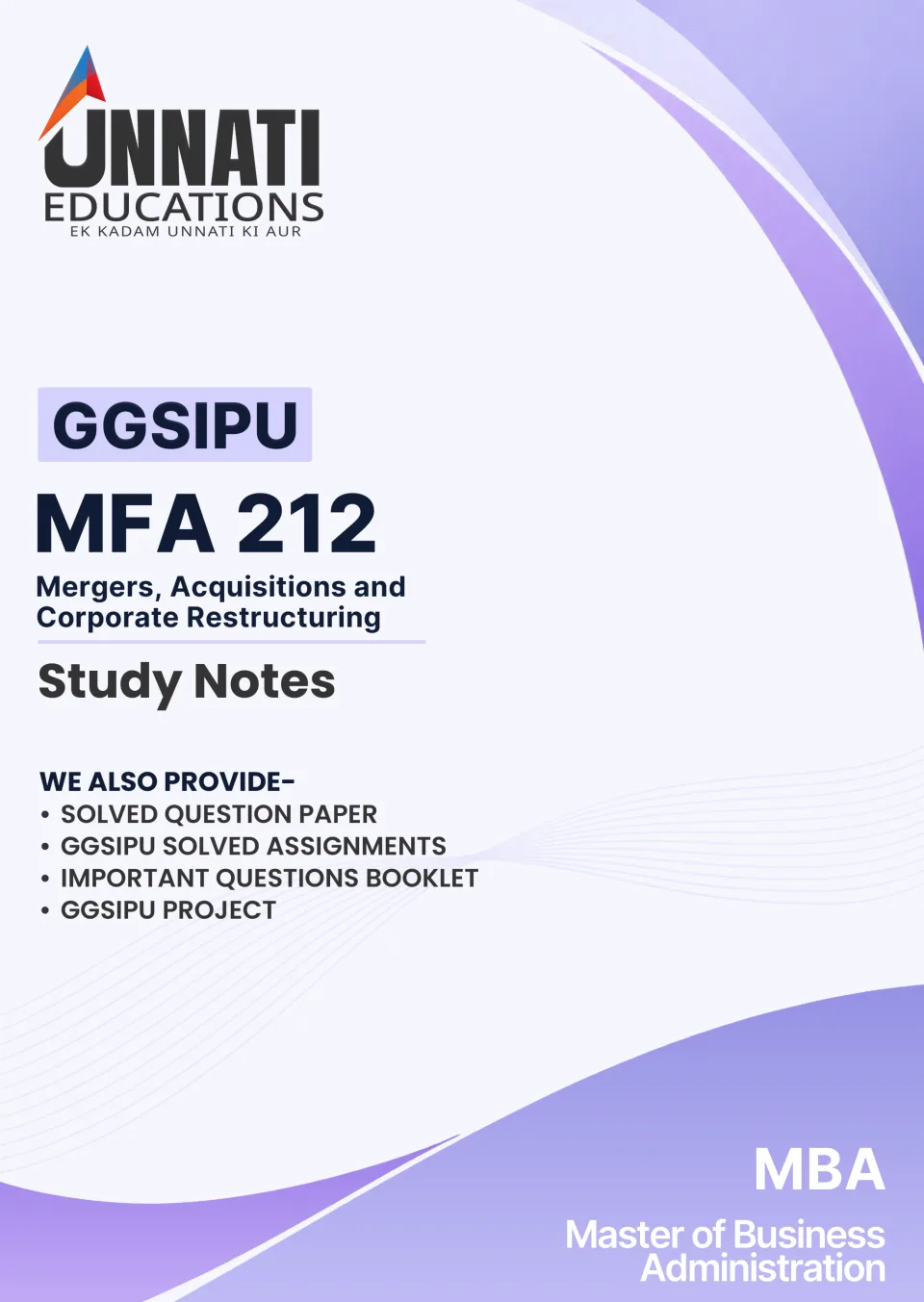
MFA-212 Mergers, Acquisitions and Corporate Restructuring Notes by Unnati Educations cover all 4 units of this GGSIPU MBA (Financial Analysis) Semester 4 elective in a 62-page printed book: 20 worked illustrations, 13 deal cases and 85 exam questions, mapped to the MBA (FA) scheme from the 2021-22 session.
Written by Prateek Talwar, Founder, Unnati Educations (ACS, ICSI) · Reviewed by Sheetal Kirola, M.Ed., Academic Head (academic review) · Checked against the MBA (FA) Scheme and Syllabus 2021-22 onwards (ipu.ac.in) · Updated 30 October 2026 · Editorial policy
Scheme: MBA (FA) Scheme and Syllabus 2021-22 onwards | Applies to: batches from the 2021-22 academic session | Verified against: official MBA (FA) syllabus PDF on ipu.ac.in, checked 30 October 2026
MFA-212 Mergers, Acquisitions and Corporate Restructuring at a glance: GGSIPU MBA (FA) Sem 4 credits, units and exam pattern
MFA-212 joins deal law, valuation and takeover tactics in one elective. It is one of 15 GGSIPU MBA (FA) Semester 4 papers.
| Code and title | MFA-212 Mergers, Acquisitions and Corporate Restructuring (also listed as "Merger, Acquisition & Corporate Restructuring") |
|---|---|
| Course and semester | MBA (Financial Analysis), Semester 4 |
| Category and credits | Discipline Specific Elective (Financial Analytics list) · L 3 · 3 credits · 42 hours (12, 10, 10, 10 by unit) |
| Marks | 100: 50 internal (two class tests of 15 + 20 for assignments and viva) + 50 end-term |
| End-term pattern | Written exam of 50 marks; paper-setter instructions not printed in the official PDF |
| Pass rules | Not printed in the MBA (FA) PDF; see GGSIPU Ordinance 11 |
| Applies to | From the 2021-22 session |
| Units | 4: Introduction to Mergers · Legal Aspects of Mergers/Amalgamation and Acquisition · Methods of Valuation · Defense against Hostile Takeover |
| Paired lab | None (MFA-206 Finance Lab II is a separate Semester 4 paper) |
MFA-212 Mergers, Acquisitions and Corporate Restructuring Notes unit-wise: 20 worked illustrations, 13 deal cases and 85 exam questions across 4 units
These MFA-212 Mergers, Acquisitions and Corporate Restructuring IPU notes follow the official unit order. Notes for the other papers sit on the GGSIPU MBA (FA) notes page.
MFA-212 Unit 1: Introduction to Mergers
Pages 4 to 19. It classifies deals (horizontal, vertical, conglomerate, reverse) and covers the motives: growth, operating and financial synergy, diversification, Tobin's q, Roll's hubris hypothesis (Tata Steel and Corus) and Section 72A loss set-off. It ends with the NPV test of a deal and with joint ventures. 10 sections, 4 illustrations, 7 figures, 22 exam questions.
| Basis | Merger / acquisition | Joint venture | Strategic alliance |
|---|---|---|---|
| Legal entity | Target loses its identity | New entity; parents remain | No new entity |
| Ownership | Full or controlling | Shared equity | None or small stake |
| Control | Complete | Joint | Limited, by contract |
Quick look: merger vs JV vs strategic alliance (from page 17)
- Basis
- Legal entity
- Merger / acquisition
- Target loses its identity
- Joint venture
- New entity; parents remain
- Strategic alliance
- No new entity
- Basis
- Ownership
- Merger / acquisition
- Full or controlling
- Joint venture
- Shared equity
- Strategic alliance
- None or small stake
- Basis
- Control
- Merger / acquisition
- Complete
- Joint venture
- Joint
- Strategic alliance
- Limited, by contract
MFA-212 Unit 2: Legal Aspects of Mergers/Amalgamation and Acquisition
Pages 20 to 34: Companies Act, 2013 Sections 232, 233 (fast-track) and 235-236 (minority squeeze-out), SEBI LODR Regulation 37, and the SAST Regulations, 2011 from triggers to exemptions. It closes with CCI combination rules and business valuation. 8 sections, 5 illustrations, 5 figures, 21 exam questions.
Quick look: open offer price after a 27% promoter deal (from page 28)
- Price parameters: negotiated Rs 300, 52-week VWAP paid Rs 285, 26-week high paid Rs 310, 60-day VWAP Rs 305; offer price is the highest, Rs 310.
- Offer size: 26% of 10 crore shares = 2.6 crore shares; maximum consideration Rs 806 crore.
- Escrow: 25% of the first Rs 500 crore + 10% of the rest = Rs 155.6 crore.
MFA-212 Unit 3: Methods of Valuation
Pages 35 to 48, the most numerical unit, values a target by FCFF and FCFE, earning potential, growth (Gordon and two-stage) and market price, tracks EPS and price effects, and sets exchange ratio limits (Larson and Gonedes). Then come MBO (Dell, 2013), LBO, bootstrapping, friendly takeover negotiation and merger financing. 13 sections, 9 illustrations, 6 figures, 22 exam questions.
Quick look: equity return in an LBO (from page 43)
- Entry: 8 × EBITDA of Rs 125 crore = Rs 1,000 crore (Rs 700 crore debt, Rs 300 crore equity).
- Cash flow repays debt to Rs 300 crore; exit at 8 × Rs 160 crore = Rs 1,280 crore leaves equity of Rs 980 crore.
- Equity multiple 3.27x, IRR about 26.7% a year (about 12.4% with no debt).
MFA-212 Unit 4: Defense against Hostile Takeover
Pages 49 to 61: hostile bid tactics, the five poison pill types, bear hug, greenmail, Pac-Man and their Indian legal position. It also covers post-merger HR and culture, cross-border deals and recent cases such as HDFC Ltd into HDFC Bank. 10 sections, 2 illustrations, 6 figures, 9 of the 13 cases, 20 exam questions.
| Basis | Bear hug | Hostile tender offer |
|---|---|---|
| Addressed to | Board of directors | Shareholders directly |
| Tone | Semi-friendly; pressure through a premium | Openly hostile |
| Aim | Get the board to recommend the deal | Bypass the board |
Quick look: bear hug vs hostile tender offer (from page 52)
- Basis
- Addressed to
- Bear hug
- Board of directors
- Hostile tender offer
- Shareholders directly
- Basis
- Tone
- Bear hug
- Semi-friendly; pressure through a premium
- Hostile tender offer
- Openly hostile
- Basis
- Aim
- Bear hug
- Get the board to recommend the deal
- Hostile tender offer
- Bypass the board
MFA-212 exam corner: 52 short-answer and 33 long-answer questions by unit
The notes label these "2.5 Marks" and "12.5 Marks"; the official PDF prints no question-wise pattern.
| Unit | Short (2.5 Marks) | Long (12.5 Marks) | Illustrations |
|---|---|---|---|
| 1 Introduction to Mergers | 13 | 9 | 4 |
| 2 Legal Aspects | 13 | 8 | 5 |
| 3 Methods of Valuation | 13 | 9 | 9 |
| 4 Defense against Hostile Takeover | 13 | 7 | 2 |
MFA-212 questions and illustrations by unit
- Unit
- 1 Introduction to Mergers
- Short (2.5 Marks)
- 13
- Long (12.5 Marks)
- 9
- Illustrations
- 4
- Unit
- 2 Legal Aspects
- Short (2.5 Marks)
- 13
- Long (12.5 Marks)
- 8
- Illustrations
- 5
- Unit
- 3 Methods of Valuation
- Short (2.5 Marks)
- 13
- Long (12.5 Marks)
- 9
- Illustrations
- 9
- Unit
- 4 Defense against Hostile Takeover
- Short (2.5 Marks)
- 13
- Long (12.5 Marks)
- 7
- Illustrations
- 2
- Unit 1: What is the hubris hypothesis? What is the winner's curse? Pointer: Roll (1986): over-confident bidders trust their own valuation over the market's, so the winner tends to overpay.
- Unit 2: What is creeping acquisition? Pointer: SAST Regulation 3(2): a holder of 25% to under 75% may add up to 5% a financial year without an open offer.
- Unit 3: What is an earn-out? Pointer: part of the price is paid later, linked to future performance, to bridge a valuation gap.
- Unit 4: Distinguish between a white knight and a white squire. Pointer: a knight buys control on friendlier terms; a squire buys only a blocking minority stake.
The MFA-212 notes list 52 short-answer and 33 long-answer questions plus 20 illustrations. More practice will sit in the MFA-212 important questions.
Scheme of amalgamation and the 8-step NCLT procedure in Indian company law: excerpt from page 23 of the MFA-212 notes
Excerpt from page 23
A scheme of amalgamation is the legal document that sets out every term of a merger. It is agreed by the boards, approved by shareholders and creditors, and finally sanctioned by the NCLT. Once sanctioned, it binds everyone: both companies, all shareholders and all creditors, including those who voted against it.
What a scheme contains
The scheme opens with definitions: the transferor and transferee companies, and the appointed, effective and record dates. It then gives the business rationale, the share capital of each company before and after, and the transfer of the whole undertaking, meaning every asset, liability, contract, licence and pending case. The consideration clause fixes the share exchange ratio, how fractions are handled and how cross-holdings are cancelled.
Employees move on terms no less favourable, with continuity of service, PF and gratuity. The scheme also states the accounting method (Ind AS 103 or AS 14), says the transferor runs its business "in trust" for the transferee until the effective date, and dissolves the transferor without winding up. The last clauses list the approvals needed and who bears the costs.
Procedure under Sections 230 to 232
- Board approval of the draft scheme, valuation report and exchange ratio.
- For a listed company, filing with the stock exchange under LODR Regulation 37 and getting the observation letter.
- First motion application to the NCLT for directions on calling, or dispensing with, meetings.
- Notices to regulators (Regional Director, ROC, income-tax, RBI, SEBI, CCI, exchanges, Official Liquidator), who get 30 days to respond.
- Meetings, where approval needs a majority in number holding three-fourths in value of those present and voting.
- Second motion petition to the NCLT, where objections are heard.
- NCLT sanction order, after which the scheme is binding on all.
- Certified copy filed with the ROC within 30 days in Form INC-28; the scheme takes effect and the transferor is dissolved.
Do the MFA-212 notes cover the full GGSIPU syllabus?
Yes. Every topic printed for MFA-212 in the official syllabus has its own section, plus extras such as Competition Act approvals.
| Official unit | Official topics | In the notes | Status |
|---|---|---|---|
| I Introduction to Mergers | Types, Growth Strategy, Synergy, Diversification, Economic Motives, Hubris Hypothesis, Tax Motives, Financial Evaluation, JV and Strategic Alliances | Sections 2-10, pp 5-17 | Covered |
| II Legal Aspects | Companies Act, SEBI, Takeover Code, Scheme of Amalgamation, Court Approval, Valuation of a Business | Sections 2-6 and 8, pp 20-32 | Covered |
| III Methods of Valuation | Cashflow, Earning Potential, Growth Rate, Market Price, EPS Impact, Exchange Ratio, Growth Variation, MBO, LBO, Boot Strapping, Friendly Takeover, Financing | Sections 2-13, pp 35-46 | Covered |
| IV Defense against Hostile Takeover | Poison Pill, Bear Hug, Greenmail, Pacman, Post Merger HR and Culture, Cross Border M&A, Recent Cases | Sections 3-10, pp 50-59 | Covered |
MFA-212 official units mapped to the notes
- Official unit
- I Introduction to Mergers
- Official topics
- Types, Growth Strategy, Synergy, Diversification, Economic Motives, Hubris Hypothesis, Tax Motives, Financial Evaluation, JV and Strategic Alliances
- In the notes
- Sections 2-10, pp 5-17
- Status
- Covered
- Official unit
- II Legal Aspects
- Official topics
- Companies Act, SEBI, Takeover Code, Scheme of Amalgamation, Court Approval, Valuation of a Business
- In the notes
- Sections 2-6 and 8, pp 20-32
- Status
- Covered
- Official unit
- III Methods of Valuation
- Official topics
- Cashflow, Earning Potential, Growth Rate, Market Price, EPS Impact, Exchange Ratio, Growth Variation, MBO, LBO, Boot Strapping, Friendly Takeover, Financing
- In the notes
- Sections 2-13, pp 35-46
- Status
- Covered
- Official unit
- IV Defense against Hostile Takeover
- Official topics
- Poison Pill, Bear Hug, Greenmail, Pacman, Post Merger HR and Culture, Cross Border M&A, Recent Cases
- In the notes
- Sections 3-10, pp 50-59
- Status
- Covered
Verify it yourself: MBA (Financial Analysis) Scheme and Syllabus, 2021-22 onwards. MFA-212 is on page 70; marks rules on page 4.
The official PDF prints "Poisson Pill"; the notes use the standard term. Every course in GGSIPU notes is checked against its official PDF this way.
Who writes and checks the MFA-212 M&A notes?
- Prateek Talwar, author · Founder, Unnati Educations · Associate Company Secretary (ACS), ICSI, membership no. 58704, since 15 May 2019 · B.Com, University of Delhi (SOL), 2012 · company-law background behind Unit 2 · author profile
- Sheetal Kirola, academic reviewer · Academic Head · M.Ed. · 7 years of experience · checks structure, clarity and syllabus order, not the valuation working or the legal provisions · reviewer profile
Mapped to the 2021-22 MBA (FA) scheme; the 2026-27 edition includes deals up to Air India and Vistara (2024). Last updated 30 October 2026 under our editorial policy.
The same check covers the GGSIPU important questions.
MFA-212 and the GGSIPU MBA (FA) Sem 4 papers it connects to
No lab; see its place in the GGSIPU MBA (FA) syllabus.
These GGSIPU MBA (FA) Sem 4 mergers and acquisitions notes connect to:
- MFA-210 Equity Valuation: Unit 3's DCF and Gordon growth.
- MFA-228 Investment Banking: open offers and deal financing.
- MFA-224 International Accounting & Reporting: Ind AS 103.
- Also in Semester 4: MFA-202 Project Dissertation, MFA-204 Corporate Social Responsibility Human Values & Ethics, MFA-206 Finance Lab II, and electives MFA-208 Technical Analysis, MFA-214 Risk Management, MFA-216 Financial Modelling, MFA-222 Strategic Financial Management, MFA-218 FinTech, MFA-220 Financial Derivatives, MFA-226 Sustainable Finance, MFA-230 Forensic Finance.
Looking back, Unit 1's NPV test of a merger builds on MFA-102 Financial Management (Semester 2).
How to write MFA-212 answers: section-cited legal answers, swap-ratio numericals and case-backed defences
The MFA-212 exam tips set a pattern per answer type:
- Law (Unit 2): steps in order with the numbers (three-fourths in value, 30-day ROC filing); for the Takeover Code, the threshold diagram (5%, 25%, 5% creeping, 75%).
- Valuation theory (Unit 3): formula, merits and limits per method, ending with the weighted average Indian valuers use.
- Defences (Unit 4): preventive vs reactive, one example each, then the Indian legal position.
- Deal numericals: gain, cost and NPV on separate lines; in a share deal, cost uses the post-merger price.
Worked example (page 39): A Ltd (earnings Rs 50 crore, 10 crore shares, price Rs 50) acquires B Ltd (Rs 12 crore, 4 crore shares, price Rs 24), no synergy. Market-price ratio = 24 ÷ 50 = 0.48, so A issues 1.92 crore shares (11.92 crore in all). Post-merger EPS = 62 ÷ 11.92 = Rs 5.20, up from Rs 5; B's holders get 5.20 × 0.48 = Rs 2.50, down from Rs 3.
A's higher P/E (10 vs 8) explains the gain; no value is created. Practise this format on GGSIPU MBA (FA) important questions.
MFA-212 M&A notes FAQs
How do I get the full MFA-212 notes?
Tap "Get Full Notes" at the top or the WhatsApp button at the end and send the pre-filled message. The full MFA-212 notes come as a 62-page printed book covering all 4 units; our team shares order details on WhatsApp. Delivery takes a maximum of 5 to 7 days, depending on your location. Check the sample PDF first to see the layout.
Are the MFA-212 notes available as a PDF?
No. The full MFA-212 notes are sold only as a printed book. The only PDF here is the watermarked sample with the cover, index and one page from each unit, so you can see the flowcharts, comparison tables and worked illustrations before ordering. Orders are taken on WhatsApp and delivered within 5 to 7 days, depending on location.
How is MFA-212 marked, and what is the passing mark?
MFA-212 is marked out of 100: 50 internal and 50 end-term. The internal part comes from two 15-mark class tests plus 20 marks for assignments, viva and participation. The MBA (FA) scheme PDF states no pass percentage, so we do not quote one. For end-term minimums and re-appear rules, check GGSIPU Ordinance 11 on ipu.ac.in.
Is MFA-212 compulsory in MBA (FA) Semester 4?
No. MFA-212 is one of 12 discipline-specific electives in the Financial Analytics list of the MBA (FA) scheme, each worth 3 credits. In Semester 4 you take four electives alongside MFA-202 Project Dissertation, MFA-204 and MFA-206 Finance Lab II. Pick MFA-212 if you aim for deal, valuation or corporate law work. Check which electives your institute offers, because not every college runs all twelve.
Which MFA-212 unit has the most numericals?
Unit 3 has 9 of the book's 20 worked illustrations: FCFF and FCFE, earning potential, the Gordon and two-stage growth models, EPS impact of exchange ratios, the negotiation range of the ratio, dilution now against growth later, LBO returns and the bootstrap effect. Unit 2 adds 5, on open offer price, NAV, DCF and the exchange ratio.
Are the 85 MFA-212 exam questions solved one by one?
No. The 52 short-answer and 33 long-answer questions at the end of each unit are a practice list for self-testing; the material to answer them sits in that unit's sections, tables, cases and Quick Revision table. The 20 illustrations are fully worked, and the exam corner above gives answer pointers for four of the questions.
Get the full MFA-212 Mergers, Acquisitions and Corporate Restructuring Notes on WhatsApp
The full Mergers, Acquisitions and Corporate Restructuring notes in English come as a 62-page printed book (not a PDF) with 20 worked illustrations, 24 figures, 13 deal cases and 85 exam questions.
| Unit | Pages | Exam questions |
|---|---|---|
| 1 Introduction to Mergers | 4-19 (16) | 22 |
| 2 Legal Aspects | 20-34 (15) | 21 |
| 3 Methods of Valuation | 35-48 (14) | 22 |
| 4 Defense against Hostile Takeover | 49-61 (13) | 20 |
MFA-212 printed book pages by unit
- Unit
- 1 Introduction to Mergers
- Pages
- 4-19 (16)
- Exam questions
- 22
- Unit
- 2 Legal Aspects
- Pages
- 20-34 (15)
- Exam questions
- 21
- Unit
- 3 Methods of Valuation
- Pages
- 35-48 (14)
- Exam questions
- 22
- Unit
- 4 Defense against Hostile Takeover
- Pages
- 49-61 (13)
- Exam questions
- 20
Delivery: maximum 5 to 7 days after your order is confirmed; the rest depends on your location.
Order the full MFA-212 notes book on WhatsApp (4 units, 62 pages)
Unnati Educations is an independent education provider based in Vikaspuri, Delhi. We are not affiliated with, authorised by, or endorsed by Guru Gobind Singh Indraprastha University (GGSIPU). 'GGSIPU' and 'IPU' are used only to describe the syllabus our notes follow. For official information, visit ipu.ac.in.
Ready for the full notes?
Discuss coverage and delivery with our team.