
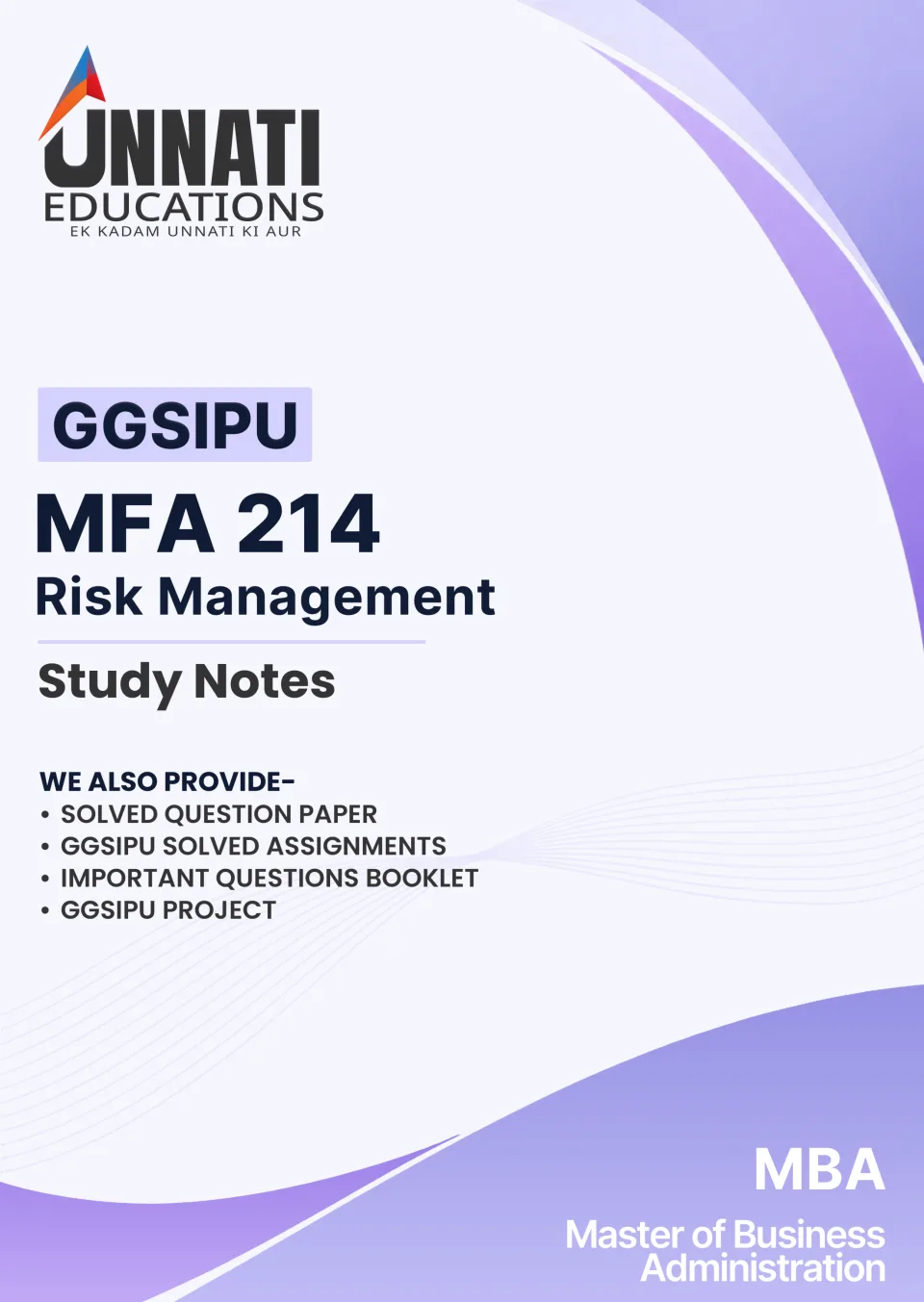
MFA-214 Risk Management Notes for GGSIPU MBA (Financial Analysis) Semester 4 run to 63 pages across 4 units, with 15 worked numericals, 6 case studies, 34 figures and 87 exam questions (55 short, 32 long). They follow the MBA (FA) scheme that applies from the 2021-22 session onwards and are sold as a printed book.
Written by Prateek Talwar, Founder, Unnati Educations (ACS, ICSI) · Academic review by Sheetal Kirola, Academic Head, M.Ed. · Checked against MBA (Financial Analysis) Scheme and Syllabus 2021-22 onwards (ipu.ac.in) · Updated 14 October 2026 · Editorial policy
Scheme: MBA (FA) Scheme and Syllabus, 2021-22 onwards | Applies to: students admitted from the 2021-22 session onwards | Verified against: nt0722536 (9).pdf on ipu.ac.in
MFA-214 Risk Management at a glance: GGSIPU MBA (FA) Sem 4 credits, units and exam pattern
MFA-214 is one of twelve Sem 4 electives (MFA-208 to MFA-230), and each student picks four. It sits with the other GGSIPU MBA (FA) Semester 4 papers.
| Code and title | MFA-214 Risk Management |
|---|---|
| Course and semester | MBA (Financial Analysis), Semester 4 |
| Category and credits | Discipline Specific Elective · L-3 (3 lecture hours a week) · 3 credits |
| Marks | 100: 50 internal + 50 end-term |
| Internal 50 | Two class tests (15 each) + assignments, viva, participation (20) |
| Applies to | Scheme and Syllabus 2021-22 onwards |
| End-term pattern | 50-mark written exam by the University; paper-setter instructions are not printed in the official PDF |
| Units | 4 (teaching hours 10 + 10 + 10 + 12 = 42) |
| Paired lab | None (Finance Lab II, MFA-206, is a separate 2-credit Sem 4 paper) |
No pass percentage is printed; end-term minimums and re-appear rules sit in Ordinance 11 (examinations and results).
MFA-214 Risk Management Notes unit-wise: 15 worked numericals, 6 case studies and 87 exam questions across 4 units
These MFA-214 Risk Management IPU notes follow the official unit order; see four inside pages via "View Sample PDF" above. Other papers: GGSIPU MBA (FA) notes.
MFA-214 Unit 1: Financial Risk
Pages 4 to 16. Knight's risk vs uncertainty, then market, credit, liquidity and operational risk with the seven Basel event types. Currency, interest rate, equity and commodity risk each get an Indian example and a hedge. Fraud closes it: the ACFE fraud tree, Cressey's triangle, forensic vs statutory audit.
9 sections · 10 figures · 1 numerical · 1 case study (Satyam) · 14 short + 8 long questions.
| Input | Value |
|---|---|
| Probability of Default (PD) | 4% |
| Loss Given Default (LGD) | 45% |
| Exposure at Default (EAD) | ₹50 lakh |
| Expected Loss = PD × LGD × EAD | ₹90,000 |
Quick look: Basel expected loss on a ₹50 lakh loan (from page 6)
- Input
- Probability of Default (PD)
- Value
- 4%
- Input
- Loss Given Default (LGD)
- Value
- 45%
- Input
- Exposure at Default (EAD)
- Value
- ₹50 lakh
- Input
- Expected Loss = PD × LGD × EAD
- Value
- ₹90,000
MFA-214 Unit 2: Insurance as a Risk Management Tool
Pages 17 to 31. India's insurance market map, then Expected Utility with U(W) = √W to show why a risk-averse buyer pays above expected loss, and Mayers and Smith on corporate demand. Then insurability, moral hazard, risk pooling (σ ÷ √n), underwriting, rate-making and the appointed actuary.
11 sections · 6 figures · 5 numericals · 1 business example · 14 short + 8 long questions.
Quick look: motor insurance premium from claims data (from page 28)
- Frequency = 800 claims ÷ 10,000 cars = 0.08
- Severity = ₹2.4 crore ÷ 800 = ₹30,000
- Pure premium = 0.08 × ₹30,000 = ₹2,400
- Gross premium = 2,400 ÷ (1 − 0.25 − 0.05) = ₹3,429 per car
MFA-214 Unit 3: Probability Distributions and Value at Risk
Pages 32 to 45, the most numerical unit. Lognormal prices and fat tails set up EWMA, GARCH, implied volatility and India VIX. Extreme Value Theory compares block maxima with peaks over threshold. VaR is computed three ways, then checked with Expected Shortfall and Basel backtesting zones.
7 sections · 9 figures · 6 numericals · 1 case study (2008 crisis) · 13 short + 7 long questions.
| Item | Result |
|---|---|
| Five worst daily returns in 100 days | −4.2%, −3.8%, −3.1%, −2.9%, −2.6% |
| 95% 1-day VaR (5th worst) | ₹2.6 lakh |
| Expected Shortfall (average of worst 5) | ₹3.32 lakh |
Quick look: historical VaR and Expected Shortfall on a ₹1 crore portfolio (from page 41)
- Item
- Five worst daily returns in 100 days
- Result
- −4.2%, −3.8%, −3.1%, −2.9%, −2.6%
- Item
- 95% 1-day VaR (5th worst)
- Result
- ₹2.6 lakh
- Item
- Expected Shortfall (average of worst 5)
- Result
- ₹3.32 lakh
MFA-214 Unit 4: Risk Forecasting
Pages 46 to 62, the longest unit. Eight forecasting methods, twelve forecasting issues and yield-curve PCA. Then parity conditions, currency hedges, bond risk, insurance and SEBI law, COSO ERM, risk budgeting and risk limits. Four cases close it: LTCM, IL&FS, the 2013 taper tantrum and SVB.
12 sections · 9 figures · 3 numericals · 4 case studies · 14 short + 9 long questions.
| Measure | Value |
|---|---|
| Macaulay / modified duration | 4.31 years / 3.99 |
| Yield +1%, duration only | −3.99% |
| Yield +1%, with convexity 21.05 | −3.89% (actual ₹96.11) |
Quick look: 5-year 8% bond priced at ₹100 (from page 53)
- Measure
- Macaulay / modified duration
- Value
- 4.31 years / 3.99
- Measure
- Yield +1%, duration only
- Value
- −3.99%
- Measure
- Yield +1%, with convexity 21.05
- Value
- −3.89% (actual ₹96.11)
MFA-214 exam corner: 55 two-and-a-half-mark and 32 twelve-and-a-half-mark questions by unit
Each unit ends with a question list labelled "2.5 Marks" and "12.5 Marks"; answers come from that unit's sections.
| Unit | 2.5 Marks | 12.5 Marks | Numericals / cases |
|---|---|---|---|
| 1. Financial Risk | 14 | 8 | 1 / 1 |
| 2. Insurance | 14 | 8 | 5 / 1 business example |
| 3. Probability and VaR | 13 | 7 | 6 / 1 |
| 4. Risk Forecasting | 14 | 9 | 3 / 4 |
MFA-214 exam questions and worked material per unit
- Unit
- 1. Financial Risk
- 2.5 Marks
- 14
- 12.5 Marks
- 8
- Numericals / cases
- 1 / 1
- Unit
- 2. Insurance
- 2.5 Marks
- 14
- 12.5 Marks
- 8
- Numericals / cases
- 5 / 1 business example
- Unit
- 3. Probability and VaR
- 2.5 Marks
- 13
- 12.5 Marks
- 7
- Numericals / cases
- 6 / 1
- Unit
- 4. Risk Forecasting
- 2.5 Marks
- 14
- 12.5 Marks
- 9
- Numericals / cases
- 3 / 4
The MFA-214 notes list 55 two-and-a-half-mark and 32 twelve-and-a-half-mark exam questions across 4 units, plus 15 worked numericals and 6 case studies.
- Unit 1 (2.5 Marks): What is the fraud triangle? Cressey (1953): pressure, opportunity, rationalisation; firms control opportunity through internal controls.
- Unit 2 (12.5 Marks): What is risk pooling? How does the law of large numbers make insurance possible? Average-loss deviation falls to σ ÷ √n, only for independent risks.
- Unit 3 (2.5 Marks): 1-day 99% VaR of a ₹20 crore portfolio with 1% daily volatility? 2.326 × 0.01 × ₹20 crore = ₹46.52 lakh.
- Unit 4 (2.5 Marks): What is Herstatt (settlement) risk? One leg of a forex deal is paid, the other is not; CLS and CCIL reduce it.
The other 83 stay in the book. More practice sits in the MFA-214 important questions.
Who writes and checks the MFA-214 Risk Management notes?
- Prateek Talwar, author. Founder, Unnati Educations. Associate Company Secretary (ACS), ICSI, membership no. 58704, since 15 May 2019. B.Com, University of Delhi (SOL), 2012. Author profile.
- Sheetal Kirola, academic review (language, structure, exam fit). Academic Head, Unnati Educations. M.Ed., 7 years of experience. Reviewer profile.
These GGSIPU MBA (FA) Sem 4 Risk Management notes are mapped topic by topic to the official MFA-214 sheet. The 2026-27 edition includes the Budget 2025-26 insurance FDI proposal and the 2023 SVB failure. Last updated 14 October 2026; see our editorial policy.
The same team prepares GGSIPU important questions for each course.
How to write MFA-214 answers: VaR numericals, comparison tables and twelve-and-a-half-mark case answers
Risk Management answers score on three things: a clean definition, a comparison table and one number. The notes' exam tips push this pattern in every unit.
Risk-type answers. For "explain the types of financial risk", use one frame for each of the four risks: definition, two or three sub-types, how it is measured, and an Indian example (for credit risk, NPAs after 90 days overdue). Open with the four-box figure.
Diagrams that save words. Draw the frequency-severity matrix when asked to choose between risk control and risk financing: retain low-frequency, low-severity losses, insure low-frequency, high-severity ones, reduce frequent small ones and avoid frequent severe ones. For risk budgeting, draw the chain: risk appetite, risk budget, risk limits, monitoring, reporting.
Points examiners look for. Fraud triangle: opportunity is the side a firm controls. Corporate insurance: shareholders can diversify, so firms insure to cut bankruptcy costs, taxes and agency problems. Insurance vs hedging: "pooling of pure risks vs offsetting of price risks", backed by the comparison table.
Worked example: forward rate by Interest Rate Parity (page 51). Spot USD/INR ₹83.00, Indian rate 7%, US rate 5%. F = S × (1 + rhome) ÷ (1 + rforeign) = 83 × 1.07 ÷ 1.05 = ₹84.58, a forward premium of about 1.9%. In forex answers, first separate transaction, translation and economic exposure, then show this formula.
Common slips in Unit 3. Using 1.645 for 99% VaR (that is the 95% value; 99% is 2.326). Scaling 1-day VaR to 10 days without √10. Calling VaR the worst possible loss, when Expected Shortfall measures the average loss beyond it. In twelve-and-a-half-mark case answers, end with two or three lessons, as the Unit 4 case table does.
Practise this format on GGSIPU MBA (FA) important questions.
MFA-214 and the GGSIPU MBA (FA) Sem 4 papers it connects to
MFA-214 has no paired lab. Every MBA (FA) paper, all four semesters, is on the GGSIPU MBA (FA) syllabus page.
Fixed Sem 4 papers: MFA-202 Project Dissertation, MFA-204 Corporate Social Responsibility Human Values & Ethics, MFA-206 Finance Lab II. Electives: MFA-208 Technical Analysis, MFA-210 Equity Valuation, MFA-212 Merger, Acquisition & Corporate Restructuring, MFA-216 Financial Modelling, MFA-218 FinTech, MFA-220 Financial Derivatives, MFA-222 Strategic Financial Management.
Also MFA-224 International Accounting & Reporting, MFA-226 Sustainable Finance, MFA-228 Investment Banking, MFA-230 Forensic Finance. Overlaps:
- Unit 1 fraud triangle and forensic audit → MFA-230 Forensic Finance.
- Unit 3 implied volatility and Unit 4 currency hedges → MFA-220 Financial Derivatives.
- Unit 3 VaR computation and Unit 4 component VaR budgets → MFA-216 Financial Modelling.
- Unit 4 duration and immunisation → MFA-211 Fixed Income Securities (Sem 3 elective).
Risk control and risk financing techniques in risk management: excerpt from page 11 of the MFA-214 notes
Excerpt from page 11
Once a risk has been identified and measured, the firm has to decide how to treat it. Every treatment method falls into one of two groups. Risk control cuts how often losses happen or how big they are. Risk financing arranges the money to pay for the losses that still happen.
Risk control techniques
Risk avoidance means not taking up the risky activity at all, such as a bank refusing to lend to a very risky sector, or an investor staying away from crypto. Loss prevention reduces the chance of a loss: fire alarms, KYC checks, password policies and proper credit appraisal. Loss reduction limits the size of a loss after it happens, through sprinklers, collateral, data backup or a disaster recovery site.
Separation spreads assets across places so one event cannot destroy everything, for example two warehouses in different cities. Duplication keeps spare units used only when the main one fails, like a spare server or a backup generator. Diversification spreads exposure across many uncorrelated items, such as a loan book across sectors or investments across asset classes.
Risk financing techniques
Risk retention, or self-financing, means the firm bears the loss itself from current income, reserves or a fund. It suits small, predictable losses and shows up as deductibles, self-insurance funds and loan-loss provisions. Active retention is a conscious choice, such as a large firm keeping a ₹50,000 deductible on vehicle cover.
Passive retention is a risk nobody identified, which is the dangerous kind. A captive insurer is an insurance company owned by the parent group to cover its own risks, often set up by large groups in Bermuda or Singapore.
Risk transfer moves the financial effect elsewhere. Insurance does this for a premium (fire, marine, credit, D&O and cyber cover). Hedging uses derivatives to offset price risk, as when an exporter sells dollars forward or an airline buys crude futures. Contracts shift risk through indemnity or hold-harmless clauses, penalty clauses or fixed-price deals. Alternative risk transfer uses capital markets: catastrophe bonds, securitisation and finite risk insurance.
Do the MFA-214 notes cover the full GGSIPU syllabus?
Yes. Every official MFA-214 topic has its own section in the notes; nothing is missing. Unit 3 also adds Expected Shortfall and VaR backtesting.
| Official unit | Official topics | Where in the notes | Status |
|---|---|---|---|
| I. Financial Risk | Types and forms of risk; significance; tools; control and financing; frauds, fraud triangle, detection vs audit | Pages 4 to 15 | Covered |
| II. Insurance as a Risk Management Tool | Market structure; risk aversion and demand; insurability; retention; types; costs; pooling; hedging; underwriting; pricing; actuarial services | Pages 17 to 29 | Covered |
| III. Probability Distributions and Value at Risk | Distribution of asset prices; implied volatility; Extreme Value Theory; VaR concept, computations, applications | Pages 32 to 44 | Covered |
| IV. Risk Forecasting | Forecasting; risk factors; currency and forex risk; fixed income; legal aspects; integrated framework; reporting; budgeting; limits; cases | Pages 46 to 61 | Covered |
MFA-214 official syllabus topics mapped to the notes
- Official unit
- I. Financial Risk
- Official topics
- Types and forms of risk; significance; tools; control and financing; frauds, fraud triangle, detection vs audit
- Where in the notes
- Pages 4 to 15
- Status
- Covered
- Official unit
- II. Insurance as a Risk Management Tool
- Official topics
- Market structure; risk aversion and demand; insurability; retention; types; costs; pooling; hedging; underwriting; pricing; actuarial services
- Where in the notes
- Pages 17 to 29
- Status
- Covered
- Official unit
- III. Probability Distributions and Value at Risk
- Official topics
- Distribution of asset prices; implied volatility; Extreme Value Theory; VaR concept, computations, applications
- Where in the notes
- Pages 32 to 44
- Status
- Covered
- Official unit
- IV. Risk Forecasting
- Official topics
- Forecasting; risk factors; currency and forex risk; fixed income; legal aspects; integrated framework; reporting; budgeting; limits; cases
- Where in the notes
- Pages 46 to 61
- Status
- Covered
Official source: MBA (Financial Analysis) Scheme and Syllabus, 2021-22 onwards (MFA-214 on page 72).
Every course in GGSIPU notes is mapped to its official PDF the same way.
MFA-214 Risk Management notes FAQs
How do I get the full MFA-214 notes?
Message 9899436384 on WhatsApp using the "Get Full Notes" button. The full MFA-214 notes are sold only as a printed book, not as a PDF. Delivery takes at most 5 to 7 days, and the exact time depends on your location. Before ordering, check the cover, index and four inside pages in the sample PDF above.
What is the passing mark for MFA-214 Risk Management?
MFA-214 is marked out of 100: 50 internal and 50 end-term. Internal marks come from two 15-mark class tests plus 20 marks for assignments, presentation, viva and participation. The MBA (FA) scheme PDF does not print a pass percentage, so we do not state one here. End-term minimums and re-appear rules are in Ordinance 11.
Is MFA-214 compulsory in MBA (FA) Semester 4?
No. MFA-214 is a Discipline Specific Elective. The Sem 4 scheme lists twelve electives, from MFA-208 Technical Analysis to MFA-230 Forensic Finance, and each student selects four. Each carries 3 credits and 3 lecture hours a week. The fixed Sem 4 papers are the Project Dissertation, the CSR, Human Values and Ethics paper, and Finance Lab II.
Which MFA-214 unit has the most numericals?
Unit 3, with 6 worked illustrations: expected return and standard deviation, annualising volatility with √252, single-asset parametric VaR, two-asset portfolio VaR with the diversification benefit, bond VaR through duration, and historical VaR with Expected Shortfall. Unit 2 has 5 worked numericals, Unit 4 has 3 (including duration and Interest Rate Parity) and Unit 1 has 1.
Do the MFA-214 notes explain all three VaR methods?
Yes. Unit 3 covers the parametric (variance-covariance) method, historical simulation and Monte Carlo simulation, each with steps and a merits and limitations table. A side-by-side comparison then covers assumptions, fat tails, options, speed and data needs. It adds Expected Shortfall, the Basel FRTB switch to 97.5% ES, and backtesting with green, yellow and red zones.
Which case studies are in the MFA-214 notes?
Six: Satyam Computer Services (2009) in Unit 1, VaR and the 2008 global financial crisis in Unit 3, and four Unit 4 case discussions: LTCM (1998), the IL&FS default (2018), the rupee in the 2013 taper tantrum, and Silicon Valley Bank (2023). Unit 4 ends with a table linking each failure to the right risk practice.
Get the full MFA-214 Risk Management Notes on WhatsApp
A 63-page printed book of Risk Management notes in English.
| Unit | Pages | Numericals | Questions (2.5 + 12.5 Marks) |
|---|---|---|---|
| 1. Financial Risk | 4 to 16 (13) | 1 | 14 + 8 |
| 2. Insurance as a Risk Management Tool | 17 to 31 (15) | 5 | 14 + 8 |
| 3. Probability Distributions and VaR | 32 to 45 (14) | 6 | 13 + 7 |
| 4. Risk Forecasting | 46 to 62 (17) | 3 | 14 + 9 |
What is inside the MFA-214 printed notes book
- Unit
- 1. Financial Risk
- Pages
- 4 to 16 (13)
- Numericals
- 1
- Questions (2.5 + 12.5 Marks)
- 14 + 8
- Unit
- 2. Insurance as a Risk Management Tool
- Pages
- 17 to 31 (15)
- Numericals
- 5
- Questions (2.5 + 12.5 Marks)
- 14 + 8
- Unit
- 3. Probability Distributions and VaR
- Pages
- 32 to 45 (14)
- Numericals
- 6
- Questions (2.5 + 12.5 Marks)
- 13 + 7
- Unit
- 4. Risk Forecasting
- Pages
- 46 to 62 (17)
- Numericals
- 3
- Questions (2.5 + 12.5 Marks)
- 14 + 9
Plus 34 figures and 6 case studies. Printed book only, not a PDF. Delivery: maximum 5 to 7 days, depending on your location.
Order the full MFA-214 Risk Management Notes book on WhatsApp (4 units, 63 pages)
Unnati Educations is an independent education provider based in Vikaspuri, Delhi. We are not affiliated with, authorised by, or endorsed by Guru Gobind Singh Indraprastha University (GGSIPU). 'GGSIPU' and 'IPU' are used only to describe the syllabus our notes follow. For official information, visit ipu.ac.in.
Ready for the full notes?
Discuss coverage and delivery with our team.