
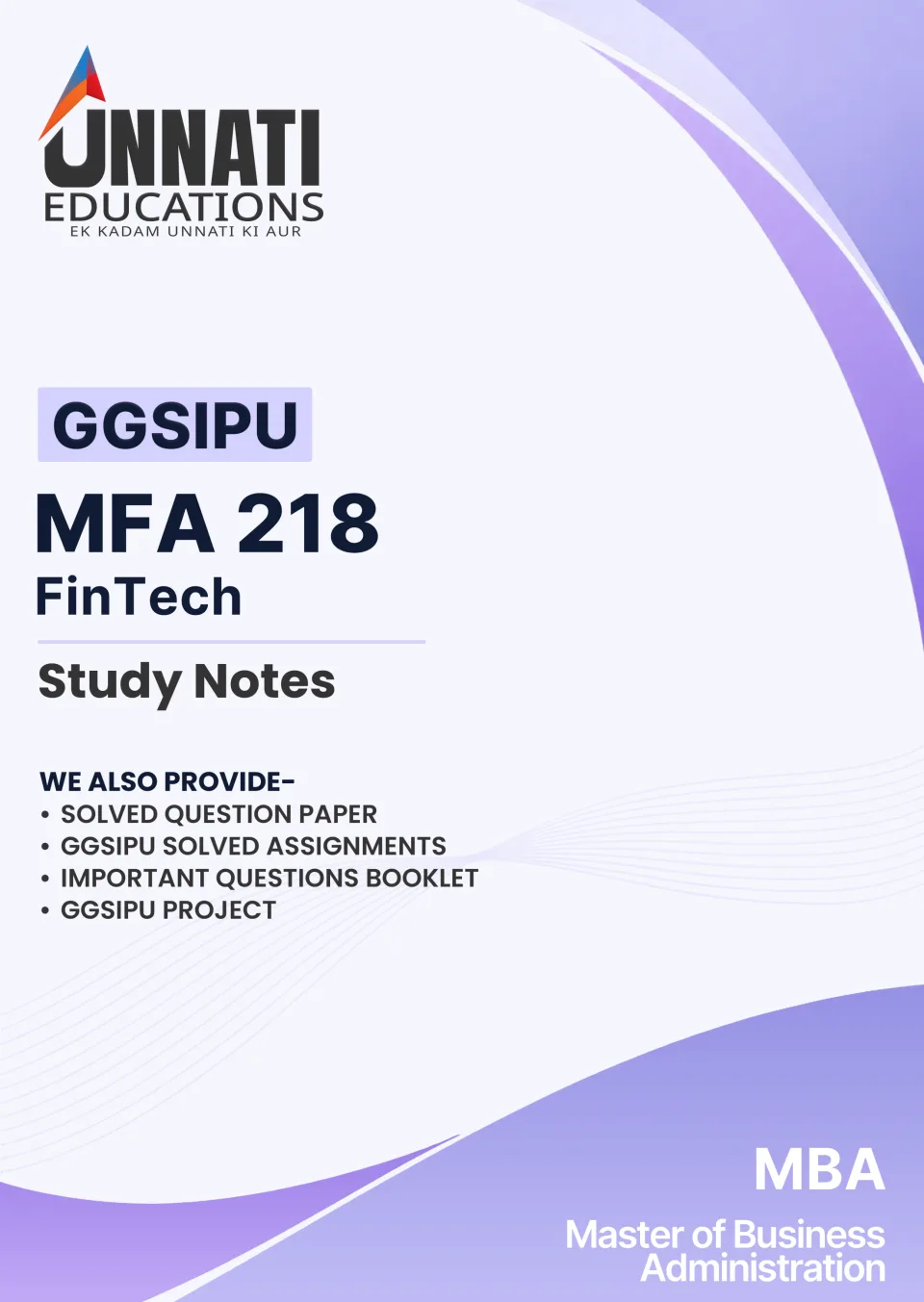
MFA-218 FinTech Notes from Unnati Educations cover all 4 units of the IPU MBA (Financial Analysis) Semester 4 elective in a 72-page printed book: 41 figures, 8 case studies, 3 worked illustrations, 102 exam-style questions and a revision table per unit, mapped to the MBA (FA) scheme that applies from the 2021-22 session onwards.
Written by Prateek Talwar, Founder, Unnati Educations (ACS, ICSI) · Reviewed by Sheetal Kirola, Academic Head, M.Ed. (academic review) · Checked against the MBA (FA) Scheme and Syllabus 2021-22 onwards · Updated 30 October 2026 · Editorial policy
Scheme: MBA (FA) 2021-22 | Applies to: batches admitted 2021-22 onwards | Verified against: MBA (Financial Analysis) Scheme and Syllabus, ipu.ac.in, 30 October 2026
MFA-218 FinTech at a glance: GGSIPU MBA (FA) Sem 4 credits, units and exam pattern
MFA-218 is one of twelve electives among the GGSIPU MBA (FA) Semester 4 papers, and the only one built around payments, crypto, RegTech and start-ups.
| Course and semester | MBA (Financial Analysis), Semester 4 |
|---|---|
| Category and credits | Discipline Specific Elective · L 3, no T/P · 3 credits |
| Marks | 100: 50 internal + 50 end-term |
| Internal split | Class Test I 15 · Class Test II 15 · assignments, presentation, viva, GD and participation 20 |
| End-term pattern | 50-mark written exam; paper-setter instructions not printed in the official PDF |
| Pass rules | Not printed in the MBA (FA) PDF; see Ordinance 11 on ipu.ac.in |
| Applies to | Scheme w.e.f. the 2021-22 session |
| Paired lab | None |
MFA-218 FinTech Notes unit-wise: 41 figures, 8 case studies and 102 exam questions across 4 units
These MFA-218 FinTech IPU notes follow the official unit order. Notes for the other papers are on the GGSIPU MBA (FA) notes page; the sample PDF button above shows the layout.
MFA-218 Unit 1: Background
Pages 5 to 22 (18 pages, 13 sections; also covered as "Background of FinTech"). It runs from money supply and financial innovation to FinTech 1.0 to 4.0, players, funding, India Stack and the global scenario. It has 11 figures, a Paytm Payments Bank case and 26 exam questions.
| Basis | Banks | FinTechs |
|---|---|---|
| Strengths | Licence, trust, cheap deposits | Technology, speed, user experience |
| Weaknesses | Legacy IT, high branch cost | No licence, high acquisition cost |
| Regulation | Heavily regulated | Lightly regulated, now tightening |
Quick look: traditional banks vs FinTech firms (from page 16)
- Basis
- Strengths
- Banks
- Licence, trust, cheap deposits
- FinTechs
- Technology, speed, user experience
- Basis
- Weaknesses
- Banks
- Legacy IT, high branch cost
- FinTechs
- No licence, high acquisition cost
- Basis
- Regulation
- Banks
- Heavily regulated
- FinTechs
- Lightly regulated, now tightening
MFA-218 Unit 2: FinTech Innovations and products
Pages 23 to 43 (21 pages, 17 sections), the longest unit. It tables India's payment systems, draws the UPI flow, and explains clearing, P2P lending, TReDS and RBI's digital lending rules, then NFTs, crypto, the e₹, InsurTech and TechFin. It has 13 figures, an Ant Group case, one worked illustration and 28 exam questions.
Quick look: multilateral netting saves ₹170 crore (from page 26)
- A owes B ₹100 crore, B owes C ₹70 crore, C owes A ₹50 crore: ₹220 crore gross.
- Net positions: A −50, B +30, C +20.
- A pays ₹30 crore to B and ₹20 crore to C; only ₹50 crore moves, saving ₹170 crore.
MFA-218 Unit 3: Regulation and Supervision
Pages 44 to 57 (14 pages, 11 sections). It explains the regulatory trilemma and seven approaches, then RegTech 1.0 to 3.0, sandboxes (UK FCA 2016, RBI 2019), SupTech, Indian regulators and laws such as PSD2, GDPR and MiCA. It has 10 figures, a case on illegal lending apps and 24 exam questions.
| Basis | RegTech | SupTech |
|---|---|---|
| Used by | Banks, NBFCs, brokers | RBI, SEBI, IRDAI |
| Purpose | Comply at lower cost | Monitor and enforce compliance |
| Example | A bank's AML software | RBI's DAKSH, SEBI surveillance |
Quick look: RegTech vs SupTech (from page 50)
- Basis
- Used by
- RegTech
- Banks, NBFCs, brokers
- SupTech
- RBI, SEBI, IRDAI
- Basis
- Purpose
- RegTech
- Comply at lower cost
- SupTech
- Monitor and enforce compliance
- Basis
- Example
- RegTech
- A bank's AML software
- SupTech
- RBI's DAKSH, SEBI surveillance
MFA-218 Unit 4: Future technologies
Pages 58 to 71 (14 pages, 8 sections). After blockchain and DeFi, it covers AI with RBI's FREE-AI principles, analytics and unit economics, digital frauds, the J-curve of a start-up and recent Indian developments. It holds 5 of the 8 case studies, 7 figures, 2 worked illustrations and 24 exam questions.
Quick look: how long will a start-up's cash last? (from page 67)
- Cash ₹12 crore; spends ₹1.5 crore, earns ₹0.5 crore a month.
- Burn rate = ₹1 crore a month; runway = 12 ÷ 1 = 12 months.
- A new round takes 6 to 9 months, so fund-raising must start now.
Blockchain types and smart contracts in finance: excerpt from page 59 of the MFA-218 notes
Excerpt from page 59
Key features of blockchain
Six features make a blockchain different from an ordinary database. It is decentralised, so no single authority controls it. It is immutable, because records cannot be changed once added. It is transparent, as every permitted user sees the same ledger. It is secure through cryptography and hashing. It runs on consensus, where the network agrees on the valid state. And it can carry smart contracts, self-executing code that lives on the chain.
| Type | Meaning | Example or use |
|---|---|---|
| Public (permissionless) | Anyone can join, read, write and validate | Bitcoin, Ethereum |
| Private (permissioned) | Controlled by one organisation; invited members only | Internal bank ledgers |
| Consortium (federated) | Controlled by a group of organisations | Bank consortia for trade finance on Hyperledger Fabric or R3 Corda |
| Hybrid | Mix of public and private features | Some data public, sensitive data private |
Types of blockchain (excerpt, page 59)
- Type
- Public (permissionless)
- Meaning
- Anyone can join, read, write and validate
- Example or use
- Bitcoin, Ethereum
- Type
- Private (permissioned)
- Meaning
- Controlled by one organisation; invited members only
- Example or use
- Internal bank ledgers
- Type
- Consortium (federated)
- Meaning
- Controlled by a group of organisations
- Example or use
- Bank consortia for trade finance on Hyperledger Fabric or R3 Corda
- Type
- Hybrid
- Meaning
- Mix of public and private features
- Example or use
- Some data public, sensitive data private
Smart contracts
A smart contract is a computer program stored on a blockchain that runs by itself when pre-defined conditions are met: "if this, then that". Nick Szabo gave the idea in 1994 and Ethereum made it practical in 2015. An insurance smart contract, for example, can pay a farmer automatically when rainfall data shows a drought.
Where finance uses blockchain
- Payments and remittances: faster, cheaper cross-border transfers and stablecoins.
- Trade finance: digital letters of credit and bills of lading shared by all parties, which cuts fraud and delay.
- Securities: tokenised shares, bonds and real assets with atomic settlement.
- KYC: shared records among banks with the customer's consent.
- CBDC: many pilots, including some e₹ use cases, run on DLT.
- Audit and compliance: a tamper-proof trail for regulators.
Limitations
Public blockchains process far fewer transactions per second than UPI or card networks. Proof of Work uses huge amounts of electricity. Mistakes and frauds cannot easily be reversed, the legal status of smart contracts is still unclear, and public ledgers expose transaction data.
MFA-218 exam corner: 60 two-and-a-half-mark and 42 twelve-and-a-half-mark questions by unit
Each unit ends with short-answer (2.5 Marks) and long-answer (12.5 Marks) practice questions, without written answers.
| Unit | Short (2.5 Marks) | Long (12.5 Marks) | Case studies |
|---|---|---|---|
| I | 15 | 11 | 1 |
| II | 15 | 13 | 1 |
| III | 15 | 9 | 1 |
| IV | 15 | 9 | 5 |
| Total | 60 | 42 | 8 |
MFA-218 exam questions and case studies per unit
- Unit
- I
- Short (2.5 Marks)
- 15
- Long (12.5 Marks)
- 11
- Case studies
- 1
- Unit
- II
- Short (2.5 Marks)
- 15
- Long (12.5 Marks)
- 13
- Case studies
- 1
- Unit
- III
- Short (2.5 Marks)
- 15
- Long (12.5 Marks)
- 9
- Case studies
- 1
- Unit
- IV
- Short (2.5 Marks)
- 15
- Long (12.5 Marks)
- 9
- Case studies
- 5
- Unit
- Total
- Short (2.5 Marks)
- 60
- Long (12.5 Marks)
- 42
- Case studies
- 8
The MFA-218 notes list 60 short-answer and 42 long-answer exam questions across 4 units, plus 8 case studies.
- Unit I: What is the JAM Trinity? Pointer: Jan Dhan, Aadhaar and mobile linked together, the base for DBT and UPI.
- Unit II: Distinguish between RTGS and NEFT. Pointer: RTGS settles each payment gross and in real time, minimum ₹2 lakh; NEFT settles net in half-hourly batches with no minimum.
- Unit III: What is the regulatory trilemma? Pointer: stability, innovation and simple rules; a regulator can fully achieve only two at once (Brummer and Yadav).
- Unit IV: What is a mule account? Pointer: another person's account used to route fraud money; RBIH's MuleHunter.AI flags them.
More practice sits in the MFA-218 important questions.
Who writes and checks the MFA-218 FinTech notes?
- Prateek Talwar, author · Founder, Unnati Educations · Associate Company Secretary (ACS), ICSI, membership no. 58704, since 15 May 2019 · B.Com, University of Delhi (SOL), 2012 · profile
- Sheetal Kirola, academic reviewer · Academic Head, Unnati Educations · M.Ed. · 7 years of experience · checks structure, clarity and syllabus order · profile
The 2026-27 edition maps MFA-218 to the 2021-22 MBA (FA) scheme and covers rules up to RBI's Digital Lending Directions (2025), FREE-AI (2025) and the FACE SRO (2024). Last updated 30 October 2026 under our editorial policy.
The same team prepares GGSIPU important questions for each paper.
Do the MFA-218 notes cover the full GGSIPU syllabus?
Yes. Every official MFA-218 topic, from "Financial System" to "FinTech Case Studies", has a matching section in the notes. We found no gap.
| Official unit | Official topics | In the notes | Status |
|---|---|---|---|
| I Background | Financial System, Money and Economy, Financial Innovation, Digitization, Evolution of FinTech, Players, Funds, Infrastructure, Banking, Typology, Consumer tech-innovations, Issues and Challenges, Global Scenario | Sections 1 to 13, pages 5 to 20 | Covered |
| II FinTech Innovations and products | Innovations, Payments, Clearing and Settlement, payment technology, Deposits, Lending and capital raising, Digital finance, Alternate financing, Digital lending, Market provisioning, Investment management, Data Analytics and Risk Management, NFT, Cryptocurrency, Central banking digital currency, InsurTech, TechFin | Sections 1 to 17, pages 23 to 41 | Covered |
| III Regulation and Supervision | RegTech, its evolution and ecosystem, Regulatory Sandboxes, SupTech, FinTech Supervision, Indian Regulatory bodies and initiatives, Global regulations and Indian scenario | Sections 1 to 11, pages 44 to 56 | Covered |
| IV Future technologies | Blockchain, decentralization, AI and Finance, Financial analytics, Frauds and cyber-security, Managing Start-ups, Recent developments in India, Case Studies | Sections 1 to 8, pages 58 to 69 | Covered |
MFA-218 official syllabus mapped to the notes
- Official unit
- I Background
- Official topics
- Financial System, Money and Economy, Financial Innovation, Digitization, Evolution of FinTech, Players, Funds, Infrastructure, Banking, Typology, Consumer tech-innovations, Issues and Challenges, Global Scenario
- In the notes
- Sections 1 to 13, pages 5 to 20
- Status
- Covered
- Official unit
- II FinTech Innovations and products
- Official topics
- Innovations, Payments, Clearing and Settlement, payment technology, Deposits, Lending and capital raising, Digital finance, Alternate financing, Digital lending, Market provisioning, Investment management, Data Analytics and Risk Management, NFT, Cryptocurrency, Central banking digital currency, InsurTech, TechFin
- In the notes
- Sections 1 to 17, pages 23 to 41
- Status
- Covered
- Official unit
- III Regulation and Supervision
- Official topics
- RegTech, its evolution and ecosystem, Regulatory Sandboxes, SupTech, FinTech Supervision, Indian Regulatory bodies and initiatives, Global regulations and Indian scenario
- In the notes
- Sections 1 to 11, pages 44 to 56
- Status
- Covered
- Official unit
- IV Future technologies
- Official topics
- Blockchain, decentralization, AI and Finance, Financial analytics, Frauds and cyber-security, Managing Start-ups, Recent developments in India, Case Studies
- In the notes
- Sections 1 to 8, pages 58 to 69
- Status
- Covered
Official source: MBA (Financial Analysis) Scheme and Syllabus, 2021-22 onwards (ipu.ac.in). MFA-218 is on page 76 of that PDF, and the Semester 4 elective list is on page 8.
Every course in GGSIPU notes is checked against its official PDF topic by topic, as MFA-218 is here.
How to write MFA-218 answers: short definitions, comparison tables and case-study essays
MFA-218 is a pure theory paper, so marks come from structure, current Indian examples and clean comparison tables, not long paragraphs. These rules come from the exam-tip boxes printed in the notes:
- Evolution of FinTech: draw the 1.0 to 4.0 timeline, give two examples per phase, and end with India's path: CBS, NEFT and RTGS, IMPS, UPI, Account Aggregator, e₹.
- Issues and challenges: pair each challenge with a regulatory response, such as the DPDP Act, digital lending rules, the sandbox or an SRO.
- Digital lending: write the process, models, benefits, risks and RBI guidelines in that order.
- Regulatory sandbox: draw the sandbox life cycle and list RBI's cohort themes.
- Global regulations: use a global vs India table and name three laws on each side (PSD2, GDPR, MiCA; PSS Act, DPDP Act, Digital Lending Directions).
- Frauds: fraud types table, CIA triad, measures at four levels, then India's 1930 helpline and limited-liability rule.
- Case studies: Background, Problem, Innovation, Results, Challenges, Lesson, and link the case to a theory such as DPI or TechFin.
Worked example: when a short answer needs a number (from page 63)
A lending app spends ₹50 lakh in a month and gains 10,000 borrowers, so CAC = ₹500. Each borrower gives ₹600 a year at 60% gross margin for 4 years, so LTV = 600 × 0.60 × 4 = ₹1,440. LTV : CAC = 2.9 : 1, just below the healthy 3 : 1, so the app must cut acquisition cost or keep customers longer. Two lines of working like this lift a two-and-a-half-mark definition above a plain one.
For short answers, give a one-line definition with its source (FSB for FinTech, BIS FSI for SupTech), then two or three crisp points. Practise this format on GGSIPU MBA (FA) important questions.
MFA-218 and the GGSIPU MBA (FA) Sem 4 papers it connects to
MFA-218 has no lab; the full paper list is in the GGSIPU MBA (FA) syllabus.
These GGSIPU MBA (FA) Sem 4 FinTech notes connect with:
- MFA-230 Forensic Finance: AI fraud prediction builds on Unit 4's digital frauds.
- MFA-214 Risk Management: fraud analysis and insurance pair with Unit 2's risk analytics and InsurTech.
- MFA-216 Financial Modelling: Excel models meet Unit 4's unit economics.
- MFA-228 Investment Banking: public offers link to Unit 2's UPI-based IPO bids.
- MFA-204 Corporate Social Responsibility Human Values & Ethics: privacy and big data link to Units 3 and 4.
- Also in Sem 4: MFA-202, MFA-206 and the other electives, MFA-208 to MFA-230.
MFA-213 Emerging Technologies in Finance (Semester 3) gives a head start on Unit 4.
MFA-218 FinTech notes FAQs
How do I get the full MFA-218 notes?
Tap "Get Full Notes" or the WhatsApp button at the end of this page and send the pre-filled message. The full MFA-218 notes come as a 72-page printed book with all 4 units, and our team shares order details on WhatsApp. Delivery takes a maximum of 5 to 7 days; the exact time depends on your location.
Are the MFA-218 notes available as a PDF?
No. The full MFA-218 notes are sold only as a printed book, not as a PDF. The only PDF on this page is the watermarked sample, which shows the cover, the index and one content page from each unit, so you can judge the writing style, tables and diagrams before you order the book on WhatsApp.
What is the passing mark for MFA-218?
MFA-218 is marked out of 100: 50 internal and 50 end-term. The MBA (FA) scheme and syllabus PDF does not print a pass percentage, so we do not quote one. Minimum end-term marks, credit rules and re-appear options are set by the university's Ordinance 11, which is on ipu.ac.in and linked in the snapshot table above.
Is MFA-218 FinTech compulsory in MBA (FA) Semester 4?
No. MFA-218 is one of twelve discipline-specific electives (MFA-208 to MFA-230) in Semester 4, and the scheme asks each student to pick any four, each worth 3 credits and 42 teaching hours. Your institute decides which electives it actually offers in a given year, so confirm the list with your programme coordinator before you order notes for MFA-218.
Which MFA-218 unit is the longest, and which has the most case studies?
Unit 2, FinTech Innovations and products, is the longest: 21 pages and 17 sections, from UPI to crypto and TechFin. Unit 4 has the most case studies, five of the book's eight: UPI, Zerodha, Razorpay, PolicyBazaar and M-Pesa, each written as background, innovation, growth and lesson, the same order the notes suggest for case-study answers.
Do the MFA-218 notes match my batch's syllabus?
The MFA-218 notes follow the MBA (Financial Analysis) scheme and syllabus that applies from the 2021-22 academic session, and all four official units match topic for topic. If your institute has issued a newer MBA (FA) scheme, send its MFA-218 page on WhatsApp before ordering and we will tell you honestly whether any topic differs.
Get the full MFA-218 FinTech Notes on WhatsApp
These are FinTech notes in English, with flowcharts, comparison tables and a revision table per unit.
| Unit | Pages | Exam questions |
|---|---|---|
| I Background | 18 | 26 |
| II Innovations and products | 21 | 28 |
| III Regulation and Supervision | 14 | 24 |
| IV Future technologies | 14 | 24 |
| Book total (with cover and index) | 72 | 102 |
What is inside the MFA-218 printed notes book
- Unit
- I Background
- Pages
- 18
- Exam questions
- 26
- Unit
- II Innovations and products
- Pages
- 21
- Exam questions
- 28
- Unit
- III Regulation and Supervision
- Pages
- 14
- Exam questions
- 24
- Unit
- IV Future technologies
- Pages
- 14
- Exam questions
- 24
- Unit
- Book total (with cover and index)
- Pages
- 72
- Exam questions
- 102
Format: printed book only, not available as PDF. Order on WhatsApp; delivery takes a maximum of 5 to 7 days, depending on your location.
Order the full MFA-218 notes book on WhatsApp (4 units, 72 pages)
Unnati Educations is an independent education provider based in Vikaspuri, Delhi. We are not affiliated with, authorised by, or endorsed by Guru Gobind Singh Indraprastha University (GGSIPU). 'GGSIPU' and 'IPU' are used only to describe the syllabus our notes follow. For official information, visit ipu.ac.in.
Ready for the full notes?
Discuss coverage and delivery with our team.