
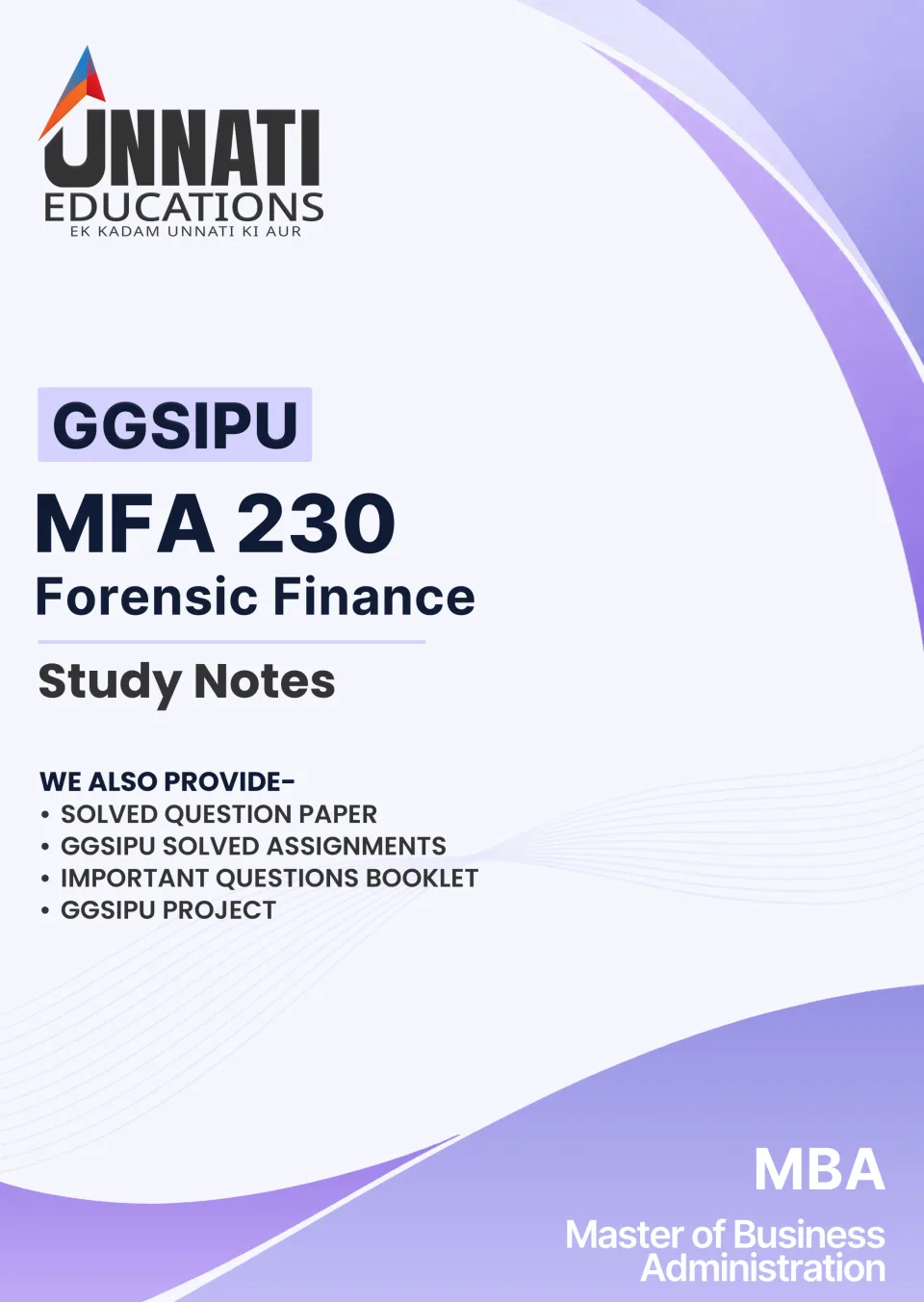
MFA-230 Forensic Finance Notes from Unnati Educations cover all 4 units of this GGSIPU MBA (Financial Analysis) Semester 4 elective in 57 pages, with 27 figures, 8 worked illustrations, 4 case studies and 83 exam questions (55 short, 28 long), mapped to the MBA (FA) scheme that applies from the 2021-22 session.
Written by Prateek Talwar, Founder, Unnati Educations · Academic review by Sheetal Kirola, M.Ed. · Checked against MBA (FA) Scheme and Syllabus 2021-22 onwards (ipu.ac.in) · Updated 14 October 2026 · Editorial policy
Scheme: MBA (FA) Scheme and Syllabus 2021-22 onwards | Applies to: students admitted from the 2021-22 academic session | Verified against: MBA (FA) Scheme and Syllabus PDF on ipu.ac.in, checked 14 October 2026
MFA-230 Forensic Finance at a glance: GGSIPU MBA (FA) Sem 4 credits, units and exam pattern
Forensic Finance is one of 12 Sem 4 electives in the MBA (Financial Analysis), of which you pick four. It is a theory paper with 3 lecture hours a week and a 50:50 internal and end-term split.
| Item | Official detail |
|---|---|
| Code and title | MFA-230 Forensic Finance |
| Course and semester | MBA (Financial Analysis), Semester 4 |
| Category and credits | Discipline Specific Elective · L-3, no T/P · 3 credits |
| Marks | 100: 50 internal + 50 end-term |
| Applies to | Scheme w.e.f. the 2021-22 academic session |
| End-term | University written exam, 50 marks; question pattern not printed in the official PDF |
| Units and teaching hours | 4 units: 12 + 10 + 10 + 10 = 42 hours |
| Paired lab | None |
MFA-230 snapshot from the official MBA (FA) scheme and syllabus PDF
- Item
- Code and title
- Official detail
- MFA-230 Forensic Finance
- Item
- Course and semester
- Official detail
- MBA (Financial Analysis), Semester 4
- Item
- Category and credits
- Official detail
- Discipline Specific Elective · L-3, no T/P · 3 credits
- Item
- Marks
- Official detail
- 100: 50 internal + 50 end-term
- Item
- Applies to
- Official detail
- Scheme w.e.f. the 2021-22 academic session
- Item
- End-term
- Official detail
- University written exam, 50 marks; question pattern not printed in the official PDF
- Item
- Units and teaching hours
- Official detail
- 4 units: 12 + 10 + 10 + 10 = 42 hours
- Item
- Paired lab
- Official detail
- None
See all GGSIPU MBA (FA) Semester 4 papers; every elective there carries 3 credits.
The scheme PDF prints no pass percentage; end-term minimums and re-appear rules sit in GGSIPU Ordinance 11 (examinations and results).
MFA-230 Forensic Finance Notes unit-wise: 83 exam questions and 8 worked illustrations across 4 units
These MFA-230 Forensic Finance IPU notes follow the official unit order: 30 main sections, 72 sub-sections, and a Quick Revision table plus an exam question list at the end of each unit.
Other papers of this programme: GGSIPU MBA (FA) notes. The sample PDF above shows one page from each unit.
MFA-230 Unit 1: Introduction
Also covered as "Introduction to Forensic Accounting" (pages 4-19, 8 sections). It compares forensic and statutory audit, extends the fraud triangle to the diamond and pentagon, and explains 10 motives for manipulation with the Satyam case. Then come Companies Act sections 143(12), 212 and 447, chain of custody, expert testimony and ICAI FAIS. Count: 9 figures, 1 illustration, 23 questions.
Quick look: when does fraud "pay" for the perpetrator? (from page 11)
| Control level | P(detection) | Expected cost (× ₹200 lakh penalty) | Result |
|---|---|---|---|
| Weak controls | 10% | ₹20 lakh | Below the gain: fraud pays |
| Strong controls + analytics | 40% | ₹80 lakh | Above the gain: deterred |
| Break-even | 25% | ₹50 lakh | Gain ÷ Penalty = 50 ÷ 200 |
Quick look: Becker risk-reward test for a ₹50 lakh fake-vendor fraud (from page 11)
- Control level
- Weak controls
- P(detection)
- 10%
- Expected cost (× ₹200 lakh penalty)
- ₹20 lakh
- Result
- Below the gain: fraud pays
- Control level
- Strong controls + analytics
- P(detection)
- 40%
- Expected cost (× ₹200 lakh penalty)
- ₹80 lakh
- Result
- Above the gain: deterred
- Control level
- Break-even
- P(detection)
- 25%
- Expected cost (× ₹200 lakh penalty)
- ₹50 lakh
- Result
- Gain ÷ Penalty = 50 ÷ 200
MFA-230 Unit 2: Planning and preparing financial forensic investigation
Pages 20-30, 7 sections. It covers predication, the 8-step planning flow, the 12 contents of an engagement letter, lawyer vs forensic accountant roles and consulting vs testifying experts. The second half is digital: electronically stored information (ESI), 12 techniques such as imaging and hashing, and the 9-stage EDRM model. Count: 5 figures, 1 case study, 13 short and 6 long questions.
Quick look: order of volatility, most fragile data first (from page 27)
- CPU registers, cache and RAM: lost as soon as power goes off.
- Network connections and running processes: change every second.
- Temporary files and swap space: overwritten in normal use.
- Hard disk or SSD data: persistent but can be overwritten.
- Remote logs, backups and archives: least volatile, collected last.
MFA-230 Unit 3: Computation of economic damage and assessment of legal issues
Pages 31-43, 8 sections, the most numerical unit. It covers the "but-for" principle, four lost-profit methods and 9 legal tests for damage claims, then the ACFE fraud tree, stress ratios, Altman Z-score, Beneish M-score, COSO 2013 and asset misappropriation. Count: 5 figures, 4 illustrations, IL&FS case, 13 short and 7 long questions.
Quick look: Altman Z-score in four lines (from page 39)
| Ratio | Value | Weight × value |
|---|---|---|
| X1 Working capital ÷ TA, X2 Retained earnings ÷ TA | 0.133, 0.200 | 0.16 + 0.28 |
| X3 EBIT ÷ TA, X4 Market value of equity ÷ TL | 0.100, 0.500 | 0.33 + 0.30 |
| X5 Sales ÷ TA | 0.800 | 0.80 |
| Z-score | 1.87 | Grey zone (1.81 to 2.99): monitor closely |
Quick look: Altman Z-score worked out for a company with total assets of ₹150 crore (from page 39)
- Ratio
- X1 Working capital ÷ TA, X2 Retained earnings ÷ TA
- Value
- 0.133, 0.200
- Weight × value
- 0.16 + 0.28
- Ratio
- X3 EBIT ÷ TA, X4 Market value of equity ÷ TL
- Value
- 0.100, 0.500
- Weight × value
- 0.33 + 0.30
- Ratio
- X5 Sales ÷ TA
- Value
- 0.800
- Weight × value
- 0.80
- Ratio
- Z-score
- Value
- 1.87
- Weight × value
- Grey zone (1.81 to 2.99): monitor closely
MFA-230 Unit 4: Fraud prediction
Pages 44-56, 7 sections. It moves from rule-based systems to machine learning: model-building steps, class imbalance, Benford's Law, then spam, loan default (EL = PD × LGD × EAD) and bankruptcy as classification problems, card-fraud scoring and the random forest classifier with a short scikit-learn example. Count: 8 figures, 3 illustrations, 14 short and 7 long questions.
Quick look: why accuracy hides missed frauds (from page 49)
| Metric | Working | Result |
|---|---|---|
| Accuracy | (80 + 9,860) ÷ 10,000 | 99.4% |
| Precision | 80 ÷ 120 | 66.7% |
| Recall | 80 ÷ 100 | 80% |
| F1-score | 2 × 0.667 × 0.80 ÷ 1.467 | 0.727 |
Quick look: evaluating a card-fraud model on 10,000 transactions with 100 actual frauds (from page 49)
- Metric
- Accuracy
- Working
- (80 + 9,860) ÷ 10,000
- Result
- 99.4%
- Metric
- Precision
- Working
- 80 ÷ 120
- Result
- 66.7%
- Metric
- Recall
- Working
- 80 ÷ 100
- Result
- 80%
- Metric
- F1-score
- Working
- 2 × 0.667 × 0.80 ÷ 1.467
- Result
- 0.727
Fraud triangle and fraud diamond in forensic accounting: excerpt from page 8 of the MFA-230 notes
Excerpt from page 8
The three sides of the fraud triangle
Donald Cressey's model says that trust is violated when three conditions meet. The first is pressure, also called incentive or motive: a financial or emotional need the person feels unable to share with anyone. Personal debt, gambling, medical bills, an expensive lifestyle, sales targets, profit-linked bonuses, analyst expectations and loan covenants all create it.
The second is opportunity: a situation that lets the fraud be committed and hidden, usually because internal controls are weak. Examples are no segregation of duties, one person handling both cash and records, missing reconciliations, weak IT access controls, a dominant CEO and an ineffective audit committee. Opportunity is the only side the organisation can directly control.
The third is rationalisation, or attitude: the mental story that makes a dishonest act feel acceptable. Typical lines are "I am only borrowing, I will return it", "the company owes me", "everybody does it" and "it is for the good of the company".
Key point: break one side
Remove any one side and fraud becomes difficult. Pressure and rationalisation live inside a person's mind, so organisations fight fraud mainly by cutting opportunity: strong internal controls, segregation of duties, surprise checks, job rotation, mandatory leave and a whistle-blower mechanism.
How the triangle was extended
The Fraud Scale (1984) by W. Steve Albrecht and others replaced rationalisation with personal integrity, so fraud depends on the balance between pressure plus opportunity on one side and integrity on the other.
The Fraud Diamond (2004) by David T. Wolfe and Dana R. Hermanson added a fourth element, capability: the person needs the position, intelligence, confidence and skill to commit and hide the fraud. The Fraud Pentagon (2011) by Jonathan Marks added competence and arrogance, the attitude that internal controls do not apply to "me". ACFE literature also uses the MICE model, which names four motives: Money, Ideology, Coercion and Ego.
How to write MFA-230 answers: legal-section tables, fraud-model diagrams and score calculations
MFA-230 answers mix statute sections, named models and small calculations.
Short answers (2.5 Marks). A one-line definition, then four or five points. For "distinguish" questions use a five-row table (objective, nature, approach, evidence, report). Quote the exact section, such as Section 143(12) for auditor fraud reporting or Section 63 of the Bharatiya Sakshya Adhiniyam for electronic records.
Long answers (12.5 Marks). Define, draw the named figure (fraud triangle, EDRM, fraud tree or random forest), explain each part, then add a table and an Indian case. Legal-issue answers need causation, remoteness (Section 73), mitigation, reasonable certainty and limitation.
Common mistake. Claiming lost revenue instead of lost profit; saved variable costs must be deducted.
Worked example: out-of-pocket loss (page 33)
Embezzled ₹2.40 crore, investigation and legal cost ₹0.30 crore, recovered from the employee ₹0.50 crore, insurance claim ₹0.60 crore. Net loss = 2.40 + 0.30 − 0.50 − 0.60 = ₹1.60 crore. Put each item on its own line.
Practise this format on GGSIPU MBA (FA) important questions.
MFA-230 exam corner: 55 two-and-a-half-mark and 28 twelve-and-a-half-mark exam questions by unit
| Unit | Short answer (2.5 Marks) | Long answer (12.5 Marks) | Worked illustrations |
|---|---|---|---|
| Unit 1 | 15 | 8 | 1 |
| Unit 2 | 13 | 6 | 0 |
| Unit 3 | 13 | 7 | 4 |
| Unit 4 | 14 | 7 | 3 + 1 Python example |
MFA-230 exam questions and worked items in the notes, by unit
- Unit
- Unit 1
- Short answer (2.5 Marks)
- 15
- Long answer (12.5 Marks)
- 8
- Worked illustrations
- 1
- Unit
- Unit 2
- Short answer (2.5 Marks)
- 13
- Long answer (12.5 Marks)
- 6
- Worked illustrations
- 0
- Unit
- Unit 3
- Short answer (2.5 Marks)
- 13
- Long answer (12.5 Marks)
- 7
- Worked illustrations
- 4
- Unit
- Unit 4
- Short answer (2.5 Marks)
- 14
- Long answer (12.5 Marks)
- 7
- Worked illustrations
- 3 + 1 Python example
The MFA-230 notes list 55 two-and-a-half-mark and 28 twelve-and-a-half-mark exam questions across 4 units, plus 8 worked illustrations. These are exam-style questions; each answer sits in the matching section of the notes.
- Unit 1: Distinguish between forensic audit and statutory audit. Pointer: true and fair opinion vs who, how and how much; sample vs 100% checking; SA 240 vs ICAI FAIS.
- Unit 2: Distinguish between a consulting expert and a testifying expert. Pointer: privilege and cross-examination; the testifying expert's duty is to the court.
- Unit 3: What is meant by mitigation of damages? Pointer: the injured party must reduce loss; avoidable losses are deducted.
- Unit 4: Why is accuracy a misleading measure in fraud detection? Pointer: calling every transaction genuine scores 99%+ accuracy yet catches no fraud; use recall and precision.
More practice for this paper sits in the MFA-230 important questions.
MFA-230 and the GGSIPU MBA (FA) Sem 4 papers it connects to
No paired lab; see the GGSIPU MBA (FA) syllabus for its official units.
Unit 4's random forest and card-fraud scoring sit close to MFA-218 FinTech. Unit 3's Z-score, M-score and fraud risk register support MFA-214 Risk Management. Unit 1's manipulation techniques (channel stuffing, cookie-jar reserves) help with MFA-224 International Accounting & Reporting, and its forensic due diligence links to MFA-212 Merger, Acquisition & Corporate Restructuring.
Sem 4 also has MFA-202 Project Dissertation, MFA-204 Corporate Social Responsibility Human Values & Ethics and MFA-206 Finance Lab II, and the electives MFA-208 Technical Analysis, MFA-210 Equity Valuation, MFA-216 Financial Modelling, MFA-220 Financial Derivatives, MFA-222 Strategic Financial Management, MFA-226 Sustainable Finance and MFA-228 Investment Banking.
Who writes and checks the MFA-230 Forensic notes?
- Prateek Talwar, author: Founder, Unnati Educations; Associate Company Secretary (ACS), ICSI, membership no. 58704, since 15 May 2019; B.Com, University of Delhi (School of Open Learning), 2012. Author bio
- Sheetal Kirola, academic review: Academic Head, Unnati Educations; M.Ed.; 7 years of experience. Reviewer bio
Unit 1's Companies Act sections (143(12), 212, 447) are a company secretary's daily ground, so Prateek writes the GGSIPU MBA (FA) Sem 4 Forensic Finance notes himself.
The 2026-27 edition maps to the 2021-22 onwards scheme, was updated on 14 October 2026, and cites the BSA and BNS 2023, ICAI FAIS (July 2023), RBI's 2024 fraud directions and the DPDP Act, 2023. See our editorial policy.
The same team prepares GGSIPU important questions for every course it covers.
Do the MFA-230 notes cover the full GGSIPU syllabus?
Yes. Every topic in the four official MFA-230 units has its own section in the notes; we found no gap.
| Official unit | Official topics | Where in the notes | Status |
|---|---|---|---|
| Unit I: Introduction (12 hours) | Forensic accounting; forensic auditor role; fraud triangle; manipulation of financial statements; risk and reward by perpetrator; independent investigation; evidence, disposition and testimony; professional standards | Sections 1-8, pages 4-18 | Covered |
| Unit II: Planning and preparing financial forensic investigation (10 hours) | Terms of engagement; legal professionals; evidence identification and collection; ESI investigation techniques; examining electronically stored data | Sections 1-7, pages 20-28 | Covered |
| Unit III: Computation of economic damage and assessment of legal issues (10 hours) | Economic damage; legal issues; impact of fraud; fraud schemes; fraud risk assessment; financial stress; internal controls; asset misappropriation | Sections 1-8, pages 31-41 | Covered |
| Unit IV: Fraud prediction (10 hours) | Fraud prediction modelling; data science, AI, ML; massive data; spam, loan default, bankruptcy; card misuse; random forest | Sections 1-7, pages 44-54 | Covered |
Official MFA-230 syllabus topics mapped to sections and pages of the notes
- Official unit
- Unit I: Introduction (12 hours)
- Official topics
- Forensic accounting; forensic auditor role; fraud triangle; manipulation of financial statements; risk and reward by perpetrator; independent investigation; evidence, disposition and testimony; professional standards
- Where in the notes
- Sections 1-8, pages 4-18
- Status
- Covered
- Official unit
- Unit II: Planning and preparing financial forensic investigation (10 hours)
- Official topics
- Terms of engagement; legal professionals; evidence identification and collection; ESI investigation techniques; examining electronically stored data
- Where in the notes
- Sections 1-7, pages 20-28
- Status
- Covered
- Official unit
- Unit III: Computation of economic damage and assessment of legal issues (10 hours)
- Official topics
- Economic damage; legal issues; impact of fraud; fraud schemes; fraud risk assessment; financial stress; internal controls; asset misappropriation
- Where in the notes
- Sections 1-8, pages 31-41
- Status
- Covered
- Official unit
- Unit IV: Fraud prediction (10 hours)
- Official topics
- Fraud prediction modelling; data science, AI, ML; massive data; spam, loan default, bankruptcy; card misuse; random forest
- Where in the notes
- Sections 1-7, pages 44-54
- Status
- Covered
Official source: MBA (Financial Analysis) Scheme and Syllabus, 2021-22 onwards (ipu.ac.in) (MFA-230 is on page 88 of the PDF).
Every course in GGSIPU notes is mapped this way.
MFA-230 Forensic notes FAQs
How do I get the full MFA-230 notes?
Tap "Get Full Notes" to message our notes desk on WhatsApp at 9899436384 with the paper code. The full MFA-230 notes come as a printed book only, not as a PDF. Delivery takes a maximum of 5 to 7 days, and the exact time depends on your location. The team confirms all order details on WhatsApp before dispatch.
Is MFA-230 Forensic Finance a core paper or an elective?
MFA-230 is a Discipline Specific Elective in Semester 4 of the MBA (Financial Analysis). The scheme lists 12 Sem 4 electives, MFA-208 to MFA-230, and every student chooses four, each worth 3 credits with 3 lecture hours a week. Your institute decides which electives it offers each academic year, so confirm with your programme coordinator.
What is the passing mark for MFA-230?
MFA-230 is marked out of 100: 50 internal and 50 end-term. Internal marks come from two 15-mark class tests plus 20 for assignments, viva or participation. The MBA (FA) scheme PDF does not state a pass percentage, so we do not quote one. End-term minimums and re-appear rules are set by Ordinance 11 on ipu.ac.in.
Which MFA-230 unit has the most numericals?
Unit III has the most: four worked illustrations on lost profits with present value, out-of-pocket loss, the Altman Z-score and the Beneish M-score. Unit IV has three (confusion matrix, Naive Bayes spam probability and Gini impurity) plus one Python example. Unit I has one risk-reward illustration, and Unit II, which is about procedure and evidence, has none.
Do I need to know Python for MFA-230?
No. MFA-230 is a theory paper with no lab or practical exam attached to it. Unit IV of the notes has one short scikit-learn example on page 54, but the exam questions in the notes ask you to explain bagging, Gini impurity, precision and recall in words and formulas, never to write or run code.
Which scheme and batch do the MFA-230 notes follow?
The MFA-230 notes follow the MBA (Financial Analysis) scheme and syllabus that applies from the 2021-22 academic session, the version on ipu.ac.in at our last check on 14 October 2026. All four official units are covered in the same order. If your college shares a newer syllabus, send it on WhatsApp so the team can check it.
Get the full MFA-230 Forensic Finance Notes on WhatsApp
| Unit | Pages in the notes | Exam questions |
|---|---|---|
| Unit 1 | 4-19 (16 pages) | 23 |
| Unit 2 | 20-30 (11 pages) | 19 |
| Unit 3 | 31-43 (13 pages) | 20 |
| Unit 4 | 44-56 (13 pages) | 21 |
What is in the full MFA-230 notes, by unit
- Unit
- Unit 1
- Pages in the notes
- 4-19 (16 pages)
- Exam questions
- 23
- Unit
- Unit 2
- Pages in the notes
- 20-30 (11 pages)
- Exam questions
- 19
- Unit
- Unit 3
- Pages in the notes
- 31-43 (13 pages)
- Exam questions
- 20
- Unit
- Unit 4
- Pages in the notes
- 44-56 (13 pages)
- Exam questions
- 21
All 57 pages: 83 exam questions, 8 worked illustrations, 4 case studies and a Quick Revision table per unit, as Forensic Finance notes in English with tables and diagrams.
Format: printed book only, not available as a PDF. Delivery: maximum 5 to 7 days; the rest depends on your location. Order on WhatsApp.
Order the full MFA-230 Forensic Finance Notes book on WhatsApp (4 units, 57 pages)
Unnati Educations is an independent education provider based in Vikaspuri, Delhi. We are not affiliated with, authorised by, or endorsed by Guru Gobind Singh Indraprastha University (GGSIPU). 'GGSIPU' and 'IPU' are used only to describe the syllabus our notes follow. For official information, visit ipu.ac.in.
Ready for the full notes?
Discuss coverage and delivery with our team.