
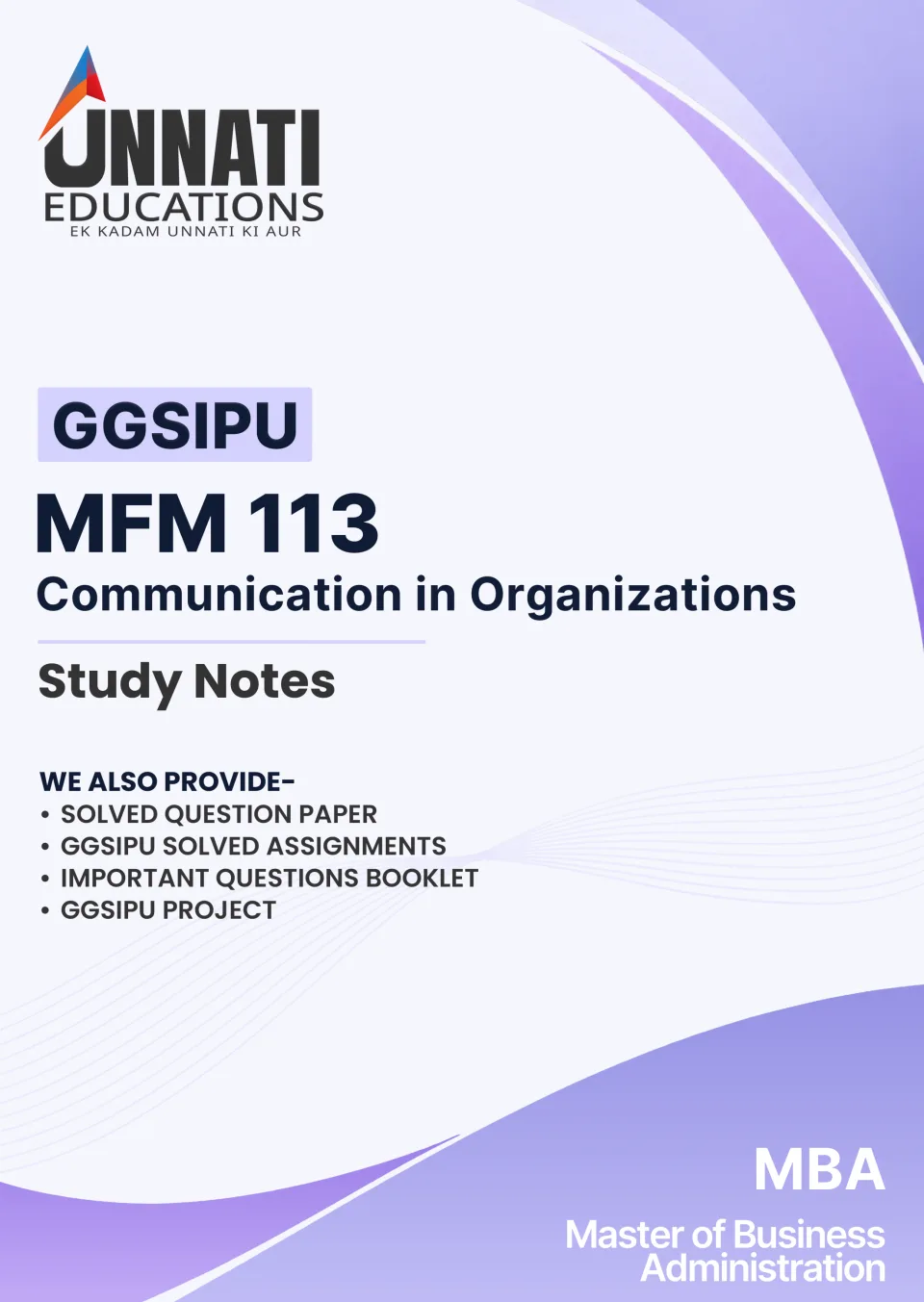
MFM 113 Communication in Organizations Notes from Unnati Educations cover all four units of the GGSIPU MBA (Financial Management) Semester 1 paper. The 61-page printed book includes 13 diagrams, 9 sample drafts, 3 solved case studies and 63 exam-style questions. Topics include business communication, letters, minutes, resumes, presentations, listening, online meetings, social media and legal issues. The notes follow the MBA (FM) scheme labelled 2021-22 onwards.
Written by Prateek Talwar, Founder, Unnati Educations · Reviewed by Prateek Talwar, Associate Company Secretary (ACS), ICSI · Checked against the MBA (Financial Management) Scheme and Syllabus, 2021-22 Onwards · Updated 14 October 2026 · Editorial policy
Scheme: MBA (FM) scheme and syllabus, 2021-22 onwards | Applies to: batches admitted from 2021-22 onwards | Verified against: MBA-Financial Management.pdf on ipu.ac.in
MFM 113 Communication in Organizations at a glance: GGSIPU MBA FM Sem 1 credits, units and exam pattern
MFM 113 is an Ability Enhancement paper in GGSIPU MBA (Financial Management) Semester 1. It develops business communication skills through written communication, oral presentations, listening, non-verbal communication and digital communication. The syllabus allocates 42 teaching hours across four units.
Code and title | MFM 113 Communication in Organizations (also written MFM-113) |
|---|---|
Course and semester | MBA (Financial Management), Semester 1 |
Category and credits | Ability Enhancement · 3 credits · L 2, T/P 2 |
Marks | 100: 25 internal (15-mark class test and 10 marks for assignments, presentations, viva, group discussion or participation) + 75 end-term |
Pass mark | Not specified in the supplied syllabus details. Refer to GGSIPU Ordinance 11 for applicable examination rules. |
Applies to | 2021-22 onwards, as printed in the scheme |
End-term pattern | 75 marks; question-paper pattern not specified in the supplied syllabus |
Units and hours | 4 units: 12 + 12 + 8 + 10 = 42 teaching hours |
Paired lab | None |
The source places MFM 113 alongside eight other Semester 1 papers, with 25 credits across the semester. The official scheme and syllabus is available in the GGSIPU MBA (Financial Management) PDF.
MFM 113 Communication in Organizations Notes unit-wise: 13 diagrams, 9 sample drafts and 3 solved case studies across 4 units
The MFM 113 notes devote 57 pages to the four units, with exam questions and quick revision material in each unit. The printed book contains 13 diagrams, 9 sample drafts and 3 case studies with solved questions.
MFM 113 Unit 1: Introduction to Business Communication
Unit 1 (pages 4 to 18) explains four definitions of communication, downward, upward, horizontal and diagonal flows, five formal communication networks, ten elements of the communication process, seven barriers and twelve gateways to effective communication. It contains 11 sections, 4 figures, a case study about a bonus rumour at a Panipat mill with 3 solved questions, and 16 exam-style questions.
Model | Key idea |
|---|---|
Lasswell (1948) | Who says what, through which channel, to whom and with what effect |
Shannon-Weaver (1949) | Highlights the effect of noise in communication |
Berlo's SMCR (1960) | Communication skills, attitudes and cultural context affect the sender and receiver |
Osgood-Schramm (1954) | A circular process in which participants alternately encode and decode messages |
Quick look: four communication models (from page 13)
Model
Lasswell (1948)
Key idea
Who says what, through which channel, to whom and with what effect
Model
Shannon-Weaver (1949)
Key idea
Highlights the effect of noise in communication
Model
Berlo's SMCR (1960)
Key idea
Communication skills, attitudes and cultural context affect the sender and receiver
Model
Osgood-Schramm (1954)
Key idea
A circular process in which participants alternately encode and decode messages
MFM 113 Unit 2: Written Communication and Application of Communication
Unit 2 (pages 19 to 34) covers principles of writing, the 7 C's of communication, business letter layout and drafting methods. It includes specimens of request, good-news, bad-news, persuasive and sales letters, board-meeting minutes, a covering letter and a fresher's resume. It contains 14 sections, 2 figures, 8 sample drafts and 16 exam-style questions. No case study is listed for this unit.
Principle | Weak wording | Improved wording |
|---|---|---|
Conciseness | We would like to take this opportunity to inform you that we are in receipt of your letter. | Thank you for your letter. |
Concreteness | Our product is very popular. | Over 2,40,000 customers in 18 states bought our product last year. |
Quick look: two of the 7 C's, weak versus improved (from page 21)
Principle
Conciseness
Weak wording
We would like to take this opportunity to inform you that we are in receipt of your letter.
Improved wording
Thank you for your letter.
Principle
Concreteness
Weak wording
Our product is very popular.
Improved wording
Over 2,40,000 customers in 18 states bought our product last year.
The numerical claim in the concreteness example illustrates specific wording; it is not presented as independently verified business data.
MFM 113 Unit 3: Oral Communication
Unit 3 (pages 35 to 48) explains five presentation stages, four delivery methods, video-conferencing, non-verbal communication, informative and persuasive speeches, and effective listening. It discusses Skype as a syllabus topic while noting its retirement in May 2025. Listening coverage includes HURIER and Keith Davis's ten commandments. The unit contains 10 sections, 5 figures, a failed video-call presentation case study with 3 solved questions, and 16 exam-style questions.
Quick look: Monroe's Motivated Sequence (from page 44)
Attention: Open with a striking fact, story or question.
Need: Explain the problem and why it matters.
Satisfaction: Present the proposed solution.
Visualisation: Show the likely benefits or consequences of inaction.
Action: Ask the audience to take a specific step.
MFM 113 Unit 4: Recent Trends in Business Communication
Unit 4 (pages 49 to 60) covers netiquette, media richness, online meetings, six social media platforms, company blogging, intercultural communication through Hall and Hofstede, and ethical and legal issues. The legal topics include the Information Technology Act, 2000, Digital Personal Data Protection Act, 2023, and Bharatiya Nyaya Sanhita, 2023. It contains 9 sections, 2 figures, a case study about a viral complaint against a lending app with 3 solved questions, 1 sample blog outline and 15 exam-style questions.
Problem | Practical response |
|---|---|
Echo, lag or poor connection | Use a reliable connection, a headset and a dial-in backup |
Video-meeting fatigue | Schedule shorter meetings and allow five-minute gaps |
Unauthorised meeting disruption | Use passwords, waiting rooms and meeting-lock controls |
Quick look: online meeting problems and fixes (from page 52)
Problem
Echo, lag or poor connection
Practical response
Use a reliable connection, a headset and a dial-in backup
Problem
Video-meeting fatigue
Practical response
Schedule shorter meetings and allow five-minute gaps
Problem
Unauthorised meeting disruption
Practical response
Use passwords, waiting rooms and meeting-lock controls
The grapevine and its four chains in organisational communication: excerpt from page 11 of the MFM 113 notes
Excerpt from page 11
What the grapevine is
Informal communication grows out of personal and social ties among employees: friendships, shared interests, travelling together and lunch groups. It is called the grapevine because information spreads irregularly in different directions, often without a clearly identifiable starting point. The term is commonly linked to the American Civil War, when loosely strung telegraph lines resembled grapevines and messages were sometimes distorted.
Features of the grapevine
It operates outside official communication channels and may flow in any direction.
It can spread information faster than formal communication.
It is often oral and may leave no reliable record.
It carries accurate information, partial information and rumours.
It becomes particularly active during uncertainty, such as restructuring or policy changes.
It is a normal feature of organisational life and can be managed rather than eliminated.
Keith Davis's four grapevine chains
Single-strand chain: A tells B, B tells C and the message continues from person to person.
Gossip chain: One person communicates information to many others.
Probability chain: Information spreads through chance contacts.
Cluster chain: A person shares information with selected contacts, some of whom pass it to others. The notes identify this as the most common pattern.
Merits and demerits
The grapevine can communicate information quickly, reveal employee concerns, provide emotional release and strengthen social relationships. It may also fill gaps left by formal communication.
Its limitations include rumour, message distortion, confidentiality risks, uncertain accountability and possible damage to morale. Managers can reduce harmful rumours by keeping official communication timely, clear and credible.
MFM 113 exam corner: 39 short-answer and 24 long-answer questions, plus 3 solved case studies
Each unit ends with short-answer questions intended for approximately 2–5 marks and long-answer questions intended for approximately 10–15 marks. The supplied material identifies these as practice questions, not verified previous-year examination questions.
Unit | Short (2–5 marks) | Long (10–15 marks) | Solved case questions | Sample drafts |
|---|---|---|---|---|
Unit I | 10 | 6 | 3 | 0 |
Unit II | 10 | 6 | 0 | 8 |
Unit III | 10 | 6 | 3 | 0 |
Unit IV | 9 | 6 | 3 | 1 |
Total | 39 | 24 | 9 | 9 |
MFM 113 exam questions and worked material by unit
Unit
Unit I
Short (2–5 marks)
10
Long (10–15 marks)
6
Solved case questions
3
Sample drafts
0
Unit
Unit II
Short (2–5 marks)
10
Long (10–15 marks)
6
Solved case questions
0
Sample drafts
8
Unit
Unit III
Short (2–5 marks)
10
Long (10–15 marks)
6
Solved case questions
3
Sample drafts
0
Unit
Unit IV
Short (2–5 marks)
9
Long (10–15 marks)
6
Solved case questions
3
Sample drafts
1
Unit
Total
Short (2–5 marks)
39
Long (10–15 marks)
24
Solved case questions
9
Sample drafts
9
Total: 63 exam-style questions (39 short-answer + 24 long-answer), 3 case studies containing 9 solved questions, 9 sample drafts and 13 diagrams.
One question per unit, with answer pointers:
Unit I: What are the barriers to effective communication? Suggest suitable gateways to overcome them. Pointer: Explain the seven barrier categories and use the gateway table on page 16 to suggest remedies.
Unit II: How does a bad-news letter differ from a good-news letter? Draft a letter refusing a customer's request for credit. Pointer: Compare direct and indirect approaches, then draft a courteous refusal with an appropriate opening, explanation and closing.
Unit III: Name the four methods of delivering a presentation. Which is best and why? Pointer: Compare manuscript, memorised, impromptu and extemporaneous delivery. Explain why extemporaneous delivery can combine preparation with natural presentation.
Unit IV: What is netiquette? Give any five rules. Pointer: Define online communication etiquette and select five rules from pages 50–51.
The important questions page for MFM 113 is planned separately.
Who writes and checks the MFM 113 Communication notes?
Prateek Talwar, author: Founder, Unnati Educations; Associate Company Secretary (ACS), ICSI, membership no. 58704, since 15 May 2019; B.Com, University of Delhi (School of Open Learning), 2012. Author profile
Prateek Talwar is also listed as the reviewer. His company-secretarial background is relevant to the board-meeting minutes material, including Section 118 of the Companies Act, 2013 and Secretarial Standard SS-1, and to the legal issues discussed in Unit 4.
The supplied editorial record identifies this as the 2026–27 edition, updated 14 October 2026. It includes references to Skype's retirement, the Digital Personal Data Protection Act, 2023 and Bharatiya Nyaya Sanhita, 2023. See the editorial policy for information about the review process.
Unnati Educations also prepares important questions for supported GGSIPU courses.
Do the MFM 113 notes cover the full GGSIPU syllabus?
The supplied syllabus map identifies corresponding notes sections for the listed topics in all four MFM 113 units. One limitation is noted: course outcome CO5 mentions negotiation strategy, which is addressed only briefly on pages 35 and 42.
Official unit | Official topics | Where in the notes | Status |
|---|---|---|---|
I: Introduction to Business Communication | Definitions, importance, forms and types, formal and informal networks, communication process, barriers and gateways | Sections 1–8, pages 4–16 | Mapped |
II: Written Communication and Application of Communication | Written communication principles, 7 C's, business letters, minutes, job applications and resumes | Sections 2–12, pages 19–33 | Mapped |
III: Oral Communication | Presentations, video-conferencing and Skype, non-verbal communication, speeches and listening | Sections 1–7, pages 35–46 | Mapped |
IV: Recent Trends in Business Communication | Online communication, meetings, social networks, blogs, intercultural communication, ethical and legal issues | Sections 1–6, pages 49–58 | Mapped |
MFM 113 official units mapped to the notes
Official unit
I: Introduction to Business Communication
Official topics
Definitions, importance, forms and types, formal and informal networks, communication process, barriers and gateways
Where in the notes
Sections 1–8, pages 4–16
Status
Mapped
Official unit
II: Written Communication and Application of Communication
Official topics
Written communication principles, 7 C's, business letters, minutes, job applications and resumes
Where in the notes
Sections 2–12, pages 19–33
Status
Mapped
Official unit
III: Oral Communication
Official topics
Presentations, video-conferencing and Skype, non-verbal communication, speeches and listening
Where in the notes
Sections 1–7, pages 35–46
Status
Mapped
Official unit
IV: Recent Trends in Business Communication
Official topics
Online communication, meetings, social networks, blogs, intercultural communication, ethical and legal issues
Where in the notes
Sections 1–6, pages 49–58
Status
Mapped
Official reference: MBA (Financial Management) Scheme and Syllabus, 2021-22 Onwards. The supplied page mapping identifies MFM 113 on page 22.
The mapping supports coverage of the four unit topic lists, but the limited treatment of negotiation strategy should be kept visible when describing course-outcome coverage.
How to write MFM 113 answers: specimen letters, board minutes and diagram-led theory answers
For drafting questions, begin with the appropriate document structure and follow the step plan for that type of communication. The notes identify ten parts of a business letter on page 22. For theory questions, use a relevant diagram, concise explanations and a named communication model where appropriate.
Communication process: Draw the communication loop, show feedback and noise, and explain the model used. 7 C's: Define each principle and add an example. Non-verbal communication: Cover the five categories and relevant technical terms. Ethical and legal issues: Organise the answer into ethical principles and applicable Indian legal provisions.
Mistakes to avoid: Beginning a bad-news letter with an unnecessarily abrupt refusal, blaming the recipient, relying on unexplained references to company policy, or copying the entire resume into a covering letter.
Worked example: Turning an informal decision into a board resolution (page 29)
Identify the decision: The company proposes to open a branch office in Noida and authorise the Managing Director to sign a lease.
Use formal resolution language: Begin with the words “RESOLVED THAT”.
State the approval: “Approval be and is hereby granted to open a branch office at Sector 62, Noida.”
Record the authority: Add that Ms. P. Verma, Managing Director, is authorised to sign the lease agreement.
Check the record: Ensure the resolution accurately reflects the decision taken and is entered into the minutes in the required format.
This worked example demonstrates formal drafting language; it does not establish that an actual board meeting or resolution took place.
MFM 113 and the GGSIPU MBA FM Sem 1 papers it connects to
Paired lab: None. MFM 113 has no dedicated paired lab in the supplied MBA (FM) scheme.
MFM 101 Management Process and Organisational Behaviour: Group communication, teams and cross-cultural behaviour connect with Units 1 and 4.
MFM 111 Marketing Management: Persuasive communication, AIDA and social media connect with Units 2 and 4.
MFM 115 Legal Aspects of Business: Contract law connects with Unit 4's discussion of legally significant business messages.
MFM 109 Information Technology Management: Networks, intranets and presentation software support the digital communication topics in Units 3 and 4.
MFM 103 Quantitative Technique, MFM 105 Managerial Economics, MFM 107 Accounting for Management and MFM 117: The supplied mapping identifies no direct subject-specific overlap.
Group | Papers |
|---|---|
Management and economics | MFM 101 Management Process and Organisational Behaviour; MFM 105 Managerial Economics |
Quantitative and accounting | MFM 103 Quantitative Techniques; MFM 107 Accounting for Management |
Technology | MFM 109 Information Technology Management; MFM 117 Information Technology Management Lab |
Marketing and law | MFM 111 Marketing Management; MFM 115 Legal Aspects of Business |
Other MBA (Financial Management) Semester 1 papers
Group
Management and economics
Papers
MFM 101 Management Process and Organisational Behaviour; MFM 105 Managerial Economics
Group
Quantitative and accounting
Papers
MFM 103 Quantitative Techniques; MFM 107 Accounting for Management
Group
Technology
Papers
MFM 109 Information Technology Management; MFM 117 Information Technology Management Lab
Group
Marketing and law
Papers
MFM 111 Marketing Management; MFM 115 Legal Aspects of Business
MFM 113 Communication notes FAQs
Is MFM 113 a core paper, and how many credits does it carry?
No. The MBA (Financial Management) scheme classifies MFM 113 as an Ability Enhancement paper. It carries 3 credits, with L 2 and T/P 2 shown in the scheme. The syllabus allocates 42 teaching hours across four units, and the paper carries 100 marks.
How is MFM 113 marked, and what is the passing mark?
MFM 113 carries 25 internal and 75 end-term marks. Internal assessment consists of a 15-mark class test and 10 marks for other activities. The supplied syllabus does not specify a passing percentage. Refer to GGSIPU Ordinance 11 for the applicable examination rules.
Why do the MFM 113 notes still teach Skype when Skype has shut down?
The official syllabus specifically names video-conferencing and Skype. The notes retain that topic for syllabus alignment while explaining that Microsoft retired Skype in May 2025 and directed users towards Microsoft Teams.
Which MFM 113 unit has the most drafting practice?
Unit 2 contains 8 complete specimens: a request for quotation, claim-granted letter, claim-refusal letter, guest-speaker invitation, sales letter, board-meeting minutes, covering letter and MBA (FM) fresher's resume. Unit 4 adds a sample blog outline, bringing the total to 9 sample drafts.
Do the MFM 113 notes follow the current MBA (FM) scheme?
The notes follow the MBA (Financial Management) scheme labelled 2021-22 onwards, using its four MFM 113 unit titles and topic lists. Students following a revised scheme should compare its syllabus with the unit mapping on this page before ordering.
How do I get the full MFM 113 notes?
Contact Unnati Educations on WhatsApp at 9899436384 using the ordering button. The full notes are sold as a printed book, not as a downloadable PDF. A sample PDF is planned for preview; price and payment information can be confirmed on WhatsApp.
Get the full MFM 113 Communication in Organizations Notes on WhatsApp
The MFM 113 notes are available as an English-language printed book. The four units occupy pages 4–60, covering 57 pages of study content. The source states a 61-page total, with page 61 not separately described.
Part | Pages |
|---|---|
Cover and preliminary pages | 1–3 (3) |
4–18 (15) | |
Unit 2: Written Communication and Application of Communication | 19–34 (16) |
35–48 (14) | |
49–60 (12) | |
Additional page to confirm | 61 (1) |
Total | 61 |
Pages per unit in the MFM 113 printed book
Part
Cover and preliminary pages
Pages
1–3 (3)
Pages
4–18 (15)
Pages
19–34 (16)
Pages
35–48 (14)
Pages
49–60 (12)
Part
Additional page to confirm
Pages
61 (1)
Part
Total
Pages
61
Delivery: within 5 to 7 days at most; the exact time may vary with your location.
Order the MFM 113 Communication in Organizations Notes book on WhatsApp (4 units, 61 pages)
Unnati Educations is an independent education provider based in Vikaspuri, Delhi. We are not affiliated with, authorised by, or endorsed by Guru Gobind Singh Indraprastha University (GGSIPU). 'GGSIPU' and 'IPU' are used only to describe the syllabus our notes follow. For official information, visit ipu.ac.in.
Ready for the full notes?
Discuss coverage and delivery with our team.