
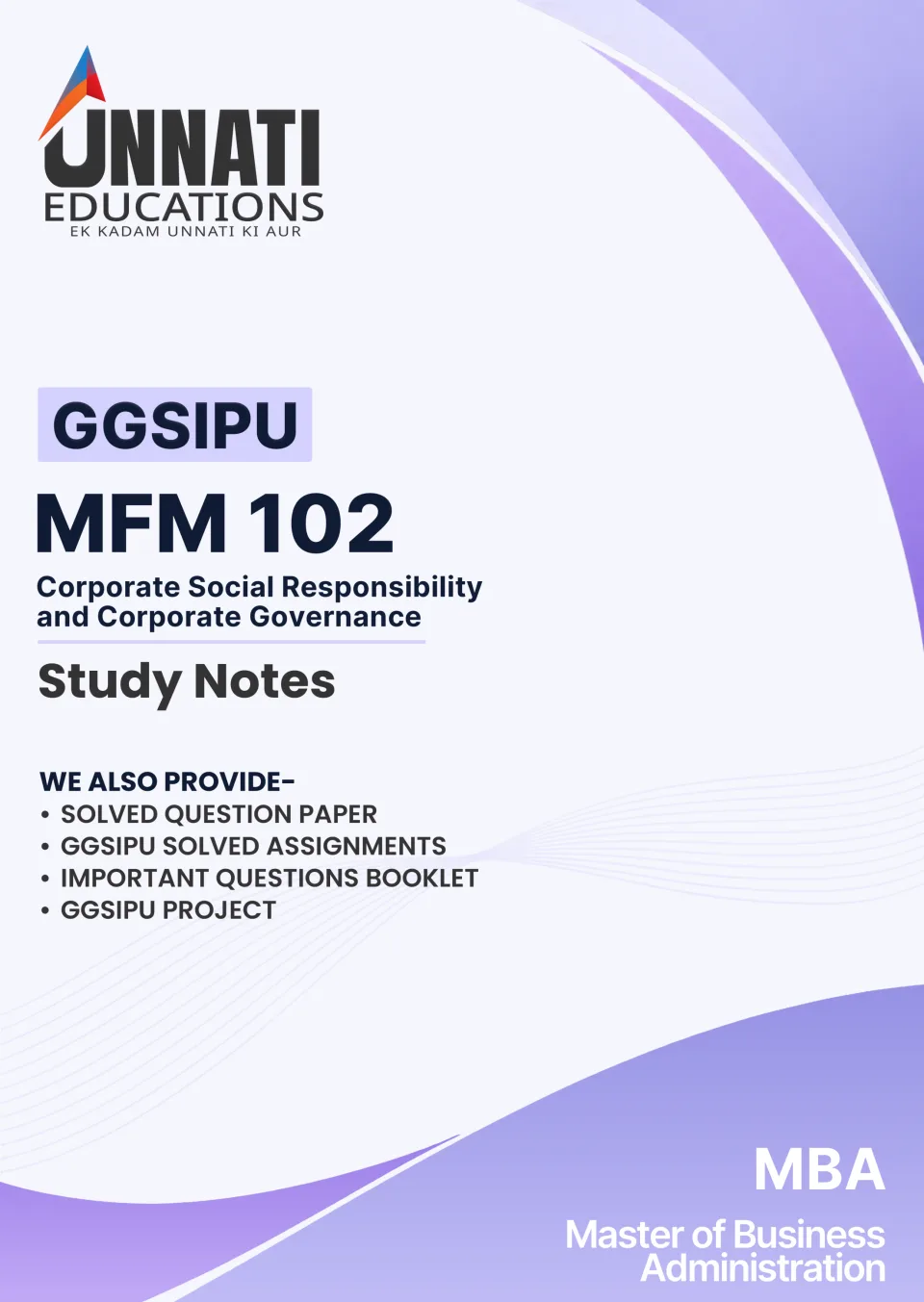
MFM 102 Corporate Social Responsibility and Corporate Governance Notes cover all four units of the GGSIPU MBA (Financial Management) Semester 2 paper. The 79-page English printed book includes 49 sections, 5 case studies, 6 case-law boxes and 83 exam-style questions. Topics include Section 135 of the Companies Act, ISO 26000, sustainability reporting, board committees, insider trading, Clause 49, SEBI LODR and major corporate governance cases. The notes follow the MBA (FM) scheme labelled 2021-22 onwards.
Written by Prateek Talwar, Founder, Unnati Educations · Reviewed by Prateek Talwar, Associate Company Secretary (ACS), ICSI · Checked against the MBA (Financial Management) Scheme and Syllabus, 2021-22 Onwards · Updated 14 October 2026 · Editorial policy
Scheme: MBA (FM) scheme 2021-22 onwards | Applies to: batches admitted from 2021-22 onwards | Verified against: MBA (Financial Management) Scheme and Syllabus
MFM 102 Corporate Social Responsibility and Corporate Governance at a glance: GGSIPU MBA (FM) Sem 2 credits, units and exam pattern
Code and title | MFM 102 Corporate Social Responsibility and Corporate Governance |
|---|---|
Course and semester | MBA (Financial Management), Semester 2 |
Category and credits | Core, 3 credits; L 3, with no tutorial or practical shown |
Marks | 100: 25 internal (15-mark class test and 10 marks for other assessment activities) + 75 end-term |
Pass mark | Not specified in the supplied scheme details; refer to GGSIPU Ordinance 11 for applicable examination rules |
Applies to | Batches admitted from 2021-22 onwards under the stated scheme |
End-term pattern | 75 marks; question-paper pattern not specified in the supplied syllabus details |
Units and hours | 4 units: 10 + 10 + 12 + 10 = 42 teaching hours |
Paired lab | None |
Unit III, covering boards, committees and insider trading, has the highest allocation at 12 teaching hours. The supplied semester plan places MFM 102 among nine MBA (FM) Semester 2 papers carrying 28 credits in total.
MFM 102 Corporate Social Responsibility and Corporate Governance Notes unit-wise: 49 sections, 5 case studies and 83 exam questions across 4 units
The source identifies a three-page index and 74 pages of unit content, from pages 5 to 78. It also lists 5 figures, 9 exam tips and a revision table closing each unit. The 79-page printed-book total leaves page 79 to be confirmed.
MFM 102 Unit 1: Introduction to CSR
Unit 1 (pages 5 to 22) covers definitions of CSR, five Indian phases of CSR, stakeholder mapping through Mendelow's matrix, the Triple Bottom Line, four Indian models and Carroll's pyramid. It contains 12 sections, 3 figures and 20 exam-style questions.
Basis | Charity | Philanthropy | CSR |
|---|---|---|---|
Motive | Emotional or religious | Goodwill and giving back | Responsibility for impacts |
Link to business | Usually separate | Often separate | Integrated with business responsibility |
Focus | Immediate needs | Selected social causes | Social, environmental and stakeholder impacts |
Accountability | Depends on the activity | Depends on the programme | Legal and reporting obligations apply where relevant |
Quick look: charity, philanthropy and CSR compared (from page 9)
Basis
Motive
Charity
Emotional or religious
Philanthropy
Goodwill and giving back
CSR
Responsibility for impacts
Basis
Link to business
Charity
Usually separate
Philanthropy
Often separate
CSR
Integrated with business responsibility
Basis
Focus
Charity
Immediate needs
Philanthropy
Selected social causes
CSR
Social, environmental and stakeholder impacts
Basis
Accountability
Charity
Depends on the activity
Philanthropy
Depends on the programme
CSR
Legal and reporting obligations apply where relevant
MFM 102 Unit 2: Regulatory Framework of CSR
Unit 2 (pages 23 to 39) covers Section 135 of the Companies Act, 2013, the CSR Amendment Rules, Schedule VII, independent directors, net profit under Section 198, ISO 26000, National Voluntary Guidelines, BRR and BRSR, international frameworks and social audit. It contains 10 sections, 1 figure, 1 worked computation and 20 exam-style questions.
Test in the immediately preceding financial year | Threshold |
|---|---|
Net worth | ₹500 crore or more |
Turnover | ₹1,000 crore or more |
Net profit | ₹5 crore or more |
CSR expenditure obligation not exceeding ₹50 lakh | CSR Committee requirement does not apply under Section 135(9); the Board performs the relevant functions |
Quick look: Section 135 applicability thresholds (from page 23)
Test in the immediately preceding financial year
Net worth
Threshold
₹500 crore or more
Test in the immediately preceding financial year
Turnover
Threshold
₹1,000 crore or more
Test in the immediately preceding financial year
Net profit
Threshold
₹5 crore or more
Test in the immediately preceding financial year
CSR expenditure obligation not exceeding ₹50 lakh
Threshold
CSR Committee requirement does not apply under Section 135(9); the Board performs the relevant functions
Meeting any one of the three financial thresholds can trigger Section 135 applicability, subject to the law and rules applicable to the company.
MFM 102 Unit 3: Corporate Governance
Unit 3 (pages 40 to 58) explains six governance theories, four national models, directors' duties under Section 166, managerial remuneration under Section 197, board evaluation, major board committees, LODR disclosure requirements, SEBI's insider trading regulations and the COSO framework. It contains 11 sections, 1 figure, 3 case-law boxes and 21 exam-style questions.
Aspect | Companies Act, Section 177 | SEBI LODR, Regulation 18 |
|---|---|---|
Members | Minimum 3 directors, with independent directors forming a majority | Minimum 3 directors, with at least two-thirds independent directors, subject to applicable provisions |
Chairperson | No equivalent chairperson requirement specified in the supplied comparison | Independent director |
Meetings | No equivalent meeting frequency specified in the supplied comparison | At least 4 meetings a year, with no more than 120 days between consecutive meetings |
Quick look: audit committee requirements under the Companies Act and SEBI LODR (from page 50)
Aspect
Members
Companies Act, Section 177
Minimum 3 directors, with independent directors forming a majority
SEBI LODR, Regulation 18
Minimum 3 directors, with at least two-thirds independent directors, subject to applicable provisions
Aspect
Chairperson
Companies Act, Section 177
No equivalent chairperson requirement specified in the supplied comparison
SEBI LODR, Regulation 18
Independent director
Aspect
Meetings
Companies Act, Section 177
No equivalent meeting frequency specified in the supplied comparison
SEBI LODR, Regulation 18
At least 4 meetings a year, with no more than 120 days between consecutive meetings
The comparison is a revision summary; the full current provisions and applicability conditions should be checked before relying on it for legal compliance.
MFM 102 Unit 4: Legislative Provisions of Corporate Governance
Unit 4 (pages 59 to 78) is the longest unit. Its 16 sections cover Indian governance committees from the 1998 CII Code to the Uday Kotak Committee, Clause 49, the Sarbanes-Oxley Act, shareholder rights, minority protection, political funding, class action, whistle-blowing, shareholder activism and CEO duality. It contains 5 case studies, 2 case-law boxes and 22 exam-style questions.
Year | Development |
|---|---|
February 2000 | Clause 49 introduced following the Kumar Mangalam Birla Committee's recommendations |
October 2004 | Revised framework following the Narayana Murthy Committee, with implementation from January 2006 |
April 2014 | Revisions aligned governance requirements with the Companies Act, 2013 |
September–December 2015 | SEBI (Listing Obligations and Disclosure Requirements) Regulations, 2015 introduced and brought into effect |
Quick look: development from Clause 49 to SEBI LODR (from page 62)
Year
February 2000
Development
Clause 49 introduced following the Kumar Mangalam Birla Committee's recommendations
Year
October 2004
Development
Revised framework following the Narayana Murthy Committee, with implementation from January 2006
Year
April 2014
Development
Revisions aligned governance requirements with the Companies Act, 2013
Year
September–December 2015
Development
SEBI (Listing Obligations and Disclosure Requirements) Regulations, 2015 introduced and brought into effect
MFM 102 exam corner: 40 short-answer and 43 long-answer exam questions by unit
Unit | Short answer (2–5 marks) | Long answer (10–15 marks) | Case studies and case-law boxes |
|---|---|---|---|
Unit 1 | 10 | 10 | 1 |
Unit 2 | 10 | 10 | 0 |
Unit 3 | 10 | 11 | 3 |
Unit 4 | 10 | 12 | 7 |
Total | 40 | 43 | 11 |
MFM 102 notes: practice questions and case material per unit
Unit
Unit 1
Short answer (2–5 marks)
10
Long answer (10–15 marks)
10
Case studies and case-law boxes
1
Unit
Unit 2
Short answer (2–5 marks)
10
Long answer (10–15 marks)
10
Case studies and case-law boxes
0
Unit
Unit 3
Short answer (2–5 marks)
10
Long answer (10–15 marks)
11
Case studies and case-law boxes
3
Unit
Unit 4
Short answer (2–5 marks)
10
Long answer (10–15 marks)
12
Case studies and case-law boxes
7
Unit
Total
Short answer (2–5 marks)
40
Long answer (10–15 marks)
43
Case studies and case-law boxes
11
Total: 83 exam-style questions (40 short-answer + 43 long-answer), 5 case studies and 6 case-law boxes. The marks bands describe practice-question categories, not a verified official examination pattern.
One question per unit, with answer pointers:
Unit 1: Critically examine Carroll's Pyramid of CSR. Pointer: Explain economic, legal, ethical and philanthropic responsibilities (pages 17–18), followed by criticism of the model.
Unit 2: Explain ISO 26000 guidelines on social responsibility. Pointer: Explain the 2010 guidance standard, its non-certifiable nature, seven principles and seven core subjects.
Unit 3: What is unpublished price-sensitive information (UPSI)? Give examples. Pointer: Refer to Regulation 2(1)(n) of the SEBI insider trading regulations and explain material unpublished information such as financial results and major transactions.
Unit 4: Explain class action under the Companies Act, 2013. Pointer: Discuss Section 245, eligible applicants, the NCLT process and the statutory exclusions and thresholds.
Additional important questions are planned for a separate MFM 102 page.
Satyam, IL&FS and ICICI-Videocon failures in Indian corporate governance: excerpt from page 75 of the MFM 102 notes
Excerpt from page 75
Satyam Computer Services (India, 2009)
On 7 January 2009, Chairman B. Ramalinga Raju admitted in a letter to the board that Satyam's accounts had been falsified for years. Over ₹5,000 crore of reported cash and bank balances did not exist, interest was overstated and liabilities understated. In December 2008, the board had approved a proposed $1.6 billion acquisition of two promoter-family companies, Maytas Properties and Maytas Infra, but the deal was abandoned after investor protests.
Governance failures: Independent directors did not adequately challenge the Maytas proposal; bank balances were not properly verified; promoter share pledging created further concerns; and management overrode internal controls.
Outcome: The Government replaced the board, Tech Mahindra acquired a controlling stake in Satyam in 2009, and Raju and others were convicted in 2015.
Lessons: Stronger internal financial controls, auditor oversight, independent director accountability and effective shareholder remedies.
IL&FS (India, 2018)
Infrastructure Leasing & Financial Services (IL&FS), a systemically important financial group with institutional shareholders including LIC, ORIX and SBI, defaulted on debt obligations in September 2018. The group had obligations exceeding ₹90,000 crore across a complex network of subsidiaries and associates. Following a Government petition under Sections 241 and 242, the NCLT replaced its board in October 2018, and a new board led by Uday Kotak took charge.
Governance failures: High leverage, asset-liability mismatches, group complexity, weak board scrutiny and concerns over credit-rating assessments.
Lessons: Stronger governance of large financial groups, better risk monitoring and greater accountability for auditors and rating agencies.
ICICI Bank and Videocon (India, 2018)
Allegations arose that Chanda Kochhar, then MD and CEO of ICICI Bank, had a conflict of interest involving business links between her husband's company, NuPower Renewables, and Videocon promoter Venugopal Dhoot. The controversy concerned loans including a ₹3,250 crore facility sanctioned to the Videocon group in 2012.
An independent inquiry led by Justice B. N. Srikrishna reported in January 2019 that Kochhar had breached the bank's code of conduct by failing to disclose relevant conflicts. The bank subsequently treated her departure as termination and sought recovery of certain benefits.
Lessons: Disclose conflicts of interest, investigate whistle-blower complaints independently, apply appropriate remuneration recovery provisions and maintain independent board oversight.
Do the MFM 102 notes cover the full GGSIPU syllabus?
The supplied syllabus mapping identifies corresponding notes sections for all four official MFM 102 units. It covers CSR principles, regulatory frameworks, corporate governance structures and legislative provisions. The mapping is a coverage claim from the supplied editorial record, rather than an independent page-by-page verification of the printed book.
Official unit | Official topics | In the notes | Status |
|---|---|---|---|
I: Introduction to CSR | Meaning, history, charity, philanthropy, corporate citizenship, sustainability, stakeholders, Triple Bottom Line, Indian CSR models, Carroll's model and CSR initiatives | Sections 1–12, pages 5–20 | Mapped |
II: Regulatory Framework of CSR | Section 135, Schedule VII, independent directors, net profit, implementation, ISO 26000, BRR, NVG, international frameworks, social audit and reporting | Sections 1–10, pages 23–38 | Mapped |
III: Corporate Governance | Governance theories and models, boards, director duties, remuneration, evaluation, committees, disclosure, insider trading and internal controls | Sections 1–11, pages 40–56 | Mapped |
IV: Legislative Provisions of Corporate Governance | National committees, Clause 49, Sarbanes-Oxley, shareholder rights, minority protection, political funding, class action, whistle-blowing, activism, CEO duality and governance cases | Sections 1–16, pages 59–76 | Mapped |
MFM 102 official syllabus topics mapped to the notes
Official unit
I: Introduction to CSR
Official topics
Meaning, history, charity, philanthropy, corporate citizenship, sustainability, stakeholders, Triple Bottom Line, Indian CSR models, Carroll's model and CSR initiatives
In the notes
Sections 1–12, pages 5–20
Status
Mapped
Official unit
II: Regulatory Framework of CSR
Official topics
Section 135, Schedule VII, independent directors, net profit, implementation, ISO 26000, BRR, NVG, international frameworks, social audit and reporting
In the notes
Sections 1–10, pages 23–38
Status
Mapped
Official unit
III: Corporate Governance
Official topics
Governance theories and models, boards, director duties, remuneration, evaluation, committees, disclosure, insider trading and internal controls
In the notes
Sections 1–11, pages 40–56
Status
Mapped
Official unit
IV: Legislative Provisions of Corporate Governance
Official topics
National committees, Clause 49, Sarbanes-Oxley, shareholder rights, minority protection, political funding, class action, whistle-blowing, activism, CEO duality and governance cases
In the notes
Sections 1–16, pages 59–76
Status
Mapped
Students can compare the mapping with the GGSIPU MBA (Financial Management) Scheme and Syllabus, 2021-22 Onwards. The supplied reference identifies MFM 102 on pages 28–29, credits on page 6 and assessment details on page 3.
Who writes and checks the MFM 102 CSR and Corporate Governance notes?
Prateek Talwar, author: Founder, Unnati Educations; Associate Company Secretary (ACS), ICSI, membership no. 58704, since 15 May 2019; B.Com, University of Delhi (School of Open Learning), 2012. Author profile
Prateek Talwar is also identified as the subject reviewer. His company-secretarial background is relevant to the Companies Act, 2013, SEBI governance regulations and board responsibilities discussed in Units 2–4.
The supplied editorial record identifies this as the 2026–27 edition, updated 14 October 2026, with discussion of the 2021 CSR Rules, BRSR and the 2024 electoral bonds judgment. See the editorial policy for review information.
Unnati Educations also prepares important questions for supported GGSIPU courses.
MFM 102 and the GGSIPU MBA (FM) Sem 2 papers it connects to
Paired lab: None. The supplied Semester 2 scheme does not identify a dedicated laboratory paper paired with MFM 102.
MFM 110 Investment Analysis & Portfolio Management: Insider trading in Unit 3 and stewardship codes in Unit 4.
MFM 104 Financial Management: Section 198 net profit in Unit 2 and internal controls in Unit 3.
MFM 108 Sustainable Operations Management: Triple Bottom Line in Unit 1 and GRI reporting in Unit 2.
MFM 112 Human Resource Management: SA 8000 labour standards in Unit 2 and remuneration committees in Unit 3.
Group | Papers |
|---|---|
Finance and investment | MFM 104 Financial Management; MFM 110 Investment Analysis & Portfolio Management |
Operations and human resources | MFM 108 Sustainable Operations Management; MFM 112 Human Resource Management |
Research and applied work | MFM 106 Business Research; MFM 114 Minor Project |
Skills and electives | MFM 116 Professional Skill Development (NUES); MFM 118 MOOC/Open Elective |
Other MBA (Financial Management) Semester 2 papers in the supplied scheme
Group
Finance and investment
Papers
MFM 104 Financial Management; MFM 110 Investment Analysis & Portfolio Management
Group
Operations and human resources
Papers
MFM 108 Sustainable Operations Management; MFM 112 Human Resource Management
Group
Research and applied work
Papers
MFM 106 Business Research; MFM 114 Minor Project
Group
Skills and electives
Papers
MFM 116 Professional Skill Development (NUES); MFM 118 MOOC/Open Elective
How to write MFM 102 answers: section-quoted law answers, comparison tables and the CSR net profit computation
For long answers on CSR, the notes recommend opening with definitions from Bowen, Carroll and an institutional framework such as ISO 26000. For legal questions, identify the relevant section or regulation and explain its application rather than relying on definitions alone.
Useful references: Section 135(5) for the CSR spending requirement; Section 177 and Regulation 18 for audit committees. For Indian governance reforms, a chronological table can connect the Birla Committee with Clause 49 and the Kotak Committee with later LODR reforms.
Worked example: Calculating the minimum CSR expenditure (page 28)
Start with the three years' profit before tax: ₹160 crore, ₹180 crore and ₹125 crore.
Apply the specified adjustments: Deduct the relevant overseas branch profits, eligible dividends and capital profit on land to arrive at the example's adjusted net profits of ₹140 crore, ₹140 crore and ₹95 crore.
Add the adjusted figures: ₹140 + ₹140 + ₹95 = ₹375 crore.
Calculate the average: ₹375 ÷ 3 = ₹125 crore.
Calculate 2%: ₹125 crore × 0.02 = ₹2.50 crore.
The example assumes the adjusted figures are correctly determined under the applicable Section 198 rules. The notes warn against calculating the obligation from only the latest year's profit or automatically deducting income tax in the Section 198 computation.
MFM 102 CSR and Corporate Governance notes FAQs
How do I get the full MFM 102 notes?
Use the WhatsApp ordering button at the end of this page. The full MFM 102 notes are sold as a printed book, not as a downloadable PDF. A free sample PDF is planned for preview. Delivery normally takes up to 5 to 7 days, depending on location.
Is MFM 102 a core paper, and how many credits does it carry?
Yes. The supplied MBA (Financial Management) scheme identifies MFM 102 as a Core Semester 2 paper carrying 3 credits, with three lecture hours per week. The supplied semester plan lists nine Semester 2 papers carrying 28 credits in total, and a programme total of 108 credits with a minimum of 102 for the degree.
What is the passing mark for MFM 102?
MFM 102 carries 100 marks: 25 internal and 75 external. The supplied scheme details do not specify a pass percentage. For applicable passing and re-appear rules, refer to GGSIPU Ordinance 11.
Which MFM 102 unit is the longest?
Unit 4, Legislative Provisions of Corporate Governance, is the longest at 20 pages (pages 59–78). It contains 16 sections, 22 exam-style questions, 5 case studies and 2 case-law boxes. Unit 3 has 19 pages, Unit 1 has 18 and Unit 2 has 17.
Do the MFM 102 notes cover recent CSR and governance developments?
The supplied 2026–27 edition includes the 2021 CSR Amendment Rules, BRSR and the Supreme Court's 15 February 2024 electoral bonds judgment. Students should check subsequent statutory amendments, rules and SEBI circulars for the latest legal position.
My batch joined MBA (FM) in 2024–25. Do the MFM 102 notes fit my syllabus?
The notes follow the MBA (FM) scheme labelled 2021–22 onwards. Students admitted in 2024–25 should compare their institute's current syllabus with the four units shown on this page before ordering, particularly if a revised scheme has been issued.
Get the full MFM 102 Corporate Social Responsibility and Corporate Governance Notes on WhatsApp
The printed English notes book contains four units, 49 sections, 5 figures, 5 case studies, 6 case-law boxes and 83 exam-style questions. The supplied book total is 79 pages; the final page's content remains to be confirmed.
Part | Pages | Sections | Figures | Exam questions |
|---|---|---|---|---|
Cover and index | 1–4 (4) | — | — | — |
5–22 (18) | 12 | 3 | 20 | |
23–39 (17) | 10 | 1 | 20 | |
40–58 (19) | 11 | 1 | 21 | |
59–78 (20) | 16 | 0 | 22 | |
Additional page to confirm | 79 (1) | — | — | — |
Total | 79 | 49 | 5 | 83 |
MFM 102 printed notes book: pages and content per unit
Part
Cover and index
Pages
1–4 (4)
Sections
—
Figures
—
Exam questions
—
Pages
5–22 (18)
Sections
12
Figures
3
Exam questions
20
Pages
23–39 (17)
Sections
10
Figures
1
Exam questions
20
Pages
40–58 (19)
Sections
11
Figures
1
Exam questions
21
Pages
59–78 (20)
Sections
16
Figures
0
Exam questions
22
Part
Additional page to confirm
Pages
79 (1)
Sections
—
Figures
—
Exam questions
—
Part
Total
Pages
79
Sections
49
Figures
5
Exam questions
83
Delivery: within 5 to 7 days at most; the exact time may vary with your location.
Order the MFM 102 notes book on WhatsApp (4 units, 79 pages)
Unnati Educations is an independent education provider based in Vikaspuri, Delhi. We are not affiliated with, authorised by, or endorsed by Guru Gobind Singh Indraprastha University (GGSIPU). 'GGSIPU' and 'IPU' are used only to describe the syllabus our notes follow. For official information, visit ipu.ac.in.
Ready for the full notes?
Discuss coverage and delivery with our team.