
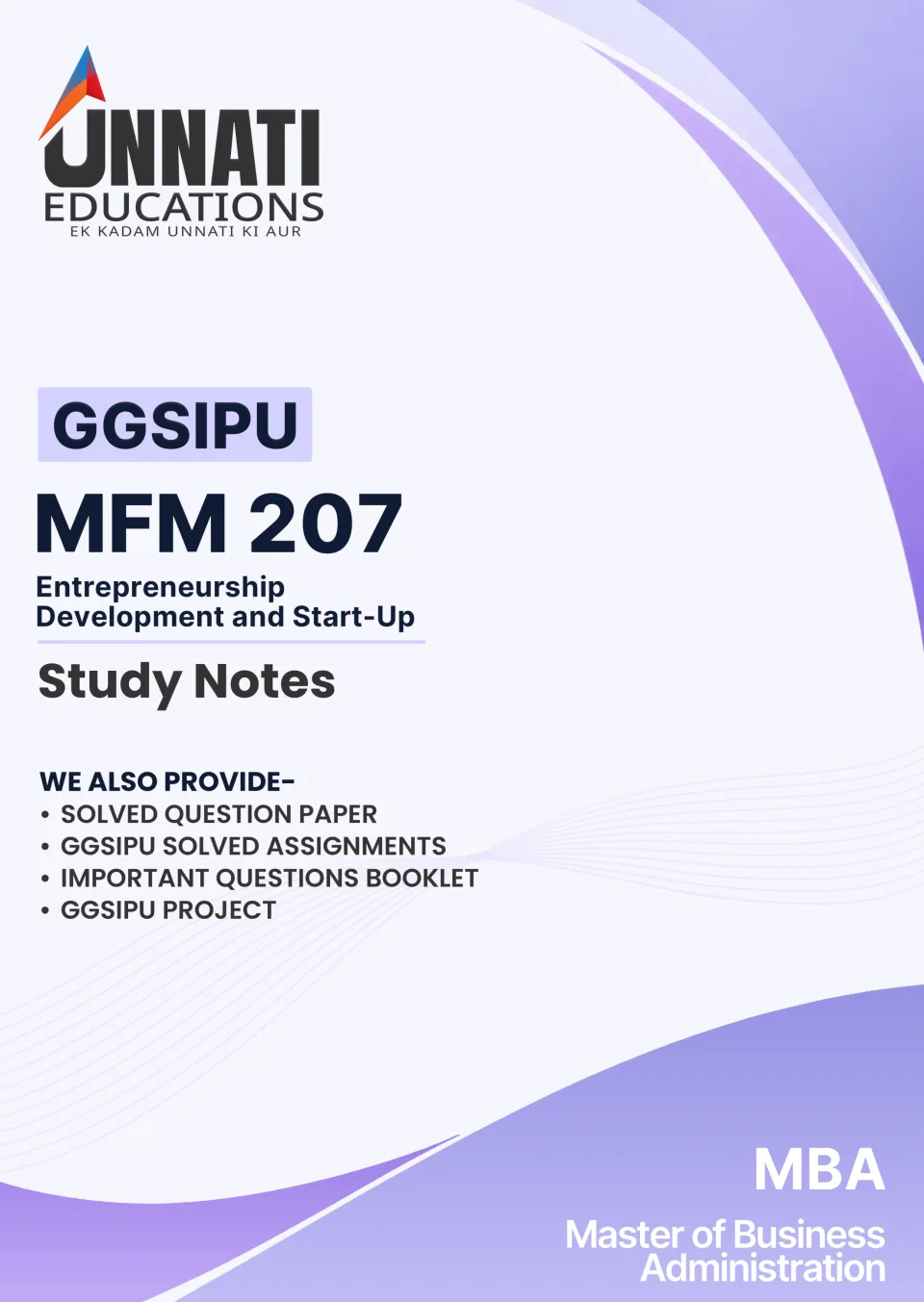
MFM 207 Entrepreneurship Development and Start-Up Notes cover all four units of the GGSIPU MBA (Financial Management) Semester 3 paper. The English printed book is listed as 65 pages and includes 6 worked examples, 10 diagrams, 21 solved short answers and 59 practice questions. Topics include entrepreneurship development programmes, opportunity identification, feasibility studies, MSME registration, PERT/CPM, project appraisal and support institutions. The notes follow the MBA (FM) scheme labelled 2021-22 onwards.
Written by Prateek Talwar, Founder, Unnati Educations · Reviewed by Prateek Talwar, Associate Company Secretary (ACS), ICSI · Checked against the MBA (Financial Management) Scheme and Syllabus, 2021-22 onwards · Updated 14 October 2026 · Editorial policy
Scheme: MBA (FM) 2021-22 onwards | Applies to: batches admitted from 2021-22 onwards under this scheme | Verified against: syllabus mapping supplied in the editorial record; official PDF identified as dated 20 May 2022
MFM 207 Entrepreneurship Development and Start-Up at a glance: GGSIPU MBA (FM) Sem 3 credits, units and exam pattern
MFM 207 is a Core and Interdisciplinary paper in Semester 3 of MBA (Financial Management). It covers entrepreneurship development, business opportunity selection, enterprise launching formalities and institutions supporting small industries.
Code and title | MFM 207 · Entrepreneurship Development and Start-Up |
|---|---|
Course and semester | MBA (Financial Management), Semester 3 |
Category and credits | Core and Interdisciplinary, 3 credits; L-T-P 3-0-0 |
Marks | 100: 25 internal (15-mark class test and 10 marks for other assessment) + 75 end-term |
Pass mark | Not specified in the supplied scheme details; refer to GGSIPU Ordinance 11 and applicable examination notifications |
Applies to | Batches admitted from 2021-22 onwards under the stated scheme |
End-term pattern | 75 marks; detailed question-paper pattern not confirmed in the supplied scheme |
Units and hours | 4 units, 42 teaching hours: 12 + 10 + 8 + 12 |
Paired lab | None |
Unit 3 has the fewest teaching hours but contains the CPM, PERT and project-appraisal worked examples. The supplied Semester 3 scheme summary lists 34 credits in total; this programme-wide figure should be confirmed against the applicable official scheme.
MFM 207 Entrepreneurship Development and Start-Up Notes unit-wise: 6 worked examples and 21 solved short answers across 4 units
The supplied page breakdown places the cover and index on pages 1 to 4, followed by four units on pages 5 to 64. The notes include 10 diagrams and 59 practice questions in addition to the solved short answers.
MFM 207 Unit 1: Entrepreneurship
Unit 1 (pages 5 to 21) contains 16 sections. It begins with the 3S model—stimulate, sustain and support—nine definitions of entrepreneurship and its historical development in India through AtmaNirbhar Bharat. It then covers 12 entrepreneurship myths, growth factors, types of entrepreneurs, 15 McBer competencies, entrepreneurship development programmes, the Kakinada experiment and differences between managers and entrepreneurs. The unit contains 4 diagrams, 6 solved short answers and 17 practice questions.
Type | Attitude to change |
|---|---|
Innovative | Introduces new products, methods or markets. |
Imitative | Adopts or adapts innovations already demonstrated elsewhere. |
Fabian | Resists change until circumstances make adaptation necessary. |
Drone | Continues established methods despite declining returns or changing conditions. |
Quick look: Danhof's four types of entrepreneur (from page 13)
Type
Innovative
Attitude to change
Introduces new products, methods or markets.
Type
Imitative
Attitude to change
Adopts or adapts innovations already demonstrated elsewhere.
Type
Fabian
Attitude to change
Resists change until circumstances make adaptation necessary.
Type
Drone
Attitude to change
Continues established methods despite declining returns or changing conditions.
MFM 207 Unit 2: Opportunity Identification and Product Selection
Unit 2 (pages 22 to 37) contains 18 sections. It explains identifying customer pain points, Drucker's seven sources of opportunity, 11 idea-generation techniques including SCAMPER, screening and seven forms of feasibility analysis. The unit also develops a business plan and specimen project report for the hypothetical NutriBite Foods millet-snacks enterprise. It contains 3 worked examples, 2 diagrams, 5 solved short answers and 14 practice questions.
Idea (six weighted criteria) | Weighted score | Rank |
|---|---|---|
A: Millet snacks unit | 7.60 | 1 |
B: Mobile repair shop | 6.90 | 2 |
C: Rooftop solar installation | 6.75 | 3 |
Quick look: weighted scoring of three business ideas (from page 26)
Idea (six weighted criteria)
A: Millet snacks unit
Weighted score
7.60
Rank
1
Idea (six weighted criteria)
B: Mobile repair shop
Weighted score
6.90
Rank
2
Idea (six weighted criteria)
C: Rooftop solar installation
Weighted score
6.75
Rank
3
The scores are illustrative results from the notes. The six underlying weights and ratings are needed to independently recalculate them.
MFM 207 Unit 3: Enterprise Launching Formalities
Unit 3 (pages 38 to 51) contains 11 sections. Topics include the MSMED Act, 2006, MSME classifications and revisions, a 13-step route to commercial production, Udyam registration, pollution-control permissions, machinery selection, the role of small and medium enterprises, PERT/CPM and six project-appraisal methods. It contains 3 worked examples, 2 diagrams, 5 solved short answers and 12 practice questions, including 3 numerical questions.
Quick look: five-activity PERT network and completion probability (from page 48)
Expected activity time: Use te = (a + 4m + b) / 6. The stated activity times are P = 2, Q = 4, R = 6, S = 3 and T = 4 weeks.
Path comparison: P-Q-S-T takes 13 weeks; P-R-T takes 12 weeks. The first is the critical path on expected durations.
Critical-path variance: 2.778 weeks squared, giving a standard deviation of approximately 1.667 weeks.
Deadline: For 15 weeks, Z = (15 − 13) / 1.667 ≈ 1.20.
Probability: The normal approximation gives approximately 88.5% probability of completion within 15 weeks.
The PERT probability uses the usual normal approximation and assumes the stated critical path remains controlling. The activity-level optimistic and pessimistic estimates are needed to independently verify the path variance.
MFM 207 Unit 4: Role of Support Institutions and Management of Small Industries
Unit 4 (pages 52 to 64) discusses nine support institutions, including the Directorate of Industries, District Industries Centres, NSIC, SIDBI and State Financial Corporations. It also covers five management functions, women's entrepreneurship, bank-support schemes, rural entrepreneurship and the role of NGOs. The unit contains 2 diagrams, 5 solved short answers and 16 practice questions.
Institution | Year | Main role |
|---|---|---|
DIC | 1978 | District-level support and coordination for industrial enterprises. |
NSIC | 1955 | Support for marketing, raw materials and MSME development. |
SIDBI | 1990 | MSME finance, refinance and development support. |
SFC | State Financial Corporations Act, 1951 | State-level term-financing institutions established under the relevant framework. |
Quick look: four support institutions (from page 55)
Institution
DIC
Year
1978
Main role
District-level support and coordination for industrial enterprises.
Institution
NSIC
Year
1955
Main role
Support for marketing, raw materials and MSME development.
Institution
SIDBI
Year
1990
Main role
MSME finance, refinance and development support.
Institution
SFC
Year
State Financial Corporations Act, 1951
Main role
State-level term-financing institutions established under the relevant framework.
MFM 207 exam corner: 21 solved short answers and 59 practice questions on EDPs, MSMEs and support institutions
Unit | Solved short answers | Long-answer practice | Short-answer practice | Numerical practice |
|---|---|---|---|---|
Unit 1 | 6 | 9 | 8 | 0 |
Unit 2 | 5 | 8 | 6 | 0 |
Unit 3 | 5 | 9 | 0 | 3 |
Unit 4 | 5 | 8 | 8 | 0 |
Total | 21 | 34 | 22 | 3 |
MFM 207 question distribution in the notes
Unit
Unit 1
Solved short answers
6
Long-answer practice
9
Short-answer practice
8
Numerical practice
0
Unit
Unit 2
Solved short answers
5
Long-answer practice
8
Short-answer practice
6
Numerical practice
0
Unit
Unit 3
Solved short answers
5
Long-answer practice
9
Short-answer practice
0
Numerical practice
3
Unit
Unit 4
Solved short answers
5
Long-answer practice
8
Short-answer practice
8
Numerical practice
0
Unit
Total
Solved short answers
21
Long-answer practice
34
Short-answer practice
22
Numerical practice
3
The notes contain 21 solved short answers and 59 additional practice questions (34 long-answer, 22 short-answer and 3 numerical), plus 6 worked examples. The source's 12.5-mark and 2.5–5-mark labels are practice categories, not a verified official examination pattern.
One question per unit, with answer pointers:
Unit 1: What is an Entrepreneurship Development Programme? Explain its objectives, phases and problems in India. Pointer: Define EDP, draw its three-phase structure, discuss implementation problems and refer to the Kakinada experiment (pages 16–17).
Unit 2: Distinguish between a business plan and a project report. Pointer: Compare intended users, purpose, focus, financial detail and scope, with reference to page 33.
Unit 3: Define MSMEs under the MSMED Act, 2006 and explain the 2020 and 2025 revisions. Pointer: Present the original, 2020 and 2025 classifications in chronological order (pages 38–39).
Unit 4: Discuss the problems of women entrepreneurs in India and suggest strategies to address them. Pointer: Explain the definition used in the notes, barriers and nine suggested strategies (pages 58–59).
A separate MFM 207 important-questions page is planned; its publication status has not been confirmed.
Pollution Control Board consent (CTE, CTO and colour categories) in enterprise launching: excerpt from page 43 of the MFM 207 notes
Excerpt from page 43
7. NOC from Pollution Control Board
Industries carrying out activities covered by applicable water or air pollution-control consent requirements may need permission from the State Pollution Control Board (SPCB) or the relevant Pollution Control Committee in a Union Territory, such as the DPCC in Delhi. These permissions are commonly referred to as consent or, informally, a no-objection certificate.
7.1 Legal basis
Water (Prevention and Control of Pollution) Act, 1974, particularly Sections 25 and 26.
Air (Prevention and Control of Pollution) Act, 1981, Section 21.
Environment (Protection) Act, 1986, and applicable environmental rules.
Pollution-control categorisation and consent procedures administered through the relevant central and state regulatory frameworks.
7.2 Two stages of consent
Consent to Establish (CTE) is obtained before establishing an activity where applicable. Authorities review the proposed location, process and pollution-control measures. Consent to Operate (CTO) is obtained before commencing operations where required, after compliance with applicable conditions. Validity and renewal requirements depend on the category, jurisdiction and prevailing rules.
7.3 Categorisation of industries
Category | Pollution Index | Examples in the notes | General treatment |
|---|---|---|---|
Red | 60 and above | Cement, sugar, distilleries and tanneries | Higher-pollution category; stringent applicable conditions. |
Orange | 41 to 59 | Food processing with boilers, ceramics | Consent requirements and conditions depend on the specific activity. |
Green | 21 to 40 | Bakery, flour mill, small oil mill | Lower-pollution category, subject to applicable consent requirements. |
White | Up to 20 | Electronics assembly, handloom, solar modules | Generally exempt from conventional consent requirements under the cited framework; applicable intimation or other requirements should be checked. |
Pollution Index bands presented in the notes under the CPCB 2016 framework
Category
Red
Pollution Index
60 and above
Examples in the notes
Cement, sugar, distilleries and tanneries
General treatment
Higher-pollution category; stringent applicable conditions.
Category
Orange
Pollution Index
41 to 59
Examples in the notes
Food processing with boilers, ceramics
General treatment
Consent requirements and conditions depend on the specific activity.
Category
Green
Pollution Index
21 to 40
Examples in the notes
Bakery, flour mill, small oil mill
General treatment
Lower-pollution category, subject to applicable consent requirements.
Category
White
Pollution Index
Up to 20
Examples in the notes
Electronics assembly, handloom, solar modules
General treatment
Generally exempt from conventional consent requirements under the cited framework; applicable intimation or other requirements should be checked.
The bands and examples reproduce the framework discussed in the notes; current categorisation, consent exemptions and activity-specific classifications must be checked with the relevant authority before relying on them for compliance.
7.4 Procedure to obtain consent
Identify the industry's applicable pollution-control category using the relevant authority's current classification.
Where CTE is required, submit the application through the prescribed online consent or single-window system.
Provide the applicable site plan, project details, process-flow information, material and water-use estimates, emission and effluent information, pollution-control measures and supporting documents.
Pay the applicable consent fee and complete any inspection or clarification process.
Obtain the required permission and, before starting operations, complete the applicable CTO process.
The notes continue on page 44 with inspection, grant of consent and renewal procedures.
Do the MFM 207 notes cover the full GGSIPU syllabus?
The supplied editorial mapping identifies corresponding sections for all four MFM 207 syllabus units. A complete independent topic-by-topic check against the finished printed book remains pending.
Official unit | Official topics | In the notes | Status |
|---|---|---|---|
I: Entrepreneurship | Concept, definitions, history, development in India, myths, growth factors, types, competencies, barriers, EDPs, traits and manager versus entrepreneur | Sections 1–16, pages 5–19 | Mapped in supplied record |
II: Opportunity Identification and Product Selection | Opportunity search, idea generation and screening, product selection, feasibility, business plans and project reports | Sections 1–18, pages 22–36 | Mapped in supplied record |
III: Enterprise Launching Formalities | MSMED Act, enterprise registration, pollution consent, machinery, SMEs, PERT/CPM and appraisal | Sections 1–11, pages 38–50 | Mapped in supplied record |
IV: Support Institutions and Management of Small Industries | Support institutions, management functions, export marketing, women's and rural entrepreneurship, NGOs | Sections 1–5, pages 52–63 | Mapped in supplied record |
MFM 207 official syllabus topics mapped to the notes
Official unit
I: Entrepreneurship
Official topics
Concept, definitions, history, development in India, myths, growth factors, types, competencies, barriers, EDPs, traits and manager versus entrepreneur
In the notes
Sections 1–16, pages 5–19
Status
Mapped in supplied record
Official unit
II: Opportunity Identification and Product Selection
Official topics
Opportunity search, idea generation and screening, product selection, feasibility, business plans and project reports
In the notes
Sections 1–18, pages 22–36
Status
Mapped in supplied record
Official unit
III: Enterprise Launching Formalities
Official topics
MSMED Act, enterprise registration, pollution consent, machinery, SMEs, PERT/CPM and appraisal
In the notes
Sections 1–11, pages 38–50
Status
Mapped in supplied record
Official unit
IV: Support Institutions and Management of Small Industries
Official topics
Support institutions, management functions, export marketing, women's and rural entrepreneurship, NGOs
In the notes
Sections 1–5, pages 52–63
Status
Mapped in supplied record
The supplied record notes that the syllabus uses the spelling “NISBUD”, while the notes use “NIESBUD”. This naming difference should be verified against the official MBA (Financial Management) syllabus before publication. The record identifies MFM 207 on PDF pages 50–51.
Who writes and checks the MFM 207 Entrepreneurship notes?
Prateek Talwar, author: Founder, Unnati Educations; Associate Company Secretary (ACS), ICSI, membership no. 58704, since 15 May 2019; B.Com, University of Delhi (School of Open Learning), 2012. Author profile
Prateek Talwar is also identified as the subject reviewer. The editorial record states that each unit was mapped to the MBA (FM) scheme labelled 2021-22 onwards. The 2026–27 edition includes the MSME classification revisions effective from 1 April 2025.
Last updated 14 October 2026. See the editorial policy for information on reviews and corrections.
MFM 207 and the GGSIPU MBA (FM) Sem 3 papers it connects to
Paired lab: None. MFM 207 is a 3-credit theory paper without a paired practical paper.
MFM 205 Financial Markets and Institutions: SIDBI refinance and State Financial Corporation financing discussed in Unit 4.
MFM 209 Strategic Financial Management: NPV and IRR tools used in Unit 3 project appraisal.
MFM 219 Venture Capital and Investment Banking: Start-up financing and enterprise support discussed in Units 1 and 4.
Group | Papers |
|---|---|
Training | MFM 201 Summer Training Report |
Finance | MFM 203 Financial Derivatives |
Analytics | MFM 211 Business Analytics and MFM 227 Business Analytics Lab |
Open elective | MFM 213 MOOCs / Open Elective |
Electives | Elective papers including MFM 219, subject to the student's selected group |
Other Semester 3 papers identified in the supplied MBA (FM) scheme summary
Group
Training
Papers
MFM 201 Summer Training Report
Group
Finance
Papers
MFM 203 Financial Derivatives
Group
Analytics
Papers
MFM 211 Business Analytics and MFM 227 Business Analytics Lab
Group
Open elective
Papers
MFM 213 MOOCs / Open Elective
Group
Electives
Papers
Elective papers including MFM 219, subject to the student's selected group
How to write MFM 207 answers: three-angle definitions, comparison tables, process diagrams and short appraisal numericals
For a long-answer entrepreneurship definition, the notes recommend explaining at least three perspectives: Cantillon on risk, Schumpeter on innovation and Hisrich or Drucker on entrepreneurial processes. Follow with a combined definition in your own words.
Unit 1 and Unit 4 answers benefit from clear diagrams and comparison tables. Draw the three-phase EDP process, identify the Kakinada experiment and distinguish support institutions such as DIC, NSIC and SIDBI by their principal functions.
For Unit 3 MSME questions, begin with the original 2006 classification and then explain the 2020 and 2025 changes. Under the revised classification stated in the notes as effective 1 April 2025, the investment and turnover ceilings are: micro ₹2.5 crore and ₹10 crore; small ₹25 crore and ₹100 crore; medium ₹125 crore and ₹500 crore. Both criteria apply together.
For distinction questions, use a table with six to eight relevant bases. The notes compare managers and entrepreneurs, PERT and CPM, and business plans and project reports. For idea generation, demonstrate SCAMPER using a familiar product, such as a water bottle.
Worked example: payback, NPV, profitability index and IRR (pages 49–50)
A proposed project requires an initial investment of ₹10 lakh and is expected to produce annual cash inflows of ₹3 lakh, ₹4 lakh, ₹4 lakh and ₹3 lakh over four years. The cost of capital is 10%.
Payback period: The first two years recover ₹7 lakh. The remaining ₹3 lakh is recovered from year 3's ₹4 lakh inflow, giving 2 + 3/4 = 2.75 years.
Present value of inflows: Discounting the four inflows at 10% gives approximately ₹11.084 lakh.
Net present value: ₹11.084 lakh − ₹10 lakh = approximately ₹1.084 lakh.
Profitability index: 11.084 / 10 = approximately 1.1084, or 1.11.
Internal rate of return: The discount rate making NPV zero is approximately 14.90%.
The positive NPV, profitability index above one and IRR exceeding the 10% cost of capital support acceptance under these assumptions. Payback alone does not establish the project's profitability.
For PERT answers, calculate expected times and variances, identify the critical path and explain any important near-critical path risks.
MFM 207 Entrepreneurship notes FAQs
How do I get the full MFM 207 notes?
Use the WhatsApp ordering button below to request the complete printed English notes book. The full book is not offered as a PDF download. A separate eight-page sample PDF is planned.
Is MFM 207 a core paper, and how many credits does it carry?
Yes. Under the supplied MBA (Financial Management) scheme, MFM 207 is a Core and Interdisciplinary Semester 3 paper carrying 3 credits with three lecture hours per week and no paired practical.
What is the passing mark for MFM 207?
MFM 207 carries 25 internal and 75 end-term marks. The supplied scheme details do not specify a separate pass percentage. Refer to Ordinance 11 and applicable university notifications for examination and result requirements.
Which MFM 207 unit has the numericals?
Unit 3 contains worked CPM, PERT and project-appraisal problems, including payback, NPV, profitability index and IRR, along with three numerical practice questions. Unit 2 also includes break-even and debt-service coverage calculations in its specimen project report.
Do the MFM 207 notes include the MSME limits introduced in 2025?
Yes. Unit 3 includes the original MSMED Act, 2006 classification, the composite criteria introduced in 2020 and the revised investment and turnover limits effective from 1 April 2025. Current eligibility should be checked against the applicable government notification.
Do the MFM 207 notes include a specimen project report?
Yes. Pages 34–36 describe the hypothetical NutriBite Foods millet-snacks project, with a ₹22 lakh proposed project cost, promoter and term-loan financing, year-one profitability at 60% capacity, an estimated break-even level of 39.4% of installed capacity and a DSCR working. The associated business plan appears on pages 32–33.
Get the full MFM 207 Entrepreneurship Development and Start-Up Notes on WhatsApp
The English printed book is listed as 65 pages and includes 6 worked examples, 10 diagrams, 21 solved short answers and 59 practice questions.
Part | Pages | Worked examples | Diagrams |
|---|---|---|---|
Cover and index | 1–4 (4) | — | — |
5–21 (17) | 0 | 4 | |
22–37 (16) | 3 | 2 | |
38–51 (14) | 3 | 2 | |
Unit 4: Support Institutions and Management of Small Industries | 52–64 (13) | 0 | 2 |
Final page to confirm | 65 (1; content not identified) | — | — |
Listed book total | 65 | 6 | 10 |
MFM 207 printed notes: documented pages and content
Part
Cover and index
Pages
1–4 (4)
Worked examples
—
Diagrams
—
Pages
5–21 (17)
Worked examples
0
Diagrams
4
Pages
22–37 (16)
Worked examples
3
Diagrams
2
Pages
38–51 (14)
Worked examples
3
Diagrams
2
Pages
52–64 (13)
Worked examples
0
Diagrams
2
Part
Final page to confirm
Pages
65 (1; content not identified)
Worked examples
—
Diagrams
—
Part
Listed book total
Pages
65
Worked examples
6
Diagrams
10
Pages 1–64 are documented in the supplied breakdown. The content of page 65 remains to be confirmed against the finished printed book.
Delivery: within 5 to 7 days at most; the exact time may vary with your location.
Order the MFM 207 notes book on WhatsApp (4 units, 65 pages)
Unnati Educations is an independent education provider based in Vikaspuri, Delhi. We are not affiliated with, authorised by, or endorsed by Guru Gobind Singh Indraprastha University (GGSIPU). 'GGSIPU' and 'IPU' are used only to describe the syllabus our notes follow. For official information, visit ipu.ac.in.
Ready for the full notes?
Discuss coverage and delivery with our team.