
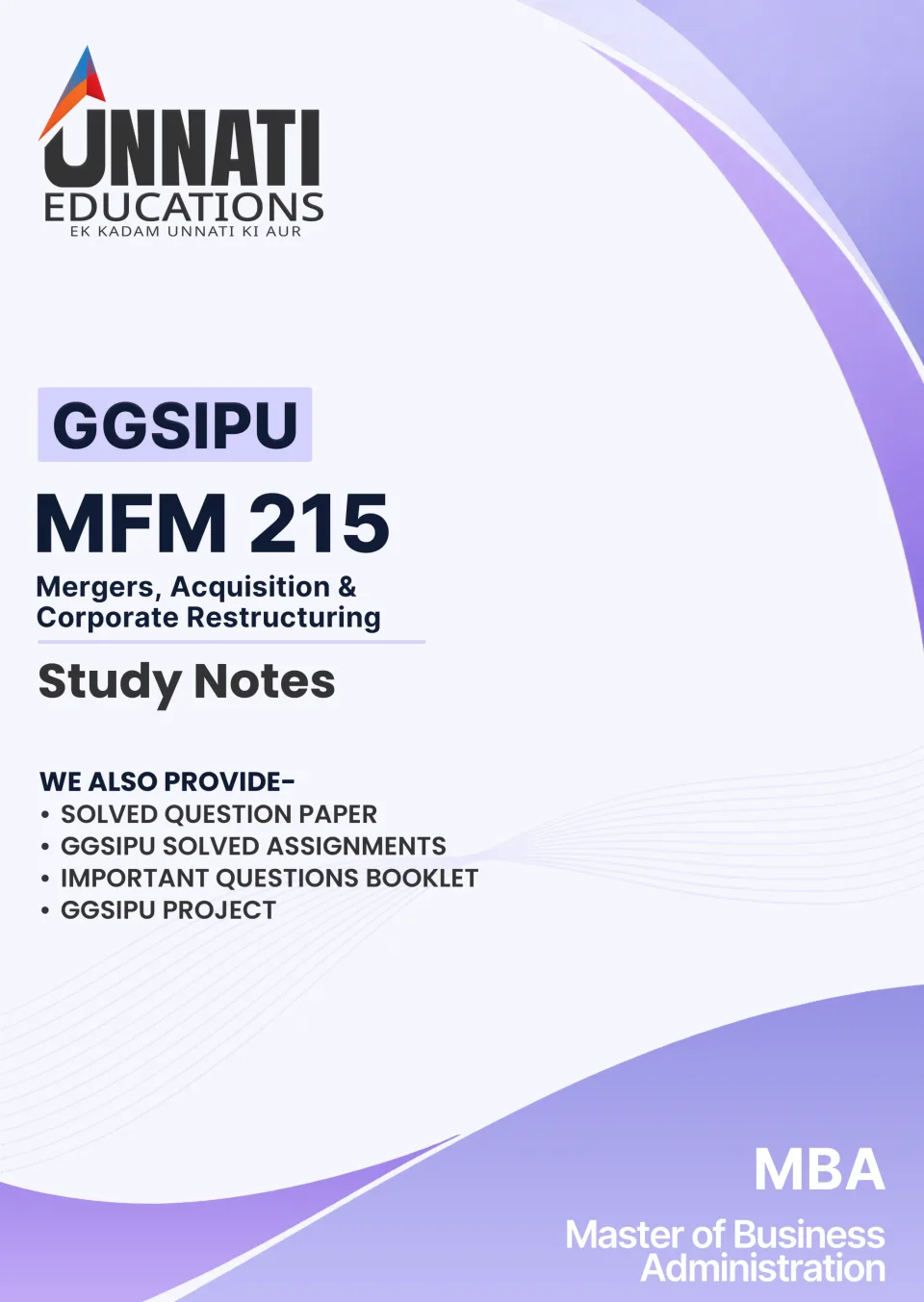
MFM 215 Mergers, Acquisitions and Corporate Restructuring Notes cover all four units of the GGSIPU MBA (Financial Management) Semester 3 elective. The English printed book is listed as 55 pages and contains 17 worked numerical illustrations, 16 figures and 57 exam-style questions, including 32 short-answer and 25 long-answer questions. Topics include corporate restructuring, mergers and amalgamations, AS 14 accounting, takeovers, internal reconstruction, discounted cash flow valuation, EVA and CFROI. The notes follow the MBA (FM) scheme labelled 2021-22 onwards and are available as a printed book ordered through WhatsApp.
Written by Prateek Talwar, Founder, Unnati Educations · Reviewed by Prateek Talwar · Checked against the MBA (Financial Management) Scheme and Syllabus, 2021-22 onwards · Updated 14 October 2026 · Editorial policy
Scheme: MBA (FM) 2021-22 onwards | Applies to: batches under the stated scheme | Verified against: supplied syllabus mapping; last recorded check 13 October 2026
MFM 215 Mergers, Acquisitions and Corporate Restructuring at a glance: GGSIPU MBA (FM) Sem 3 credits, units and exam pattern
MFM 215 is a Semester 3 elective covering restructuring strategies, amalgamation accounting, takeover regulations, internal reconstruction and valuation methods. The supplied scheme lists four units and 42 teaching hours.
Code and title | MFM 215 · Mergers, Acquisitions and Corporate Restructuring |
|---|---|
Course and semester | |
Category and credits | Elective, 3 credits; L-3 |
Marks | 100: 25 internal (15 class test + 10 assignments, presentation, viva or participation) + 75 end-term |
Pass mark | Not specified in the supplied scheme details; check GGSIPU Ordinance 11 and applicable examination notifications |
Applies to | Batches covered by the MBA (FM) scheme labelled 2021-22 onwards |
End-term pattern | 75 marks; detailed official question-paper pattern not confirmed. The notes label practice questions as 2.5–5 marks and 12.5 marks. |
Units and hours | 4 units, 42 teaching hours: 10 + 10 + 10 + 12 |
Paired lab | None. MFM 227 Business Analytics Lab is associated with MFM 211, not MFM 215. |
The supplied editorial mapping places MFM 215 on page 57 of the official syllabus PDF. The source also identifies MFM 215 as one of six Semester 3 elective options.
MFM 215 Mergers, Acquisitions and Corporate Restructuring Notes unit-wise: 17 worked numericals and 57 exam questions across 4 units
The four units cover corporate restructuring, amalgamation accounting, takeover rules, internal reconstruction and valuation. Each unit includes revision material and exam-style questions. The documented unit pages run from 4 to 54.
MFM 215 Unit 1: Meaning of Corporate Restructuring
Unit 1 (pages 4 to 18) explains portfolio, financial, ownership and organisational restructuring. Its 16 topics cover restructuring modes, seven global M&A waves, Indian developments, disinvestment, strategic alliances, demerger, hive-off, slump sale, asset sale, reverse demerger, regulatory considerations and common M&A pitfalls. It contains 7 figures, 1 worked numerical, 8 short-answer questions and 7 long-answer questions.
Quick look: slump sale capital-gain illustration under the source's Section 50B reference (from page 14)
Step | Working |
|---|---|
Consideration used in the example | Higher of ₹50 crore stated consideration and ₹48 crore stated fair market value = ₹50 crore |
Less: net worth | ₹32 crore |
Illustrative capital gain | ₹18 crore |
Illustrative slump sale calculation
Step
Consideration used in the example
Working
Higher of ₹50 crore stated consideration and ₹48 crore stated fair market value = ₹50 crore
Step
Less: net worth
Working
₹32 crore
Step
Illustrative capital gain
Working
₹18 crore
The arithmetic is ₹50 crore − ₹32 crore = ₹18 crore. The source describes this as a long-term capital gain without indexation. Actual tax treatment depends on the applicable statutory provisions, valuation rules and holding-period facts; the example does not independently establish them.
MFM 215 Unit 2: Merger and Amalgamation
Unit 2 (pages 19 to 30) contains 11 topics on amalgamation conditions, the Section 2(1B) shareholder test, AS 14 pooling and purchase methods, purchase consideration, journal entries, realisation accounts, inter-company holdings, tax provisions, Companies Act procedures and Ind AS 103. It includes 2 figures, 4 worked illustrations, 8 short-answer questions and 5 long-answer questions.
Quick look: share-exchange ratio using intrinsic values (from page 22)
Intrinsic value per share of A Ltd. = ₹40.
Intrinsic value per share of B Ltd. = ₹30.
Exchange ratio = 30 ÷ 40 = 0.75, or 3 shares of A Ltd. for every 4 shares of B Ltd.
If B Ltd. has 80,000 shares, A Ltd. issues 80,000 × 3/4 = 60,000 shares.
This is an intrinsic-value-based illustration; an actual transaction's negotiated exchange ratio can also reflect other valuation and commercial considerations.
MFM 215 Unit 3: Takeovers & Internal Reconstruction
Unit 3 (pages 31 to 43) has 15 topics and 4 figures. Part A introduces takeover types, defensive tactics, the SEBI Substantial Acquisition of Shares and Takeovers Regulations, 2011, consideration, accounting, tax, stamp duty and revival-related acquisitions. Part B discusses share-capital reorganisation and internal reconstruction, including Sections 61 and 66 of the Companies Act and an R Ltd. reconstruction illustration. It includes 1 worked numerical, 8 short-answer questions and 6 long-answer questions.
Quick look: R Ltd.'s Capital Reduction Account (from pages 40–41)
Particulars | Amount |
|---|---|
Total sacrifices from equity, preference capital and creditors | ₹6,70,000 |
Goodwill, debit balance, asset write-downs and provisions adjusted | ₹6,20,000 |
Balance transferred to Capital Reserve | ₹50,000 |
Capital Reduction Account summary
Particulars
Total sacrifices from equity, preference capital and creditors
Amount
₹6,70,000
Particulars
Goodwill, debit balance, asset write-downs and provisions adjusted
Amount
₹6,20,000
Particulars
Balance transferred to Capital Reserve
Amount
₹50,000
The summary reconciles because ₹6,70,000 − ₹6,20,000 = ₹50,000. The individual ledger entries require the full R Ltd. illustration.
MFM 215 Unit 4: Approaches to Valuation
Unit 4 (pages 44 to 54) contains 11 topics and 3 figures. It explains net-asset, yield and Gordon-model share valuations; business valuation through discounted cash flows and multiples; goodwill and brand valuation; private-company valuation using bottom-up beta; loss-making firms; start-ups and venture-capital methods; Rappaport's value drivers; EVA, MVA and CFROI. It has 11 worked numericals, 8 short-answer questions and 7 long-answer questions.
Quick look: synergy and maximum acquisition price (from page 48)
Measure | ₹ crore |
|---|---|
Combined value less standalone values: 1,100 − (800 + 200) | 100 |
Acquisition premium: 260 − 200 | 60 |
Net value to acquirer: 100 − 60 | 40 |
Maximum price before eliminating the acquirer's synergy benefit: 200 + 100 | 300 |
Illustrative acquisition synergy calculation
Measure
Combined value less standalone values: 1,100 − (800 + 200)
₹ crore
100
Measure
Acquisition premium: 260 − 200
₹ crore
60
Measure
Net value to acquirer: 100 − 60
₹ crore
40
Measure
Maximum price before eliminating the acquirer's synergy benefit: 200 + 100
₹ crore
300
The ₹300 crore ceiling assumes that the entire ₹100 crore synergy is available to the acquirer and ignores additional deal costs, financing effects and execution risk.
Pooling of interests vs purchase method in amalgamation accounting: excerpt from page 21 of the MFM 215 notes
Excerpt from page 21
Pooling of Interests Method
Under the AS 14 pooling method, assets, liabilities and reserves of the transferor are generally carried forward at existing book values, with the identity of reserves preserved. The difference between the consideration represented by shares issued and the transferor's share capital is adjusted in reserves according to the applicable accounting requirements.
The source explains that differences in accounting policies are addressed by adopting uniform policies and recognising the resulting adjustments. It describes pooling as appropriate for an amalgamation in the nature of merger when the relevant conditions are satisfied.
Purchase Method
Under the AS 14 purchase method, the transferee accounts for the business acquired and the consideration paid. Assets and liabilities may be recorded at existing carrying amounts or adjusted values, as permitted by the applicable accounting framework.
Identify the assets and liabilities taken over by the transferee.
Determine the purchase consideration.
Record the acquired net assets using the applicable measurement basis.
Recognise goodwill where consideration exceeds the relevant net assets acquired, or a capital reserve where the reverse applies under the applicable accounting treatment.
Account separately for statutory reserves when their continuation is legally required.
Apply the relevant accounting requirements to goodwill and any amalgamation adjustment reserve.
The source describes goodwill amortisation under AS 14, generally over a period not exceeding five years unless a longer period is justified. This must not be confused with the different goodwill treatment applicable under Ind AS 103.
Basis | Pooling of interests | Purchase method |
|---|---|---|
Nature of amalgamation | Amalgamation in the nature of merger | Amalgamation in the nature of purchase |
Assets and liabilities | Generally carried at existing book values | Recorded at carrying amounts or adjusted values, as applicable |
Transferor's reserves | Identity generally preserved | Generally not carried forward, except statutory reserves where required |
Goodwill or capital reserve | Difference in share capital and consideration adjusted in reserves | May arise from the purchase accounting calculation |
Consideration | Relevant merger conditions require equity-share consideration, apart from permitted fractional-share cash adjustments | May involve shares, cash or other forms of consideration |
Ind AS comparison | Common-control combinations are addressed by Ind AS 103 Appendix C | Other business combinations are generally addressed through the Ind AS 103 acquisition method |
Pooling of interests method vs purchase method under AS 14
Basis
Nature of amalgamation
Pooling of interests
Amalgamation in the nature of merger
Purchase method
Amalgamation in the nature of purchase
Basis
Assets and liabilities
Pooling of interests
Generally carried at existing book values
Purchase method
Recorded at carrying amounts or adjusted values, as applicable
Basis
Transferor's reserves
Pooling of interests
Identity generally preserved
Purchase method
Generally not carried forward, except statutory reserves where required
Basis
Goodwill or capital reserve
Pooling of interests
Difference in share capital and consideration adjusted in reserves
Purchase method
May arise from the purchase accounting calculation
Basis
Consideration
Pooling of interests
Relevant merger conditions require equity-share consideration, apart from permitted fractional-share cash adjustments
Purchase method
May involve shares, cash or other forms of consideration
Basis
Ind AS comparison
Pooling of interests
Common-control combinations are addressed by Ind AS 103 Appendix C
Purchase method
Other business combinations are generally addressed through the Ind AS 103 acquisition method
AS 14 and Ind AS 103 operate under different accounting frameworks. Their treatments should be compared carefully rather than treated as interchangeable.
How to write MFM 215 answers: twelve-and-a-half-mark theory answers, AS 14 journal entries and valuation workings
MFM 215 combines restructuring theory, legal and regulatory provisions, amalgamation entries and valuation numericals. The notes use 12.5-mark labels for long-answer practice, but the supplied syllabus does not independently confirm that as the official end-term question format.
Restructuring theory: Draw the modes-of-restructuring diagram referenced as Figure 1.3. Explain expansion, contraction, ownership and control, and collaboration with examples.
Takeover regulation: Organise an answer around SEBI SAST objectives, acquisition triggers, open-offer procedures, pricing, disclosures, escrow and exemptions. Check current regulatory thresholds before quoting them.
Amalgamation accounting: Distinguish the shareholder test under the tax provisions from the conditions for merger accounting under AS 14. Show the purchase consideration working, journal entries and relevant reserves.
Tax section numbers: The notes refer to familiar Income-tax Act, 1961 provisions such as Sections 2(19AA), 50B and 72A and discuss the Income-tax Act, 2025. Use the section numbering applicable to the examination and relevant tax period rather than assuming identical numbering across the two Acts.
Valuation numericals: State assumptions, write the formula, show calculations and interpret the result. For DCF, discuss sensitivity to WACC and terminal growth.
Worked example: Economic Value Added of E Ltd. (page 52)
Operating profit before tax = ₹200 crore; tax rate = 25%.
NOPAT = 200 × (1 − 0.25) = ₹150 crore.
Invested capital = ₹1,000 crore; WACC = 12%.
Capital charge = 1,000 × 12% = ₹120 crore.
EVA = NOPAT − capital charge = 150 − 120 = ₹30 crore.
ROIC = 150 / 1,000 × 100 = 15%, exceeding the 12% WACC by 3 percentage points.
Under these assumptions, positive EVA indicates that operating profit after tax exceeds the required capital charge.
MFM 215 exam corner: 32 short-answer and 25 twelve-and-a-half-mark practice questions by unit
Unit | Short practice | Long practice | Worked numericals |
|---|---|---|---|
Unit 1: Corporate restructuring | 8 | 7 | 1 |
Unit 2: Merger and amalgamation | 8 | 5 | 4 |
Unit 3: Takeovers and reconstruction | 8 | 6 | 1 |
Unit 4: Valuation | 8 | 7 | 11 |
Total | 32 | 25 | 17 |
MFM 215 exam-style questions and worked numericals per unit
Unit
Unit 1: Corporate restructuring
Short practice
8
Long practice
7
Worked numericals
1
Unit
Unit 2: Merger and amalgamation
Short practice
8
Long practice
5
Worked numericals
4
Unit
Unit 3: Takeovers and reconstruction
Short practice
8
Long practice
6
Worked numericals
1
Unit
Unit 4: Valuation
Short practice
8
Long practice
7
Worked numericals
11
Unit
Total
Short practice
32
Long practice
25
Worked numericals
17
Total: 57 exam-style questions (32 short and 25 long) and 17 worked numericals. The source labels short questions as 2.5–5 marks and long questions as 12.5 marks; those labels are not independently verified as the official examination pattern.
One question per unit, with answer pointers:
Unit 1: Distinguish between demerger and hive-off. Pointer: Compare the transaction structure, who receives consideration and the applicable legal and tax conditions. The notes discuss these distinctions on page 13.
Unit 2: Distinguish between appointed date and effective date in a merger scheme. Pointer: Explain the date specified for the scheme's accounting and legal operation and the date on which the prescribed effectiveness conditions are fulfilled. The exact consequences depend on the sanctioned scheme and applicable law.
Unit 3: What is a bail-out takeover? Pointer: Explain acquisition or rescue of a financially distressed business, possible revival arrangements and the Tech Mahindra–Satyam example discussed in the notes. Distinguish this historical example from an acquisition specifically conducted under the IBC.
Unit 4: What is a discount for lack of marketability (DLOM)? Pointer: Define the valuation adjustment reflecting the difficulty of selling an illiquid ownership interest. Its size depends on the asset, restrictions, evidence and valuation circumstances; a fixed 20–30% discount is not universally applicable.
The separate MFM 215 important-questions page is planned; its live publication is not confirmed.
MFM 215 and the GGSIPU MBA (FM) Sem 3 papers it connects to
Paired lab: None. MFM 215 is an elective theory paper and has no separately identified practical component.
MFM 209 Strategic Financial Management: Connects to swap ratios, buy-backs, leveraged buyouts and demergers.
MFM 219 Venture Capital and Investment Banking: Relates to start-up valuation and the venture-capital method.
MFM 217 International Financial Management: Connects to international joint ventures and cross-border restructuring.
MFM 206 Business Valuation, Semester 4: Extends the valuation concepts introduced in Unit 4.
Group | Papers |
|---|---|
Training | MFM 201 Summer Training Report |
Finance core papers | MFM 203 Financial Derivatives; MFM 205 Financial Markets and Institutions; MFM 209 Strategic Financial Management |
Entrepreneurship | |
Analytics | MFM 211 Business Analytics; MFM 227 Business Analytics Lab |
Open elective | MFM 213 MOOCs / Open Elective |
Other elective options | MFM 217 International Financial Management; MFM 219 Venture Capital and Investment Banking; MFM 221 Financial Econometrics; MFM 223 Data Visualization for Decision Making; MFM 225. |
Other MBA (FM) Semester 3 papers and elective options in the supplied scheme summary
Group
Training
Papers
MFM 201 Summer Training Report
Group
Finance core papers
Group
Entrepreneurship
Group
Analytics
Papers
MFM 211 Business Analytics; MFM 227 Business Analytics Lab
Group
Open elective
Papers
MFM 213 MOOCs / Open Elective
Group
Other elective options
Who writes and checks the MFM 215 M&A notes?
Prateek Talwar, author: Founder, Unnati Educations; Associate Company Secretary (ACS), ICSI, membership no. 58704, since 15 May 2019; B.Com, University of Delhi (School of Open Learning), 2012. Author profile
Prateek Talwar is also named as the reviewer in the supplied editorial record. The notes follow the GGSIPU MBA (FM) scheme labelled 2021-22 onwards.
The source describes a 2026–27 edition covering the Income-tax Act, 2025, the CCI deal-value threshold and the ITC Hotels demerger. The precise legal and transaction details of those updates have not been independently verified in this audit.
Last updated 14 October 2026; last recorded syllabus check 13 October 2026. See the editorial policy for the site's review approach.
Do the MFM 215 notes cover the full GGSIPU syllabus?
The supplied mapping identifies coverage for all four official units. However, negotiation techniques mentioned in course outcomes CO4 and CO5 do not have a separate chapter and are described only briefly on page 9. Complete coverage should therefore not be presented as independently verified.
Official unit | Official topics | Where in the notes | Status |
|---|---|---|---|
I: Meaning of Corporate Restructuring | Needs, scope, modes, Indian and global developments, M&A strategies, takeovers, disinvestment, alliances, demerger, hive-off, slump sale, asset sale, reverse demerger and regulatory aspects | Topics 1–16, pages 4–17; revision and questions continue to page 18 | Mapped in source |
II: Merger and Amalgamation | AS 14, pooling and purchase methods, goodwill, capital reserve, purchase consideration, inter-company holdings, accounting, tax and Companies Act provisions | Topics 1–11, pages 19–29; unit continues to page 30 | Mapped in source |
III: Takeovers & Internal Reconstruction | Takeover types, SEBI rules, accounting, tax, stamp duty, payment, bail-out takeovers, sick units, capital reorganisation and reconstruction | Part A pages 31–37; Part B pages 37–42; unit continues to page 43 | Mapped in source |
IV: Approaches to Valuation | Share, business and intangible valuation, private and loss-making companies, start-ups, DCF, value enhancement, EVA and CFROI | Topics 1–11, pages 44–54 | Mapped in source |
MFM 215 syllabus units mapped to the printed notes
Official unit
I: Meaning of Corporate Restructuring
Official topics
Needs, scope, modes, Indian and global developments, M&A strategies, takeovers, disinvestment, alliances, demerger, hive-off, slump sale, asset sale, reverse demerger and regulatory aspects
Where in the notes
Topics 1–16, pages 4–17; revision and questions continue to page 18
Status
Mapped in source
Official unit
II: Merger and Amalgamation
Official topics
AS 14, pooling and purchase methods, goodwill, capital reserve, purchase consideration, inter-company holdings, accounting, tax and Companies Act provisions
Where in the notes
Topics 1–11, pages 19–29; unit continues to page 30
Status
Mapped in source
Official unit
III: Takeovers & Internal Reconstruction
Official topics
Takeover types, SEBI rules, accounting, tax, stamp duty, payment, bail-out takeovers, sick units, capital reorganisation and reconstruction
Where in the notes
Part A pages 31–37; Part B pages 37–42; unit continues to page 43
Status
Mapped in source
Official unit
IV: Approaches to Valuation
Official topics
Share, business and intangible valuation, private and loss-making companies, start-ups, DCF, value enhancement, EVA and CFROI
Where in the notes
Topics 1–11, pages 44–54
Status
Mapped in source
Official reference: MBA (Financial Management) Scheme and Syllabus, 2021-22 onwards. The supplied mapping identifies MFM 215 on page 57.
MFM 215 M&A notes FAQs
How do I get the full MFM 215 notes?
Use the WhatsApp ordering button below to request the English printed book. The source lists 55 pages covering four units. The complete book is not supplied as a PDF; a seven-page sample PDF is planned. Delivery normally takes up to 5 to 7 days, depending on location.
Is MFM 215 a core paper or an elective in GGSIPU MBA (FM)?
MFM 215 is listed as a 3-credit Semester 3 elective with three lecture hours and 42 teaching hours across four units. The supplied scheme summary lists six Semester 3 elective options and states that students select four, subject to the applicable programme structure.
What is the passing mark for MFM 215?
The paper carries 100 marks: 25 internal and 75 end-term. A specific passing percentage is not stated in the supplied scheme details. Refer to GGSIPU Ordinance 11 and applicable examination notifications.
Which MFM 215 unit has the most numericals?
Unit 4, Approaches to Valuation, contains 11 of the 17 worked numerical illustrations. These include share valuation, DCF, acquisition synergy, goodwill, brand valuation, beta, venture-capital valuation, EVA and CFROI. Unit 2 has four amalgamation illustrations, while Units 1 and 3 have one each.
Do the MFM 215 notes use Income-tax Act, 1961 or 2025 section numbers?
The source says the notes retain familiar Income-tax Act, 1961 section references, including Sections 2(1B), 2(19AA), 2(42C), 47, 50B and 72A. It also discusses the Income-tax Act, 2025, stated to apply from 1 April 2026. Students should check the relevant law and section numbering for the tax period and examination in question.
Does MFM 215 follow AS 14 or Ind AS 103 for amalgamation accounting?
The supplied syllabus mapping names AS 14, and the notes cover its merger conditions, pooling and purchase methods, goodwill, capital reserve, statutory reserves and journal entries. Ind AS 103 is introduced separately on page 29 for comparison, including acquisition-method accounting and differences in goodwill treatment.
Get the full MFM 215 Mergers, Acquisitions and Corporate Restructuring Notes on WhatsApp
The English printed book is listed as 55 pages with 17 worked numericals, 16 figures and 57 exam-style questions.
Part | Pages | Numericals | Exam questions |
|---|---|---|---|
Cover and index | 1–3 (3) | — | — |
4–18 (15) | 1 | 15 | |
19–30 (12) | 4 | 13 | |
31–43 (13) | 1 | 14 | |
44–54 (11) | 11 | 15 | |
Final page to confirm | 55 (1; content not identified) | — | — |
Listed book total | 55 | 17 | 57 |
MFM 215 printed notes: documented page allocation and contents
Part
Cover and index
Pages
1–3 (3)
Numericals
—
Exam questions
—
Pages
4–18 (15)
Numericals
1
Exam questions
15
Pages
19–30 (12)
Numericals
4
Exam questions
13
Pages
31–43 (13)
Numericals
1
Exam questions
14
Pages
44–54 (11)
Numericals
11
Exam questions
15
Part
Final page to confirm
Pages
55 (1; content not identified)
Numericals
—
Exam questions
—
Part
Listed book total
Pages
55
Numericals
17
Exam questions
57
The documented ranges cover pages 1–54. The content of page 55 needs confirmation against the final printed book.
Delivery: within 5 to 7 days at most; the exact time may vary with your location.
Order the MFM 215 notes book on WhatsApp (4 units, 55 pages)
Unnati Educations is an independent education provider based in Vikaspuri, Delhi. We are not affiliated with, authorised by, or endorsed by Guru Gobind Singh Indraprastha University (GGSIPU). 'GGSIPU' and 'IPU' are used only to describe the syllabus our notes follow. For official information, visit ipu.ac.in.
Ready for the full notes?
Discuss coverage and delivery with our team.