
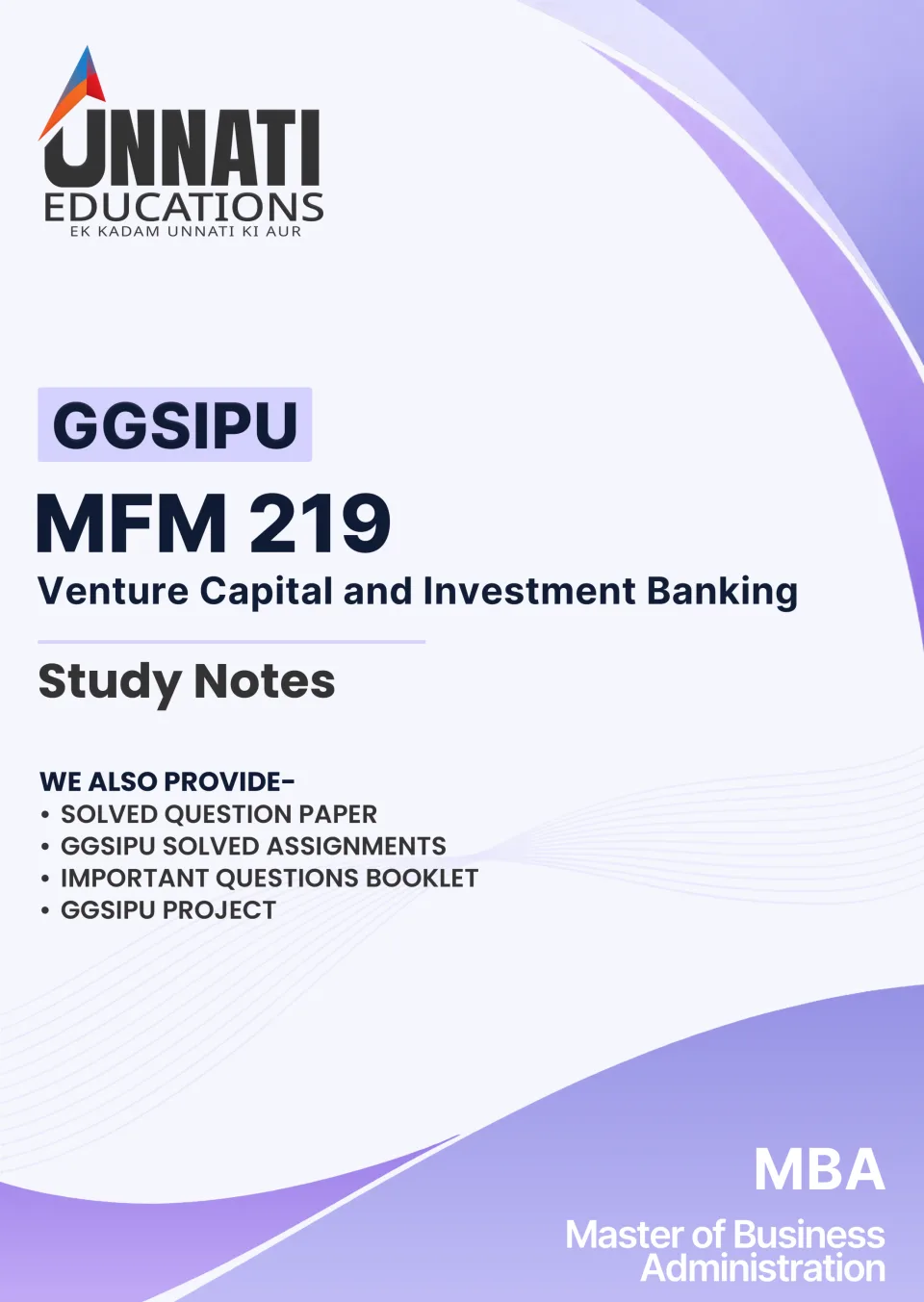
MFM 219 Venture Capital and Investment Banking Notes cover all four units of the GGSIPU MBA (Financial Management) Semester 3 elective in a 56-page printed English book. The notes include 24 solved short answers, 27 long-answer practice questions, 20 short-note practice questions, 5 worked numericals and 18 labelled diagrams. Topics include investment banking, merchant banking, public offers, underwriting, private equity, venture capital, AIFs, fund distributions, valuation and exit strategies. They follow the MBA (FM) scheme labelled 2021-22 onwards.
Written by Prateek Talwar, Founder, Unnati Educations · Reviewed by Prateek Talwar · Checked against the MBA (Financial Management) Scheme and Syllabus, 2021-22 onwards · Updated 14 October 2026 · Editorial policy
Scheme: MBA (FM) 2021-22 onwards | Applies to: batches admitted from 2021-22 onwards | Source record last verified: 14 October 2026
MFM 219 Venture Capital and Investment Banking at a glance: GGSIPU MBA (FM) Sem 3 credits, units and exam pattern
MFM 219 is a Semester 3 elective covering investment banking, public offers, private equity, venture capital and the legal and fiscal framework of venture capital investment schemes.
Code and title | MFM 219 (also MFM-219 or MFM219) · Venture Capital and Investment Banking |
|---|---|
Course and semester | |
Category and credits | Elective theory paper; 3 credits; L-3, T/P-0 |
Marks | 100: 25 internal (15 class test + 10 assignments or other assessed activities) + 75 end-term |
Pass mark | Not specified in the supplied scheme details; consult GGSIPU Ordinance 11 and applicable examination notifications |
Applies to | Batches covered by the MBA (FM) scheme labelled 2021-22 onwards |
End-term pattern | 75 marks; detailed question-paper pattern not confirmed in the supplied syllabus details |
Units and hours | 4 units, 42 teaching hours: 12 + 10 + 10 + 10 |
Paired lab | None |
Unit 1 receives 12 teaching hours; Units 2, 3 and 4 receive 10 hours each. The supplied Semester 3 scheme summary lists MFM 219 among six elective options, with students selecting four under that programme structure.
MFM 219 Venture Capital and Investment Banking Notes unit-wise: 24 solved short answers and 5 worked numericals across 4 units
Each unit contains six solved short answers, additional practice questions and diagrams or worked examples. The documented unit content runs from page 4 to page 55.
MFM 219 Unit 1: Investment Banking
Unit 1 (pages 4 to 17) explains investment banking versus commercial banking, merchant banking, investment-bank functions, industry structure, allied services, regulation, hedge funds, trading operations and conflicts of interest. The source also discusses the Abacus transaction and the IL&FS case. This unit contains 3 diagrams, 6 solved short answers and 12 practice questions.
Basis | Hedge fund | Mutual fund |
|---|---|---|
Typical investors | Eligible sophisticated investors, including high-net-worth individuals and institutions | Retail and institutional investors, subject to scheme eligibility |
Investment approach | May pursue absolute-return strategies and use leverage or derivatives | Follows the scheme's stated investment objective and permitted strategy |
Fee structure | May include management and performance fees; the traditional 2-and-20 model is an example, not a universal rule | Scheme expenses subject to applicable SEBI rules |
Indian regulatory route | Category III Alternative Investment Funds are a relevant structure | SEBI mutual fund regulatory framework |
Quick look: hedge funds versus mutual funds (from page 12)
Basis
Typical investors
Hedge fund
Eligible sophisticated investors, including high-net-worth individuals and institutions
Mutual fund
Retail and institutional investors, subject to scheme eligibility
Basis
Investment approach
Hedge fund
May pursue absolute-return strategies and use leverage or derivatives
Mutual fund
Follows the scheme's stated investment objective and permitted strategy
Basis
Fee structure
Hedge fund
May include management and performance fees; the traditional 2-and-20 model is an example, not a universal rule
Mutual fund
Scheme expenses subject to applicable SEBI rules
Basis
Indian regulatory route
Hedge fund
Category III Alternative Investment Funds are a relevant structure
Mutual fund
SEBI mutual fund regulatory framework
The comparison highlights differences in investor eligibility, strategies, fee arrangements and regulatory structure rather than assuming that every hedge fund or mutual fund follows one model.
MFM 219 Unit 2: Public Offers
Unit 2 (pages 18 to 32), also described as Public Offers and Underwriting, covers IPO eligibility, SEBI ICDR Regulation 6, relevant Companies Act provisions, public-shareholding requirements, issue management, offer documents, rights issues, debt issues and underwriting. The supplied notes mention March 2026 public-shareholding changes; their current legal applicability requires confirmation against the relevant notification. This unit contains 4 diagrams, 2 worked numericals, 6 solved short answers and 12 practice questions.
Quick look: value of a rights issue (from page 28)
Existing share price = ₹120; rights offer price = ₹80; entitlement = one new share for every four existing shares.
Theoretical ex-rights price (TERP) = (4 × ₹120 + ₹80) ÷ 5 = ₹112.
Value of the entitlement attached to each existing share = ₹120 − ₹112 = ₹8.
Total theoretical entitlement value required for one new share = 4 × ₹8 = ₹32, also equal to ₹112 − ₹80.
This theoretical calculation assumes the stated prices and excludes transaction costs and market movements.
MFM 219 Unit 3: Private Equity and Venture Capital in the Financial System
Unit 3 (pages 33 to 43) compares venture capital and private equity, their economic roles, investment trends, six competitive models, AIF categories, general partners, limited partners, management fees and carried interest. The source cites an approximately US$36 billion India investment figure attributed to Bain for 2025; that figure has not been independently checked here. The unit contains 6 diagrams, 2 worked numericals, 6 solved short answers and 11 practice questions.
Distribution stage | To LPs (₹ crore) | To GP (₹ crore) |
|---|---|---|
Return of invested capital | 500 | 0 |
Preferred return or hurdle | 120 | 0 |
GP catch-up | 0 | 30 |
Remaining ₹350 crore, split 80:20 | 280 | 70 |
Total distributed | 900 | 100 |
Quick look: illustrative European-style fund distribution waterfall (from page 42)
Distribution stage
Return of invested capital
To LPs (₹ crore)
500
To GP (₹ crore)
0
Distribution stage
Preferred return or hurdle
To LPs (₹ crore)
120
To GP (₹ crore)
0
Distribution stage
GP catch-up
To LPs (₹ crore)
0
To GP (₹ crore)
30
Distribution stage
Remaining ₹350 crore, split 80:20
To LPs (₹ crore)
280
To GP (₹ crore)
70
Distribution stage
Total distributed
To LPs (₹ crore)
900
To GP (₹ crore)
100
The total distribution is ₹1,000 crore. Under this example's assumptions, the GP receives ₹100 crore and LPs receive ₹900 crore. Actual fund waterfalls depend on the partnership agreement, preferred-return calculation, catch-up mechanism and any clawback provisions.
MFM 219 Unit 4: Legal and Fiscal Issues for Venture Capital Investment Schemes
Unit 4 (pages 44 to 55) discusses closed-end funds, venture capital funds, US Small Business Investment Companies, UK Venture Capital Trusts, angel investing, investee categories, the venture capital value chain, valuation, term sheets and exit routes. It contains 5 diagrams, 1 worked numerical, 6 solved short answers and 12 practice questions.
Quick look: venture capital valuation method (from page 51)
Expected profit at exit in Year 5 = ₹25 crore; assumed exit P/E multiple = 20.
Estimated exit equity value = ₹25 crore × 20 = ₹500 crore.
Discounting at the investor's required return of 50% annually: ₹500 crore ÷ 1.55 = ₹65.84 crore post-money value today.
For a ₹10 crore investment, pre-money valuation = ₹65.84 crore − ₹10 crore = ₹55.84 crore.
Required initial ownership = ₹10 crore ÷ ₹65.84 crore = 15.19%. If the investor expects to retain only 80% of that ownership by exit, the initial stake required becomes approximately 18.98%.
The calculation is illustrative. The 80% retention adjustment assumes dilution affects the investor's stake proportionately and that other valuation assumptions remain unchanged.
MFM 219 exam corner: 24 solved short answers and 27 ten-to-fifteen-mark practice questions by unit
Unit | Solved short answers | Long-answer practice | Short-note practice | Worked numericals |
|---|---|---|---|---|
Unit 1 | 6 | 7 | 5 | 0 |
Unit 2 | 6 | 7 | 5 | 2 |
Unit 3 | 6 | 6 | 5 | 2 |
Unit 4 | 6 | 7 | 5 | 1 |
Total | 24 | 27 | 20 | 5 |
MFM 219 solved answers, practice questions and worked numericals
Unit
Unit 1
Solved short answers
6
Long-answer practice
7
Short-note practice
5
Worked numericals
0
Unit
Unit 2
Solved short answers
6
Long-answer practice
7
Short-note practice
5
Worked numericals
2
Unit
Unit 3
Solved short answers
6
Long-answer practice
6
Short-note practice
5
Worked numericals
2
Unit
Unit 4
Solved short answers
6
Long-answer practice
7
Short-note practice
5
Worked numericals
1
Unit
Total
Solved short answers
24
Long-answer practice
27
Short-note practice
20
Worked numericals
5
The supplied notes record 24 solved short answers, 47 additional practice questions (27 long-answer and 20 short-note questions), 5 worked numericals and 18 labelled diagrams. The practice questions' suggested mark bands are editorial labels, not a confirmed official end-term paper pattern.
One question per unit, with answer pointers:
Unit 1: What are the dark sides of investment banking? Pointer: Explain conflicts of interest, information asymmetry, complex products and misconduct risks. Use the Abacus and LIBOR examples, then discuss information barriers and relevant regulatory controls.
Unit 2: Discuss the merchant banker's role as issue manager before and after an IPO. Pointer: Cover due diligence, offer documents, regulatory compliance, price-band coordination, allotment and listing. Explain the applicable T+3 listing timeline, subject to the relevant rules.
Unit 3: Explain the competitive models of private equity and venture capital. Pointer: Describe the six models identified in the notes and use the comparison on page 38 to distinguish investment stage, ownership approach and value-creation strategy.
Unit 4: What exit routes are available to venture capital investors? Pointer: Discuss the five exit routes described in the notes and organise the process using the seven exit steps.
The separate MFM 219 important-questions page is planned; its publication is not confirmed in the supplied page plan.
Who writes and checks the MFM 219 VC and investment banking notes?
Prateek Talwar, author: Founder, Unnati Educations; Associate Company Secretary (ACS), ICSI, membership no. 58704, since 15 May 2019; B.Com, University of Delhi (School of Open Learning), 2012. Author profile
Prateek Talwar is also named as the subject reviewer. The supplied editorial record states that the units were mapped against the MBA (FM) scheme labelled 2021-22 onwards.
The source describes updates relating to SEBI's December 2025 merchant banker framework and other securities-market requirements. The exact current regulatory provisions and their commencement dates should be checked against official SEBI notifications before publication.
Last updated and last recorded verification: 14 October 2026. Read the editorial policy.
How to write MFM 219 answers: regulation-backed theory answers, IPO flowcharts and underwriting, carry and valuation numericals
For regulation-based questions, begin with the legal framework, then explain the relevant provision and its application. The notes refer to the Companies Act, SEBI ICDR Regulations, AIF Regulations, FEMA and applicable taxation provisions. Always confirm the version and effective date of a rule before quoting an exact threshold.
For public-offer answers, draw a sequence from issue planning and due diligence to offer-document preparation, regulatory procedures, subscription, allotment and listing. A flowchart can make the responsibilities of the issue manager easier to explain.
For venture capital and private equity questions, distinguish the fund's investors, fund manager, portfolio companies, management fee, carried interest and exit proceeds. For legal and fiscal questions, use separate headings for fund structure, investor protection, foreign investment, taxation and compliance.
For comparison questions, use a table with a clear basis of comparison. Investment banking covers a broader set of activities than merchant banking, so explain the relationship without treating the two expressions as interchangeable in every legal context.
Worked example: underwriters' liability for a 100,000-share issue (page 30)
X Ltd issues 100,000 shares, underwritten by A, B and C in the ratio 50:30:20. Applications received total 80,000 shares, including 20,000 unmarked applications.
Calculation | A | B | C | Total |
|---|---|---|---|---|
Gross liability | 50,000 | 30,000 | 20,000 | 100,000 |
Less: unmarked applications, allocated 50:30:20 | 10,000 | 6,000 | 4,000 | 20,000 |
Less: marked applications | 30,000 | 20,000 | 10,000 | 60,000 |
Net liability | 10,000 | 4,000 | 6,000 | 20,000 |
Underwriting liability calculation
Calculation
Gross liability
A
50,000
B
30,000
C
20,000
Total
100,000
Calculation
Less: unmarked applications, allocated 50:30:20
A
10,000
B
6,000
C
4,000
Total
20,000
Calculation
Less: marked applications
A
30,000
B
20,000
C
10,000
Total
60,000
Calculation
Net liability
A
10,000
B
4,000
C
6,000
Total
20,000
Check: 100,000 shares issued − 80,000 applications received = 20,000 unsubscribed shares. This equals the combined net liability of A, B and C.
The example assumes the stated treatment of marked and unmarked applications and no additional firm-underwriting adjustments.
For fund-waterfall and valuation numericals, state the formula, show intermediate calculations and verify the final totals. The page 42 waterfall allocates ₹1,000 crore in total, while the page 51 venture capital method derives the post-money valuation, pre-money valuation and investor ownership.
MFM 219 and the GGSIPU MBA (FM) Sem 3 papers it connects to
Paired lab: None. MFM 219 is an elective theory paper without a separately identified practical component.
MFM 205 Financial Markets and Institutions: Connects with merchant banking, venture capital, private equity and underwriting.
MFM 207 Entrepreneurship Development and Start-Up: Connects with business planning, start-up financing and venture capital investment.
MFM 215 Mergers, Acquisitions and Corporate Restructuring: Connects with investment-bank advisory functions, business valuation and exit transactions.
Group | Papers |
|---|---|
Training | MFM 201 Summer Training Report |
Core finance papers | MFM 203 Financial Derivatives; MFM 205 Financial Markets and Institutions; MFM 209 Strategic Financial Management |
Entrepreneurship | |
Analytics | MFM 211 Business Analytics; MFM 227 Business Analytics Lab |
Open elective | MFM 213 MOOCs / Open Elective |
Other elective options | MFM 215 Mergers, Acquisitions and Corporate Restructuring; MFM 217 International Financial Management; MFM 221 Financial Econometrics; MFM 223 Data Visualization for Decision Making; MFM 225 Fixed Income Securities |
Other MBA (FM) Semester 3 papers in the supplied scheme summary
Group
Training
Papers
MFM 201 Summer Training Report
Group
Core finance papers
Group
Entrepreneurship
Group
Analytics
Papers
MFM 211 Business Analytics; MFM 227 Business Analytics Lab
Group
Open elective
Papers
MFM 213 MOOCs / Open Elective
Group
Other elective options
Evolution of investment banking in India, from Grindlays to ICDR 2018: excerpt from page 8 of the MFM 219 notes
Excerpt from page 8, Unit 1: Investment Banking
Investment banking in India developed in stages, from merchant banking activities associated with banks and financial institutions to a broader securities-market and advisory industry. The supplied notes describe five phases.
Phase I: Before 1969
Industrial finance was closely associated with managing agency houses, including major Indian business groups and British agency houses. The notes identify National Grindlays Bank's establishment of a merchant banking division with RBI permission in 1967 as an early landmark in formal merchant banking in India.
Phase II: 1970 to 1984 — Bank-led growth
The source identifies Citibank's entry in 1970, the State Bank of India's merchant banking division in 1972 and ICICI's entry in 1973. Merchant banking activities concentrated on issue management, while the Controller of Capital Issues regulated capital issues under the Capital Issues (Control) Act, 1947.
Phase III: 1985 to 1991 — Institution building
Capital-market activity expanded, with more specialised merchant banking organisations. The notes identify SBI Capital Markets Ltd, formed in 1986, alongside the growth of private firms including JM Financial and DSP. Investor-protection and issue-pricing concerns remained important.
Phase IV: 1992 to 2000 — Liberalisation
The abolition of the Controller of Capital Issues in 1992 changed the issue-pricing environment. SEBI gained statutory powers under the SEBI Act, 1992, and merchant banking came under a dedicated regulatory framework. Book-building practices developed during the decade, while domestic and international firms expanded capital-market advisory services.
Phase V: 2000 onwards — Market expansion
Large public offerings, privatisation, cross-border acquisitions, private equity, venture capital and new listing platforms contributed to a broader investment banking market. The regulatory framework included the SEBI ICDR Regulations, 2009, followed by the ICDR Regulations, 2018, alongside the development of REITs, InvITs and SME platforms.
The global financial crisis of 2008 also changed investment banking. Lehman Brothers collapsed, Merrill Lynch was acquired by Bank of America, and Goldman Sachs and Morgan Stanley became bank holding companies. These events reshaped the independent investment-bank model without ending investment banking as a business.
Do the MFM 219 notes cover the full GGSIPU syllabus?
The supplied editorial mapping identifies sections for all four official MFM 219 units. The final printed book has not been independently checked topic by topic, so the table records the source's coverage mapping rather than an independently certified coverage result.
Official unit | Official topics | In the notes | Status |
|---|---|---|---|
I: Investment Banking | Concept, functions, structure, allied services, regulation and future developments | Sections 1–12, pages 4–16; additional unit content to page 17 | Mapped in source |
II: Public Offers | Types of offers, issue management, regulatory requirements, listing, debt issues and underwriting | Sections 1–17, pages 18–31; additional unit content to page 32 | Mapped in source |
III: Private Equity and Venture Capital in the Financial System | Economic roles, trends, competitive models, legal issues, fees and carried interest | Sections 1–6, pages 33–42; additional unit content to page 43 | Mapped in source |
IV: Legal and Fiscal Issues for Venture Capital Investment Schemes | Fund structures, legal and fiscal issues, angel investment, valuation and exit process | Sections 1–13, pages 44–54; additional unit content to page 55 | Mapped in source |
MFM 219 syllabus topics mapped to the supplied notes
Official unit
I: Investment Banking
Official topics
Concept, functions, structure, allied services, regulation and future developments
In the notes
Sections 1–12, pages 4–16; additional unit content to page 17
Status
Mapped in source
Official unit
II: Public Offers
Official topics
Types of offers, issue management, regulatory requirements, listing, debt issues and underwriting
In the notes
Sections 1–17, pages 18–31; additional unit content to page 32
Status
Mapped in source
Official unit
III: Private Equity and Venture Capital in the Financial System
Official topics
Economic roles, trends, competitive models, legal issues, fees and carried interest
In the notes
Sections 1–6, pages 33–42; additional unit content to page 43
Status
Mapped in source
Official unit
IV: Legal and Fiscal Issues for Venture Capital Investment Schemes
Official topics
Fund structures, legal and fiscal issues, angel investment, valuation and exit process
In the notes
Sections 1–13, pages 44–54; additional unit content to page 55
Status
Mapped in source
Official reference: MBA (Financial Management) Scheme and Syllabus, 2021-22 onwards. The supplied source identifies the MFM 219 syllabus on pages 61–62, the Semester 3 elective list on page 7 and the marks scheme on page 3.
MFM 219 VC and investment banking notes FAQs
How do I get the full MFM 219 notes?
Order the English printed notes book through the WhatsApp button below. The full book is listed as 56 pages covering four units. It is not offered as a complete PDF. A seven-page sample PDF is planned separately. Delivery normally takes up to 5 to 7 days, depending on location.
Is MFM 219 a compulsory paper in MBA (FM) Semester 3?
No. The supplied MBA (FM) scheme summary identifies MFM 219 as one of six Semester 3 electives, alongside MFM 215, 217, 221, 223 and 225. Students select four electives under the stated scheme. Availability can depend on the institute's offerings. MFM 219 carries three credits and has no paired practical.
What is the passing mark for MFM 219?
MFM 219 carries 100 marks: 25 internal and 75 end-term. The supplied scheme details do not specify a passing percentage. Consult GGSIPU Ordinance 11 and applicable examination notifications for current passing and re-appear rules.
Do the MFM 219 notes cover SEBI's December 2025 merchant banker rules?
The supplied editorial record says that the notes incorporate SEBI's December 2025 merchant banker framework, including revised categories, net-worth requirements and underwriting limits. The exact thresholds, commencement provisions and current amendments should be checked against official SEBI notifications before relying on them for compliance or examination answers.
Which MFM 219 units have numericals?
Units 2, 3 and 4. Unit 2 includes rights-issue valuation and underwriting liability. Unit 3 covers a fund management-fee calculation and a distribution waterfall. Unit 4 includes venture capital valuation. Unit 1 relies on theory, diagrams and comparisons.
My batch joined MBA (FM) in 2024-25. Do these notes fit my syllabus?
The notes follow the MBA (Financial Management) scheme labelled 2021-22 onwards, which includes the 2024-25 admission period unless a newer applicable scheme supersedes it. Compare your institute's four unit headings with the syllabus map above before ordering.
Get the full MFM 219 Venture Capital and Investment Banking Notes on WhatsApp
The English printed book is listed as 56 pages, with 24 solved short answers, 47 practice questions, 5 worked numericals and 18 labelled diagrams.
Part | Pages | Worked numericals | Diagrams |
|---|---|---|---|
Cover and index | 1–3 (3) | — | — |
4–17 (14) | 0 | 3 | |
18–32 (15) | 2 | 4 | |
Unit 3: Private Equity and Venture Capital in the Financial System | 33–43 (11) | 2 | 6 |
Unit 4: Legal and Fiscal Issues for Venture Capital Investment Schemes | 44–55 (12) | 1 | 5 |
Final page to confirm | 56 (1; content not identified) | — | — |
Listed book total | 56 | 5 | 18 |
MFM 219 printed notes: documented page allocation
Part
Cover and index
Pages
1–3 (3)
Worked numericals
—
Diagrams
—
Pages
4–17 (14)
Worked numericals
0
Diagrams
3
Pages
18–32 (15)
Worked numericals
2
Diagrams
4
Pages
33–43 (11)
Worked numericals
2
Diagrams
6
Pages
44–55 (12)
Worked numericals
1
Diagrams
5
Part
Final page to confirm
Pages
56 (1; content not identified)
Worked numericals
—
Diagrams
—
Part
Listed book total
Pages
56
Worked numericals
5
Diagrams
18
The supplied page ranges account for 55 pages. The content of page 56 requires confirmation against the final printed book.
Delivery: within 5 to 7 days at most; the exact time may vary with your location.
Order the MFM 219 notes book on WhatsApp (4 units, 56 pages)
Unnati Educations is an independent education provider based in Vikaspuri, Delhi. We are not affiliated with, authorised by, or endorsed by Guru Gobind Singh Indraprastha University (GGSIPU). 'GGSIPU' and 'IPU' are used only to describe the syllabus our notes follow. For official information, visit ipu.ac.in.
Ready for the full notes?
Discuss coverage and delivery with our team.