
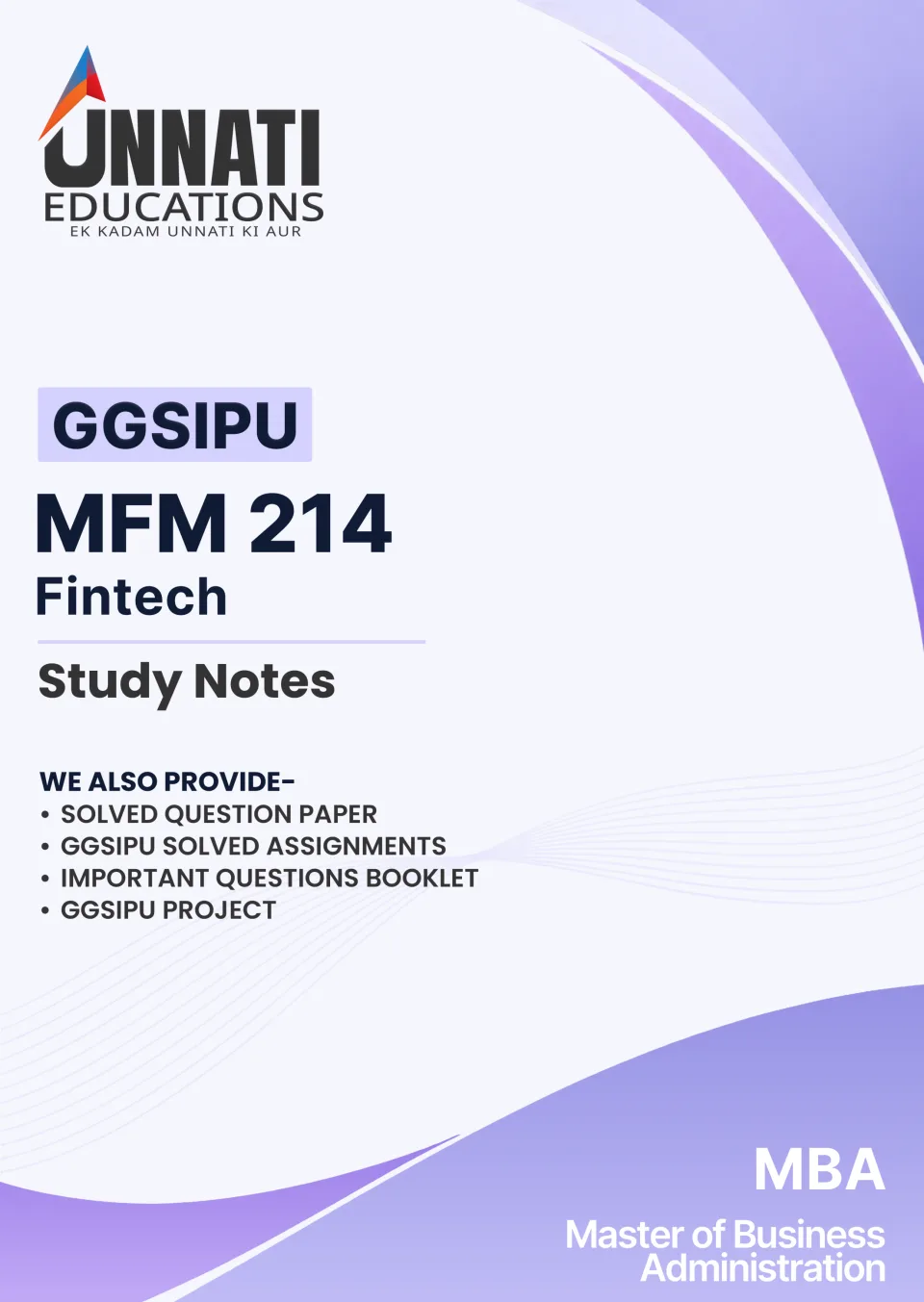
MFM 214 FinTech Notes cover all four units of the GGSIPU MBA (Financial Management) Semester 4 elective in a 52-page printed English book. The notes include 14 case studies, 13 numbered figures, 19 answered short questions and 44 additional practice questions. Topics include FinTech evolution, UPI, RTGS, NEFT, cryptocurrencies, blockchain, RegTech, regulatory sandboxes, data protection, AI governance and differential privacy. They follow the MBA (FM) syllabus scheme labelled 2021-22 onwards.
Written by Prateek Talwar, Founder, Unnati Educations · Reviewed by Prateek Talwar · Checked against the MBA (Financial Management) Scheme and Syllabus, 2021-22 onwards · Updated 14 October 2026 · Editorial policy
Scheme: MBA (Financial Management), 2021-22 onwards | Applies to: batches admitted from 2021-22 onwards, subject to subsequent revisions | Last recorded syllabus verification: 14 October 2026
MFM 214 FinTech at a glance: GGSIPU MBA (FM) Sem 4 credits, units and exam pattern
MFM 214 FinTech is a three-credit elective in Semester 4 of the GGSIPU MBA (Financial Management) programme. It covers the evolution of financial technology, digital payments, cryptocurrencies, blockchain, financial regulation, RegTech and the use of data and artificial intelligence in finance.
Code and title | MFM 214 · FinTech (spelled Fintech in the scheme list) |
|---|---|
Course and semester | MBA (Financial Management), Semester 4 |
Category and credits | Elective; 3 credits; L-3, T-0, P-0 |
Marks | 100: 25 internal + 75 external |
Pass mark | Not specified in the supplied scheme details; consult GGSIPU Ordinance 11 and applicable examination notifications |
Applies to | Batches covered by the MBA (FM) scheme labelled 2021-22 onwards |
End-term pattern | 75 marks; detailed question-paper pattern not confirmed in the supplied scheme |
Units and hours | 4 units, 42 teaching hours: 8 + 12 + 10 + 12 |
Paired lab | None |
Units II and IV each receive 12 teaching hours, the highest allocation in this paper. The supplied Semester 4 scheme lists seven electives, of which students select four, subject to institutional offerings. MFM 202 Project Dissertation and MFM 204 Project Management are also listed for the semester.
Official reference: GGSIPU MBA (Financial Management) Scheme and Syllabus. The supplied editorial mapping identifies MFM 214 on PDF page 82, marks information on page 3 and the elective list on page 8.
MFM 214 FinTech Notes unit-wise: 14 case studies and 19 answered questions across 4 units
The printed book covers four units across pages 4–51, with the first three pages allocated to the cover and index. Its contents include 14 case studies, 13 numbered figures, 19 answered short questions and 44 additional practice questions.
MFM 214 Unit 1: FinTech
Unit 1 (pages 4 to 14) introduces financial technology and its development. It covers definitions associated with the Financial Stability Board and RBI, the ABCD technology pillars, the FinTech ecosystem, drivers of financial transformation and India Stack.
The unit also discusses FinTech 1.0 through FinTech 3.5, four FinTech typologies and ten opportunities alongside ten challenges in emerging economies.
Unit content: Five sections, three numbered figures, two case studies, four answered short questions and eleven additional practice questions.
Quick look: the four FinTech eras (from page 10)
Era | Period | Leading participants | Milestones |
|---|---|---|---|
FinTech 1.0 | 1866–1967 | Governments, telegraph operators and card companies | Transatlantic cable, Fedwire and Diners Club |
FinTech 2.0 | 1967–2008 | Banks and established financial institutions | ATMs, SWIFT, NASDAQ and online banking |
FinTech 3.0 | 2008 onwards | Start-ups and large technology companies | Bitcoin, peer-to-peer lending, robo-advisers and neobanks |
FinTech 3.5 | 2008 onwards | Emerging-market FinTech ecosystems | M-Pesa, Alipay, UPI and Pix |
FinTech evolution: periods, leading participants and milestones
Era
FinTech 1.0
Period
1866–1967
Leading participants
Governments, telegraph operators and card companies
Milestones
Transatlantic cable, Fedwire and Diners Club
Era
FinTech 2.0
Period
1967–2008
Leading participants
Banks and established financial institutions
Milestones
ATMs, SWIFT, NASDAQ and online banking
Era
FinTech 3.0
Period
2008 onwards
Leading participants
Start-ups and large technology companies
Milestones
Bitcoin, peer-to-peer lending, robo-advisers and neobanks
Era
FinTech 3.5
Period
2008 onwards
Leading participants
Emerging-market FinTech ecosystems
Milestones
M-Pesa, Alipay, UPI and Pix
The eras are a framework for explaining financial innovation. FinTech 3.0 and 3.5 overlap in time because the distinction concerns market conditions and participants rather than strictly consecutive periods.
MFM 214 Unit 2: Digital Finance, Payments, Crypto Currencies and Blockchain
Unit 2 (pages 15 to 28) explains digital finance, the history of financial innovation, India's payment infrastructure and the development of crypto-assets and blockchain technology.
Topics include NPCI payment systems, mobile money, prepaid payment instruments, the Structured Financial Messaging System (SFMS), RTGS, NEFT, the Negotiated Dealing System – Order Matching (NDS-OM), crypto-asset categories, Indian tax and anti-money-laundering provisions, the European Union's MiCA framework, consensus mechanisms and eight blockchain frameworks.
Unit content: Eight sections, four numbered figures, two case studies, five answered short questions and eleven additional practice questions.
Quick look: Indian payment systems compared (from page 20)
Basis | RTGS | NEFT | UPI |
|---|---|---|---|
System operator | RBI | RBI | NPCI |
Settlement | Real-time gross settlement | Half-hourly net settlement batches | Instant customer-facing transfer, with interbank settlement arrangements |
Minimum transaction amount | ₹2 lakh | No prescribed minimum | No prescribed minimum |
Common identifier | Account number and IFSC | Account number and IFSC | UPI ID, QR code or supported mobile-number flow |
RTGS, NEFT and UPI: operating and settlement characteristics
Basis
System operator
RTGS
RBI
NEFT
RBI
UPI
NPCI
Basis
Settlement
RTGS
Real-time gross settlement
NEFT
Half-hourly net settlement batches
UPI
Instant customer-facing transfer, with interbank settlement arrangements
Basis
Minimum transaction amount
RTGS
₹2 lakh
NEFT
No prescribed minimum
UPI
No prescribed minimum
Basis
Common identifier
RTGS
Account number and IFSC
NEFT
Account number and IFSC
UPI
UPI ID, QR code or supported mobile-number flow
The table is based on the supplied notes. Operational limits, permitted transaction types and payment-system rules can change; students should consult current RBI and NPCI instructions for practical use.
MFM 214 Unit 3: FinTech Regulation and RegTech
Unit 3 (pages 29 to 39) covers the relationship between financial innovation and regulation. It introduces the innovation trilemma, regulatory approaches, RegTech and SupTech, the evolution of RegTech from 1.0 to 3.0, the regulatory ecosystem, smart regulation and financial infrastructure.
It also examines regulatory sandboxes, outsourced compliance technology, e-KYC, anti-money-laundering monitoring, regulatory reporting, fraud detection and supervisory technology.
Unit content: Six sections, four numbered figures, two case studies, five answered short questions and eleven additional practice questions.
Quick look: Indian FinTech regulators and their areas (from page 30)
Institution | Area | Example in the notes |
|---|---|---|
RBI | Banking, NBFCs, payment systems and digital lending | Digital Lending Guidelines, 2022 |
SEBI | Securities markets, intermediaries and investment advisers | Algorithmic trading norms |
IFSCA | Financial activities in India's International Financial Services Centres | FinTech entity framework |
FIU-IND | Financial intelligence and anti-money-laundering reporting | PMLA reporting requirements applicable to specified virtual digital asset service providers |
Regulatory institutions and FinTech activities discussed in the notes
Institution
RBI
Area
Banking, NBFCs, payment systems and digital lending
Example in the notes
Digital Lending Guidelines, 2022
Institution
SEBI
Area
Securities markets, intermediaries and investment advisers
Example in the notes
Algorithmic trading norms
Institution
IFSCA
Area
Financial activities in India's International Financial Services Centres
Example in the notes
FinTech entity framework
Institution
FIU-IND
Area
Financial intelligence and anti-money-laundering reporting
Example in the notes
PMLA reporting requirements applicable to specified virtual digital asset service providers
The institutions have different statutory functions. This table is an educational comparison rather than an exhaustive statement of their jurisdiction or current rules.
MFM 214 Unit 4: Data & TechFin
Unit 4 (pages 40 to 51) examines data-driven financial services. Topics include TechFin, the BIS DNA loop, the history of data regulation, the Digital Personal Data Protection Act, 2023, the five Vs of big data, four types of analytics, fraud detection and Aadhaar-based digital identity.
The unit also discusses AI governance, Singapore's FEAT principles, the EU AI Act, the RBI FREE-AI report and differential privacy. Its cases include MSME cash-flow lending, the 2024 Hong Kong deepfake fraud, Equifax, Capital One, Cambridge Analytica, Ant Group and India's Account Aggregator framework.
Unit content: Eleven sections, two numbered figures, eight case studies, five answered short questions and eleven additional practice questions.
Quick look: differential privacy in a banking statistic (from page 48)
Original statistic: A bank records 120 customers in a defined area who defaulted during the previous month.
Noise addition: Instead of publishing the exact count, a privacy-preserving mechanism might publish 118 or 123.
Purpose: Randomised output can help limit the information revealed about an individual when the mechanism satisfies a defined differential privacy guarantee.
Privacy parameter: A smaller epsilon (ε), with other assumptions held constant, generally represents a stronger privacy guarantee.
Adding arbitrary noise does not, by itself, establish differential privacy. A formal guarantee depends on the mechanism, its sensitivity, the chosen privacy parameters and the way queries are handled. The numbers above are illustrative rather than proof that an individual cannot be identified.
MFM 214 exam corner: 19 answered short questions, 24 five-mark and 20 long-answer practice questions by unit
Unit | Answered short questions | Short-answer practice | Long-answer practice | Case studies |
|---|---|---|---|---|
Unit 1 | 4 | 6 | 5 | 2 |
Unit 2 | 5 | 6 | 5 | 2 |
Unit 3 | 5 | 6 | 5 | 2 |
Unit 4 | 5 | 6 | 5 | 8 |
Total | 19 | 24 | 20 | 14 |
MFM 214 exam-question and case-study counts by unit
Unit
Unit 1
Answered short questions
4
Short-answer practice
6
Long-answer practice
5
Case studies
2
Unit
Unit 2
Answered short questions
5
Short-answer practice
6
Long-answer practice
5
Case studies
2
Unit
Unit 3
Answered short questions
5
Short-answer practice
6
Long-answer practice
5
Case studies
2
Unit
Unit 4
Answered short questions
5
Short-answer practice
6
Long-answer practice
5
Case studies
8
Unit
Total
Answered short questions
19
Short-answer practice
24
Long-answer practice
20
Case studies
14
The notes contain 19 answered short questions and 44 additional practice questions, making 63 questions in total. The practice questions comprise 24 short-answer and 20 long-answer questions. The book also includes 14 case studies and 13 numbered figures.
The five-mark and 10–15-mark labels are the notes' editorial practice categories, not a confirmed official GGSIPU question-paper pattern.
One question per unit, with answer pointers:
Unit 1: Discuss the opportunities and challenges of FinTech in emerging economies. Pointer: Explain financial inclusion, reduced transaction costs and leapfrogging alongside the digital divide, cybersecurity and fraud risks. Use M-Pesa and UPI as examples and explain what each illustrates.
Unit 2: Discuss the legal and regulatory implications of cryptocurrencies. Pointer: Cover consumer protection, financial integrity and regulatory uncertainty; then explain India's 2018 RBI circular, the 2020 Supreme Court decision, virtual digital asset taxation and applicable PMLA obligations. Compare with the EU's MiCA framework.
Unit 3: How does smart regulation differ from traditional rule-based regulation? Pointer: Compare proportionality, risk-based supervision, activity-based regulation, innovation support and consumer protection. Use digital lending as an Indian example.
Unit 4: Discuss the challenges of artificial intelligence and machine learning in financial services. Pointer: Discuss bias, opaque models, model drift, deepfake fraud, data protection and accountability. Use the 2024 Hong Kong deepfake case to illustrate operational risk.
The separate MFM 214 important-questions page is planned but is not confirmed as published in the supplied source.
Who writes and checks the MFM 214 FinTech notes?
Prateek Talwar, author: Founder, Unnati Educations; Associate Company Secretary (ACS), ICSI, membership no. 58704, since 15 May 2019; B.Com, University of Delhi (School of Open Learning), 2012. Author profile
Prateek Talwar is also identified as the subject reviewer. The supplied editorial record states that the four MFM 214 units were mapped against the MBA (Financial Management) scheme labelled 2021-22 onwards.
The source describes the 2026–27 edition as including the RBI FREE-AI report and the Digital Personal Data Protection Rules, 2025. These are time-sensitive regulatory topics, so their publication status, operative provisions, commencement dates and subsequent amendments should be checked against official notifications.
Last updated and last recorded syllabus verification: 14 October 2026. Read the editorial policy.
How to write MFM 214 answers: comparison tables, dated timelines and case-study endings
For FinTech theory questions, organise the answer around a definition, a comparison or framework, examples and a short explanation of the practical implications.
FinTech versus traditional banking: Compare delivery channels, speed, cost, credit assessment, customer reach and trust. Explain why banks and FinTech firms also collaborate.
History of financial innovation: Organise the answer into money and coins, banking and markets, electronic finance, and digital or mobile finance. Add dated examples under each phase.
Data regulation: Use a timeline from the early development of data-protection law through modern privacy frameworks. Explain GDPR principles and the terminology used in India's DPDP framework.
RTGS versus NEFT: Compare gross and net settlement, real-time and half-hourly batch settlement, minimum transaction amounts, typical use cases and RBI's role. Both systems operate around the clock.
Cryptocurrency regulation: Structure a long answer around the regulatory issues, India's position, international approaches and possible policy responses.
AI governance: Explain fairness, ethics, accountability and transparency using the FEAT framework. Discuss the EU AI Act's treatment of specified creditworthiness and credit-scoring uses as high-risk AI.
Worked answer format: What is RegTech? Give its applications. (page 32)
Meaning: Regulatory technology, or RegTech, is the use of technology to help financial institutions meet regulatory and compliance requirements more efficiently.
RegTech and SupTech: RegTech is generally used by regulated firms to support compliance. SupTech refers to supervisory technology used by regulators to monitor institutions and analyse supervisory information.
Five applications:
Electronic KYC: Technology-supported customer identity verification.
AML monitoring: Automated screening and analysis of potentially suspicious transactions.
Regulatory reporting: Data collection, validation and preparation of regulatory returns.
Risk analytics: Identification and monitoring of compliance and operational risks.
Fraud detection: Rules and analytical models that flag unusual activity for investigation.
Indian examples: Central KYC infrastructure and video-based customer identification are useful illustrations. RBI's supervisory systems, including DAKSH and CIMS, can be discussed when explaining SupTech.
A clear definition, distinction between RegTech and SupTech, five explained applications and one relevant example provide a structured short-answer response.
MFM 214 and the GGSIPU MBA (FM) Sem 4 papers it connects to
Paired lab: None. MFM 214 is a three-credit elective theory paper. The supplied semester scheme associates MFM 218 Big Data Analytics Lab with MFM 216 Big Data Analytics, not with MFM 214.
The subject connects with several other Semester 4 papers:
MFM 216 Big Data Analytics: Regression, clustering and analytical models extend Unit 4's discussion of data and fraud detection.
MFM 210 Treasury and Wealth Management: NDS-OM and RBI Retail Direct connect with digital financial-market infrastructure in Unit 2.
MFM 208 Risk Management and Insurance: InsurTech, cybersecurity and the Equifax and Capital One data-breach cases connect with technology and operational risk.
MFM 212 Sustainable Finance: Digital infrastructure and technology-enabled financial services can support sustainable-finance applications.
Other papers in the supplied Semester 4 list include MFM 202 Project Dissertation, MFM 204 Project Management, MFM 206 Business Valuation and MFM 218 Big Data Analytics Lab.
Students should confirm the electives and practical papers offered by their institution under the applicable scheme.
Regulatory sandboxes in FinTech regulation: excerpt from page 34 of the MFM 214 notes
Excerpt from page 34, Unit 3: FinTech Regulation and RegTech; adapted for the web
Accountability does not move to the technology vendor
Using outsourced RegTech does not automatically transfer a regulated institution's legal compliance responsibilities to its technology provider. If an outsourced KYC system fails, the regulated institution remains responsible for meeting its applicable obligations. This is why outsourcing and IT governance frameworks emphasise vendor due diligence, monitoring and appropriate controls.
Meaning of a regulatory sandbox
A regulatory sandbox is a framework established by a regulator that permits eligible firms to test innovative financial products, services or business models in a controlled environment. Testing may involve real customers, defined limits, safeguards, regulatory oversight and time-bound evaluation.
The sandbox concept allows regulators and firms to observe how an innovation operates before wider deployment. The UK Financial Conduct Authority introduced its regulatory sandbox in 2016, and comparable approaches were subsequently adopted in other jurisdictions.
Objectives of a regulatory sandbox
Encourage innovation and competition in financial services.
Reduce the time and cost involved in testing eligible new products.
Help regulators understand emerging technologies and associated risks.
Protect participating consumers through safeguards and controlled testing.
Generate evidence that can inform regulatory decisions.
Stages of the RBI regulatory sandbox
Preliminary screening: Assess eligibility, innovation and the suitability of the proposal for sandbox testing.
Test design: Agree on the scope, participants, safeguards, test parameters and success criteria.
Application assessment: Evaluate the proposed innovation and its associated risks.
Testing: Conduct a supervised live test under agreed conditions.
Evaluation and exit: Review the results and determine the next steps under the applicable framework.
RBI regulatory sandbox framework
The supplied notes identify RBI's Enabling Framework for Regulatory Sandbox, issued in August 2019 and revised in October 2021. They describe theme-based cohorts and later approaches involving on-tap and theme-neutral applications.
Sandbox participation does not amount to permanent regulatory approval. Eligibility, permitted relaxations, customer safeguards, testing stages and exit requirements depend on the applicable framework and current RBI instructions.
Do the MFM 214 notes cover the full GGSIPU syllabus?
The supplied editorial mapping marks the listed topics in all four units as covered, with one qualification: course outcome CO5, concerning comparison of machine-learning techniques, is only partly covered. The notes discuss AI risks, governance and fraud models but do not provide a full technique-by-technique comparison.
Official unit | Topics in supplied syllabus mapping | Mapped notes sections | Coverage status |
|---|---|---|---|
I: FinTech | Transformation, evolution, typology and FinTech in emerging economies | Sections 1–5, pages 4–14 | Covered according to source |
II: Digital Finance, Payments, Crypto Currencies and Blockchain | Digital finance, financial innovation, payment systems, mobile money, SFMS, RTGS, NEFT, NDS, cryptocurrency law and blockchain | Sections 1–8, pages 15–28 | Covered according to source |
III: FinTech Regulation and RegTech | RegTech evolution, regulatory ecosystem, sandboxes, smart regulation and financial infrastructure | Sections 1–6, pages 29–39 | Covered according to source |
IV: Data & TechFin | Data regulation, analytics, fraud detection, digital identity, AI governance, differential privacy and cases | Sections 1–11, pages 40–51 | Topics covered according to source; CO5 partly covered |
MFM 214 syllabus topics mapped to printed notes
Official unit
I: FinTech
Topics in supplied syllabus mapping
Transformation, evolution, typology and FinTech in emerging economies
Mapped notes sections
Sections 1–5, pages 4–14
Coverage status
Covered according to source
Official unit
II: Digital Finance, Payments, Crypto Currencies and Blockchain
Topics in supplied syllabus mapping
Digital finance, financial innovation, payment systems, mobile money, SFMS, RTGS, NEFT, NDS, cryptocurrency law and blockchain
Mapped notes sections
Sections 1–8, pages 15–28
Coverage status
Covered according to source
Official unit
III: FinTech Regulation and RegTech
Topics in supplied syllabus mapping
RegTech evolution, regulatory ecosystem, sandboxes, smart regulation and financial infrastructure
Mapped notes sections
Sections 1–6, pages 29–39
Coverage status
Covered according to source
Official unit
IV: Data & TechFin
Topics in supplied syllabus mapping
Data regulation, analytics, fraud detection, digital identity, AI governance, differential privacy and cases
Mapped notes sections
Sections 1–11, pages 40–51
Coverage status
Topics covered according to source; CO5 partly covered
Students can compare the topics with the GGSIPU MBA (Financial Management) Scheme and Syllabus. The supplied mapping identifies MFM 214 on PDF page 82.
This coverage assessment is based on the supplied editorial mapping, not a fresh independent verification of the official syllabus PDF.
MFM 214 FinTech notes FAQs
How do I get the full MFM 214 notes?
Order the printed MFM 214 FinTech notes using the WhatsApp button below. The full book is listed as 52 pages and is not offered as a complete downloadable PDF. A free seven-page sample PDF is planned, but its publication status still needs confirmation.
Is MFM 214 FinTech compulsory in MBA (FM) Semester 4?
No. MFM 214 is a three-credit Semester 4 elective. The supplied scheme lists seven elective options, of which students select four, subject to institutional offerings. MFM 202 Project Dissertation and MFM 204 Project Management are also listed in the semester.
What is the passing mark for MFM 214?
MFM 214 carries 100 marks: 25 internal and 75 external. The supplied scheme summary describes a 15-mark class test and 10 marks for other internal assessment activities. It does not establish a specific passing percentage. Consult GGSIPU Ordinance 11 and current examination notifications for passing and re-appear requirements.
Do the MFM 214 notes explain how cryptocurrency is taxed in India?
Yes. Unit 2 discusses the tax treatment of virtual digital assets, including the 30% tax framework, TDS provisions and restrictions on setting off losses. The supplied source also refers to changes in statutory section numbering under the Income-tax Act, 2025. Students should verify current provisions, thresholds, commencement dates and applicable amendments before relying on them for legal or tax compliance.
Which MFM 214 unit has the most case studies?
Unit 4, Data & TechFin, has eight of the fourteen case studies. The source identifies examples involving MSME cash-flow lending, the 2024 Hong Kong deepfake fraud, differential privacy, Equifax, Capital One, Cambridge Analytica, Ant Group and the Account Aggregator framework. Units 1, 2 and 3 contain two cases each.
My MBA (FM) batch joined in 2024-25. Do these notes match my syllabus?
The notes follow the MBA (Financial Management) scheme labelled 2021-22 onwards. A 2024-25 batch falls within that stated period unless a revised scheme applies to that admission batch or institution. Before ordering, compare the four unit headings with the syllabus supplied by your institution.
Get the full MFM 214 FinTech Notes on WhatsApp
The full MFM 214 notes are listed as a 52-page printed English book with four units, 14 case studies, 13 numbered figures, 19 answered short questions and 44 additional practice questions.
Part | Pages | Case studies | Figures |
|---|---|---|---|
Cover and index | 1–3 (3) | — | — |
4–14 (11) | 2 | 3 | |
Unit 2: Digital Finance, Payments, Crypto Currencies and Blockchain | 15–28 (14) | 2 | 4 |
29–39 (11) | 2 | 4 | |
40–51 (12) | 8 | 2 | |
Final page to confirm | 52 (1; content not identified) | — | — |
Listed book total | 52 | 14 | 13 |
MFM 214 printed notes: page allocation and unit content
Part
Cover and index
Pages
1–3 (3)
Case studies
—
Figures
—
Part
Pages
4–14 (11)
Case studies
2
Figures
3
Pages
15–28 (14)
Case studies
2
Figures
4
Pages
29–39 (11)
Case studies
2
Figures
4
Pages
40–51 (12)
Case studies
8
Figures
2
Part
Final page to confirm
Pages
52 (1; content not identified)
Case studies
—
Figures
—
Part
Listed book total
Pages
52
Case studies
14
Figures
13
The supplied page ranges account for 48 unit-content pages and three cover/index pages. Page 52 is not assigned to a specific section. The full notes are sold as a printed book, not as a complete PDF download.
Delivery: within 5 to 7 days at most; the exact time may vary with your location.
Order the MFM 214 notes book on WhatsApp (4 units, 52 pages)
Unnati Educations is an independent education provider based in Vikaspuri, Delhi. We are not affiliated with, authorised by, or endorsed by Guru Gobind Singh Indraprastha University (GGSIPU). 'GGSIPU' and 'IPU' are used only to describe the syllabus our notes follow. For official information, visit ipu.ac.in.
Ready for the full notes?
Discuss coverage and delivery with our team.