
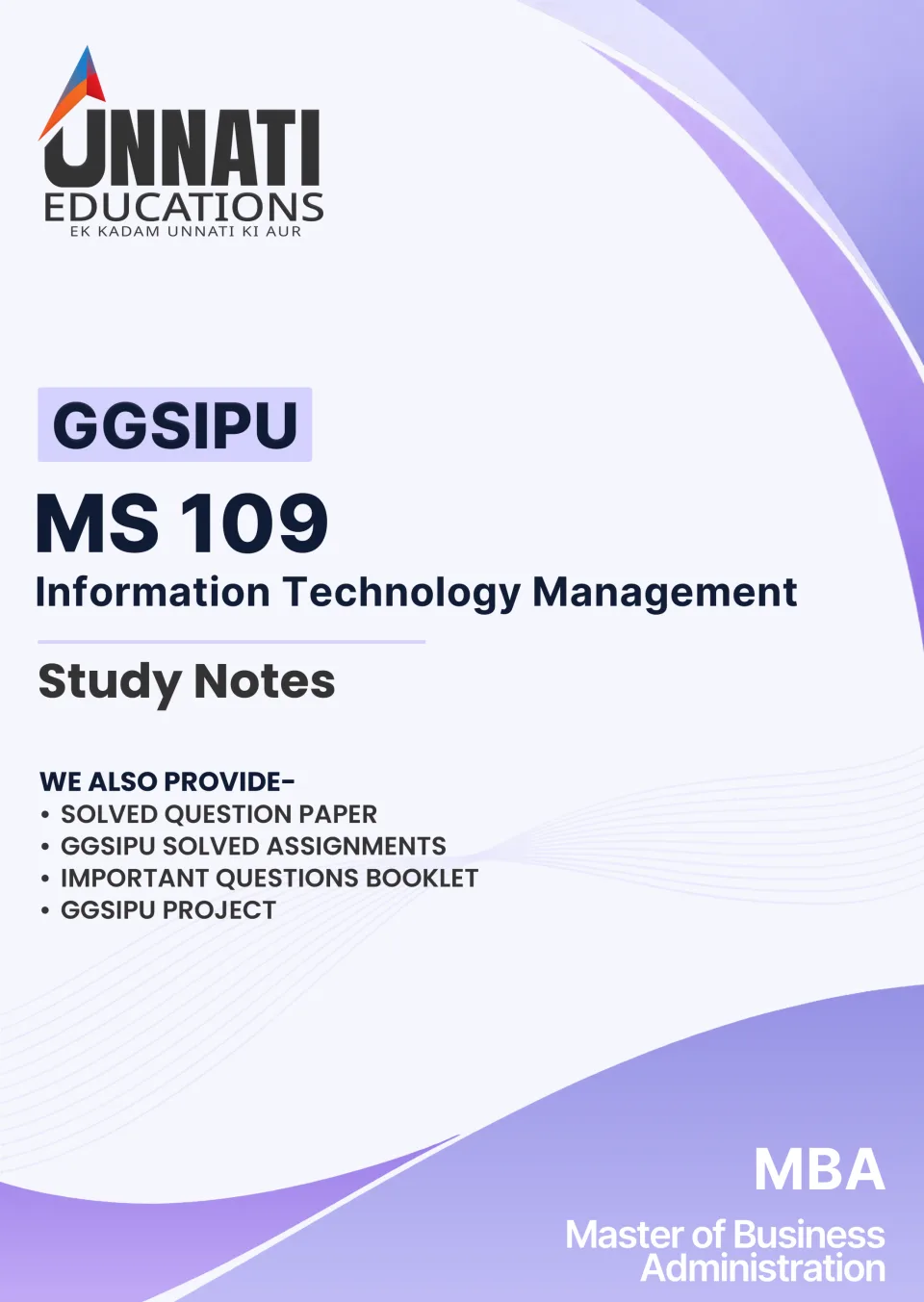
MS 109 Information Technology Management Notes cover all 4 units of the IPU MBA Semester 1 paper in a 73-page printed book: 32 labelled figures, 24 "Basis" comparison tables, 36 long-answer questions and 64 short-note topics. They follow the MBA scheme in force from 2021-22 and are ordered on WhatsApp; the book is not sold as a PDF.
Written by Prateek Talwar, Founder, Unnati Educations · Checked against GGSIPU MBA Scheme and Syllabus, 2021-22 onwards (Approved by AC Sub Committee) · Updated 13 October 2026 · Editorial policy
Scheme: MBA Scheme and Syllabus, w.e.f. 2021-22 academic session | Applies to: batch admitted 2021-22 onwards | Verified against: GGSIPU MBA Scheme and Syllabus 2021-22 onwards, checked 13 October 2026
MS 109 Information Technology Management at a glance: GGSIPU MBA Sem 1 credits, units and exam pattern
MS 109 is the only Skill Enhancement theory paper of the MBA first semester. These GGSIPU MBA Sem 1 Information Technology Management notes take every value below from the official 2021-22 scheme.
Code and title | MS 109 Information Technology Management (also printed as MS-109) |
|---|---|
Course and semester | MBA, First Semester |
Category and credits | Skill Enhancement · 3 credits · L 3, T/P nil |
Marks | 100: 25 internal (class test 15 + assignments or viva 10) + 75 end-term |
Applies to | Batches admitted from 2021-22 |
End-term pattern | Not printed in the official PDF (75 marks) |
Exam duration | 3 hours |
Units and teaching hours | 4 units: 6 + 14 + 12 + 10 = 42 hours |
Paired lab | MS 117 Information Technology Management Lab · Skill Enhancement · T/P 2 · 1 credit · 40 internal + 60 external |
Unit 2 gets 14 of the 42 hours, so revise software, Excel and SQL first. It sits with seven theory papers and one lab in the GGSIPU MBA Semester 1 papers. Pass and re-appear rules are in Ordinance 11 (ipu.ac.in).
MS 109 Information Technology Management Notes unit-wise: 32 figures and 100 exam questions across 4 units
These MS 109 Information Technology Management IPU notes give one chapter per official unit, each ending with an exam-question list and a Quick Revision Table. Notes for every other MBA paper sit under GGSIPU MBA notes. The official PDF numbers units only, so the titles below are the notes' own; one page per unit is in the sample PDF above.
MS 109 Unit 1: Information Technology, Computer Architecture and Cloud Computing
Pages 5-21 (17 pages) · 9 figures · 7 comparison tables · 8 long and 16 short questions.
The six components of an IT system, classes of computers, the Von Neumann model, machine cycle, memory hierarchy, RAM and ROM types, HDD vs SSD, DAS, NAS, SAN and RAID, cloud models, and data centre challenges with the PUE ratio.
Tier | Availability | Maximum downtime a year |
|---|---|---|
Tier I | 99.671% | about 28.8 hours |
Tier II | 99.741% | about 22 hours |
Tier III | 99.982% | about 1.6 hours |
Tier IV | 99.995% | about 26 minutes |
Quick look: data centre tiers by availability (from page 19)
Tier
Tier I
Availability
99.671%
Maximum downtime a year
about 28.8 hours
Tier
Tier II
Availability
99.741%
Maximum downtime a year
about 22 hours
Tier
Tier III
Availability
99.982%
Maximum downtime a year
about 1.6 hours
Tier
Tier IV
Availability
99.995%
Maximum downtime a year
about 26 minutes
MS 109 Unit 2: Computer Software, Excel and Database Management
Pages 22-41 (20 pages) · 11 figures · 7 comparison tables · 10 long and 16 short questions.
The longest chapter: software and licence types, OS functions, CLI vs GUI, translators; Excel formulas with SUMIF, VLOOKUP and PMT, Pivot Tables, Goal Seek and Solver; then the three-level DBMS architecture, data models, ER modelling, integrity constraints and SQL.
Quick look: SELECT queries on the five-row EMPLOYEE table (from page 39)
SELECT * FROM Employee WHERE City = 'Delhi';
SELECT Name FROM Employee WHERE Salary > 50000 AND Dept_ID = 20;
SELECT Dept_ID, SUM(Salary) FROM Employee GROUP BY Dept_ID;Output: Rahul, Amit and Karan; then Priya and Karan; then 83,000 (Dept 10), 1,15,000 (Dept 20) and 72,000 (Dept 30).
MS 109 Unit 3: Data Communication, Networks and the Internet
Pages 42-57 (16 pages) · 6 figures · 6 comparison tables · 9 long and 16 short questions.
The five components of data communication, simplex to full-duplex modes, PAN to WAN, peer-to-peer vs client-server, guided and unguided media, six topologies, hub to gateway devices, Internet, intranet, extranet and the WWW, ending with HTML tags and an "ABC Traders" web page.
Quick look: creating and viewing a web page (from page 55)
Type the code in Notepad inside
<html>,<head>,<body>.Save with the
.htmlextension.Open it in a browser; edit, save, refresh.
Upload to a host and link a domain.
MS 109 Unit 4: Functional and Enterprise Systems, Security and Emerging Trends
Pages 58-72 (15 pages) · 6 figures · 4 comparison tables · 9 long and 16 short questions.
The DIKW hierarchy, Simon's decision model and bounded rationality, TPS to ESS, functional systems, ERP, SCM, CRM and KMS; security through the CIA triad, threats, controls, the IT Act 2000 and DPDP Act 2023; then blockchain, AI, machine learning and IoT with FASTag as an example.
Decision type | Example in the notes | IS support |
|---|---|---|
Structured | Reordering stock at reorder level | TPS, MIS |
Semi-structured | Preparing a budget, selecting a supplier | DSS |
Unstructured | Entering a new market, a merger | ESS / EIS, AI |
Quick look: types of decisions and the systems that support them (from page 60)
Decision type
Structured
Example in the notes
Reordering stock at reorder level
IS support
TPS, MIS
Decision type
Semi-structured
Example in the notes
Preparing a budget, selecting a supplier
IS support
DSS
Decision type
Unstructured
Example in the notes
Entering a new market, a merger
IS support
ESS / EIS, AI
MS 109 exam corner: 36 long-answer questions and 64 short-note topics by unit
Each MS 109 chapter ends with exam-style questions (no year tags); the answers sit in the unit's own sections.
Unit (page) | Short-note topics | Long-answer questions |
|---|---|---|
Unit 1 (20) | 16 | 8 |
Unit 2 (40-41) | 16 | 10 |
Unit 3 (56) | 16 | 9 |
Unit 4 (71) | 16 | 9 |
MS 109 exam questions listed in the notes, by unit
Unit (page)
Unit 1 (20)
Short-note topics
16
Long-answer questions
8
Unit (page)
Unit 2 (40-41)
Short-note topics
16
Long-answer questions
10
Unit (page)
Unit 3 (56)
Short-note topics
16
Long-answer questions
9
Unit (page)
Unit 4 (71)
Short-note topics
16
Long-answer questions
9
The MS 109 notes list 64 short-note topics and 36 long-answer questions across 4 units.
Unit 1: Compare DAS, NAS and SAN and explain RAID levels. Pointer: the comparison table on page 15, then RAID levels with minimum disks.
Unit 2: Explain ER modelling and draw an ER diagram for a company. Pointer: symbols table plus the EMPLOYEE WORKS_IN DEPARTMENT diagram (page 37).
Unit 3: Differentiate between Internet, Intranet and Extranet. Pointer: public network vs staff-only portal vs partner logins over a VPN (page 51).
Unit 4: What is blockchain? Explain how it works and its business uses. Pointer: the six-step flow on page 67, then the RBI e-Rupee.
More practice sits in the MS 109 important questions.
Who writes and checks the MS 109 IT Management notes?
Prateek Talwar, author: Founder, Unnati Educations · Associate Company Secretary (ACS), ICSI, membership no. 58704, since 15 May 2019 · B.Com, University of Delhi (School of Open Learning), 2012 · author bio
The notes are mapped unit by unit to the 2021-22 MBA scheme. The 2026-27 edition adds Indian examples such as UPI, FASTag, the DPDP Act 2023 and the 1930 cyber fraud helpline. Last updated 13 October 2026 under our editorial policy.
The same team prepares GGSIPU important questions for every course.
How to write MS 109 answers: diagram-led long answers, "Basis" comparison tables and Excel or SQL examples
MS 109 rewards structure more than length. The notes' exam tips show four habits.
Draw first. A labelled Von Neumann block diagram beats a page of text on architecture.
Use a "Basis" table for every "differentiate" question, like the notes' RAM vs ROM or TPS vs MIS vs DSS vs ESS tables.
Follow a fixed order. For security issues, page 66 gives: meaning → CIA triad → threats → measures → IT Act 2000 and DPDP Act 2023.
Write real syntax. In HTML answers, write the basic structure first, then tags with
href,srcandborder(page 56).
Worked example: "How can Excel be used for data analysis in business?"
Use the page 32 scene of a sales manager analysing region-wise sales: Pivot Table, Goal Seek for a profit target, Scenario Manager for best and worst cases, Conditional Formatting for missed targets.
Then add formulas from page 31, such as =SUMIF(A2:A50,"North",C2:C50) and =VLOOKUP(E2,A2:C100,3,FALSE). The common mistake: an Excel or SQL answer with no formula at all.
Practise this format on GGSIPU MBA important questions.
MS 109 and the MS 117 IT Management lab, plus other GGSIPU MBA Sem 1 papers
Paired lab: MS 117 IT Management lab notes are planned. The scheme says MS 117 is based on MS 109. Theory units feed it like this:
Unit 2 operating systems (pages 23-25) → OS utilities
Unit 2 Excel tools (pages 30-32) → spreadsheet exercises
Unit 2 SQL (pages 38-40) → SQL queries
Unit 3 HTML (pages 54-55) → web pages with basic tags
Units 1 and 4 are for the written paper only. The other Semester 1 papers (25 credits in all) are MS 101 Management Process and Organisational Behaviour, MS 103 Quantitative Techniques, MS 105 Managerial Economics, MS 107 Accounting for Management, MS 111 Marketing Management, MS 113 Communication in Organizations and MS-115 Legal Aspects of Business.
OSI model layers and TCP/IP in business networks: excerpt from page 49 of the MS 109 notes
Excerpt from page 49 (Unit 3)
The 7 layers of the OSI model
The OSI reference model splits network communication into seven layers, each with one job. From the top: 7 Application gives user services such as HTTP, FTP, SMTP and DNS; 6 Presentation handles translation, encryption and compression; 5 Session sets up, manages and ends sessions.
Below them, 4 Transport gives end-to-end delivery through TCP and UDP; 3 Network handles IP addressing and routing with a router; 2 Data Link handles framing and MAC addresses with a switch or bridge; 1 Physical sends raw bits over the medium through a hub or repeater.
A memory aid from layer 7 down to layer 1 is "All People Seem To Need Data Processing". From layer 1 up to layer 7 it is "Please Do Not Throw Sausage Pizza Away".
Functions and data units of each layer
Layer | Main function | Data unit | Protocols / devices |
|---|---|---|---|
7 Application | Network services for user applications: browsing, e-mail, file transfer | Data | HTTP, HTTPS, FTP, SMTP, POP3, DNS, Telnet |
6 Presentation | Translates data formats, encrypts and compresses: the network's "translator" | Data | SSL/TLS, JPEG, MPEG, ASCII |
5 Session | Opens, maintains and closes the dialogue; adds checkpoints for recovery | Data | NetBIOS, RPC |
4 Transport | Reliable end-to-end delivery; segmenting, sequencing, error and flow control | Segment | TCP, UDP |
3 Network | Logical (IP) addressing and choosing the best path between networks | Packet | IP, ICMP; router |
2 Data Link | Node-to-node delivery, framing, MAC addressing, error detection | Frame | Ethernet, PPP; switch, bridge, NIC |
1 Physical | Sends raw bits as electrical, light or radio signals; defines cables and connectors | Bit | Cables, hub, repeater, modem |
OSI layers with their data unit and protocols or devices (page 49)
Layer
7 Application
Main function
Network services for user applications: browsing, e-mail, file transfer
Data unit
Data
Protocols / devices
HTTP, HTTPS, FTP, SMTP, POP3, DNS, Telnet
Layer
6 Presentation
Main function
Translates data formats, encrypts and compresses: the network's "translator"
Data unit
Data
Protocols / devices
SSL/TLS, JPEG, MPEG, ASCII
Layer
5 Session
Main function
Opens, maintains and closes the dialogue; adds checkpoints for recovery
Data unit
Data
Protocols / devices
NetBIOS, RPC
Layer
4 Transport
Main function
Reliable end-to-end delivery; segmenting, sequencing, error and flow control
Data unit
Segment
Protocols / devices
TCP, UDP
Layer
3 Network
Main function
Logical (IP) addressing and choosing the best path between networks
Data unit
Packet
Protocols / devices
IP, ICMP; router
Layer
2 Data Link
Main function
Node-to-node delivery, framing, MAC addressing, error detection
Data unit
Frame
Protocols / devices
Ethernet, PPP; switch, bridge, NIC
Layer
1 Physical
Main function
Sends raw bits as electrical, light or radio signals; defines cables and connectors
Data unit
Bit
Protocols / devices
Cables, hub, repeater, modem
How data moves through the layers
At the sender, data travels down from layer 7 to layer 1 and each layer adds its own header. This is encapsulation. At the receiver, data travels up from layer 1 to layer 7 and each layer removes its header, which is de-encapsulation.
OSI model vs TCP/IP model
TCP/IP is the practical model the Internet actually runs on. It has 4 layers, though some books show 5. The OSI Application, Presentation and Session layers together map to the single TCP/IP Application layer (HTTP, FTP, SMTP, DNS), and the OSI Transport layer maps to the TCP/IP Transport layer (TCP, UDP).
Do the MS 109 notes cover the full GGSIPU syllabus?
Yes. Every MS 109 topic in the 2021-22 MBA scheme has its own section in the notes; we found no gap.
Official unit (hours) | Official topics | Where in the notes | Status |
|---|---|---|---|
Unit I (06) | Components of IT systems, characteristics and classification of computers, computer architecture, types of memory, storage devices, mass storage systems, cloud computing, data centres and their challenges | Sections 1-9, pages 5-19 | Covered |
Unit II (14) | Types of software, operating system, GUI, compiler, interpreter and assembler, programming languages, application software, good software, emerging trends, spreadsheet and presentation software, Excel data analysis, DBMS concepts, data models, ER modeling, integrity constraints, SQL queries | Sections 1-15, pages 22-40 | Covered |
Unit III (12) | Data communication, networks, communications media, primary network topologies, the OSI model, inter-networking devices, Internet, intranet and extranets, Internet services, World Wide Web, HTML web pages | Sections 1-11, pages 42-55 | Covered |
Unit IV (10) | Data, information and knowledge, decision making process, classification of information systems, security issues in IT, block chain, artificial intelligence, machine learning, Internet of Things and their applications | Sections 1-5, pages 58-70 | Covered |
MS 109 official unit topics mapped to the notes
Official unit (hours)
Unit I (06)
Official topics
Components of IT systems, characteristics and classification of computers, computer architecture, types of memory, storage devices, mass storage systems, cloud computing, data centres and their challenges
Where in the notes
Sections 1-9, pages 5-19
Status
Covered
Official unit (hours)
Unit II (14)
Official topics
Types of software, operating system, GUI, compiler, interpreter and assembler, programming languages, application software, good software, emerging trends, spreadsheet and presentation software, Excel data analysis, DBMS concepts, data models, ER modeling, integrity constraints, SQL queries
Where in the notes
Sections 1-15, pages 22-40
Status
Covered
Official unit (hours)
Unit III (12)
Official topics
Data communication, networks, communications media, primary network topologies, the OSI model, inter-networking devices, Internet, intranet and extranets, Internet services, World Wide Web, HTML web pages
Where in the notes
Sections 1-11, pages 42-55
Status
Covered
Official unit (hours)
Unit IV (10)
Official topics
Data, information and knowledge, decision making process, classification of information systems, security issues in IT, block chain, artificial intelligence, machine learning, Internet of Things and their applications
Where in the notes
Sections 1-5, pages 58-70
Status
Covered
Official source: MBA Scheme and Syllabus, 2021-22 onwards.
Extras include PMT for loan EMIs and generative AI tools in Unit 4. Every course in GGSIPU notes is mapped to its official scheme the same way.
MS 109 IT Management notes FAQs
How do I get the full MS 109 notes?
The full MS 109 notes come only as a printed book of 73 pages; they are not available as a PDF. Tap "Get Full Notes" or message 9899436384 on WhatsApp with the code MS 109; our team confirms the order, dispatch and delivery details on the chat. The sample PDF shows the cover, index and one page per unit.
Are the MS 109 notes based on the current MBA scheme?
The MS 109 notes follow the university's MBA Scheme and Syllabus applicable from the 2021-22 academic session, where the paper is a 3-credit Skill Enhancement course with four units. We matched every unit topic to a section of the notes and found no gap. If your college follows a newer scheme, compare its units with the syllabus map above first.
Which MS 109 unit is the longest in the notes?
Unit 2 is the longest MS 109 chapter, at 20 pages with 11 figures and 10 long-answer questions. It also has the most official teaching time, 14 of the 42 hours, because it combines software, operating systems, Excel data analysis and a full DBMS section with ER diagrams and SQL queries. Unit 4 is the shortest chapter at 15 pages.
What is the passing mark for MS 109 Information Technology Management?
MS 109 is marked out of 100: 25 internal and 75 end-term. The MBA scheme we checked does not print a pass percentage, so we do not quote one here. End-term minimums, results and re-appear rules are set by Ordinance 11 on ipu.ac.in. The same scheme says a student needs at least 102 of the programme's 108 credits for the degree.
How is MS 109 different from the MS 117 lab?
MS 109 is the 3-credit theory paper, marked 25 internal and 75 end-term, covering all four units. MS 117 is the 1-credit lab, marked 40 internal and 60 external, and the scheme says it is based on MS 109. It covers OS utilities, SQL queries, HTML web pages and Excel exercises such as Goal Seek, recorded in a signed lab file.
Do I need a computer science background to study MS 109?
No. The official objective of MS 109 is to familiarise students coming from diverse backgrounds with the basic concepts of information technology and its business use. The notes explain each term in plain English and tie it to examples a commerce or arts graduate already knows, such as UPI billing, IRCTC reservations, Tally and FASTag tolls, then use diagrams and comparison tables.
Get the full MS 109 Information Technology Management Notes on WhatsApp
The complete MS 109 book is printed, not a PDF, and indexed by page.
Part of the book | Pages |
|---|---|
Cover and index | 1-4 |
5-21 (17) | |
22-41 (20) | |
42-57 (16) | |
58-72 (15) |
What is inside the printed MS 109 book
Part of the book
Cover and index
Pages
1-4
Part of the book
Pages
5-21 (17)
Part of the book
Pages
22-41 (20)
Part of the book
Pages
42-57 (16)
Part of the book
Pages
58-72 (15)
In total: 73 pages, 32 figures, 24 comparison tables and 4 Quick Revision Tables. These are Information Technology Management notes in English, with Indian business examples. Dispatch details are confirmed on WhatsApp.
Order the printed MS 109 notes book on WhatsApp (4 units, 73 pages)
Unnati Educations is an independent education provider based in Vikaspuri, Delhi. We are not affiliated with, authorised by, or endorsed by Guru Gobind Singh Indraprastha University (GGSIPU). 'GGSIPU' and 'IPU' are used only to describe the syllabus our notes follow. For official information, visit ipu.ac.in.
Ready for the full notes?
Discuss coverage and delivery with our team.