
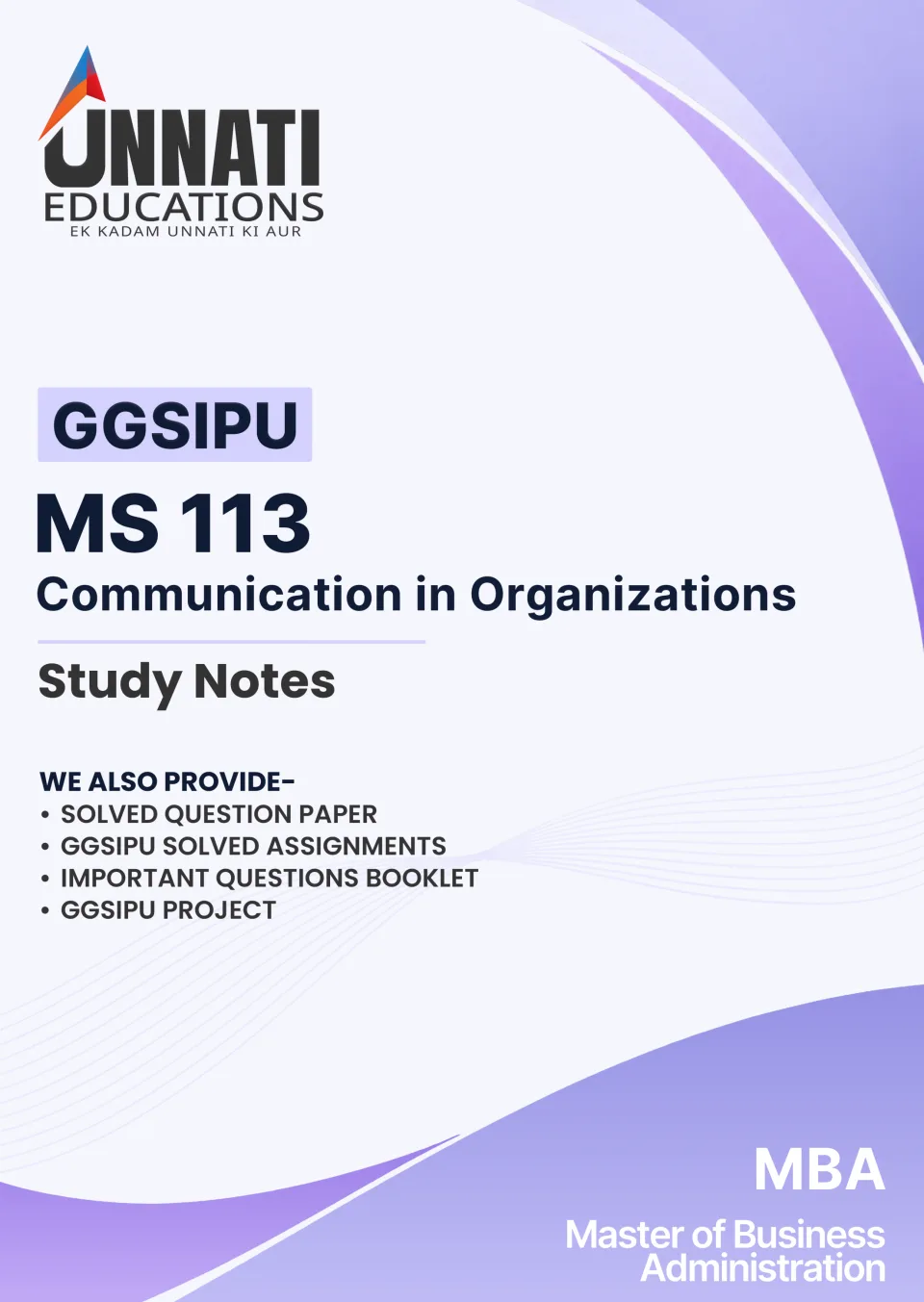
MS 113 Communication in Organizations Notes by Unnati Educations cover all 4 units of the GGSIPU MBA Semester 1 paper in 61 pages: 32 sections, 14 diagrams, 31 solved short-answer questions, 25 long-answer practice questions and 9 model drafts (letters, a resume, a speech, an e-mail and a blog). They follow the MBA scheme and syllabus for 2021-22 onwards.
Written by Prateek Talwar, Founder, Unnati Educations (ACS, ICSI) · Checked against GGSIPU MBA Scheme and Syllabus 2021-22 onwards, verified 13 Oct 2026 · Updated 14 October 2026 · Editorial policy
Scheme: MBA Scheme and Syllabus 2021-22 onwards | Applies to: batches admitted 2021-22 onwards | Verified against: GGSIPU MBA Scheme and Syllabus 2021-22 onwards, 13 Oct 2026
MS 113 Communication in Organizations at a glance: GGSIPU MBA Sem 1 credits, units and exam pattern
MS 113 is the only Ability Enhancement paper in MBA Semester 1, and the only one with a tutorial/practical hour (L-2, T/P-1). It sits with eight other GGSIPU MBA Semester 1 papers, from MS 101 to the MS 117 lab.
Item | Detail |
|---|---|
Code and title | MS 113 (printed MS-113 on the syllabus page) · Communication in Organizations |
Course and semester | MBA, First Semester |
Category and credits | Ability Enhancement · L-2, T/P-1 · 3 credits |
Marks | 100: 25 internal (class test 15 + assignments, presentation, viva or class participation 10) + 75 end-term |
Applies to | MBA Scheme and Syllabus 2021-22 onwards |
End-term pattern | Paper-setter instructions are not printed in the official PDF |
Exam duration | 3 hours |
Units | 4 units, 42 teaching hours (12 + 12 + 8 + 10) |
Paired lab | None (the Sem 1 lab, MS 117, belongs to MS 109) |
MS 113 Communication in Organizations: official snapshot (MBA Scheme and Syllabus 2021-22 onwards)
Item
Code and title
Detail
MS 113 (printed MS-113 on the syllabus page) · Communication in Organizations
Item
Course and semester
Detail
MBA, First Semester
Item
Category and credits
Detail
Ability Enhancement · L-2, T/P-1 · 3 credits
Item
Marks
Detail
100: 25 internal (class test 15 + assignments, presentation, viva or class participation 10) + 75 end-term
Item
Applies to
Detail
MBA Scheme and Syllabus 2021-22 onwards
Item
End-term pattern
Detail
Paper-setter instructions are not printed in the official PDF
Item
Exam duration
Detail
3 hours
Item
Units
Detail
4 units, 42 teaching hours (12 + 12 + 8 + 10)
Item
Paired lab
Detail
None (the Sem 1 lab, MS 117, belongs to MS 109)
Its printed objective is written and oral skill, so two of the four units are about drafting and speaking. Minimum marks and re-appear rules sit in GGSIPU Ordinance 11.
MS 113 Communication in Organizations Notes unit-wise: 31 solved short answers and 9 model drafts across 4 units
These GGSIPU MBA Sem 1 Communication in Organizations notes end every unit with an exam-questions page and a quick revision table. Notes for every other paper sit on the GGSIPU MBA notes page; one page per unit is in the sample PDF above.
MS 113 Unit 1: Introduction to Business Communication
Pages 4 to 19, 9 sections, 6 diagrams. It starts from the Latin root communis and five classic definitions, then classifies communication by mode, relationship, area and direction. Next come the five formal networks, Keith Davis's grapevine chains, the two-way process model with noise, eight families of barriers and their gateways. Exam questions: 10 solved short answers, 6 long-answer questions.
Network | Speed | Accuracy | Member satisfaction |
|---|---|---|---|
Chain | Moderate | High | Moderate |
Wheel | Fast for simple tasks | High | Low |
Circle | Slow | Low | Moderate |
All-channel | Fast for complex tasks | Moderate | Very high |
Quick look: how the formal networks compare (from page 10)
Network
Chain
Speed
Moderate
Accuracy
High
Member satisfaction
Moderate
Network
Wheel
Speed
Fast for simple tasks
Accuracy
High
Member satisfaction
Low
Network
Circle
Speed
Slow
Accuracy
Low
Member satisfaction
Moderate
Network
All-channel
Speed
Fast for complex tasks
Accuracy
Moderate
Member satisfaction
Very high
MS 113 Unit 2: Written Communication and Application of Communication
Pages 20 to 34, 9 sections, 2 diagrams and six full drafts: a quotation request, a good-news claim settlement, a persuasive guest-lecture invitation, a sales letter, a solicited job application and a fresher MBA resume. Before them, the unit covers the 7 C's, the twelve parts of a business letter and the direct versus indirect plan. Exam questions: 7 solved short answers, 7 long-answer questions.
Layout | What it looks like | Used for |
|---|---|---|
Full block | Every line starts at the left margin | Most modern letters; e-mail friendly |
Modified block | Date, close and signature start from the centre | Traditional corporate letters |
Semi-block | Modified block with indented paragraphs | Conservative business letters |
Quick look: the three business letter layouts (from page 24)
Layout
Full block
What it looks like
Every line starts at the left margin
Used for
Most modern letters; e-mail friendly
Layout
Modified block
What it looks like
Date, close and signature start from the centre
Used for
Traditional corporate letters
Layout
Semi-block
What it looks like
Modified block with indented paragraphs
Used for
Conservative business letters
MS 113 Unit 3: Oral Communication
Pages 35 to 48, 7 sections, 4 diagrams. It covers presentation stages and factors, video-conferencing etiquette, the five non-verbal codes, informative versus persuasive speeches with ethos, pathos and logos, and listening. Exam questions: 7 solved short answers, 6 long-answer questions.
Quick look: Monroe's Motivated Sequence for a persuasive speech (from page 44)
Attention: a story, striking fact or question.
Need: the problem and why it matters to this audience.
Satisfaction: the solution and how it meets the need.
Visualisation: the benefits if adopted, or the cost if not.
Action: exactly what the audience should do now.
MS 113 Unit 4: Recent Trends in Business Communication
Pages 49 to 60, 7 sections, 2 diagrams. It covers digital work relationships, netiquette with a model e-mail, the three stages of an online meeting, social media guidelines, an eight-step blog method, Hall and Hofstede, and Indian communication laws. Exam questions: 7 solved short answers, 6 long-answer questions.
Dimension | Effect on communication |
|---|---|
Power distance | High (India): formal titles, respect for hierarchy |
Individualism vs collectivism | Collectivist cultures value group harmony and face-saving |
Uncertainty avoidance | High: detailed rules and formal plans |
Long-term vs short-term orientation | Patience in negotiations versus a push for quick results |
Quick look: four of Hofstede's six cultural dimensions (from page 56)
Dimension
Power distance
Effect on communication
High (India): formal titles, respect for hierarchy
Dimension
Individualism vs collectivism
Effect on communication
Collectivist cultures value group harmony and face-saving
Dimension
Uncertainty avoidance
Effect on communication
High: detailed rules and formal plans
Dimension
Long-term vs short-term orientation
Effect on communication
Patience in negotiations versus a push for quick results
Managing the grapevine in business communication: excerpt from page 12 of the MS 113 notes
Excerpt from page 12
Merits and demerits of the grapevine
The grapevine works as a safety valve: employees release emotion and tension through it, and managers get honest feedback on how staff really feel about a decision. It supplements formal channels, fills gaps where official information is missing, and builds social bonds, cohesion and team spirit.
The same speed makes it risky. It can damage morale and reputations and create anxiety. No responsibility can be fixed because the source is unknown, confidential information can leak, and it can undermine authority or spread resistance to change.
How should managers handle the grapevine?
It cannot be eliminated, so it should be managed and used constructively.
Keep formal channels open and timely. Rumours grow where official information is missing or late, summed up as "rumour = importance × ambiguity".
Counter rumours quickly and openly with facts; do not ignore them or deny them without explanation.
Identify the opinion leaders and liaison persons and keep them correctly informed.
Use it to test reactions to a proposed change before the formal announcement, but never to spread falsehoods.
Build trust and an open-door culture so that employees ask instead of guessing.
Formal vs informal communication
Basis | Formal | Informal |
|---|---|---|
Meaning | Through official channels laid down by the organisation | Through social relationships; unofficial |
Channel | Follows the chain of command | Grapevine; flows freely in all directions |
Speed | Slow | Very fast |
Reliability | Reliable and authentic | Less reliable; rumours possible |
Record | Usually written; documentary evidence | Mostly oral; no record |
Responsibility | Source known; responsibility can be fixed | Source hard to trace |
Nature | Rigid, impersonal | Flexible, personal |
Purpose | Achieve organisational goals | Satisfy social and emotional needs |
Formal and informal communication compared (excerpt from page 12)
Basis
Meaning
Formal
Through official channels laid down by the organisation
Informal
Through social relationships; unofficial
Basis
Channel
Formal
Follows the chain of command
Informal
Grapevine; flows freely in all directions
Basis
Speed
Formal
Slow
Informal
Very fast
Basis
Reliability
Formal
Reliable and authentic
Informal
Less reliable; rumours possible
Basis
Record
Formal
Usually written; documentary evidence
Informal
Mostly oral; no record
Basis
Responsibility
Formal
Source known; responsibility can be fixed
Informal
Source hard to trace
Basis
Nature
Formal
Rigid, impersonal
Informal
Flexible, personal
Basis
Purpose
Formal
Achieve organisational goals
Informal
Satisfy social and emotional needs
The same page then opens section 1.7, the process of communication: a series of connected steps that carry a message from the sender to the receiver and back, which helps a manager see where communication breaks down.
MS 113 exam corner: 31 solved short-answer questions and 25 long-answer practice questions by unit
Unit | Short answers (solved) | Long-answer questions | Model drafts |
|---|---|---|---|
Unit 1: Introduction to Business Communication | 10 | 6 | 0 |
Unit 2: Written Communication | 7 | 7 | 6 |
Unit 3: Oral Communication | 7 | 6 | 1 |
Unit 4: Recent Trends | 7 | 6 | 2 |
MS 113 exam questions in the notes, unit by unit
Unit
Unit 1: Introduction to Business Communication
Short answers (solved)
10
Long-answer questions
6
Model drafts
0
Unit
Unit 2: Written Communication
Short answers (solved)
7
Long-answer questions
7
Model drafts
6
Unit
Unit 3: Oral Communication
Short answers (solved)
7
Long-answer questions
6
Model drafts
1
Unit
Unit 4: Recent Trends
Short answers (solved)
7
Long-answer questions
6
Model drafts
2
The MS 113 notes solve 31 short-answer questions and list 25 long-answer questions across 4 units, plus 9 model drafts and 14 diagrams. Long-answer questions are for practice and have no model answers. One question per unit:
Unit 1: What is Fayol's gang plank? A direct link between two same-level employees in different chains of command, allowed with their superiors' consent.
Unit 2: What is a Central Selling Point? The one benefit, chosen from the prospect's needs, around which the whole sales letter is built.
Unit 3: Differentiate between hearing and listening. Hearing is passive and physical; listening is an active, learned skill of attending, understanding and responding.
Unit 4: What is greenwashing? False or exaggerated green claims; unethical, and possibly a misleading advertisement under consumer protection law.
More practice sits in the MS 113 important questions.
Who writes and checks the MS 113 Communication notes?
Prateek Talwar, author. Founder, Unnati Educations; Associate Company Secretary (ACS), ICSI, membership no. 58704, since 15 May 2019; B.Com, University of Delhi (School of Open Learning), 2012. Author bio
The MS 113 Communication in Organizations IPU notes are mapped unit by unit to the MBA Scheme and Syllabus 2021-22 onwards. The 2026-27 edition adds Skype's May 2025 retirement, the DPDP Act, 2023 and the Bharatiya Nyaya Sanhita, 2023. Last updated 14 October 2026. See our editorial policy.
The same team prepares GGSIPU important questions for every course.
Do the MS 113 notes cover the full GGSIPU syllabus?
Yes. Every topic printed for MS 113 in the 2021-22 MBA syllabus has its own numbered section in the notes, from Unit I to Unit IV.
Official unit | Official topics | Where in the notes | Status |
|---|---|---|---|
I: Introduction to Business Communication | Definition, importance; forms and types (downward, upward, horizontal and lateral); formal and informal network; process; barriers and gateways | 1.1 to 1.9, pages 4 to 16 | Covered |
II: Written Communication and Application of Communication | Principles of written communication, 7C's; request, good news, persuasive and sales letters; job application and resume writing | 2.1 to 2.9, pages 20 to 32 | Covered |
III: Oral Communication | Oral presentations; factors affecting presentation; video-conferencing and Skype; non-verbal communication (paralanguage, time, space, silence, body language); informative and persuasive speeches; listening | 3.1 to 3.7, pages 35 to 46 | Covered |
IV: Recent Trends in Business Communication | Online communication and personal relationships; online meetings; social networks; social blogs; inter-cultural communication; ethical and legal issues | 4.1 to 4.7, pages 49 to 58 | Covered |
MS 113 official syllabus mapped to the notes
Official unit
I: Introduction to Business Communication
Official topics
Definition, importance; forms and types (downward, upward, horizontal and lateral); formal and informal network; process; barriers and gateways
Where in the notes
1.1 to 1.9, pages 4 to 16
Status
Covered
Official unit
II: Written Communication and Application of Communication
Official topics
Principles of written communication, 7C's; request, good news, persuasive and sales letters; job application and resume writing
Where in the notes
2.1 to 2.9, pages 20 to 32
Status
Covered
Official unit
III: Oral Communication
Official topics
Oral presentations; factors affecting presentation; video-conferencing and Skype; non-verbal communication (paralanguage, time, space, silence, body language); informative and persuasive speeches; listening
Where in the notes
3.1 to 3.7, pages 35 to 46
Status
Covered
Official unit
IV: Recent Trends in Business Communication
Official topics
Online communication and personal relationships; online meetings; social networks; social blogs; inter-cultural communication; ethical and legal issues
Where in the notes
4.1 to 4.7, pages 49 to 58
Status
Covered
Official source: MBA Scheme and Syllabus 2021-22 onwards, which also lists six suggested readings for MS 113, including Bovée's Business Communication Today.
Every course in GGSIPU notes is mapped to its official PDF the same way.
How to write MS 113 answers: draft letters, labelled diagrams and law-backed theory answers
The notes' exam tips give one pattern per answer type:
Process: draw the two-way model (sender, encoding, channel, decoding, receiver, feedback, noise), explain each element with an example, and name Shannon-Weaver and Berlo's SMCR.
7 C's: for each C, give its meaning in two lines, how to achieve it, and a weak versus improved example.
Drafting: full-block format with every part up to "Encl.", using dummy names and addresses, never your own.
Ethical and legal issues: split ethics from law, and name the Act: IT Act 2000, DPDP Act 2023, Consumer Protection Act 2019, Copyright Act 1957, POSH Act.
Vague | Concrete |
|---|---|
"Our product is very popular." | "Over 2 lakh customers in 18 states have bought our water purifier since 2024." |
"Please reply soon." | "Please reply by 15 October." |
Worked example: vague versus concrete lines for a 7 C's answer (from page 22)
Vague
"Our product is very popular."
Concrete
"Over 2 lakh customers in 18 states have bought our water purifier since 2024."
Vague
"Please reply soon."
Concrete
"Please reply by 15 October."
Practise this format on GGSIPU MBA important questions.
MS 113 and the GGSIPU MBA Sem 1 papers it connects to
MS 113 has no lab; see where it sits in the GGSIPU MBA syllabus.
Unit 1's barriers and networks reappear in MS 101 Management Process and Organisational Behaviour. Unit 2's AIDA sales letter and Central Selling Point feed into MS 111 Marketing Management. Unit 4's consumer and privacy laws overlap with MS-115 Legal Aspects of Business. Unit 3's video-conferencing set-up connects to MS 109 Information Technology Management.
Other Sem 1 papers: MS 103 Quantitative Techniques, MS 105 Managerial Economics, MS 107 Accounting for Management and MS 117 Information Technology Management Lab.
MS 113 Communication notes FAQs
How do I get the full MS 113 notes?
The full MS 113 Communication in Organizations notes come only as a printed book; they are not sold as a PDF. Tap "Get Full Notes" and the GGSIPU desk on 9899436384 will share order and delivery details on WhatsApp. To check quality first, open the sample PDF in the page header, which has one page from each unit.
Is MS 113 a theory paper or a lab paper?
MS 113 is a theory paper. The MBA scheme lists it as an Ability Enhancement course with two lecture hours and one tutorial or practical hour a week, worth 3 credits. It has no lab code; the only Sem 1 lab, MS 117, belongs to MS 109. The practical hour suits the presentations, speeches and letters taught in Units 2 and 3.
Which MS 113 unit needs the most drafting practice?
Unit 2 of MS 113 needs the most drafting practice. It carries six of the nine model drafts in the notes: a quotation request, a good-news claim settlement, a persuasive guest-lecture invitation, a sales letter, a solicited job application and a fresher MBA resume. Units 3 and 4 add a speech outline, an e-mail and a blog outline. Practise each in full-block format.
Do the MS 113 notes follow the 2021-22 MBA scheme?
Yes. The MS 113 notes follow the MBA Scheme and Syllabus 2021-22 onwards, where the paper is titled Communication in Organizations and carries 3 credits in Semester 1. All four official units, from Introduction to Business Communication to Recent Trends in Business Communication, keep the same order and titles in the notes, and every printed topic has its own numbered section.
What is the passing mark for MS 113?
MS 113 is marked out of 100: 25 internal and 75 end-term, as the MBA scheme sets for every theory course. The internal 25 splits into a 15-mark class test and 10 marks for assignments, presentations, viva, group discussion or class participation. The scheme PDF does not print a pass percentage, so check GGSIPU Ordinance 11 on ipu.ac.in for minimum marks and re-appear rules.
Do the MS 113 notes still teach Skype after Microsoft retired it?
Yes, because "Video-conferencing and Skype" is still a printed MS 113 topic in Unit III. The notes explain that Skype launched in 2003, was bought by Microsoft in 2011 and was retired in May 2025 in favour of Microsoft Teams. They treat it as the textbook example of internet-based (VoIP) video calling and also cover Zoom, Teams, Google Meet and Webex.
Get the full MS 113 Communication in Organizations Notes on WhatsApp
These Communication in Organizations notes in English come as a 61-page printed book, ordered on WhatsApp; they are not available as a PDF.
Unnati Educations is an independent education provider based in Vikaspuri, Delhi. We are not affiliated with, authorised by, or endorsed by Guru Gobind Singh Indraprastha University (GGSIPU). 'GGSIPU' and 'IPU' are used only to describe the syllabus our notes follow. For official information, visit ipu.ac.in.
Ready for the full notes?
Discuss coverage and delivery with our team.