
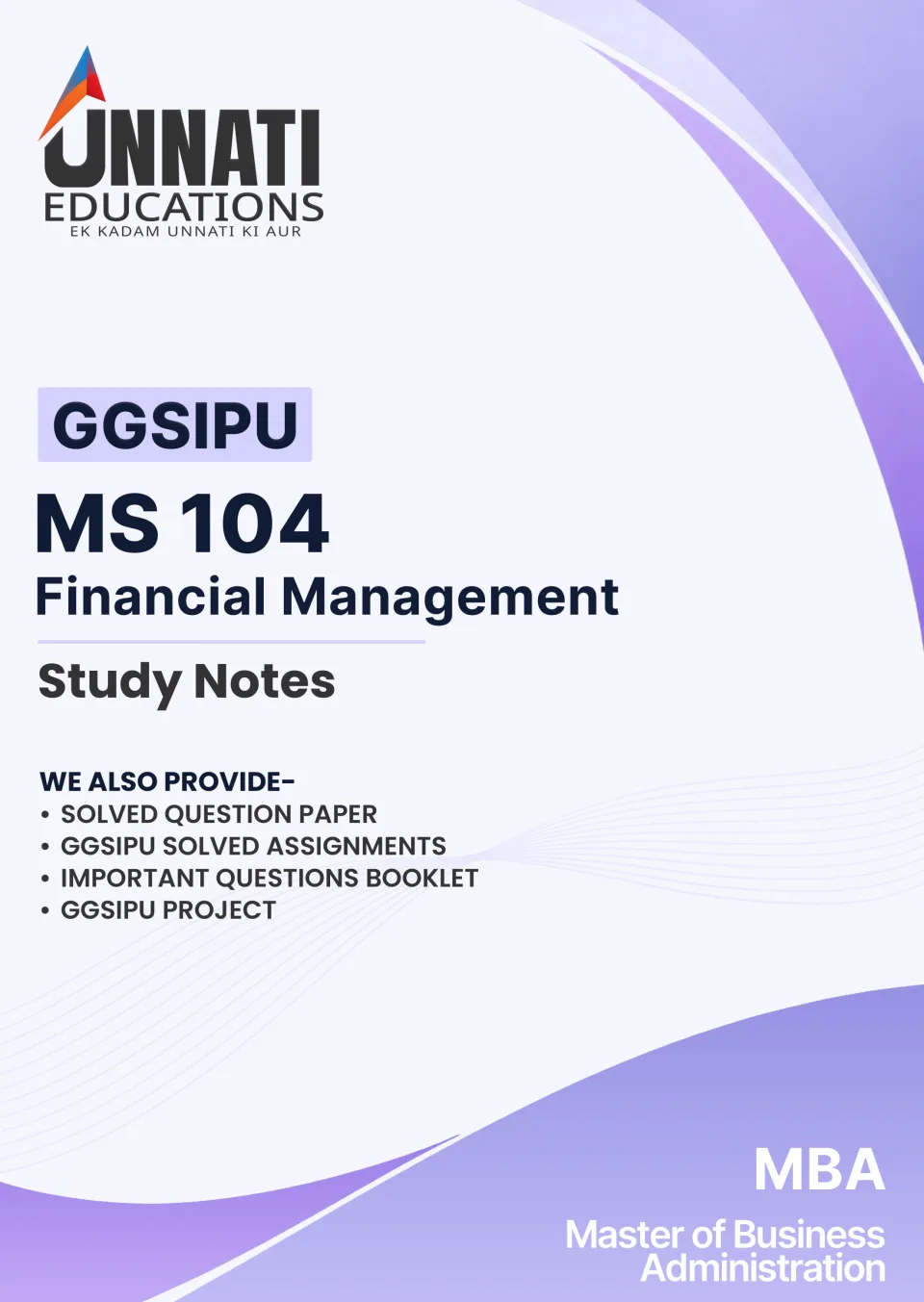
MS 104 Financial Management Notes for GGSIPU MBA Semester 2 cover all four official units in a 71-page printed book: 46 solved illustrations, 35 important exam questions, 4 diagrams and 7 MS-Excel function boxes. They follow the MBA Scheme and Syllabus 2021-22 onwards, which applies to batches admitted from the 2021-22 session.
Written by Prateek Talwar, Founder, Unnati Educations (ACS, ICSI) · Checked against GGSIPU MBA Scheme and Syllabus 2021-22 onwards · Updated 13 October 2026 · Editorial policy
Scheme: MBA 2021-22 onwards | Applies to: batches admitted from 2021-22 | Verified against: MBA Scheme and Syllabus 2021-22 onwards
MS 104 Financial Management at a glance: GGSIPU MBA Sem 2 credits, units and exam pattern
Code and title | MS 104 (also printed as MS-104) · Financial Management |
|---|---|
Course and semester | MBA, Second Semester |
Type and credits | Core · L 3 · 3 credits · 42 teaching hours |
Marks | 100: 25 internal (class test 15 + assignments or viva 10) + 75 end-term |
Applies to | MBA Scheme and Syllabus 2021-22 onwards |
End-term pattern | Paper-setter instructions are not printed in the official MBA 2021-22 PDF |
Exam duration | 3 hours |
Units | 4 (official PDF numbers units only) |
Paired lab | None in MBA Semester 2 |
The syllabus adds that MS-Excel functions are to be used. MS 104 sits with eight other GGSIPU MBA Semester 2 papers.
MS 104 Financial Management Notes unit-wise: 46 solved illustrations across 4 units
These MS 104 Financial Management IPU notes run from page 5 to 71; each unit ends with a Quick Revision Table and exam questions. Notes for every other MBA paper sit on the GGSIPU MBA notes page. For the layout, see the sample PDF above.
MS 104 Unit 1: Financial Objectives, Time Value of Money and Cash Flow Analysis
The four finance decisions, why wealth maximisation beats profit maximisation (Solomon's W = V − C), the agency problem, the Indian financial system, compounding, annuity due, EMI, funds flow and the AS-3 cash flow statement.
Pages 5 to 24 · 12 solved illustrations · 9 exam questions · 3 MS-Excel boxes.
Month | Interest @0.75% (₹) | Principal repaid (₹) | Closing balance (₹) |
|---|---|---|---|
1 | 3,750.00 | 6,629.18 | 4,93,370.82 |
2 | 3,700.28 | 6,678.90 | 4,86,691.93 |
3 | 3,650.19 | 6,728.99 | 4,79,962.94 |
Quick look: first EMIs of ₹10,379.18 on a ₹5,00,000 loan at 9% for 5 years (from page 15)
Month
1
Interest @0.75% (₹)
3,750.00
Principal repaid (₹)
6,629.18
Closing balance (₹)
4,93,370.82
Month
2
Interest @0.75% (₹)
3,700.28
Principal repaid (₹)
6,678.90
Closing balance (₹)
4,86,691.93
Month
3
Interest @0.75% (₹)
3,650.19
Principal repaid (₹)
6,728.99
Closing balance (₹)
4,79,962.94
MS 104 Unit 2: Capital Structure, Cost of Capital and Leverage Analysis
NI, NOI, traditional and Modigliani-Miller approaches, the cost of each source and WACC, then operating, financial and combined leverage, the EBIT-EPS indifference point and capital gearing.
Pages 25 to 40 · 12 solved illustrations · 8 exam questions · 2 diagrams · 1 MS-Excel box.
Quick look: MM arbitrage between firms U and L (from page 30)
Levered L is worth ₹17,50,000, identical unlevered U ₹16,00,000: L is overvalued.
Mr X sells 10% of L for ₹1,25,000 and borrows ₹50,000 personally at 10%.
He buys 10.9375% of U and nets ₹21,875 − ₹5,000 = ₹16,875, above his old ₹15,000.
Such switching continues until VL = VU.
MS 104 Unit 3: Capital Budgeting and Risk Analysis
One base project (Project X, ₹5,00,000 over five years) runs through payback, ARR and every DCF method; then risk: certainty equivalent, RADR, decision tree, Hillier's model, sensitivity and replacement.
Pages 41 to 56 · 12 solved illustrations · 8 exam questions · 1 diagram · 2 MS-Excel boxes.
Year | CFAT (₹) | α | PV of certain CF (₹) |
|---|---|---|---|
1 | 80,000 | 0.9 | 67,925 |
2 | 90,000 | 0.8 | 64,080 |
3 | 1,00,000 | 0.7 | 58,772 |
Quick look: certainty equivalent for Project Y at 6% (from page 49)
Year
1
CFAT (₹)
80,000
α
0.9
PV of certain CF (₹)
67,925
Year
2
CFAT (₹)
90,000
α
0.8
PV of certain CF (₹)
64,080
Year
3
CFAT (₹)
1,00,000
α
0.7
PV of certain CF (₹)
58,772
PV ₹1,90,777 less cost ₹2,00,000 = NPV −₹9,223: reject.
MS 104 Unit 4: Dividend Policy and Working Capital Management
Part A: Walter, Gordon, MM and Lintner. Part B: operating cycle, financing approaches, working capital estimation, EOQ, Baumol and Miller-Orr, credit policy and marketable securities.
Pages 57 to 71 · 10 solved illustrations · 10 exam questions · 1 diagram · 1 MS-Excel box.
Quick look: EOQ for 40,000 units a year (from page 66)
Demand 40,000 units, ordering cost ₹100, carrying cost ₹2 per unit.
EOQ = √(2 × 40,000 × 100 ÷ 2) = 2,000 units, so 20 orders a year.
Ordering cost ₹2,000 = carrying cost ₹2,000; total ₹4,000, the minimum.
MS 104 exam corner: 35 important exam questions and 46 solved illustrations by unit
Unit | Important exam questions | Solved illustrations |
|---|---|---|
Unit 1: TVM and cash flow | 9 | 12 |
Unit 2: Capital structure and leverage | 8 | 12 |
Unit 3: Capital budgeting and risk | 8 | 12 |
Unit 4: Dividend and working capital | 10 | 10 |
MS 104 exam questions and illustrations per unit
Unit
Unit 1: TVM and cash flow
Important exam questions
9
Solved illustrations
12
Unit
Unit 2: Capital structure and leverage
Important exam questions
8
Solved illustrations
12
Unit
Unit 3: Capital budgeting and risk
Important exam questions
8
Solved illustrations
12
Unit
Unit 4: Dividend and working capital
Important exam questions
10
Solved illustrations
10
The MS 104 notes list 35 important exam questions across 4 units, plus 46 solved illustrations. One exam-style question per unit:
Unit 1: "Wealth maximisation is a superior objective to profit maximisation." Discuss.
Pointer: limits of profit maximisation, then the cash flow, time value and risk case for wealth (pages 6 to 8).Unit 2: What is EBIT-EPS analysis? Explain the indifference point with a numerical example.
Pointer: equate the EPS of two plans; chart for Plans A, B and C (pages 36 to 38).Unit 3: What is a decision tree? Explain its use in capital budgeting with an example.
Pointer: big plant expected NPV ₹4.4 lakh beats ₹2.8 lakh (pages 50 to 51).Unit 4: Compare the Baumol and Miller-Orr models of cash management.
Pointer: certain versus random cash flows; one optimum versus three limits (pages 67 to 68).
The other 31 stay in the full book. More practice sits in the MS 104 important questions.
Who writes and checks the MS 104 finance notes?
Prateek Talwar, author · Founder, Unnati Educations · ACS (ICSI, membership no. 58704, since 15 May 2019) · B.Com, University of Delhi (SOL), 2012 · bio
The book is written as plain Financial Management notes in English and mapped unit by unit to the MBA Scheme and Syllabus 2021-22 onwards. The 2026-27 edition adds seven MS-Excel boxes (PMT, NPV, IRR, MIRR, SUMPRODUCT for WACC) to meet the syllabus note on Excel. Last updated 13 October 2026, under our editorial policy.
The same team prepares GGSIPU important questions for every course.
How to write MS 104 answers: formula-first numericals with working notes and an accept or reject line
MS 104 mixes theory and numericals in every unit. The notes' exam-tip boxes give one pattern: write the formula first, show the factor value (PVF, PVAF or CVF) and working notes, put the computation in a table, and end with a one-line conclusion.
In capital budgeting, add the decision rule and a clear "Accept" or "Reject". In working capital estimation, say whether debtors are taken at cost or at sales value.
Worked example (Illustration 10, page 36): sales of 10,000 units at ₹50, variable cost ₹30, fixed cost ₹80,000 and ₹4,00,000 of 10% debt.
Formula: DOL = Contribution ÷ EBIT; DFL = EBIT ÷ EBT; DCL = DOL × DFL.
Table: Contribution ₹2,00,000 → EBIT ₹1,20,000 → EBT ₹80,000.
Result: DOL 1.67, DFL 1.50, DCL 2.50.
Check: a 10% rise in sales lifts EBIT by 16.67% and EAT from ₹60,000 to ₹75,000, a 25% rise.
Conclusion: never pair a high DOL with a high DFL.
For theory, the notes use comparison grids, such as Walter, Gordon, MM and Lintner on page 62. Practise this format on GGSIPU MBA important questions.
MS 104 and the GGSIPU MBA Sem 2 papers it connects to
MS 104 has no paired lab; every MBA paper with its official units is on the GGSIPU MBA syllabus page.
MS 106 Business Research: Unit IV descriptive statistics underpin the standard deviation of NPV in Hillier's model (Unit 3, page 51).
MS 108 Sustainable Operations Management: Unit III inventory control meets MS 104 Unit 4 EOQ and ABC analysis (pages 65 to 67).
MS 114 Minor Project: NPV or working capital estimation can anchor a finance project.
Other Sem 2 papers: MS 102 Technology and Innovation Management, MS 110 Management of Information Systems, MS 112 Human Resource Management, MS 116 Professional Skill Development (NUES), MS-118 MOOC/Open Elective.
From Semester 1, MS 107 Accounting for Management feeds the Unit 1 cash flow statement and MS 103 Quantitative Techniques the Unit 3 decision tree.
Net present value and profitability index in financial management: excerpt from page 45 of the MS 104 notes
Excerpt from page 45
Illustration 3: NPV and Profitability Index
Calculate the NPV and PI of Project X at a discount rate of 10%. Project X costs ₹5,00,000, runs for five years and has no salvage value.
Year | CFAT (₹) | PVF @10% | PV (₹) |
|---|---|---|---|
1 | 1,20,000 | 0.9091 | 1,09,092 |
2 | 1,50,000 | 0.8264 | 1,23,960 |
3 | 1,80,000 | 0.7513 | 1,35,234 |
4 | 1,60,000 | 0.6830 | 1,09,280 |
5 | 1,40,000 | 0.6209 | 86,926 |
Total PV of inflows | 5,64,492 | ||
Less: initial investment | (5,00,000) | ||
NPV | 64,492 | ||
NPV is positive at ₹64,492, so Project X is accepted. The profitability index is PV of inflows ÷ PV of outflows = 5,64,492 ÷ 5,00,000 = 1.129. Since PI is above 1, the decision is again accept.
Merits and limits of NPV
NPV considers the time value of money and every cash flow over the project's life. It measures the increase in shareholders' wealth directly, it is value-additive, so NPV(A + B) = NPV(A) + NPV(B), and it can use a different discount rate for each year.
Its limits are practical. It needs a cost of capital fixed in advance, it is an absolute rupee figure that can favour large projects, it can mislead when projects have unequal lives, and non-finance managers often find a rupee figure harder to read than a percentage.
Profitability index (benefit-cost ratio)
PI = PV of cash inflows ÷ PV of cash outflows, and Net PI = PI − 1. Accept when PI is above 1 and reject when it is below 1. Because PI is a relative measure, it is the method to rank projects under capital rationing.
Internal rate of return
IRR is the discount rate at which NPV becomes zero, so the present value of inflows equals the present value of outflows. It is the project's own expected rate of return: the highest interest rate the project could pay on the funds invested and still break even.
Do the MS 104 notes cover the full GGSIPU syllabus?
Yes. Every topic in the four official MS-104 units has its own section, and the MS-Excel note is met through seven Excel boxes.
Official unit | Official topics | Where in the notes | Status |
|---|---|---|---|
Unit I (10 hours) | Financial Objectives; Impact of Financial and Economic Environment on Financial Management; Time Value of Money, Computation of EMI, Annuity, Annuity Due, Funds Flow Analysis, Cash Flow Statement and its Interpretation (AS-3) | pages 6 to 23 | Covered |
Unit II (10 hours) | Capital Structure: Net Income Approach, Net Operating Income Approach, Traditional Approach and MM Approach, Cost of Capital: Leverage Analysis, Operating Leverage, Financial Leverage, Combined Leveraged. EBIT-EPS Analysis, Capital Gearing | pages 25 to 39 | Covered |
Unit III (10 hours) | Capital Budgeting, Conventional and DCF Methods, Risk Analysis-Certainty Equivalent Factor, Risk Adjusted Discounting Rate, Decision Tree, Independent and Dependent Risk Analysis, Replacement Decisions, Sensitivity Analysis | pages 41 to 55 | Covered |
Unit IV (12 hours) | Dividend Policy: Walter Model, Gordon Model, MM Approach, Lintner Model; Working Capital Management: approaches, estimation; Management of Inventories; Management of Cash (Various Theoretical Models); Management of Receivables and Marketing Securities | pages 57 to 70 (as "Marketable Securities") | Covered |
MS 104 official units mapped to the notes
Official unit
Unit I (10 hours)
Official topics
Financial Objectives; Impact of Financial and Economic Environment on Financial Management; Time Value of Money, Computation of EMI, Annuity, Annuity Due, Funds Flow Analysis, Cash Flow Statement and its Interpretation (AS-3)
Where in the notes
pages 6 to 23
Status
Covered
Official unit
Unit II (10 hours)
Official topics
Capital Structure: Net Income Approach, Net Operating Income Approach, Traditional Approach and MM Approach, Cost of Capital: Leverage Analysis, Operating Leverage, Financial Leverage, Combined Leveraged. EBIT-EPS Analysis, Capital Gearing
Where in the notes
pages 25 to 39
Status
Covered
Official unit
Unit III (10 hours)
Official topics
Capital Budgeting, Conventional and DCF Methods, Risk Analysis-Certainty Equivalent Factor, Risk Adjusted Discounting Rate, Decision Tree, Independent and Dependent Risk Analysis, Replacement Decisions, Sensitivity Analysis
Where in the notes
pages 41 to 55
Status
Covered
Official unit
Unit IV (12 hours)
Official topics
Dividend Policy: Walter Model, Gordon Model, MM Approach, Lintner Model; Working Capital Management: approaches, estimation; Management of Inventories; Management of Cash (Various Theoretical Models); Management of Receivables and Marketing Securities
Where in the notes
pages 57 to 70 (as "Marketable Securities")
Status
Covered
Official source: GGSIPU MBA Scheme and Syllabus 2021-22 onwards. Rules on examinations and results are in GGSIPU Ordinance 11.
The official PDF numbers units only, so unit names here come from the notes. Every course in GGSIPU notes is mapped to its official PDF the same way.
MS 104 finance notes FAQs
How do I get the full MS 104 notes?
The full MS 104 Financial Management notes are sold as a printed book only; they are not available as a PDF. Tap "Get Full Notes" or the WhatsApp button at the end of this page and send the pre-filled message. Our team confirms the order, shares the price and delivery details in the chat, and dispatches the 71-page book.
Is MS 104 Financial Management a theory paper or a numerical paper?
MS 104 is both. Unit 1 is the most theory-heavy, yet it carries 12 solved illustrations on compounding, annuity, EMI and cash flow statements. Units 2 and 3 are mostly numerical: cost of capital, leverage, NPV, IRR and risk analysis. Unit 4 mixes dividend theories with EOQ, Baumol and Miller-Orr working, and has 10 exam questions.
What are the passing marks for MS 104 Financial Management?
MS 104 is marked out of 100: 25 internal and 75 end-term, as the GGSIPU MBA 2021-22 scheme states for all theory courses. The MBA 2021-22 scheme PDF does not print a pass percentage, so we do not state one. For minimum marks and re-appear rules, read GGSIPU Ordinance 11 on ipu.ac.in or ask your institute's examination cell.
Do the MS 104 notes follow the current GGSIPU MBA scheme?
Yes. The MS 104 notes are mapped to the MBA Scheme and Syllabus 2021-22 onwards, which lists MS-104 Financial Management as a 3-credit core paper in the Second Semester. All four official units are covered. If your batch follows a different scheme, compare its official PDF on ipu.ac.in with the unit-by-unit syllabus map above before you order.
Do the MS 104 notes show the MS-Excel functions the syllabus asks for?
Yes. The MS-104 syllabus says MS-Excel functions and formulas are to be used, and the notes carry seven MS-Excel boxes. They cover functions such as PMT for EMI, NPV, IRR and MIRR for capital budgeting, SUMPRODUCT for WACC, Goal Seek and Data Table for sensitivity analysis, and ready-to-type formulas for EOQ, Baumol, Miller-Orr, Walter and Gordon.
Can I see sample pages of the MS 104 notes before ordering the book?
Yes. The "View Sample PDF" button at the top opens an 8-page sample of the MS 104 notes: the cover, the four-page index and one page from each unit (compounding, the MM approach, NPV and profitability index, Walter's model). It is watermarked and is there so you can judge the layout and depth before you order the printed book.
Get the full MS 104 Financial Management Notes on WhatsApp
What the printed MS 104 notes book contains
Unit
Pages in the book
5 to 24 (20)
Solved illustrations
12
Exam questions
9
Unit
Pages in the book
25 to 40 (16)
Solved illustrations
12
Exam questions
8
Unit
Pages in the book
41 to 56 (16)
Solved illustrations
12
Exam questions
8
Unit
Pages in the book
57 to 71 (15)
Solved illustrations
10
Exam questions
10
These GGSIPU MBA Sem 2 Financial Management notes come only as a 71-page printed book, not as a PDF. Price and delivery details are shared on WhatsApp.
Order the printed MS 104 notes book on WhatsApp (4 units, 71 pages)
Unnati Educations is an independent education provider based in Vikaspuri, Delhi. We are not affiliated with, authorised by, or endorsed by Guru Gobind Singh Indraprastha University (GGSIPU). 'GGSIPU' and 'IPU' are used only to describe the syllabus our notes follow. For official information, visit ipu.ac.in.
Ready for the full notes?
Discuss coverage and delivery with our team.