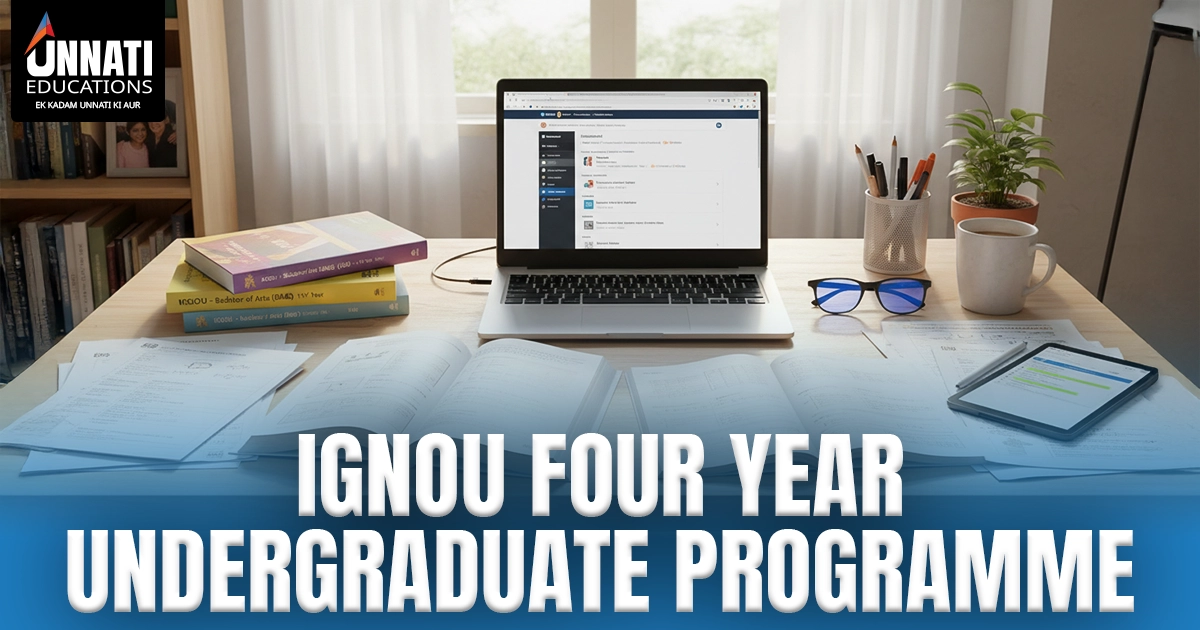
The IGNOU Four Year Undergraduate Programme was one of the significant reforms implemented under the National Education Policy 2020 (NEP 2020). Students who choose open or distance learning will benefit from the model's Flexibility, credit mobility, numerous entry and exit choices, and academic continuity over time. Academic mentors help IGNOU applicants navigate from 0 to 100% in the admission process so that they can understand and follow their course without any guesswork. IGNOU formally introduced FYUP in the admission cycle of July 2025, following the approval of the FYUP Committee. It is an ideal model for learners who require a flexible study schedule that fits their lifestyle, not vice versa. The format is particularly useful for students with a busy schedule, who may be juggling family duties, working, traveling, or preparing for exams.
The IGNOU Four Year undergraduate programme is a four-year program.
IGNOU Four Year Undergraduate Programme is a credit-based, modular degree that spans over eight semesters in four academic years. It is based on the NEP 2020 structure, which encourages depth and breadth to be achieved in later semesters. Structure: The program is divided into four years, with foundational knowledge in the first year and interdisciplinary learning in the second. IGNOU combines skill courses with core papers, discipline-specific electives, vocational credentials, as well as research and project components. It is a practical journey that can be adapted to different age groups, abilities and learning goals.
Why IGNOU switched to FYUP – The student-centric reasoning
Students who paused in their studies lost the continuity of their degree. IGNOU recognized this long before. FYUP's model addresses this issue by implementing checkpoints. This allows students to return at a later date without losing any recognition. Consistency across the globe is another reason why FYUP exists. Numerous international institutions provide four-year Bachelor's programs. IGNOU is bringing its framework up to date with global standards through the FYUP, which will give learners greater acceptance and mobility at foreign universities. Students who are open to learning need Flexibility. Open learning students need Flexibility. FYUP is able to support their realities by offering a combination of structured progress and breathing space.
IGNOU 4 Year Undergraduate Programme: Features and Key Factors
Multiple entry and Multiple exit
The student may stop at Year 1, 2 or 3, and receive an accredited qualification. Students can also enter later to complete their degree.
All Stages of Certification have Recognised Certification.
Every academic degree or certificate -- whether it's a diploma, certificate, or other award -- has been officially acknowledged.
Credit Mobility
Credits can be stored in the Academic Bank of Credits and transferred using this system.
Major and Minor Discipline Combinations
Students may choose one primary academic discipline, and can explore others as minor components.
Everyone can benefit from Flexibility.
The programme can be completed at the pace of working learners, students on gap years, and those in need of academic space.
Understanding Multiple Entry/Exit (FYUP Me-ME Scheme).
IGNOU FYUP Multiple Entry Exit Scheme is designed to ensure that the academic progress of students does not suffer due to their personal situations. The following is an explanation of how the scheme works:
Exit Level 1 - After Year 1
The Undergraduate Certificate Credits: 44 Students can choose whether to continue next year or take a short break.
Exit Level 2 - After Year 2
Graduate Diploma Credits: 84 Outcome: Good for job applications or to re-enter Year 3 in the future.
Exit Level 3 - After Year 3
Minor with UG Award Credits: 120 Students who successfully complete the stage are then eligible to take higher education and exams at the national level.
Exit Level 4 - After Year 4
Earning a Bachelor's Honors Degree Credits: 160 Outcome: A full honors degree with advanced coursework, or a project. Unnati Education helps many students plan their goals by helping them understand how to exit.
IGNOU FYUP Syllabus summary (simple and no listing)
The first year is a time when students develop the academic foundations and skills they need to succeed in university. Second-year students are exposed to multidisciplinary subjects that allow them to integrate different disciplines. The third year concentrates on the main discipline to enhance depth and build subject authority. Fourth-year components include project-based education, vocational credit, and exposure to research. The credit distribution is based on core papers and electives. It also includes skill courses, interdisciplinary modules, fieldwork or project elements, as well as interdisciplinary modules.
Multiple Entry Options for Existing IGNOU Students (Course Code Section)
When a student leaves after year 1
After completing the credits required, students may be eligible to enter straight into year 2.
When a student leaves after year 2
The student may be able to enter the third year with full recognition of credits.
Conditions for Re-Entry
You must submit your grade cards or certificates for verification.
Following re-entry, the completion timeframe is extended.
- Four years is the maximum allowed for re-entry in Year 2.
- Two years maximum for re-entry in Year 3.
All previous credit is transferred to the new number.
Lateral Entry for Students From Other Universities
IGNOU FYUP allows students to enter the program in Year 2 from another institution.
Qualification Conditions
- They must also match their earlier degree and minor with the IGNOU.
- You must possess a degree equivalent to a Certificate of Undergraduate Studies.
- IGNOU requires earning at least 50% of all degree credits.
- You must present verified grades and certificates.
It is most useful to students who are unable to attend regular classes due to personal, work, or other reasons.
IGNOU FYUP-2025 Model Benefits
Flexibility without compromise
Maintain academic standing while studying at your own pace.
You will not lose any credits
If students stop, the previous work they have done is still valid.
Future-Ready Education
The alignment of NEP 2020 with the NEP 2020 strategy ensures its long-term relevance.
The Year After Each Other
The value of each certificate, degree or honors is different.
Skills Development and Practical Experience
You can learn through vocational education and project-based learning.
FYUP Timeline Overview (Clear Chart)
| Year | Semesters | Credits | Award Received |
| Year 1 | 1–2 | 44 | UG Certificate |
| Year 2 | 3–4 | 84 | UG Diploma |
| Year 3 | 5–6 | 120 | UG Degree (Major) |
| Year 4 | 7–8 | 160 | UG Honours Degree |
What is the difference between an FYUP and a three-year degree?
It is entirely up to the individual student whether they prefer a FYUP or a 3-year degree. Three-year programmes are faster, and they work for those who want to graduate from college sooner. FYUP on the other offers more academic training, an organized major-minor, skills components, research experience, and final Honours. FYUP is more suitable for those who plan to continue their studies or pursue a career that will last a long time.
Recognition of FYUP by UGC DEB
FYUP has full recognition in India, as it's part of the NEP 2020 Reforms. UGC's support for IGNOU's Year Undergraduate Programme and UGC-DEB's recognition of its open-distance format are key factors in the success of IGNOU. All awards, whether they are a certificate, a diploma, a degree or an honours program, can be used for academic mobility, admission, government positions and other opportunities. IGNOU, as a central institution, has national credibility, and students can feel confident about their academic credentials.
Does FYUP Affect UPSC Eligibility?
FYUP is not a disadvantage to UPSC applicants. UPSC is looking for a recognized bachelor s-level degree, and FYUP third-year students have that. The students who complete 120 credits are fully qualified to take the UPSC Civil Services Exam and other national-level examinations. It is possible that completing all four years will even improve preparation, due to additional concepts and knowledge gained through honours courses or research.
Who should choose IGNOU FYUP?
It is designed for:
- Flexible schedules are needed for work or family responsibilities
- You may prefer open learning and distance education.
- Want modular progression
- Plans to further your education
- Need multiple exit points.
- Combine academics and vocational training.
- Studying interdisciplinary paths is a good choice.
Unnati Education provides students with the information they need to understand their academic pathway, timetable, and options for re-entry.
Differentiation between exit, entry, re-entry, and lateral Entry
Exit
A student may leave after earning certain credits and receive a recognised prize.
Entrance (Fresh admission)
The student begins to complete the FYUP at the beginning of the year.
Re-Entry
The student who has previously dropped out of school may return and complete their remaining semesters.
Lateral Entry
After meeting eligibility criteria, a student from another university can apply to IGNOU FYUP for Year 2.
FAQs on IGNOU FYUP
Q1. What is the IGNOU FYUP Multi Entry Exit Scheme
Students can leave the system after Year 1, 2 or 3, receive a recognized certification, and then return to complete their remaining semesters. Credits can be stored in the Academic Bank of Credits and then transferred to ensure that no year of study is wasted. It allows Flexibility and ensures continuity in the future.
Q2. What is the IGNOU FYUP diploma?
After completing the first two years of FYUP, students receive an Undergraduate Diploma with 84 credits. The Undergraduate Diploma is recognised as an academic achievement and also a valid step to re-enter the third year. The program supports students who require temporary breaks, without affecting their progress.
Q3. What is the IGNOU FYUP diploma?
You can. Students must have a major or minor that matches the IGNOU system, and must earn at least half of all degree credits from IGNOU. Also, they must submit verified grade cards and certificates.
Q4. Can FYUP be used to prepare for competitive exams and/or help with exam preparation?
FYUP may be useful for exams that need a strong understanding of concepts. Honors students may benefit from extra academic experience that can be useful for UPSC or SSC exams, as well as banking examinations.
Q5. What happens if the student interrupts FYUP?
The earned credits are still valid, and the student can return within a certain timeframe. So, personal issues will not affect academic progress.
Conclusion
IGNOU Four-Year Undergraduate Programme creates a flexible academic structure for all learners. It allows for flexible study plans that are tailored to the needs of students. With its multiple entry/exit routes, clear rules on credit, and national recognition, it is a great option. Learners can use our help to understand their journey in the IGNOU, from 0 to 100%, so they are able to plan with confidence their future academic and career goals.