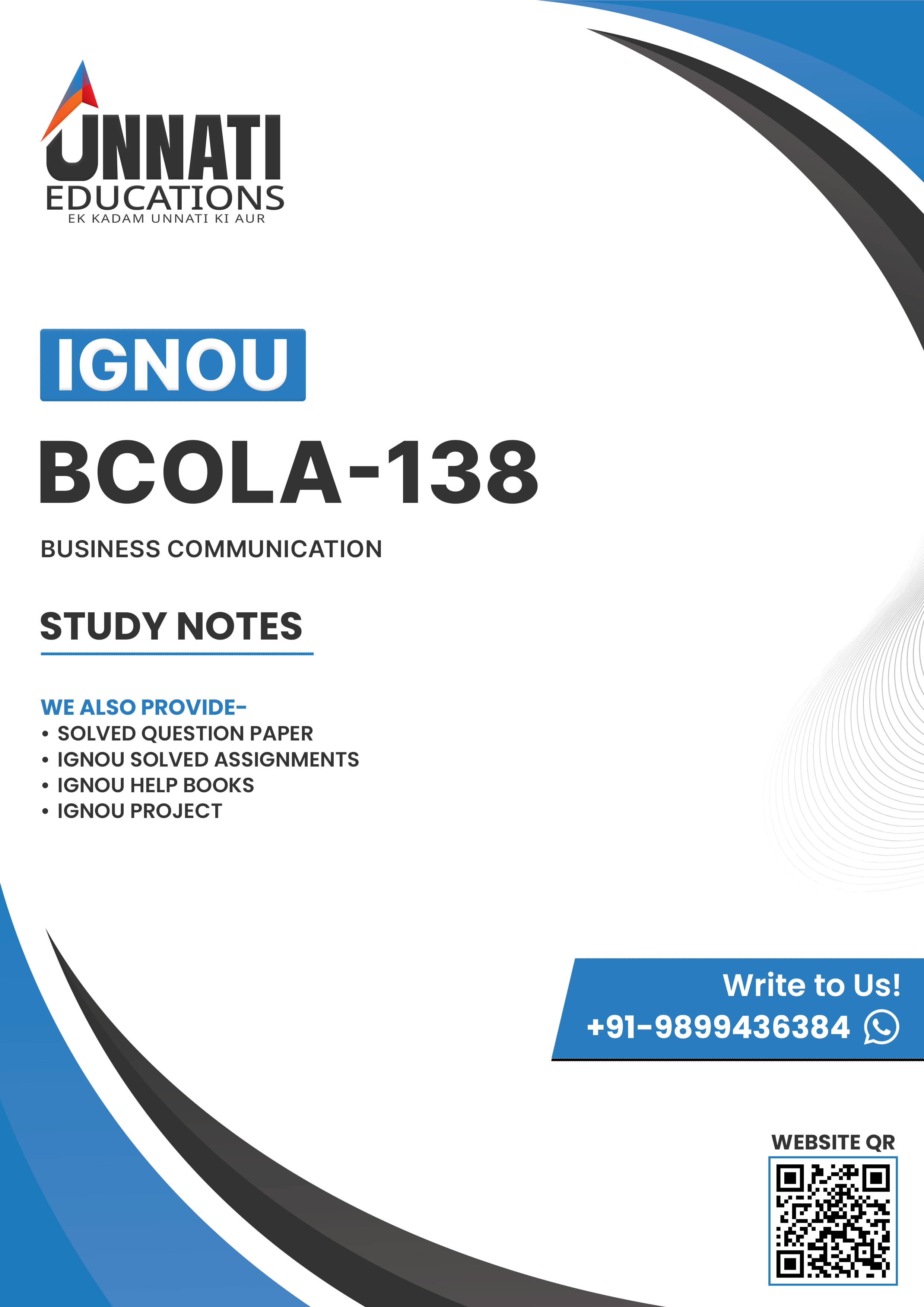
BCOLA 138 notes: key facts
- Course code: BCOLA 138 (also written as BCOLA-138)
- Official title: Business Communication
- Programme: Bachelor of Commerce (General), BCOMG, CBCS
- Semester: Fourth semester (2026 assignment booklet)
- Blocks and units: 5 blocks, 19 units
- Notes pages: 153 pages, A4 PDF
- Notes language: English
- Revision tables: 19 quick revision tables, 285 rows in total
- Key points: 70 key-point boxes
- Figures and diagrams: 29
- Practice questions: None in this file
- Exam: 3 hours, 100 marks, any 5 of 8 questions
- Practical component: None
- Hindi version of the notes: Ask on WhatsApp
- Shown on this page: 2 sample topics and the first 5 rows of one revision table
- Edition: 2026 edition
- Last updated: 10 November 2026
IGNOU BCOLA 138 Notes cover Business Communication, a fourth-semester course in IGNOU's Bachelor of Commerce (General), BCOMG, in 153 pages across 5 blocks and 19 units, with 19 of 19 eGyanKosh units covered. Every unit closes with a summary and a quick revision table. Written in English; download a free sample PDF here and get the full PDF on WhatsApp.
Looking for IGNOU's official BCOLA 138 blocks? They are in IGNOU's open eGyanKosh library; this page is about our own unit-wise notes written from those blocks.
Download the free sample PDF (8 pages)
or read 2 sample topics on this page
What BCOLA 138 covers from communication basics to the job market
IGNOU BCOLA 138 Notes explain Business Communication, a fourth-semester course in IGNOU's Bachelor of Commerce (General), built on 5 blocks and 19 units.
- Block 1 Basic Concepts, Units 1 to 5: communication process, barriers, types, purposes and channels.
- Block 2 Business Correspondence, Units 6 to 10: letters, postal services, meetings and minutes.
- Block 3 Report Writing, Units 11 to 13: types of reports, report process and precis.
- Block 4 Vocabulary For Business Writing, Units 14 to 17: business terms and tricky words.
- Block 5 Conferencing and Job Market, Units 18 and 19: calls, visual aids, CV, interview.
The course belongs to the Bachelor of Commerce (General) programme.
Try 2 topics from the notes on voting methods and long reports
Here are voting methods from Block 2, the block that gave 3 main questions in June 2026, and long reports from Block 3, both taken from the notes and also in the free sample PDF. Neither section was set in the last two papers, so they show the style of the notes without handing you a ready answer.
Sample 1 Voting Procedures and Methods from Unit 10
10.3 Voting Procedures and Methods
- Every motion must reach a logical conclusion: carried or fall. The chairman seeks the opinion of the house: called ascertaining the sense of the meeting.
- Acclamation (clapping/cheering) is unreliable in formal meetings: fit only for formal motions like a vote of thanks. Serious business needs a proper voting system.
10.3.1 Methods of Voting
| Method | How It Works | Key Feature |
|---|---|---|
| Voice Vote | Members say 'Aye' (for) or 'No' (against); chairman judges by volume of sound. | Used in legislative bodies; no exact count possible. |
| Show of Hands | Members raise hands; a 'teller' counts and reports to chairman. | Common in meetings; no proxy allowed. |
| Standing Vote | Members in favour stand and are counted; then those against. | Avoids confusion of raised hands; no secrecy, no proxy. |
| Division | Members split into two groups (for/against) in the hall or rooms; teller counts. | Clear picture, no secrecy, no proxy; disturbs seating. |
| Ballot | Members write 'yes/no' or mark a ballot paper and drop it in a sealed box. | Secret voting; no outside influence; time consuming. |
| Poll | Each member delivers votes to an officer, orally or in writing (via rolling papers). | Best for large numbers; proxies allowed; reflects shareholding. |
Key point: Casting Vote: in case of a tie, the chairman may use his casting vote either way. If he does NOT use it, the motion is lost. Proxy = written authorisation to vote on another's behalf; the authorised person is also called a proxy. Allowed only in Poll (not in show of hands, standing vote, or division).
Poll: when it can be demanded
- When members are not satisfied with the result of a show of hands, they may demand an immediate poll (as per bye-laws).
- When the rules demand a poll on important agenda issues.
- When the chairman himself decides a poll is necessary (if rules do not prohibit).
Advantages of a Poll:
- Ascertains the sense of the meeting with greater accuracy.
- All members can take part even when numbers are large; absentees can vote via proxies.
- Where proxies are allowed, voting reflects shareholding strength.
- Limitation: a minority may collect many proxies of disinterested members; also time consuming.
10.3.2 General Rules for Voting
- Any departure from usual procedure needs the meeting's assent.
- All issues decided by simple majority unless a special majority is prescribed.
- A vote once cast cannot be withdrawn or altered; absentee votes are not counted.
- Only members present and entitled may vote; proxies (if allowed) must be checked and verified.
- The chairman may vote and use a casting vote in a tie; if not cast, the motion is lost.
- The chairman's declaration of the result is final; on a show of hands, members may demand a poll.
In the full notes this unit goes on to motions, amendments and resolutions before this part, and to the two kinds of minutes after it, with a 20-row revision table at the end.
Sample 2 Long Reports from Unit 12
12.5 Long Reports
Based on length, business reports are of two types: Long Reports and Short Reports. A long report generally has three parts: the preliminary part, the text, and the supplementary part. Each part has several sub-parts.
12.5.1 Preliminary Part
The preliminary part contains several items (a formal report has more items than an informal one):
| Item | Meaning |
|---|---|
| 1. Title Fly | Contains only the report title: brief and indicative of the contents and depth. |
| 2. Title Page | Compulsory for all reports. Includes title, author's name & designation, date of submission, and name/title of the person it is for. |
| 3. Authorisation Document | A copy of the letter from the competent person authorising the report. |
| 4. Table of Contents | Called 'contents'. Lists chapters, sub-chapters, tables, figures, appendices, bibliography with page numbers. |
| 5. List of Tables | Placed after contents. Gives table number, title and page number, in order of appearance. |
| 6. List of Figures | Follows the list of tables; same format: serial number, title and page number of figures. |
| 7. Abstract | Also called 'synopsis': a summary of the whole text, usually a few paragraphs, seldom over one page. |
12.5.2 Text
The text is the part between the preliminary and supplementary parts: also called the body of the report and the major part. It has three sub-parts:
| Part | What It Contains |
|---|---|
| 1. Introduction | Background, objectives, methods of data collection, analysis and organisation of the report: tells the reader what is in the body. |
| 2. Body | The most important part: full details of the study including tables, figures, graphs and diagrams. |
| 3. Conclusion | Summary of what was read; highlights significant and divergent points. Recommendations may be given at the end of this section. |
12.5.3 Supplementary Part
The supplementary part appears at the end of the report (after the text). Common items:
- Endnotes: when notes are placed on a separate page immediately after the text (instead of footnotes at the foot of a page). Presented in the same serial order as cited.
- Appendices / Annexures: relevant material (questionnaires, letters, memos) that would distract if placed in the text; given with a title and serial number.
- Bibliography: also called references; a list of documents/publications consulted, usually in alphabetical order; useful to readers wanting more information.
- Index: an alphabetical list of key topics/terms with the page numbers where they occur.
Do you know? Not every long report has all these parts. Some may also add a preface, foreword or acknowledgements.
In the full notes this unit continues with short reports in memorandum, minutes and letter form, and closes with a 14-row revision table.
Download the free sample PDF of these 2 topics
The sample PDF has these 2 topics as they look in the notes, with the contents page and the first 5 revision rows.
IGNOU BCOLA 138 Notes for each of the 19 units, block by block
Every unit in these notes opens with its objectives and an introduction, and ends with a "Let Us Sum Up" summary and a quick revision table. Sixteen units also carry a Key Words glossary; Units 16, 17 and 18 do not, because their tables already work as word lists.
For other courses, see our IGNOU Notes list.
Block 1 Basic Concepts of Business Communication
- Unit 1 An Introduction to Communication (pages 1 to 10, 4 figures, 13-row table; asked in June 2026). Lasswell's five questions, the chain from sender to feedback, and personal, environmental and mechanical barriers.
- Unit 2 Types of Communication (pages 11 to 20, 4 figures, 14-row table; asked in June 2026). Oral and written forms, then kinesics, proxemics, paralanguage and appearance as non-verbal types.
- Unit 3 An Introduction to Business Communication (pages 21 to 29, 5 figures, 10-row table; asked in December 2025). Twelve features, downward, upward, horizontal and diagonal flows, and nine roles in a business.
- Unit 4 Purpose of Business Communication (pages 30 to 37, 12-row table; asked in December 2025). Eight purposes, Toyota's Five-Why process, remote workers, then chatbots, blockchain and LiFi.
- Unit 5 Channels of Business Communication (pages 38 to 46, 16-row table). Organisational, direction-based and expression-based channels, with the plus and minus points of formal and informal ones.
Block 2 Business Correspondence
- Unit 6 Principles of Letter Writing (pages 47 to 54, 13-row table; asked in June 2026). The you-attitude and courtesy, then a long part on the form and arrangement of a letter.
- Unit 7 Business Correspondence-I (pages 55 to 61, 12-row table; asked in December 2025). Planning a letter, then enquiry, order, claim, status, banking and agency letters.
- Unit 8 Business Correspondence-II (pages 62 to 72, 3 figures, 22-row table; asked in June 2026). Publicity, letters to editors, then money order, V.P.P., Speed Post, PLI and IPPB.
- Unit 9 Meetings-I (pages 73 to 80, 1 figure, 18-row table; asked in both papers). Kinds of meetings and the requisites of a valid one: notice, quorum, agenda and the chairman's powers.
- Unit 10 Meetings-II (pages 81 to 88, 20-row table; asked in December 2025; sample above). Motions, amendments and resolutions, then voting methods and the two kinds of minutes.
Block 3 Report Writing
- Unit 11 Business Reports (pages 89 to 96, 12-row table; asked in December 2025). Johnson's definition, why reports matter, ten essentials of a good report and the types of reports.
- Unit 12 Process of Writing a Report (pages 97 to 103, 1 figure, 14-row table; asked in June 2026; sample above). General guidelines, the procedure, Hicks' four stages, and long and short reports.
- Unit 13 Precis Writing (pages 104 to 108, 10-row table). The 3 C's, the one-third length rule, a five-step method, common problems and four worked passages.
Block 4 Vocabulary For Business Writing
- Unit 14 Some Business Terms-I (pages 109 to 119, 5 figures, 25-row table; asked in both papers). Terms such as acquisition, brand, balance sheet, business plan, Digital India and disinvestment, each with an example.
- Unit 15 Some Business Terms-II (pages 120 to 127, 1 figure, 16-row table). NAV, NPA, nominal interest rate and USP, plus a long part on how supply and demand relate.
- Unit 16 Words Often Confused (pages 128 to 133, 14-row table). Pairs like affect and effect, principal and principle, and stationary and stationery, each with a memory line.
- Unit 17 Words Often Misspelt (pages 134 to 136, 9-row table). The shortest unit: why words get misspelt, double-letter traps and British versus American spelling.
Block 5 Conferencing and Preparing for Job Market
- Unit 18 Voice Mail, Video Conferencing and Conference Calls (pages 137 to 146, 4 figures, 20-row table; asked in both papers). Call etiquette, video conferencing, answering machines and visual aids.
- Unit 19 Preparing for Job Market (pages 147 to 153, 1 figure, 15-row table; asked in December 2025). Reading a job advertisement, the application letter, the CV and the interview.
Pages, figures and revision tables in every business communication unit
Units 8 and 14 run to 11 pages each, while Unit 17 takes only 3, so the reading load in this course is far from even. The table shows what each unit holds, so you can see where the time goes before you plan.
| Unit | Pages | Sections | Key points | Figures | Revision rows | Practice questions |
|---|---|---|---|---|---|---|
| 1 | 10 | 10 | 7 | 4 | 13 | 0 |
| 2 | 10 | 7 | 5 | 4 | 14 | 0 |
| 3 | 9 | 8 | 4 | 5 | 10 | 0 |
| 4 | 8 | 9 | 2 | 0 | 12 | 0 |
| 5 | 9 | 8 | 6 | 0 | 16 | 0 |
| 6 | 8 | 7 | 3 | 0 | 13 | 0 |
| 7 | 7 | 7 | 3 | 0 | 12 | 0 |
| 8 | 11 | 7 | 6 | 3 | 22 | 0 |
| 9 | 8 | 9 | 4 | 1 | 18 | 0 |
| 10 | 8 | 7 | 5 | 0 | 20 | 0 |
| 11 | 8 | 8 | 3 | 0 | 12 | 0 |
| 12 | 7 | 9 | 2 | 1 | 14 | 0 |
| 13 | 5 | 9 | 5 | 0 | 10 | 0 |
| 14 | 11 | 5 | 2 | 5 | 25 | 0 |
| 15 | 8 | 5 | 4 | 1 | 16 | 0 |
| 16 | 6 | 4 | 1 | 0 | 14 | 0 |
| 17 | 3 | 4 | 0 | 0 | 9 | 0 |
| 18 | 10 | 8 | 5 | 4 | 20 | 0 |
| 19 | 7 | 9 | 3 | 1 | 15 | 0 |
| Total | 153 | 140 | 70 | 29 | 285 | 0 |
Each unit ends with a quick revision table, and these BCOLA 138 revision notes are what you read in the last two days before the exam. Here is how the Unit 16 table starts.
| Pair | One-line Difference |
|---|---|
| Accept / Except | Accept = agree/receive | Except = excluding. |
| Advice / Advise | Advice = noun (opinion) | Advise = verb (to counsel). |
| Affect / Effect | Affect = verb (influence) | Effect = noun (result). |
| Complement / Compliment | Complement = completes | Compliment = praise. |
| Conscience / Conscious | Conscience = moral sense | Conscious = aware. |
The other 9 rows of this table, and the other 18 tables, are in the full PDF.
Unit 8 is long because its postal services part alone runs to about 2,000 words, covering money order, V.P.P., Speed Post, PLI and IPPB. Unit 14 is long because it explains its business terms one by one, often with an Indian example such as demonetisation or Digital India.
To see how these units turn up in real papers, open our IGNOU Previous Year Question Paper collection.
How the BCOLA 138 paper is set and which block gave most questions
In the June 2026 paper you answer any 5 of 8 questions in 3 hours, each worth 20 marks, and Block 2 gave 3 of the 7 main questions. Question 8 is always a set of short notes: 2 of 4 in June 2026, and 4 of 5 at 5 marks each in December 2025. Neither paper sets a word limit.
| Item | Detail |
|---|---|
| Time | 3 hours |
| Maximum marks | 100 |
| Questions | 8, answer any 5, all carry equal marks (20 each) |
| Split questions | Q4 (10 + 10), Q5 and Q7 (5 + 15), Q8 short notes (10 + 10) |
| Word limit | Not stated |
| Medium | English and Hindi versions in the same paper |
| Paper | Block 1 | Block 2 | Block 3 | Block 4 | Block 5 | Short-note options |
|---|---|---|---|---|---|---|
| June 2026 | 2 | 3 | 1 | 0 | 1 | Blocks 1, 2, 2, 4 |
| December 2025 | 2 | 2 | 1 | 0 | 2 | Blocks 3, 4, 4, 4, 4 |
In the official June 2026 paper, Block 2 gave 3 of the 7 main questions; in December 2025, Blocks 1, 2 and 5 gave 2 each. Block 4 has not had a main question in either paper, but it supplied 4 of the 5 short-note options in December 2025.
A few more topics from these two papers, with the unit that covers them:
- Steps of the communication process: June 2026, 20 marks, Unit 1.
- Procedure of report writing: June 2026, 20 marks, Unit 12.
- Requisites of a valid meeting: December 2025, Q4(a) for 10 marks, Unit 9.
- Types of visual aids: December 2025, 20 marks, Unit 18.
- Job application letter: December 2025, 20 marks, Unit 19.
To turn the notes into a 20-mark answer, start from the definition the unit gives. For the communication process, open with the Oxford English Dictionary definition from Unit 1, frame the answer with Lasswell's five questions, then walk from sender and encoding to decoding and feedback in the same order as section 1.4.
For a 5 + 15 question, such as the conference call one, give the meaning in four or five lines and spend the rest on the steps. Unit 18's revision rows on "Before a Call" and "Call Etiquette" give you a ready skeleton to expand.
For letter questions, use Unit 6's form and arrangement part as the order of your headings, and write the specimen letter in that layout. For report questions, Unit 12's procedure and Hicks' four stages give a natural order of points, and you can close with the unit summary idea that a report is written for a decision-maker.
Three mistakes cost marks in this paper. First, mixing up the notice and the agenda: Unit 9 treats them as separate documents. Second, adding your own opinion to a precis: Unit 13 says a precis is not a paraphrase and adds nothing new. Third, treating a money order, a postal order and V.P.P. as one service, when Unit 8 explains each separately.
The official paper is on IGNOU's site as the June 2026 term-end question paper.
For exam practice built on past papers, see the BCOLA 138 Solved Guess Paper.
Syllabus check with 19 of 19 eGyanKosh business communication units covered
All 19 unit titles on the eGyanKosh course page appear in the notes, in the same order and under the same 5 blocks. The notes do not print block names, so the grouping below is the official one. The course has no practical manual, lab or project, so nothing sits outside the notes.
| Block | Official unit title (eGyanKosh) | Notes pages | Status | What to revise |
|---|---|---|---|---|
| 1 | Unit-1 An Introduction to Communication | 1 to 10 | Covered | Lasswell's five questions, barriers |
| 1 | Unit-2 Types of Communication | 11 to 20 | Covered | Kinesics, proxemics, paralanguage |
| 1 | Unit-3 An introduction to Business Communication | 21 to 29 | Covered | Diagonal flow, nine roles |
| 1 | Unit-4 Purpose of Business Communication | 30 to 37 | Covered | Purposes, Five-Why process |
| 1 | Unit-5 Channels of Business Communication | 38 to 46 | Covered | Formal versus informal channels |
| 2 | Unit-6 Principles of Letter Writing | 47 to 54 | Covered | Letter layout, you-attitude |
| 2 | Unit-7 Business Correspondence-I | 55 to 61 | Covered | Banking and agency letters |
| 2 | Unit-8 Business Correspondence-II | 62 to 72 | Covered | Money order, V.P.P., IPPB |
| 2 | Unit-9 Meetings-I | 73 to 80 | Covered | Notice, quorum, valid meeting |
| 2 | Unit-10 Meetings-II | 81 to 88 | Covered | Amendments, poll, minutes |
| 3 | Unit-11 Business Reports | 89 to 96 | Covered | Johnson's definition, report types |
| 3 | Unit-12 Process of Writing a Report | 97 to 103 | Covered | Hicks' four stages |
| 3 | Unit-13 Precis Writing | 104 to 108 | Covered | 3 C's, one-third rule |
| 4 | Unit-14 Some Business Terms-I | 109 to 119 | Covered | Brand, business plan, Digital India |
| 4 | Unit-15 Some Business Terms-II | 120 to 127 | Covered | NAV, NPA, USP |
| 4 | Unit-16 Words Often Confused | 128 to 133 | Covered | Principal versus principle |
| 4 | Unit-17 Words Often Misspelt | 134 to 136 | Covered | Double-letter traps |
| 5 | Unit-18 Voice Mail, Video Conferencing and Conference Calls | 137 to 146 | Covered | Call etiquette, visual aids |
| 5 | Unit-19 Preparing for Job Market | 147 to 153 | Covered | Application letter, CV order |
Block 1 takes 46 pages for 5 units, while Block 3 needs only 20 pages for 3 units, which is why the 10-day plan further down gives Block 1 two full days.
Check any unit against the official text in IGNOU's open eGyanKosh library.
Diagrams to practise drawing in business communication
This course has no numericals, but a quick diagram earns marks in at least four of the questions set in June 2026 and December 2025. The notes carry 29 figures in all; the ones below are the drawings worth practising, because each one maps to a question type the papers keep using.
Draw them small and simple: boxes and arrows are enough. A process chain at the start of the communication answer, or a tree of meeting types at the start of the meetings answer, shows the examiner the structure before you write the detail.
| Unit | Diagram in the notes | What it shows |
|---|---|---|
| 1 | Lasswell's model chain | Who, says what, which channel, to whom, with what effect |
| 1 | Figure 1.2 Whole Process of Sending and Receiving a Message | Sender, encoding, channel, decoding, response, feedback loop |
| 1 | Figure 1.3 Classification of Communication Barriers | Personal, environmental and mechanical branches |
| 3 | Figures 3.3 to 3.6 Downward, Upward, Horizontal and Diagonal Communication | How messages move between levels and departments |
| 8 | Figure 8.2 Kinds of Postal Services | Telegraphic, remittance and postal service branches |
| 9 | Figure 9.1 Classification of Meetings | Public and private meetings, then general and committee meetings |
| 12 | Figure 12.1 Parts of a Long Report | Preliminary, text and supplementary parts with their items |
| 18 | Figures 18.2 to 18.5 Visual Aid Samples | A poster, an infographic, a flip chart and an image |
The postal services tree in Unit 8 fits the June 2026 money order and V.P.P. question, and the visual aid samples in Unit 18 fit the December 2025 visual aids question. Practise each drawing once in under two minutes.
How the business communication notes were written and checked
The IGNOU BCOLA 138 Notes were written from the official course blocks on eGyanKosh and checked unit by unit against the eGyanKosh title list, where all 19 titles match.
For each unit the notes add what the official block does not lay out for quick revision: a summary, a quick revision table, key-point boxes and, in sixteen units, a Key Words glossary. Long running text becomes tables you can revise fast, such as the six voting methods in Unit 10 or the seven preliminary items of a long report in Unit 12.
What the notes leave out: they carry no practice questions, so use past papers for answer practice. There is no practical component in this course, so nothing needs separate study. These BCOLA 138 Notes in English are the 2026 edition, last updated on 9 November 2026.
The Unnati Educations academic team prepared the notes. Prateek Talwar, founder of Unnati Educations, edited and approved them, and Sheetal Kirola, Academic Head, reviewed them against the blocks.
Notes help you revise the BCOLA 138 blocks faster; they do not replace reading the official blocks or guarantee marks.
Other notes for the same programme are collected on our BCOMG Notes page.
Who takes business communication and a 10-day plan to finish it
This is a fourth-semester course of the Bachelor of Commerce (General), BCOMG, and the 2026 assignment booklet gives the assignment a 30% weight. The term-end exam carries the rest, and the 2026 assignment is valid from 1 January to 31 December 2026.
On the mock day, compare your answers with the BCOLA 138 Solved Question Paper for December 2025.
B.Com (General) students take this paper alongside Corporate Accounting and Cost Accounting, so the next notes to open are the IGNOU BCOC 137 Notes.
The plan below spreads the BCOLA 138 unit-wise notes over 10 days by page count, so the heavier units get more time.
| Day | Units | Pages | Focus |
|---|---|---|---|
| 1 | 1 and 2 | 20 | Communication process, barriers, verbal and non-verbal types |
| 2 | 3, 4 and 5 | 26 | Features and roles, purposes, three groups of channels |
| 3 | 6 and 7 | 15 | Letter layout and kinds of business letters |
| 4 | 8 | 11 | Publicity, letters to editors, postal services |
| 5 | 9 and 10 | 16 | Notice, quorum, agenda, motions, voting, minutes |
| 6 | 11, 12 and 13 | 20 | Report types, report process, precis method |
| 7 | 14 and 15 | 19 | Business terms I and II |
| 8 | 16 to 19 | 26 | Confused and misspelt words, conference calls, CV and interview |
| 9 | All units | Revision tables | Read every quick revision table once |
| 10 | Mock | 3 hours | 5 answers of 20 marks under exam conditions |
On day 10, take 10 minutes to read the paper and choose, 32 minutes for each of the 5 answers, and 10 minutes to check. In a short-notes question with 4 notes of 5 marks, that is about 8 minutes per note.
BCOLA 138 business communication notes FAQs
Do the BCOLA 138 notes cover every eGyanKosh unit?
Yes, all 19 unit titles on the eGyanKosh course page are covered, in the same order and under the same 5 blocks. The course has no practical manual or project, so no separate component is left out. The shortest units are Unit 17 Words Often Misspelt at 3 pages and Unit 13 Precis Writing at 5 pages, so they need less time than the rest.
How are these notes different from the eGyanKosh business communication blocks?
The eGyanKosh blocks are the official source and you should still read them; the notes are a faster way to revise them. Each unit in the notes gets a short summary, a quick revision table and key-point boxes, and long passages are turned into tables, such as the voting methods in Unit 10. The notes do not add practice questions.
What is the BCOLA 138 exam pattern and which block gave most questions?
You answer any 5 of 8 questions in 3 hours for 100 marks, and each question carries 20 marks. In June 2026, Block 2 Business Correspondence gave 3 of the 7 main questions: letter layout, money order with V.P.P., and the notice of a meeting. Block 4 gave no main question in that paper or in December 2025.
Which business communication unit needs the most study time?
Unit 8 Business Correspondence-II needs the most time. It runs to 11 pages, and its postal services part alone is about 2,000 words, which matches the money order and V.P.P. question set in June 2026. Unit 14 is equally long at 11 pages, but its business terms are short items you can learn in smaller sittings.
Are the BCOLA 138 notes written in English or Hindi?
These notes are in English, written in simple sentences with tables. The official paper itself is printed in both English and Hindi, so a Hindi-medium student can still use the notes by matching the terms. For a Hindi version of the notes, ask on WhatsApp at 9899436384 and we will tell you what is available right now.
How should I study the business communication notes unit by unit?
Follow the page count. Block 1 is the heaviest at 46 pages, so give its 5 units two days, give Unit 8 its own day, and finish all 19 units in 8 days. Use day 9 for the quick revision tables only, and day 10 for a 3-hour mock with 5 answers of about 32 minutes each.
Do the business communication notes include practice questions?
No, this file has no practice questions. Each unit ends with a summary, a Key Words glossary in most units and a quick revision table, but not a question set. For answer practice, use the official term-end papers of June 2026 and December 2025, which show the kind of 20-mark and short-note questions the course sets.
How do I get the full IGNOU BCOLA 138 Notes PDF?
Message 9899436384 on WhatsApp and the full PDF is shared after you confirm the order. It holds 153 pages across all 19 units in 5 blocks. Before you order, you can download the free sample PDF from this page, which has the contents page, both sample topics and the first 5 rows of the Unit 16 revision table.
How to get the full IGNOU BCOLA 138 Notes PDF
The full IGNOU BCOLA 138 Notes file has every unit in the official block order.
| Block | Units | Pages |
|---|---|---|
| 1 Basic Concepts of Business Communication | 1 to 5 | 46 |
| 2 Business Correspondence | 6 to 10 | 42 |
| 3 Report Writing | 11 to 13 | 20 |
| 4 Vocabulary For Business Writing | 14 to 17 | 28 |
| 5 Conferencing and Preparing for Job Market | 18 and 19 | 17 |
| Total | 19 units | 153 |
In total: 153 pages, 19 units, 29 figures and diagrams, and 19 quick revision tables with 285 rows. Language: English. Format: PDF, A4, branded.
After you confirm the order on WhatsApp, the full PDF is shared there; the free sample stays on this page.
- Tap the button below or message 9899436384 on WhatsApp.
- Confirm the course and the language, English.
- Confirm the order and receive the PDF in the same chat.