The MEC 106 Question Paper for June 2025 created confusion for many MA Economics students. The paper was not easy to find immediately, and several learners were not sure whether they were revising the correct questions. The limited period preceding examinations often leads to panic and hurried preparation & ill-structured answers. We have been seeing this situation every term. That is why we have prepared this long-form, student-focused guide. Instead of providing answers from the get-go, we are discussing the structure, intent, repeated themes and scoring logic of the MEC 106 paper. This helps the students to know what to write, how to write and why some answers are scoring more marks. This is a guide that has been made for the sake of clarity. Even a 14-15-year-old reader should be able to follow the flow without getting lost. For more IGNOU papers or support, you may visit: https://www.unnatieducations.com/ignou .
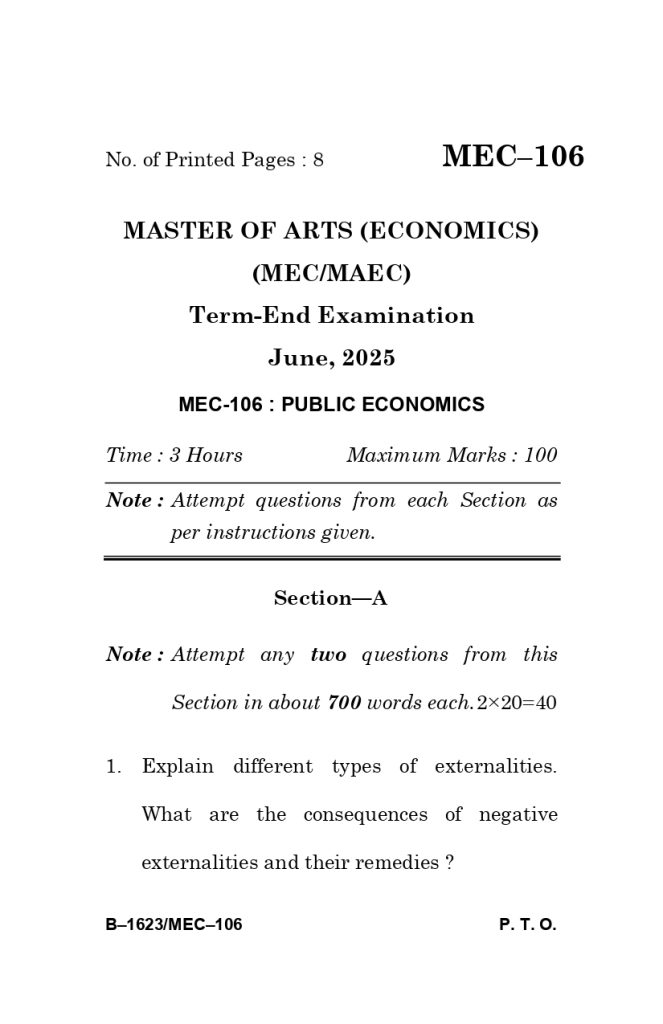
MEC 106 Question Paper June 2025 – One-Glance Clarity Box
Before studying any topic, every student should first understand the structure of the paper. Many marks are lost just because the format of papers is misunderstood.
| Component | Details |
|---|---|
| Course Code | MEC 106 |
| Course Title | Public Economics |
| Programme | MA Economics |
| Exam Session | June 2025 |
| Duration | 3 Hours |
| Maximum Marks | 100 |
| Section A | 2 questions × 20 marks |
| Word Limit (Section A) | Around 700 words each |
| Section B | 5 questions × 12 marks |
| Word Limit (Section B) | Around 400 words each |
This structure informs us, in one way or another, that depth is more important than speed in MEC 106.
MEC 106 Question Paper June 2025 Sample Paper
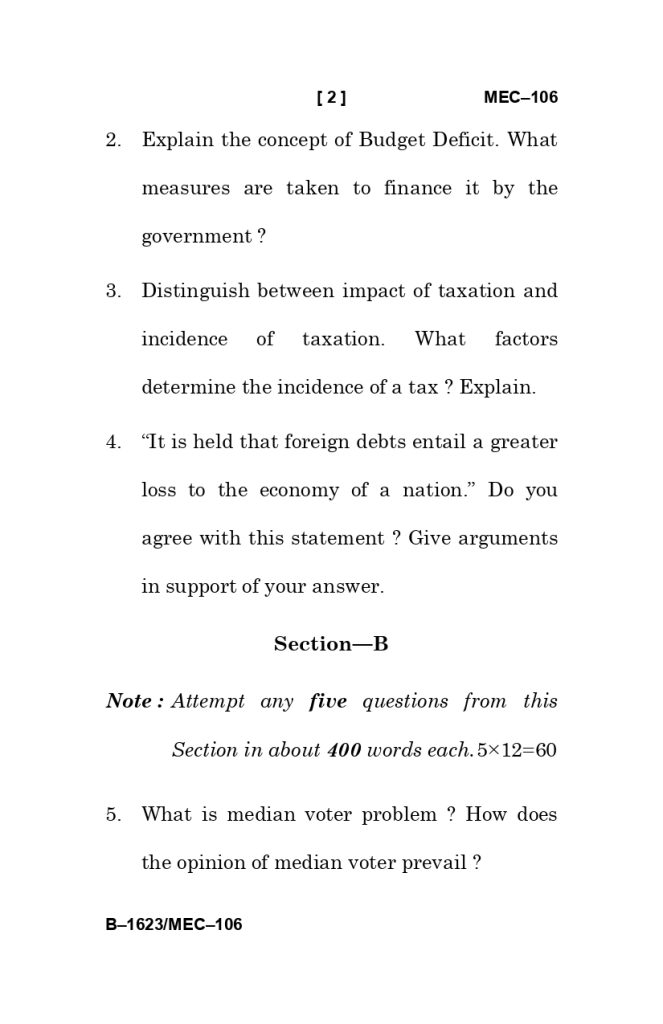
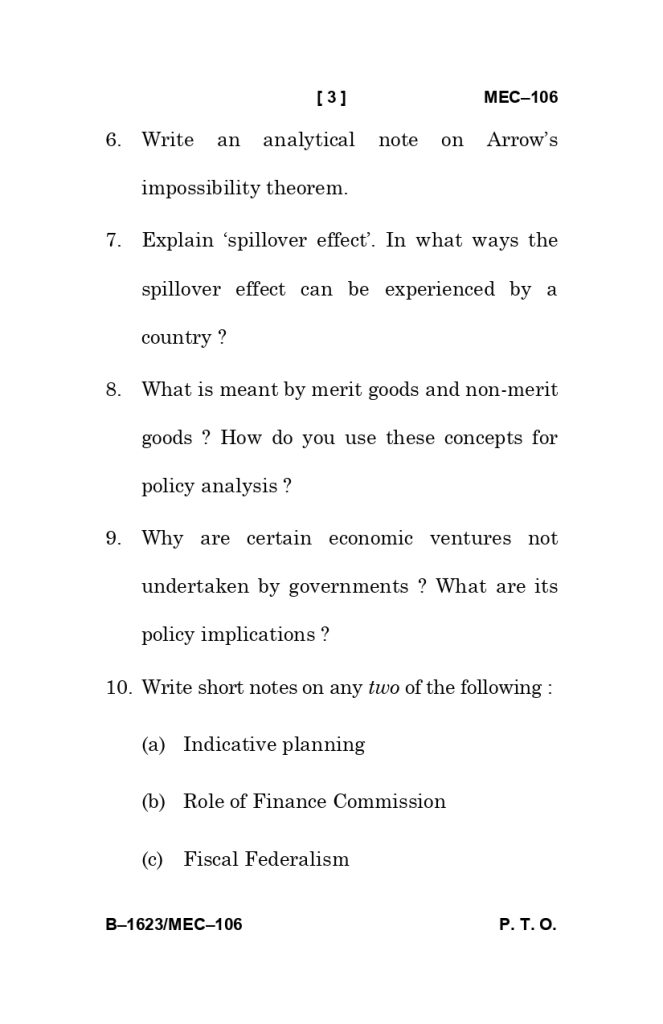
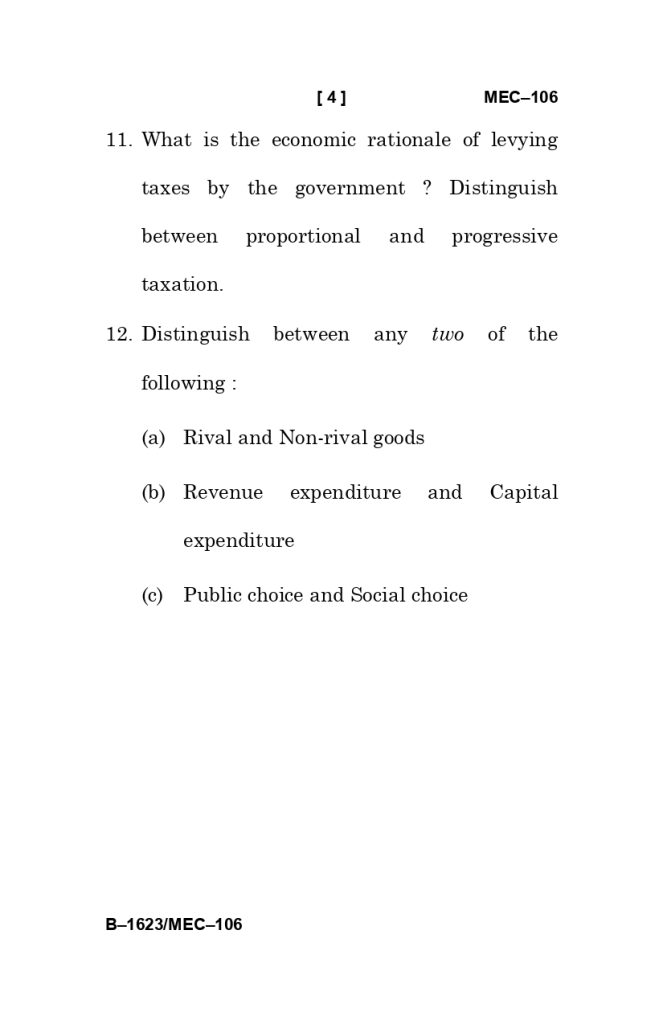
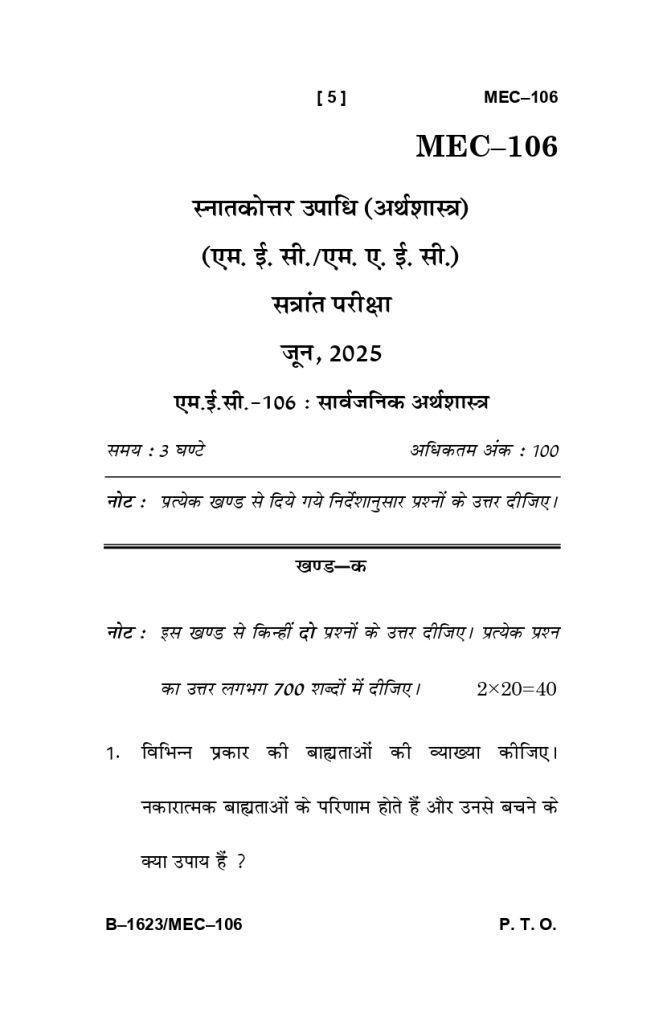
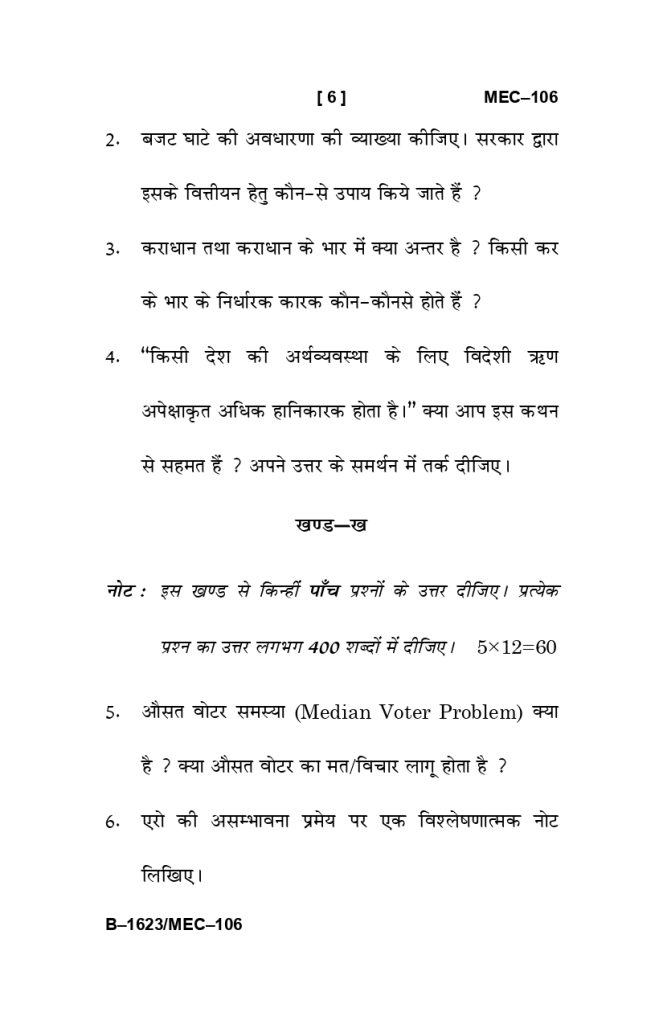
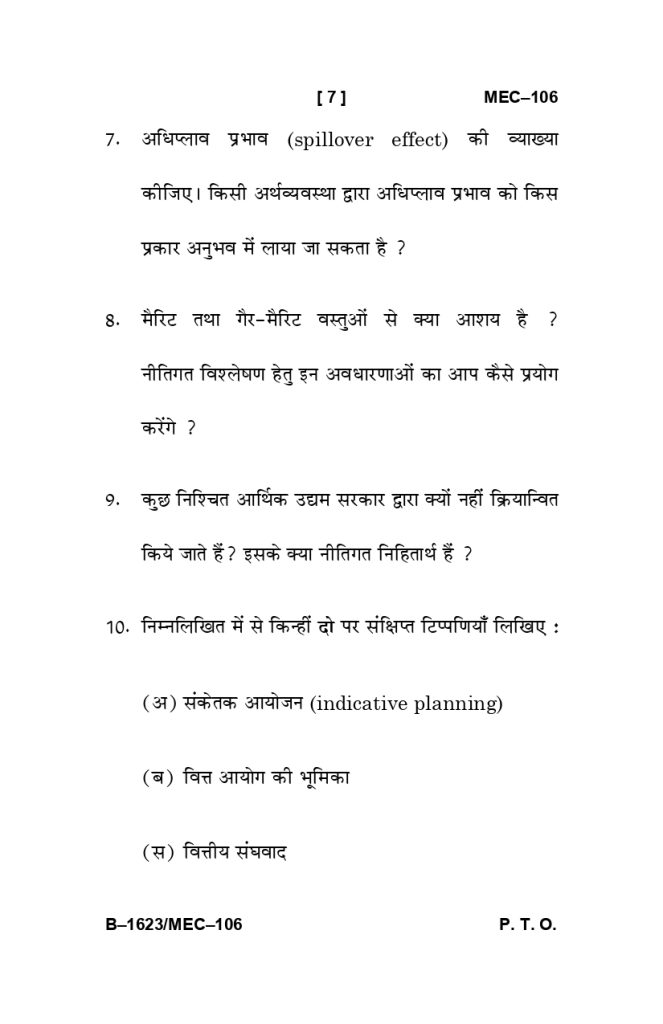
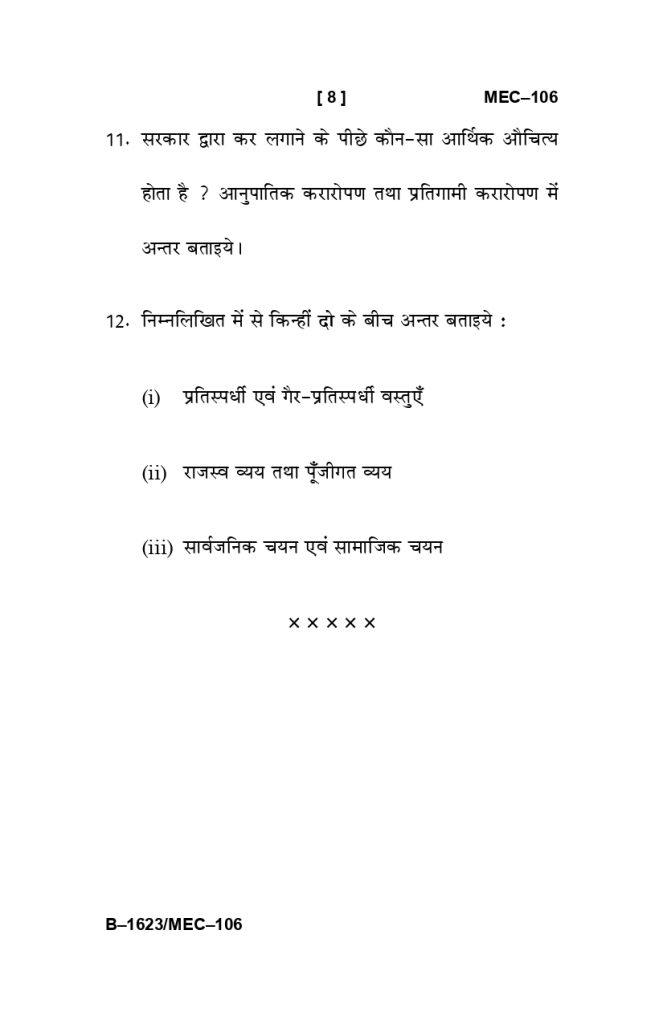
Need Help With MEC 106 Question Paper?
Students looking for complete support with the MEC 106 question paper, or who need guidance on answer structure, economic concepts, and exam writing, can connect with our academic team. We help learners with clear notes, organised frameworks and exam-focused preparation strategies.
Understanding MEC 106 Before Studying It
MEC 106 is not a memory-based subject. It is about the way that governments respond to market failures and how public policy impacts welfare, efficiency and equity. This paper requires students to be able to do the following:
- Think like economists, not story-tellers
- Explain why there is a policy and not just what it is
- Use some economic logic and structure.
- Write answers that are analytical, not descriptive.
The problem with students who approach this paper like general studies disorders.
Overall Nature of MEC 106 Question Paper June 2025
The June 2025 paper was in a classic IGNOU vein. There were no surprising topics, but the depth of the topics expected was high. The strong topics in the paper were:
- Market failure
- Government intervention
- Fiscal imbalance
- Tax burden distribution
- Long-term macro-economic consequences
This confirms a trend, which can be seen over many years: IGNOU lands on the fact that conceptual stability is valued more than surprise elements.
Section A – How Long Answers are Evaluated in Sec MEC 106
Section A answers determine the final outcome for most students. Each answer has a high level of weight and requires approximately 700 words. So, a good Section A answer has an internal structure of:
- Concept definition
- Theoretical explanation
- Classification or types
- Economic consequences
- Policy relevance
- Short conclusion
Skipping any part weakens the answer even when the language is fluent.
Externalities – The Biggest Topic in MEC 106
Externalities are the backbone of public economics, and they appeared again prominently in the MEC 106 Question Paper. Students are expected to have a knowledge of:
- What externalities are
- Why Markets fail because of externalities
- How private and social costs differ
- Why is government intervention required?
For more IGNOU papers or support, you may visit: https://www.unnatieducations.com/ignou.
Conceptual Classification of Externalities
| Basis | Explanation |
| Positive externalities | Benefits spill over to other people |
| Negative externalities | Costs of the third parties |
| Production externalities | Effects during production |
| Consumption externalities | Effects during consumption |
| Local externalities | Limited impact on a geographical area |
| Global externalities | Cross-border impact |
| Pecuniary externalities | Price-based effects |
Tables like this help examiners instantly see clarity.
Consequences of Externalities – Where Analysis Petitions
Many students explain types but fail to analyse consequences. Negative externalities result in:
- Excessive production of harmful goods
- Welfare loss
- Environmental degradation
- Public health costs
- Reduced productivity
Examiners do not want to see lists, but cause-and-effect reasoning.
Policy Remedies For Externalities – Scoring via Logic
Remedies are where public economics gets down to business. Some of the remedies that are commonly expected are:
- Pigouvian taxation
- Regulatory standards
- Tradable pollution permits
- Subsidies for Positive Externalities
- Property Rights and Bargaining
The answers that score well connect each remedy with the solution of each problem.
Budget Deficit – A Dominant Theme of MEC 106
Budget deficit questions are almost a must in the papers of MEC 106. Students need to clearly understand:
- Budget deficit
- Revenue deficit
- Fiscal deficit
- Primary deficit
More importantly, students must explain the importance of deficits.
Measures to Finance Budget Deficit
| Basis | Explanation |
|---|---|
| Positive externalities | Benefits spill over to other people |
| Negative externalities | Costs of the third parties |
| Production externalities | Effects during production |
| Consumption externalities | Effects during consumption |
| Local externalities | Limited impact on a geographical area |
| Global externalities | Cross-border impact |
| Pecuniary externalities | Price-based effects |
This structure of clarity helps to get better marks.
Taxation – Impact vs Incidence (High Risk Area)
This is one of the most misconstrued topics in MEC 106. Students have to distinguish clearly:
- Impact of taxation/ who pays initially
- Incidence of taxation
Factors Influencing the Incidence of Tax
- Price elasticity of demand
- Price elasticity of supply
- Market structure
- Time period
- Factor mobility
It works best using a combination of comparison and explanation.
Foreign Debt – How Much Depth Does It Require for Analysis
Foreign debt questions – questions to test the maturity of thought. Students should understand:
- Nature of foreign debt
- Resource inflow & long-term burden
- Vulnerability to exchange rates
- Pressure on future generations
Balanced answers that admit both utility and risk are rated higher.
Section B – Short Answers that are still Needed Structure
Section B answers are about 400 words, but still one needs to structure. Common themes include:
- Median voter theorem
- Arrow's theorem of impossibility
- Spillover effects
- Merit and non-merit goods
- Fiscal federalism
Each answer should include:
- Definition
- Core idea
- One implication
Important Topics for MEC 106 (Previous year trend analysis)
After analysing multiple papers, some of the topics emerge.
| Topic | Frequency |
|---|---|
| Externalities | Very High |
| Budget deficit | Very High |
| Taxation | High |
| Foreign debt | High |
| Public goods | Medium |
| Public choice theory | Medium |
| Fiscal federalism | Regular |
Students who know these things rarely get lost.
Four Sections Often Ignored, But Shouldn't Be by Students
1. Public Goods Vs Private Goods
Public goods are non-excludable and non-rival, such as defence or street lighting, whereas private goods are market-driven. This difference is why governments have to come to the rescue where markets fail.
2. Merit and Non-Merit Goods
Merit goods, such as education, require encouragement in the form of subsidies, while non-merit goods, such as alcohol, require control. This topic tests the role of welfare judgments in making public policy decisions.
3. Spillover Effects
Spillover effects happen when the benefits or costs transcend regions or nations, e.g., pollution or education. They justify international cooperation and coordinated responses to government policies.
4. The institutional role of Public Finance
Institutions such as the Finance Commission are responsible for the state's fiscal balance. Indirect understanding of revenue sharing, grants, and cooperative federalism is frequently raised in practice.
Presentation Rules That Are More Important Than You Think
Marks are affected by small things:
- Headings clearly written
- Balanced spacing
- No overcrowded paragraphs
- Logical flow
Presentation does not replace knowledge, but enhances knowledge. For more IGNOU papers or support, you may visit: https://www.unnatieducations.com/ignou.
Frequent Errors Seen in MEC 106 Answer Scripts
We regularly see:
- No conclusions
- Weak introductions
- Mixing concepts
- Overwriting without organization
- Ignoring word limits
Avoiding these mistakes alone can increase the scores by a huge margin.
Time Management for MEC 106 Exam
A practical approach:
- First 10 minutes – selecting questions
- 40 minutes > each answer for Section A
- 15 minutes each Section B answer
- Last 10 minutes → revision
Never rush Section A.
MEC 106 Question Paper – See full question paper video
Watching the walkthrough helps students to have a clear understanding of the expectations of the examiner.
Where to Go for More IGNOU Support
If anybody wants help with IGNOU papers or wants more access to question papers, then they can visit: https://www.unnatieducations.com/ignou This helps the students to be organised while preparing for the exam.
Frequently Asked Questions – MEC 106 Question Paper June 2025
1. What is the pattern of the MEC 106 Question Paper June 2025?
The MEC 106 Question Paper June 2025 is divided into two sections. Section A consists of two long-answer questions of nearly 700 words, and Section B consists of the short-answer questions of around 400 words. Understanding this structure helps students to manage time and mark effectively.
2. Which topics were most important in the MEC 106 Question Paper June 2025?
Most significant subjects covered in this were externalities, budget deficit, deficit financing, impact and incidence of taxation and foreign debt. These topics have been repeatedly asked in previous years, making them high-priority areas to be revised and bring conceptual clarity to them.
3. How to Write the Answers to Score Good Marks in MEC 106?
Answers in MEC 106 should be well organized with headings and subheadings in addition to a brief conclusion. For example, while writing on externalities, students should be able to provide the meaning, types, consequences, and means of remedy. Structured answers help examiners to quickly evaluate and award higher marks.
4. Is MEC 106 a theoretical or an analytical paper?
MEC 106 is conceptually theoretical, but analytically oriented. Students are required not only to define concepts such as budget deficit or taxation but also to explain the economic implications of the concepts. Writing policy-linked analysis rather than memorised definitions helps with the quality of answers and potential for marks.
5. How many years previous should one study for MEC 106?
Students should study at least five previous years’ MEC 106 question papers. This helps to identify the repetition of topics like externalities and fiscal deficit, understand the examiner's expectations and practise writing answers under a word limit under exam conditions.
Final Thoughts on MEC 106 Question Paper June 2025
The MEC 106 Question Paper for June 2025 followed a predictable but demanding pattern. It rewarded students who understood public economics intensely and gave answers with structure and logic. Memorisation was not enough, though. Clear flow, policy linkage and disciplined writing were the real difference makers. Students who are in need of full solutions or customised help for MEC 106 can contact our team. We support the learners with notes, solutions and exam guidance in a focused and academic way. With the right strategy, the MEC 106 Question Paper becomes a scoring opportunity rather than a source of stress.