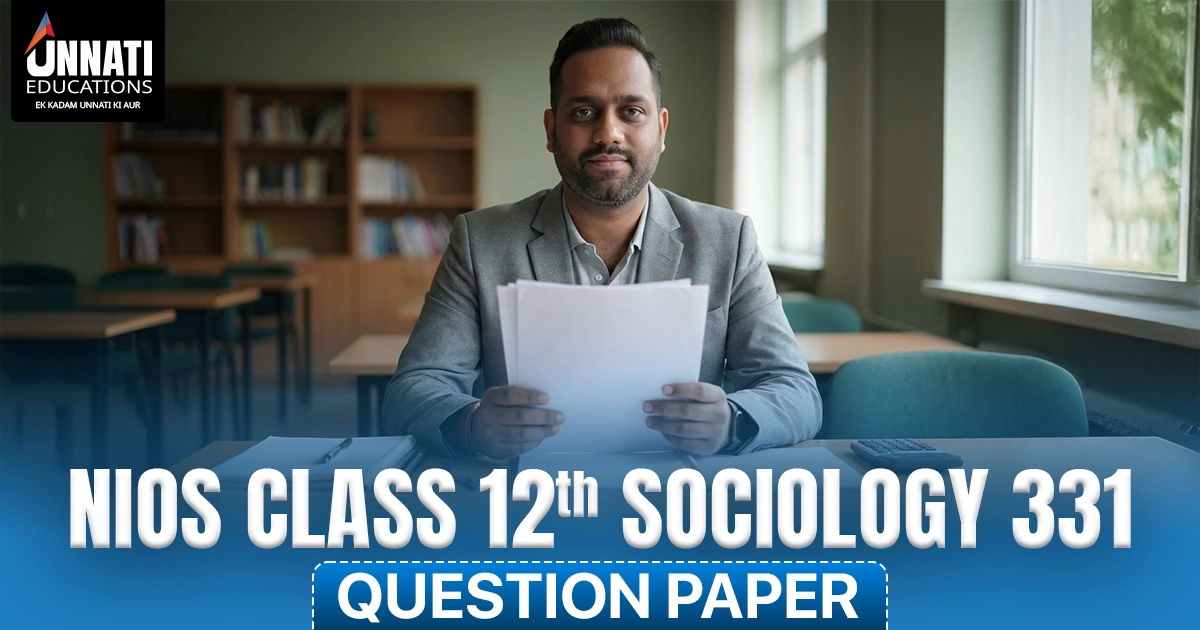
NIOS Class 12 Sociology 331 Question Paper (Set C) October 2025 – Complete Analysis, Weightage, Topics & Preparation Guide for 2026
The NIOS Class 12 Sociology 331 Question Paper (Set C) of October 2025 reflects NIOS’s strong focus on understanding society, social institutions, culture, inequality, and change. The paper is concept-based, analytical, and application-oriented rather than memory-driven. This detailed analysis explains the full paper pattern, topic-wise coverage, weightage, and preparation strategy for students appearing in the 2026 examination.
Download Solved Question Paper PDF
Quick Summary
This in-depth guide on the NIOS Class 12 Sociology 331 Question Paper explains the complete structure of Set C, including MCQs, assertion–reason questions, passage-based questions, short answers, long answers, and the optional module. It highlights important themes, expected trends for 2026, and clear preparation strategies to help students score confidently.
Overview Table: NIOS Class 12 Sociology 331 Exam (October 2025 – Set C)
| Particulars | Details |
|---|---|
| Subject | Sociology (331) |
| Class | 12th |
| Board | National Institute of Open Schooling (NIOS) |
| Question Paper Set | Set C |
| Exam Month | October 2025 |
| Total Marks | 100 |
| Time Duration | 3 Hours |
| Total Questions | 49 |
| Sections | A and B |
| Question Types | MCQs, Objective, Assertion–Reason, Short Answer, Long Answer |
| Optional Module | Status of Women |
| Medium | Hindi / English |
Understanding the NIOS Sociology 331 Question Paper Pattern
The NIOS Sociology 331 Question Paper is designed to test conceptual clarity, sociological thinking, and the ability to relate theory to real social situations. The paper follows a clear structure, with questions moving from objective knowledge to analytical writing. Set C strictly follows the NIOS blueprint, making it predictable for students who prepare sincerely from the syllabus.
NIOS Class 12 Sociology 331 Question Paper (Set C) October 2025


Download Solved Question Paper PDF
Structure of the NIOS Class 12 Sociology Question Paper
Section-Wise Exam Structure (As per Set C)
| Section | Question Numbers | Question Type | Marks |
|---|---|---|---|
| Section A | 1–25 | MCQs, Fill in the blanks, True/False, Assertion–Reason | 1–2 Marks |
| Section B | 26–49 | Short Answer, Long Answer, Essay-Type | 2–5 Marks |
Internal choices are provided in higher-mark questions and in the optional module.
Section A: Multiple Choice Questions (MCQs)
Section A included objective MCQs testing basic sociological knowledge.
Topics Covered in MCQs
- Domestic Violence Act and women's protection laws
- Tribal language families such as Khasi and Santhali
- Social institutions like caste and kinship
- Sociological thinkers and concepts
- Community, society, and group distinctions
- Socialisation and enculturation processes
These questions were direct and textbook-based.
Section A: Fill in the Blanks and One-Word Answers
This part tested conceptual accuracy.
Commonly Asked Areas
- Village republics during British administration
- Moksha concepts in Hindu philosophy
- Role identification and role performance
- Kinship, lineage, and clan systems
- Marriage rules and family structures
Correct terminology was essential for full marks.
Section A: Assertion–Reason Questions
Assertion–Reason questions tested logical thinking.
Themes Covered
- Diffusion as a mechanism of social change
- Laws and social transformation
- Value neutrality in social change
Students had to judge whether statements were true and logically connected.
Section A: Passage-Based Question on Kinship
A passage-based question tested comprehension and application.
Skills Tested
- Understanding kinship as a social institution
- Identifying types of kinship groups
- Explaining the roles and functions of kinship
- Relating traditional kinship to modern society
This question rewarded clear reading and structured answers.
Section A: Matching Columns and True/False
These questions tested factual recall.
Key Areas Included
- Jainism and Hinduism concepts
- Indian Constitution and social reformers
- Buddhist revival and religious movements
- Primary and secondary groups
- Nature of social groups
Accuracy mattered more than explanation.
Section B: Short Answer Questions (80–120 Words)
Short answers tested explanation skills.
Frequently Asked Topics
- Importance of social institutions in society
- Major functions of the family
- Ways of regulating behaviour in society
- Problems of street children
- Cyclical theory of social change
- Impact of population increase on poverty
Answers needed a clear structure and examples.
Section B: Medium-Length Analytical Questions (150–200 Words)
These questions required a deeper sociological understanding.
Topics Asked
- Law as a formal means of social control
- Family as an agency of social control
- Rewards and punishment in socialisation
- Education’s role in shaping human behaviour
- Classification of groups based on social contacts
Logical flow and sociological terms were crucial.
Section B: Long Answer Questions (400–500 Words)
Long answers tested analytical and evaluative ability.
Major Long Answer Themes
- Challenges faced by Scheduled Tribes in India
- Kinship terms and their classification
- Tribal society characteristics
- Factors affecting the tribal population
- Impact of displacement on tribal communities
These questions carried high weightage and required proper planning.
Optional Module: Status of Women
The optional module focused on gender issues.
Key Areas Covered
- Gender discrimination and its roots
- Joint parenting and shared responsibility
- Gender division of labour
- Organised and unorganised sectors
- Education and gender inequality
- Gender justice versus gender equality
Students choosing this module needed conceptual clarity and examples.
Major Topics Covered in NIOS Sociology 331 Set C
Social Institutions
- Family, marriage, kinship
- Religion and education
- Law and social control
Social Change and Development
- Social change theories
- Poverty and population
- Education and modernisation
Social Stratification
- Caste and class
- Inequality and discrimination
- Tribal society
Gender Studies
- Status of women
- Gender roles and labour division
- Feminism and social reform
NIOS Class 12 Sociology Question Paper Weightage 2025
| Area | Approximate Weightage |
|---|---|
| Social Institutions | 25–30 Marks |
| Social Change & Development | 20–25 Marks |
| Social Stratification | 20–25 Marks |
| Gender Studies (Optional) | 15–20 Marks |
This distribution is expected to remain similar in 2026.
NIOS Class 12 Sociology Question Paper Download PDF – Why It Matters
Students searching for the NIOS Class 12 Sociology Question Paper download PDF want exposure to real exam questions. Solving actual papers helps understand sociological language, answer depth, word limits, and examiner expectations, which builds confidence and improves performance. Download Solved Question Paper PDF
Eligibility Criteria for NIOS Class 12 (2026)
| Requirement | Details |
|---|---|
| Minimum Age | 16 Years |
| Qualification | Class 10 or equivalent |
| Mode | Open Schooling |
| Medium | Hindi / English |
Important Dates for NIOS 2026 (Expected)
| Event | Tentative Timeline |
|---|---|
| Admission Window | January – March 2026 |
| Exam Form Submission | August – September 2026 |
| October Exam | October 2026 |
| Result Declaration | December 2026 |
How Unnati Education Supports Sociology Students
Unnati Education supports NIOS Sociology students with exam-focused academic guidance based strictly on real question paper analysis. Support includes:
- NIOS Previous Year Papers for Sociology practice
- Solved TMAs prepared as per NIOS guidelines
- Simplified Sociology notes with examples
- Help with NIOS previous year question paper Class 12 practice
- Complete assistance for NIOS Class 12 TMA preparation
Deep Section-Wise Scoring Strategy for NIOS Class 12 Sociology 331 (Based on Set C)
After carefully analysing the NIOS Class 12 Sociology 331 Question Paper (Set C) October 2025, it is clear that Sociology is a subject where marks depend on understanding society and expressing ideas clearly. Writing sociological terms correctly and linking answers to real social situations play a major role in scoring high.
How to Score High in Section A (MCQs, Objective & Assertion–Reason)
Section A builds the foundation of the total score and should never be taken lightly.
What NIOS Tests Through Section A
- Basic sociological concepts such as society, community, and social group
- Understanding of laws related to women, children, and weaker sections
- Knowledge of kinship, marriage rules, and family structures
- Awareness of social change, diffusion, and modernisation
- Ability to logically connect assertion and reason statements
Smart Scoring Strategy
- Revise definitions and terms exactly as given in NIOS textbooks.
- Read assertion–reason questions carefully before choosing options.
- Avoid guessing answers when unsure about sociological logic.
Students who revised the basics thoroughly scored almost full marks in this section.
Passage-Based Questions: Easy Marks with Careful Reading
Passage-based questions test comprehension and application.
Examiner Expectations
- Clear understanding of the passage
- Direct answers linked to the passage content
- Use of sociological terms such as kinship, lineage, or role
How to Score Full Marks
- Read the passage twice before answering.
- Do not add information outside the passage.
- Write answers in simple, direct sentences.
This question rewards attention rather than memorisation.
Short Answer Questions: Concept + Example Combination
Short answers usually carry 2 to 3 marks and require balanced answers.
High-Scoring Answer Format
- One line explaining the sociological concept clearly
- One or two points explaining its role or importance
- One simple real-life example when relevant
Topics Where Students Scored Well
- Functions of the family in society
- Regulation of social behaviour
- Problems of street children
- Effects of population growth on poverty
Clear and structured answers performed better than lengthy writing.
Medium-Length Analytical Questions: Sociological Thinking Matters
These questions test a deeper understanding.
What NIOS Looked For
- Explanation of sociological ideas in logical order
- Use of correct sociological terminology
- Clear cause-and-effect relationships
Common Topics Asked
- Law as a means of social control
- Family as an agency of socialisation
- Role of education in shaping behaviour
- Rewards and punishments in society
Answers written in points with short explanations scored higher.
Long Answer Questions: Planning Before Writing Is Essential
Long answers carried the highest weightage and decided final scores.
What Makes a High-Scoring Long Answer
- Clear introduction defining the topic
- Well-explained points with headings
- Use of examples from Indian society
- Proper conclusion summarising the answer
Major Long Answer Topics in Set C
- Problems and Challenges of Scheduled Tribes
- Classification and importance of kinship terms
- Characteristics of tribal society
- Impact of displacement on tribal communities
Unstructured writing resulted in unnecessary mark loss.
Optional Module Strategy: Status of Women
The optional module on the Status of Women was concept-oriented and analytical.
Important Areas to Prepare
- Gender discrimination and its social roots
- Gender division of labour in society
- Education and empowerment of women
- Organised and unorganised sector employment
- Gender justice and gender equality
Students who used examples from daily life and Indian society scored better.
Common Mistakes Students Made in October 2025 (Set C)
Many students lost marks because they:
- Wrote vague answers without sociological terms
- Memorised answers without understanding concepts
- Ignored the optional module preparation
- Exceeded word limits unnecessarily
- Failed to provide real-life examples
Avoiding these mistakes alone can improve scores significantly.
Expected Trends for NIOS Sociology 331 Exam 2026
Based on Set C analysis, students can expect:
- Similar question paper structure
- Continued focus on social institutions and inequality
- Regular inclusion of gender and tribal issues
- Repetition of core sociological themes
NIOS follows consistency and avoids sudden changes.
Smart 2026 Preparation Plan for Sociology 331
Daily Preparation
- 30 minutes reading one sociology chapter
- 15 minutes revising key sociological terms
- 10 minutes practising short answers
Weekly Preparation
- One full-length practice paper
- One revision of social institutions
- One revision of the optional module topics
Regular study ensures clarity and confidence.
Time Management Strategy for Sociology Exam
| Section | Suggested Time |
|---|---|
| Section A | 35 minutes |
| Short Answers | 35 minutes |
| Medium Answers | 40 minutes |
| Long Answers | 50 minutes |
| Revision | 20 minutes |
Following this plan helps complete the paper comfortably.
Presentation Tips That Improve Sociology Scores
- Write answers in clear paragraphs or points.
- Underline key sociological terms.
- Leave space between answers.
- Use simple and correct language.
A good presentation makes answers easier to evaluate.
How Unnati Education Helps Sociology Students
Unnati Education supports NIOS Sociology students with exam-focused academic guidance. Support includes:
- Solved Sociology question papers
- Simplified notes with real-life examples
- Structured answer-writing guidance
- Help with NIOS Class 12 previous year question paper practice
- Complete support for NIOS TMA Class 12 preparation
For academic support: Phone/WhatsApp: 9654279279, 9899436384
Frequently Asked Questions (FAQs)
Q1. Is the NIOS Class 12 Sociology 331 Question Paper difficult for average students? The Sociology 331 paper is not difficult if the concepts are understood clearly. Questions are syllabus-based and linked to real society. Average students who understand topics and practise structured answers can score well without pressure. Q2. Which section is the most scoring in Sociology 331? MCQs and short-answer questions are the most scoring sections. They test basic understanding and terminology. Students who revise definitions and key concepts regularly can easily secure strong marks. Q3. How important are previous year question papers for Sociology preparation? Previous year question papers are very important because NIOS repeats themes and question formats. Practising them helps students understand word limits, answer depth, and examiner expectations clearly. Q4. How should long answers be written to score full marks in Sociology? Long answers should include a clear introduction, explained points using sociological terms, and real-life examples. Writing in a structured manner and staying within the topic helps secure full marks. Q5. Can Sociology be prepared well in the last three months before the exam? Yes, Sociology can be prepared effectively in three months with focused study. Regular reading, concept revision, and answer practice based on previous papers are enough to score confidently.
Final Conclusion
The NIOS Class 12 Sociology 331 Question Paper (Set C) October 2025 clearly shows that Sociology is a concept-based and scoring subject. Students preparing for 2026 should focus on understanding society, using correct sociological terms, and writing structured answers with real-life relevance. Unnati Education provides Sociology solutions, NIOS TMAs, and NIOS previous year question papers to support students throughout their preparation. If you need solved papers, TMA help, or academic guidance, you can contact Unnati Education for reliable support. Download Solved Question Paper PDF