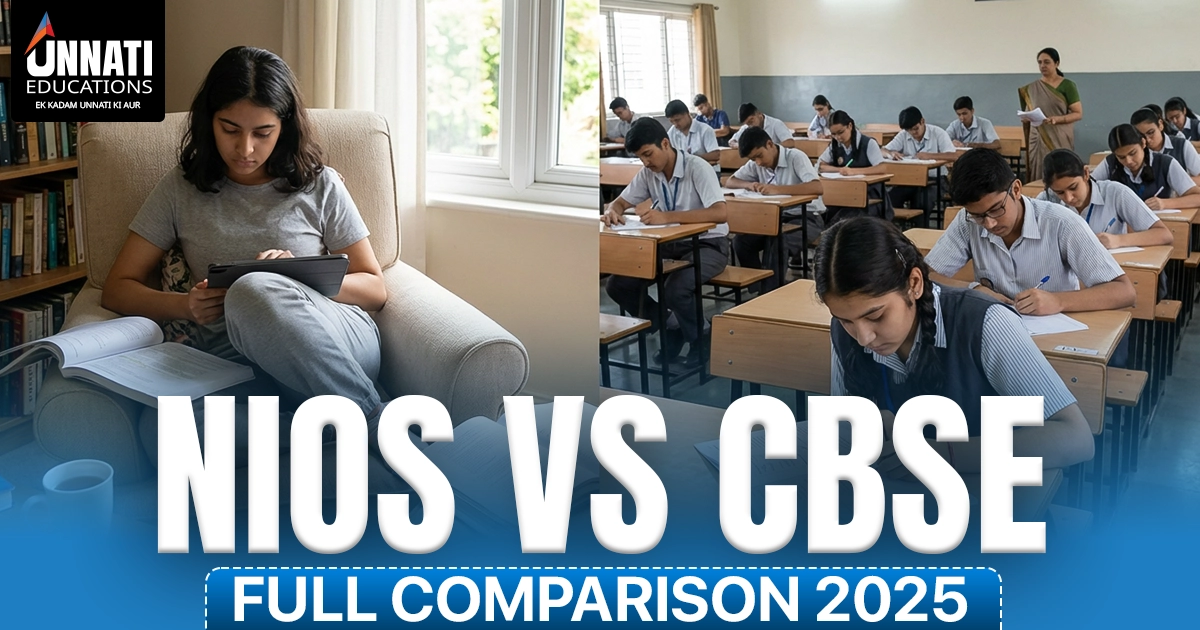
Choosing between NIOS and CBSE may be the most difficult choice for both students and parents. This is especially true when trying to find the right match in terms of learning style and academic stress level. Both boards are government-recognized, widely accepted, and academically strong -- but they work in very different ways. By understanding these differences, families can choose a board that best suits their child's educational needs and avoid any confusion. We compare NIOS vs CBSE in this comprehensive guide using comparisons of learner types and structures, as well as facts. It is our goal to give you a balanced, impartial view of both boards. Unnati Education offers support to students who are interested in flexible education, self-directed learning or alternative academic paths. We are here to help learners understand the options available to them, not to force them to choose a particular school board.
What is CBSE? (Central Board of Secondary Education)
CBSE (Central Board of Secondary Education) is the largest and most recognized school education body in India. The Ministry of Education of the Government of India operates this board, which was founded in 1962. CBSE's curriculum is used by over 25,000 schools across India and more than 250 international schools. CBSE is a school that focuses on regulated assessments and structured learning. It also encourages regular attendance.
CBSE Features
1. NCERT-Based Curriculum
CBSE is following the NCERT textbooks in all subject areas. This system ensures uniform content in all parts of the country. It is still a focus on standardized testing, conceptual learning, and a clear path to graduation.
2. National Level Recognition
CBSE Certificates are recognized by international and national institutions, universities, as well as government exams, competition exams, and competitive exams.
3. Competitor Exam Alignment
CBSE has a large overlap with exams such as JEE or NEET.
4. Regular Schooling Environment
CBSE Requires:
- Everyday Attendance
- Classes on a timetable
- Co-curricular participation
- Regular assessment
- Intern evaluations
It is ideal for students who enjoy a fixed schedule and structure.
5. Holistic Analysis
CBSE uses internal assessments, tasks, and practicals to evaluate students, ensuring a balanced performance in academics as well as co-curricular activities.
Who should choose CBSE as their preferred option?
CBSE suits
- Preparing for Competitive Exams
- Students who are disciplined and like strict rules.
- Moving families (due to the uniform national curriculum).
- The benefits of guided learning environments for students
What Is NIOS? (National Institute of Open Schooling)
NIOS was founded in 1989 by the Ministry of Education as an open education board. This is the largest open school system in existence, providing education to students who are looking for flexibility, alternate learning methods, or another chance to finish their schooling. NIOS supports:
- Working Students
- School dropouts
- Student with Health Challenges
- Sportspersons, performers and travelers
- Adult Learners
- Students who don't like strict schedules
NIOS has both academic courses and vocational training with multiple exams available.
Features and Benefits of NIOS
1. Open and Flexible learning
There is no daily attendance requirement. Students are free to work at home and at their own pace. The requirement to attend daily classes is not enforced. Print books, digital modules, or resource materials are used to teach.
2. The freedom to choose subjects
NIOS lets learners choose subjects based on their career aspirations, interests or comfort level. Also, the board offers over 40 academic and vocational subjects.
3. Multiple Exam Opportunities
NIOS conducts exams:
- Two times a year, (April/May/October/November)
- Year-round, you can take the Plus On-Demand Examinations (ODE).
This allows you to avoid the worry of wasting a whole year by failing just once.
4. The Inclusive Educational Model
NIOS has many uses.
- Students who have failed CBSE/State Boards
- A student juggling sports, a job, or other commitments.
- Learners with Disabilities
- Students who wish to have more control and less pressure over their studies
5. Public Recognition
NIOS certification is valid for the following:
- The College Admissions Process
- UPSC
- SSC, defence exams
- Government jobs at the state and federal levels
- University of International Students
The Ministry of Education is the only one that can give it the same legal status as CBSE.
Who should choose NIOS?
NIOS suits:
- Students who like flexible schedules
- Students who discontinue schooling
- Multiple exam opportunities or more time for students who require it
- Teenagers manage health, sports, and travel conditions or other interests.
- Independent, self-paced learners
NIOS vs CBSE - Full Comparison Table (2025)
| A Factor | CBSE | NIOS |
| Year Established | 1962 | 1989 |
| Governance | Ministry of Education | Ministry of Education |
| Curriculum Type | NCERT | Learn NCERT in an Open Environment |
| The Learning Mode | Regular Classroom | Distance Learning & Open Education |
| Exam Frequency | One time a year | Double yearly + ODE |
| Flexibility | Low Prices | The very high |
| Student Type | Students who are enrolled in school | Students who learn independently |
| Level of Difficulty | The concept of high-level conceptual | Moderate, learner-centric |
| Subject Options | Fixed-streams | Wide choices + vocational |
| The Study Pace | You can fix it yourself | Self-paced |
| The Recognition of Your Work | National + International | National + International |
| You Can Get the Best | Competitive exam aspirants | Flexibility is a must for students |
Key similarities between NIOS and CBSE
Two are:
- Boards of government under the Ministry of Education
- NCERT-based
- Recognition for College Admissions
- Accepted to government jobs
- Valid for Competitive Exams (JEE, NEET, UPSC, NDA, NDA NEET)
- A national and an international credible
This is to say that choosing NIOS doesn't reduce a student's academic potential.
Advantages of NIOS
1. Study and Exam Flexibility
They can study at their own pace, choose the subject, plan exams, etc.
2. There are multiple chances to clear the subject matter
NIOS will allow reattempts for a maximum of five years.
3. The Large Subject Variety
NIOS has a wide range of academic and vocational choices that CBSE does not offer.
4. All Ages Inclusive
Anybody can do it – teenagers and adults alike, as well as dropouts and working professionals.
5. There is less pressure
It is designed to minimize stress and calm the learning environment.
Disadvantages of NIOS
1. Self-Discipline Required
It is important that students study without constant supervision.
2. Fewer Extracurricular Opportunities
There are a limited number of activities like sporting days, competitions, or school events.
3. Longer Evaluation Times
Due to high exam enrollment, results could take some time. Unnati Education assists learners in staying organized, on time, and consistent with their studies.
Advantages of CBSE
1. The Ability to Perform at a High Level of Academic Excellence
The ideal course for those who seek a challenging, structured curriculum.
2. Great for Competitive Exams
This syllabus complements major national entrance examinations.
3. The Highest Quality School Environment
The discipline of students is enhanced by the daily class and learning from peers.
4. Uniform Curriculum Nationwide
CBSE benefits families that relocate the most.
Disadvantages of CBSE
1. High-Pressure
Due to competition, students often experience stress.
2. Schedules Fixed
You have no flexibility to deal with health concerns, work commitments, or travel.
3. There are limited choices of subject matter
You must use a fixed combination of streams.
Evaluation of Both Boards
| Aspect | CBSE | NIOS |
| You can also experience the benefits of this | Classroom Interaction | Learn at your own pace |
| Expertise | High academic level | Academic + skill-oriented blend |
| Authoritativeness | The world's most recognized brand | The Government recognizes UPSC as a recognized equal. UPSC |
| Reliability | Transparent evaluation | Verified by the government |
Educational trust and Recognition scores for both boards are very high.
What each board does to shape career opportunities
| The Category | CBSE | NIOS |
| Admission to College | CBSE can be accepted at all Universities | NIOS is accepted in all Universities |
| Work in the Government | Eligible | Eligible |
| Overseas Educational Opportunities | Valid worldwide | Valid worldwide |
| Skill Pathways | The Moderate | Higher (vocational) programs |
Both exams open doors to the same opportunities. There is only one difference: the preferred learning style.
Real-World Example
The CBSE attendance rules prohibit a full-time tennis player from attending school. She studied at her own pace with NIOS and passed her exams in time. This allowed her to get into Delhi University without sacrificing any of her athletic career. Here is when open education can transform your life.
Summary Table – CBSE vs NIOS
| CBSE | NIOS |
| Structured, school-based, demanding | Student-centered learning is flexible |
| Great for competitive exam preparation | This is a great tool for learners who have multiple attempts. |
| Pressure environment | The open format is less stressful |
| Fixed time | Select your own timing |
| Only Limited Subjects | There are many subjects, plus vocational |
| Classroom-dependent | Self-learning |
How Unnati Education Supports NIOS Students (Neutral, Non-Promotional)
Unnati Education is a provider of academic assistance for students who select the NIOS route. Unnati Education helps students understand the NIOS system, to complete important academic steps and to prepare effectively. Support includes:
- Clarifying the admission and registration process
- Instructing open learners with structured study plans
- Students need help understanding assignments and practicals.
- Reminding students of exam deadlines and providing updates
- Supporting career development and academic advancement
It is our goal to make sure that NIOS learners remain confident, knowledgeable, and consistent at every level of academic study.
FAQs - NIOS vs CBSE
1. What if a student wants to change from NIOS or CBSE?
Yes. You can switch from NIOS (National Institute of Schooling) to CBSE if you pass the necessary class (usually, Class 10 or 11). The school may request migration certificates or document verification.
2. Which is easier, the NIOS board or the CBSE board?
NIOS tends to be easier, as it offers self-paced study and flexible examinations. CBSE's rigid structure is harder for students to understand, particularly those preparing for competitive examinations.
3. Can I use NIOS for Government Exams and Jobs?
Yes. NIOS has been recognized by UPSC, SSC Railways, Defence Services and other state-level agencies. Students holding an NIOS certificate can apply for government jobs.
4. Are both Boards using NCERT Books?
Yes. The NCERT Framework is followed by both CBSE and NIOS. NIOS does adapt the material for self-study, but CBSE follows it.
5. Who benefits most from the NIOS system?
NIOS is the best option for students with unpredictable schedules or health problems, as well as artistic careers and those who are anxious about exams.
Conclusion - NIOS vs CBSE
This is not a matter of which board is superior. This is a fundamental question. Which board is best for the learner's learning style, lifestyle, and goals? CBSE suits students who enjoy structure, regular learning, competition, and a supervised environment, and who are interested in a structured, regular education. NIOS suits learners who prefer flexibility, multiple test opportunities and self-paced training. The two are recognized equally in India and abroad. These two paths lead to higher education, government employment, and professional careers. Unnati Education is a company that has one simple mission: Make sure that every student, whether they are in CBSE or NIOS, is guided with confidence and clarity.