BCOG 172 Question Paper June 2025 – Complete Pattern, Question Analysis & Scoring Strategy
It is not because the syllabus of BCOG 172 is scary that students don't score well. They fail because they write like it's a school exam—long, emotional, and unstructured. IGNOU does not reward that. It rewards clean headings, correct fulfillment of the demand, and balanced depth. In this guide, we are breaking down the BCOG 172 Question Paper for the June 2025 Term-End Exam in a way that actually helps you score. We will not pour in the full solutions here. Instead, we'll show you how the paper works, how marks are "hidden" inside questions, how to write answers without overwriting, and what topics are clearly important based on patterns. For other IGNOU papers or support related to it, click: https://www.unnatieducations.com/ignou
Why the BCOG 172 Question Paper Feels Difficult for Students
BCOG 172 (Indian Economy) looks simple as the topics are familiar—liberalisation, MSMEs, poverty, agriculture, and education. Then, students walk out of the exam saying: "The paper was okay, but the marks won't come." Here’s the real reason:
- IGNOU is expecting headings and sub-headings.
- Many questions are internally divided (like 4+16). Students ignore this.
- Students have too much theory and miss the exact demand.
- Students overwrite. Overwriting is not "extra marks." It’s usually “extra confusion.”
A cruel truth: examiners are checking dozens of copies. If your answer is not readable, then you lose marks even if you know the content. Keywords (keep separate as you demanded) - secondary
- BCOG 172 question paper
- BCOG 172 solved question paper
- BCOG 172 question paper solution
- IGNOU Indian Economy Important Question
- BCOG 172 question paper June 2025
BCOG 172 Question Paper June 2025 – Quick Overview
Here's your "clarity box" at a glance. This is what most students are searching for, so we're putting it early.
| Feature | Details |
|---|---|
| Course Code | BCOG 172 |
| Subject | Indian Economy |
| Exam Session | June 2025 |
| Total Marks | 100 |
| Time Duration | 3 Hours |
| Nature of Answers | Analytical answers with proper headings |
| Best Scoring Method | Structured points with correct length |
Paper Strategy Snapshot (Read before doing anything else)
| Goal | What to do |
|---|---|
| Maximise marks | Attempt the 5 questions that you can structure the best |
| Avoid losing marks | Divide answers exactly according to the demand of the question |
| Save time | Use headings + 2–3 lines per point |
| Look mature | Definition writing → reasons → impact → conclusion |
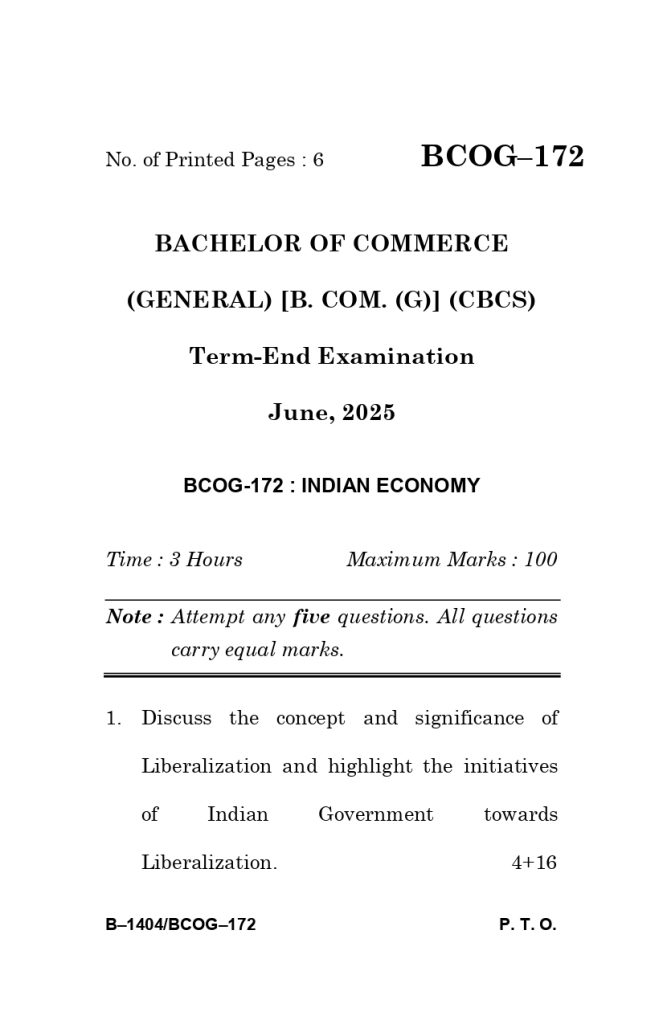
BCOG 172 Indian Economy Question Paper June 2025
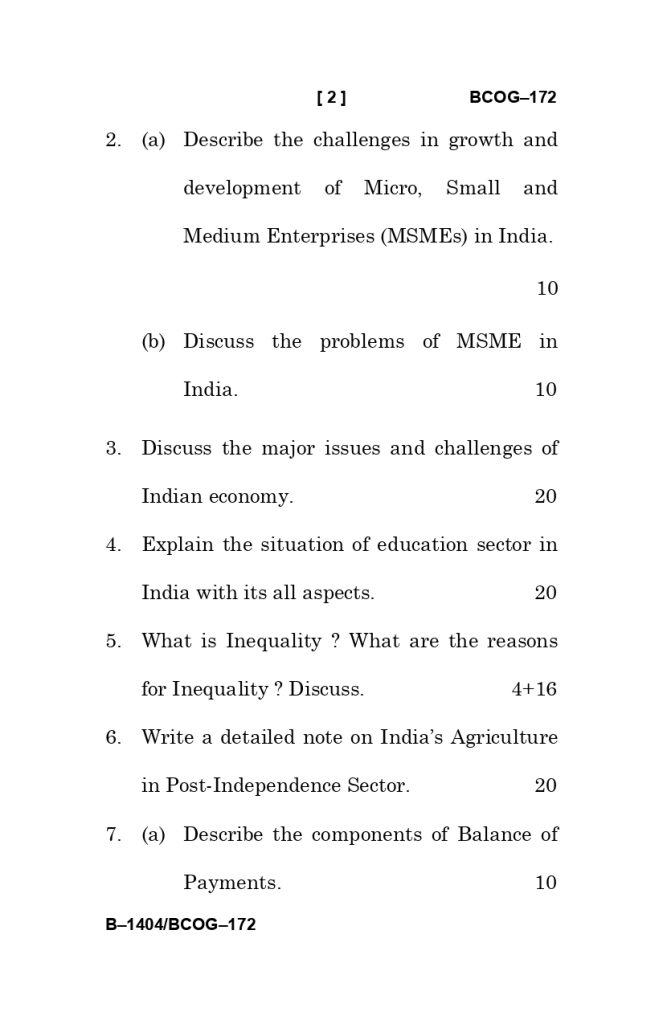
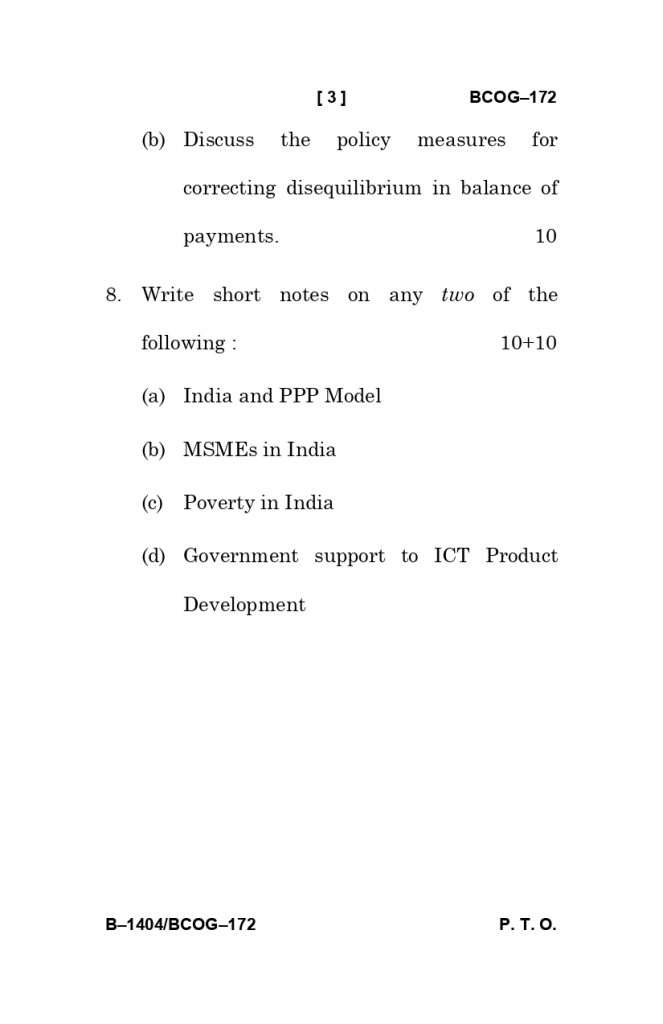

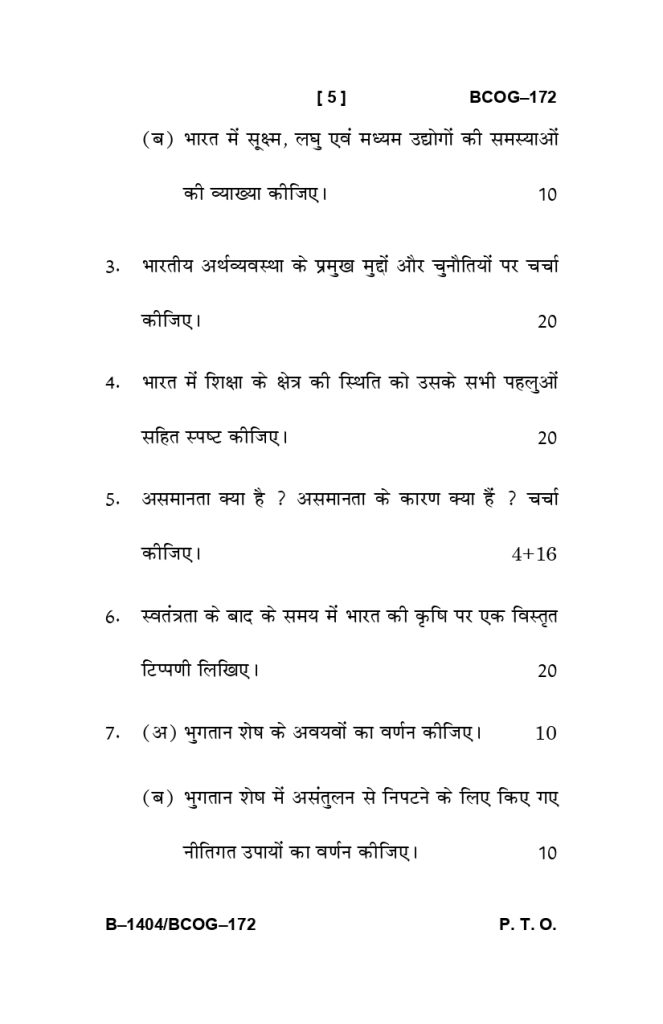
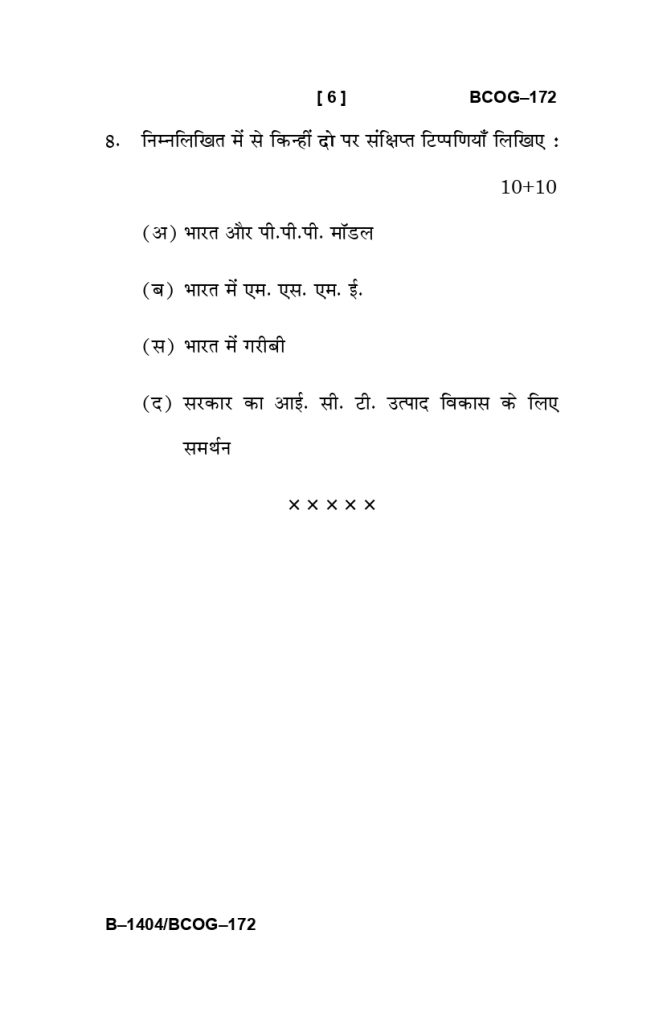
Want BCOG 172 Question Paper Solutions?
We are keeping this article informative and examination-based. We are not publishing full model answers here. If students require full-fledged solutions or personalised help, they can contact our team. We support learners with notes, structured solutions, and guidelines for exams based on the style of IGNOU evaluation. Also, if anyone needs any more IGNOU resources or papers, they can visit: https://www.unnatieducations.com/ignou
Why BCOG 172 Is Easy for the Student (But Still Trips Them Up)
BCOG 172 seems easy because:
- The syllabus is common-sense economics,
- questions are direct,
- and nothing looks “technical.”
But the scoring is strict as IGNOU checks for:
- structure,
- correct keywords,
- correct coverage,
- and "answer discipline" (no unnecessary fluff).
So yes, the paper is not hard. The evaluation is.
BCOG 172 Question Paper June 2025 – Question-Wise Analysis
Below is the breakdown of the major themes in the June 2025 paper, explained in easy-to-understand language. We are providing only 1-2 lines of explanation for the questions, not full answers. 1) Liberalisation: concept + importance + govt. initiatives (4+16 style) What IGNOU wants:
- Short definition first
- Then significance with appropriate subheadings
- Then, government initiatives are like bullets
1-2 line explanation: Liberalisation is the reduction of state control and the easing of regulations with the objective of bringing in more private participation and efficiency in the economy. Industrial policy changes, deregulation, trade reforms, and simplifying FDI are some common government initiatives. How to write it cleanly:
- Meaning (4 marks)
- Why needed
- Significance
- Key initiatives
- Short conclusion
2) MSMEs: challenges in growth and development (10 Marks style) This is a recurring theme because MSMEs are a link with a direct connection to jobs and economic development. 1-2 line explanation: MSMEs are important in employment and output but suffer from a finance gap, expensive credit, outdated technology, disorganised marketing, infrastructure problems, unavailability of raw materials, and a lack of skilled manpower. Best format:
- Write 7-8 Headers such as 'Finance', 'Technology', 'Infrastructure', 'Marketing.'
- Give 2–3 lines under each.
3) Major problems & challenges of the Indian economy (20 marks style) Often, students write random lists. That's the quickest way to lose marks. 1-2 line explanation: Vital issues include poverty, unemployment, inequality, inflation, agricultural backwardness, fiscal imbalance, and regional imbalances, along with challenges in job creation and infrastructure improvement. Best format:
- 6–7 issue headings
- 2–3 lines each
- End with a tight conclusion
4) Education in India: problems + quality + accessibility This is usually asked to see how well you are able to cover "all aspects." 1-2 line explanation: Education challenges include access gaps, dropouts, teacher shortages, lack of infrastructure, shortage of high-quality educators in one region versus another, lack of funding, and inequality in digital integration. Write it as:
- Current status
- Major gaps
- Practical measures (brief)
5) Inequality: meaning (4) + reasons and impacts (16) Students often compose emotional content here. IGNOU would like academic framing. 1-2 line explanation: Inequality means the unequal distribution of income, wealth, and opportunity. It is caused by a lack of education, unemployment, patterns of asset ownership, regional imbalances, and social stratification. Structure that scores:
- Definition
- Measures/indicators (give them names)
- Reasons
- Impacts
- Conclusion
6) Agriculture after independence: Reforms + Progress + Problems This is a classic BCOG 172 area. 1-2 line explanation: Post-independence agriculture underwent changes in the form of land reforms, expansion of irrigation, the Green Revolution, institutional credit, MSP procurement, and infrastructure development, but problems such as regional disparity and productivity gaps still persist. Write in headings in a timeline format:
- 1950s reforms
- Green Revolution phase
- Diversification & modern challenges
Important Topics of BCOG 172 Based on Previous Papers
This is a student shortcut to this section. If you revise these properly, then you cover a big chunk of what IGNOU asks multiple times. High-frequency topics:
- Liberalisation, Privatisation, Globalisation (LPG)
- Industrial policy reforms
- MSMEs: role + problems
- Poverty and unemployment
- Inflation and fiscal deficit
- Reforms relating to agriculture and the Green Revolution
- Education sector issues
- Balance of Payments and challenges in the external sector
- At the local level: Regional imbalance and development planning basics
Quick Revision Table (What to revise vs why it is important)
| Topic | Why it repeats | How to prepare |
| Liberalisation | 4+16 questions are common | Learn definition + 6 initiatives |
| MSME | Direct development link | Make an 8-heading list |
| Poverty/Unemployment | Core Indian economy unit | Use short definitions + reasons (causes) |
| Agriculture | Long answers often come | Timeline-based writing |
| Education | “All aspects” type question | Access + quality + equity |
Answer Writing Strategy of BCOG 172 (What Actually Gets Marks)
We are not just going to say "write neatly" and leave it there. Here is the real method. 1) Use a strict answer format Every long answer should be in the form of:
- Intro (2–3 lines)
- Headings (6–8 points)
- Mini conclusion (2 lines)
2) Use “mark-logic.” If a question is 4+16:
- Don’t write a 1-page definition
- Give a definition in 4–5 lines
- Put the depth in the 16-mark part
3) Don’t overwrite If you overwrite, your answer becomes:
- repetitive,
- messy,
- hard to check. Instead: Crisp points, plus a brief explanation of each point.
4) Keep language simple IGNOU does not appreciate complicated English. It rewards clear English.
Common Mistakes that Students Should Try to Avoid
Let’s be straight. The following are the mistakes that kill marks:
- Writing without headings
- Consolidating two sub-questions into one paragraph
- Using irrelevant examples for everything
- Not concluding the answer
- Rushing on one question for 60 minutes and rushing the rest
- Writing "story-style" answers rather than structured answers
But if you avoid just these, your marks go up.
Time Management While Taking the Exam
A basic time plan for a 3-hour paper:
- 10 minutes: Read + select your best five questions
- 30–32 minutes per answer × 5: 160 minutes
- 10 minutes: Revision and complete
Mini table - Time divided by answer
| Answer Part | Time |
|---|---|
| Intro | 2–3 minutes |
| Headings points | 22–24 minutes |
| Conclusion + checking | 5 minutes |
This prevents you from overwriting and losing time.
BCOG 172 Question Paper – See full question paper video
Where to Find More IGNOU Help
If any student needs more question papers, exam updates, or course-specific help, they can visit: https://www.unnatieducations.com/ignou. We are mentioning this once and making it clean.
Frequently Asked Questions
1) What is the best way to score in BCOG 172?
The best thing to do is to write structured answers with headings and match the question's demand. For example, if a question implies a split like concept + significance, then write a short definition first and then cover significance in points. This makes checking easier and increases marks.
2) Do we need to write very long answers to get full marks?
No. Long answers with repetition tend to reduce clarity. IGNOU has a soft spot for relevant points, headings, and balanced explanations. Do not write everything you know, but enough to cover the demand. Think "complete and clean," not "big and messy."
3) In a 20-mark question, how many headings should we use?
Usually, 6–8 headings work well. Each heading should contain between 2 and 3 lines of explanation. This gives depth but doesn't require overwriting and helps the examiner to award marks quickly.
4) Is the June 2025 BCOG 172 paper more conceptual or factual?
It is mostly conceptual with application-style framing. Subjects such as liberalisation and MSME issues require definitions coupled with an organised explanation. It is not enough to merely memorise things; the style of writing and organisation is important.
5) Which topics should we revise first if we have less time?
Start with some repeated themes: liberalisation initiatives, MSME problems, the poverty-unemployment-inequality set, agriculture after independence, and issues around education. These cover a large portion of common patterns on the paper.
Final Thoughts on BCOG 172 Question Paper June 2025
The BCOG 172 Question Paper June 2025 is not design
BCOG 172 Question Paper June 2025: Pattern & Strategy
ed to trap students with unknown topics. It is testing whether you can write in IGNOU's expected format: definition first, then points based on the headings, and finally a small conclusion. If you stop overwriting and start writing answers in a structured way, your marks improve fast—without studying 'extra'. If students require the full solutions, they may access the video section above or contact us for guided support. For more papers and help, the IGNOU section is available on our site. Most of all, revise smart, write clean, and treat every answer like a checklist.