BCS 011 Question Paper June 2025: Complete Analysis and Preparation Guide
The BCS 011 Question Paper from June 2025 is not “hard.” It’s strict. If you write fluffy answers, it is a punishment. If you write structured answers with headings, steps, and small examples, it rewards you. Our goal for this guide is simple: to get you to know the pattern of the paper. What are the high-scoring areas? What exactly is the style IGNOU wants us to follow without just dumping full answers here? For more IGNOU papers or support, you may visit: https://www.unnatieducations.com/ignou.
BCS 011 Question Paper June 2025 – Quick Overview
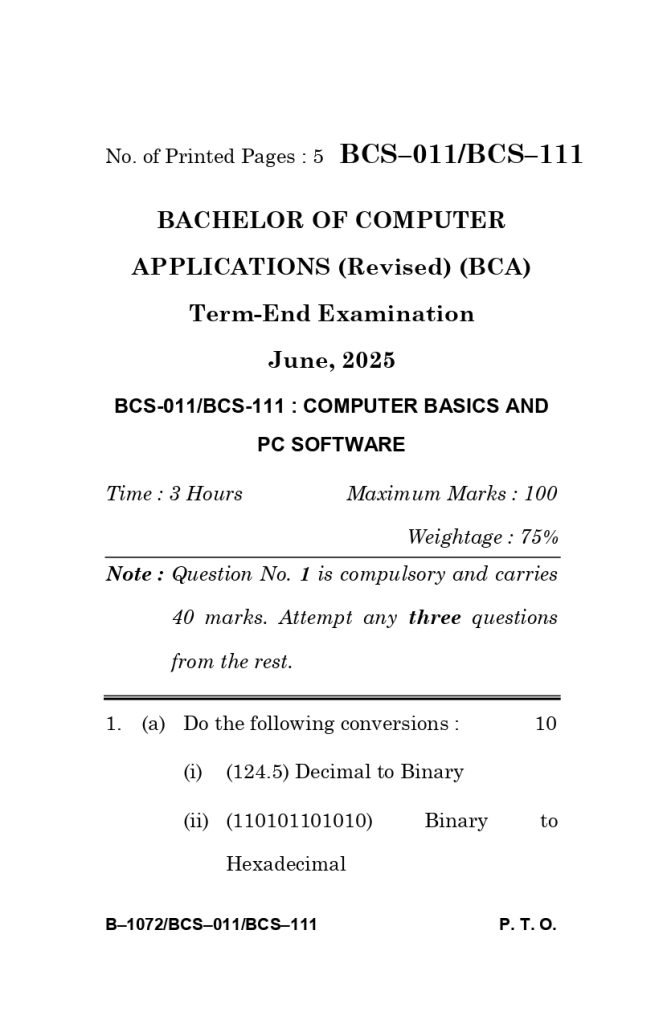
This paper is for BCA (Revised), and the Course Name is Computer Basics and PC Software. It is a 3-hour exam of 100 marks with 75% weightage (the rest is usually from assignments). Question 1 is compulsory (40 marks), and you answer any three questions from the rest of the choices.
BCS 011: One-Glance Clarity Box (Read this before anything else)
| Exam Aspect | Details |
|---|---|
| Time | 3 hours |
| Total Marks | 100 |
| Compulsory Question | Q1 = 40 marks |
| Choice Questions | Attempt any 3 of Q2–Q5 = 60 marks |
| Winning Move | Score 30+ in Q1, then choose the 3 strongest long questions |
Why This BCS 011 Question Paper Feels Difficult for Students
Here's the blunt truth: Most students lose marks for presentation, not knowledge.
- Conversions are terrifying for people, as one mistake spoils the final output.
- It is easy to look at the Excel function, but at IGNOU, they want "working + syntax + mini example."
- IP + DNS is theoretical, but marks are awarded for structure + diagram.
- Long questions (software project management, OS services, mail merge) do not require story writing, but they need headings.
- So yes, the syllabus is basic—but the checking is not casual.
IGNOU Computer Basics and PC Software Question Paper
Understanding the Structure of the BCS 011 Question Paper
The paper is divided into 2 layers:
- Q1 (Compulsory) – 40 marks
- Q2 to Q5 (Attempt any 3) – 60 marks
Paper Pattern Table
| Section | What you do | Marks | What checking focuses on |
|---|---|---|---|
| Q1 (a–f) | Short + mixed practical + theory | 40 | Steps, definitions, small diagrams, accuracy |
| Q2–Q5 | Choose any 3 questions | 60 | Headings, examples, flowcharts/diagrams, sharp points |
This pattern is clearly stated in the paper itself.
Q1 Strategy: How to "Lock" 40 Marks Without Thinking Too Much
Q1 is not optional. That means it's your rank-maker. The Real Hack:
- Don’t aim for perfection. Aim for clean steps.
- For conversions: Display the method, not just the final value.
- For Excel: Give meaning + syntax + one small example line.
- For IP: Make a nice block diagram & label it.
- For Antivirus: Write 3 reasons + 3 techniques; Done.
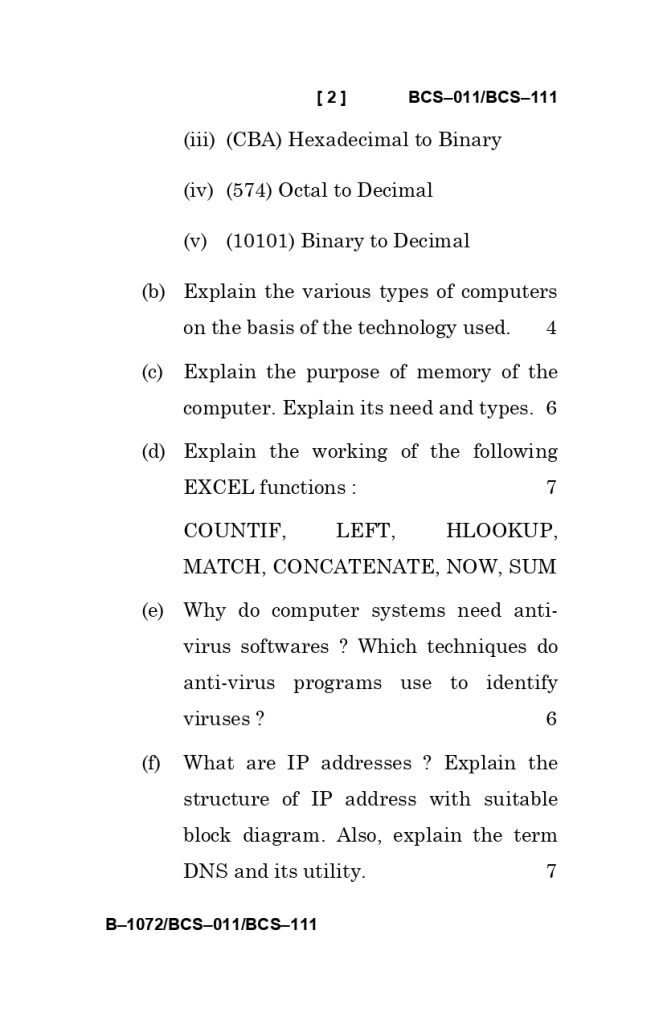
- Q1 Topics: Number system conversions, types of computers, memory, Excel functions, antivirus, IP + DNS.
Question 1 - What Does Each Part Test (Without Full Answers)
Q1(a) Conversions (10 marks) This is pure scoring as long as you can show your steps. The paper asks questions like decimal <--> binary, binary --> hex, hex --> binary, octal -> decimal, etc.
- What To Write: Steps of the method (successive division/positional weights) + final result.
Q1(b) Types of computers on the basis of technology (4 marks) Analog vs. Digital vs. Hybrid.
- What to write: 1 line definition + 1 real use case each.
Q1(c) Memory: what is it, the need for it, types (6 marks) IGNOU wants Structure: Purpose > Need > Types (primary/secondary).
- What to write: Bullet points + RAM/ROM + example of Secondary storage.
Q1(d) Excel functions (7 marks) Countif, Left, Hlookup, Match, Concatenate, Now, Sum.
- What to write: Each function = meaning + syntax + 1 tiny example.
Q1(e) Antivirus: why needed + techniques (6 marks)
- What to write: Reasons for protection + signature/heuristic/behavior-based scanning.
Q1(f) IP address + structure + block diagram + DNS utility (7 marks) This is where many students lose marks by missing the diagram.
- What to write: The definition, the structure of IPv4 (32 bits, 4 parts) + simple block diagram + the meaning of DNS + 1 example.
Choose Your 3 Long Questions Like a Smart Player (Not Like a Hero)
You don't have to try "tough-looking" questions in order to prove anything. You need marks. From Q2 to Q5, choose the set that is appropriate for you regarding your comfort:
- If you like theory + management: Software project management + Cloud + OS.
- If you are a fan of diagrams: CPU diagram + flowchart + IP addressing.
- If you are a fan of office tools: Mail merge + utilities + malware.
The paper has these themes throughout Q2 - Q5.
Question-Wise Analysis: What The Exam Makers Expect
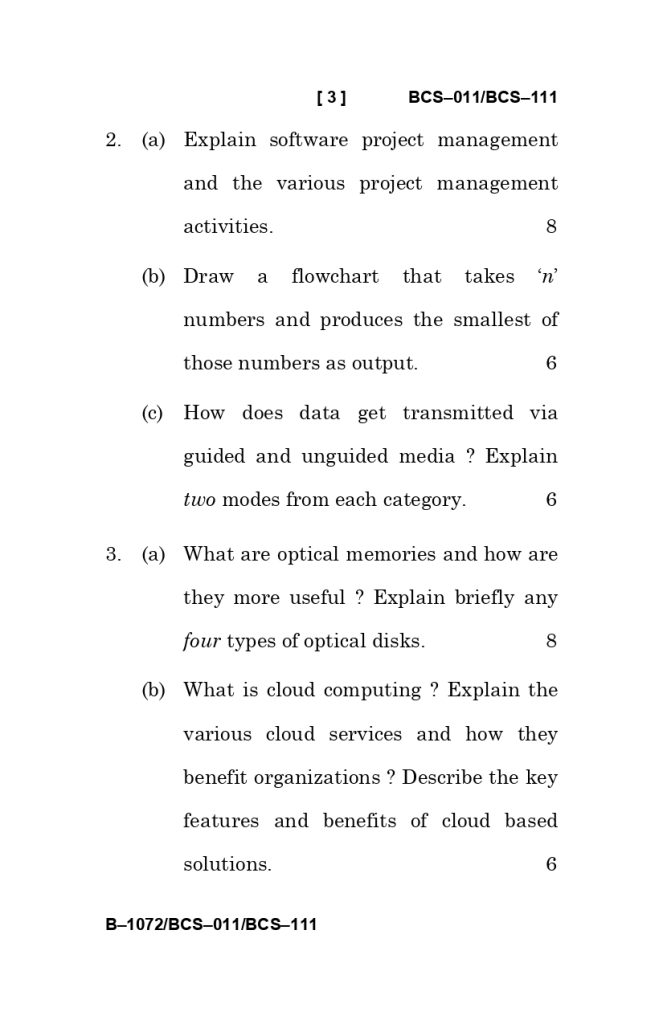
Q2(a) Software project management + Activities (8 marks) Write definition, objectives, then activities: 1. planning, 2. estimation, 3. scheduling, 4. risk, 5. quality 6. monitoring.
- Scoring move: Add a mini "activity --> output" list (example: scheduling --> Gantt chart timeline).
Q2(b) Flowchart: smallest of n numbers (6 marks) Draw it clean: Start --> read n --> read first --> assume smallest --> loop --> compare --> update --> end.
- Scoring move: Write 4-5 lines after the diagram explaining the flowchart logic.
Q2(c) Guided vs unguided media + 2 modes each (6 Marks) Guided: twisted pair, coax, fiber. Unguided: radio, microwave, satellite.
- Scoring move: Add "when to use what" in 1 crisp line.
Q3(a) Optical memories + four optical discs (8 marks) CD-ROM, CD-R, CD-RW, DVD (You may say Blu-ray if they ask, but they usually ask for 4 on the paper).
- Scoring move: 1 line working principle (laser + pits/lands).
Q3(b) Cloud computing + services + benefits + key features (6 marks) Define cloud, and then services: IaaS, PaaS, SaaS.
- Scoring move: Mention features such as scalability, pay-as-you-go, accessibility, and backup.
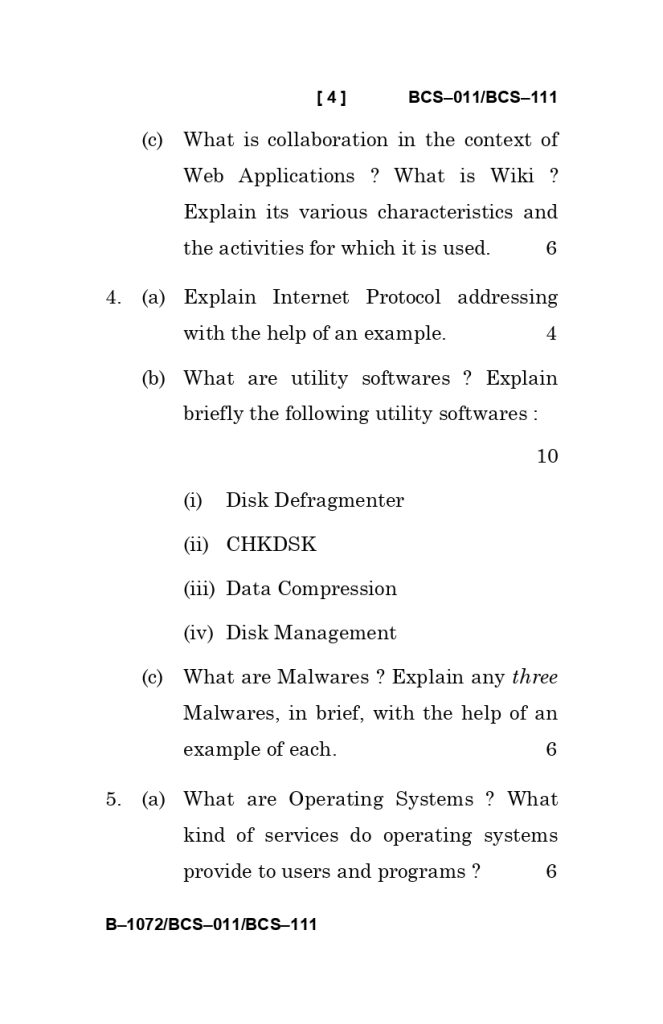
Q3(c) Collaboration in web apps + wiki + characteristics + activities (6 marks) Don’t write philosophy. Define collaboration; wiki; list features: versioning, editing, history, permissions. Q4(a) Internet Protocol addressing, with example (4 marks) Write one example: IP address + what the network/host part means (basic level). Q4(b) Utility software + explain 4 tools (10 marks) Disk Defragmenter, CHKDSK, Data Compression, Disk Management.
- Scoring move: For each tool: purpose + what problem it fixes + 1 real scenario.
Q4(c) Malware + explain 3 with example each (6 marks) Virus, worm, trojan, spyware, ransomware - take your pick of three.
- Scoring move: Keep examples simple (e.g., locked files by ransomware).
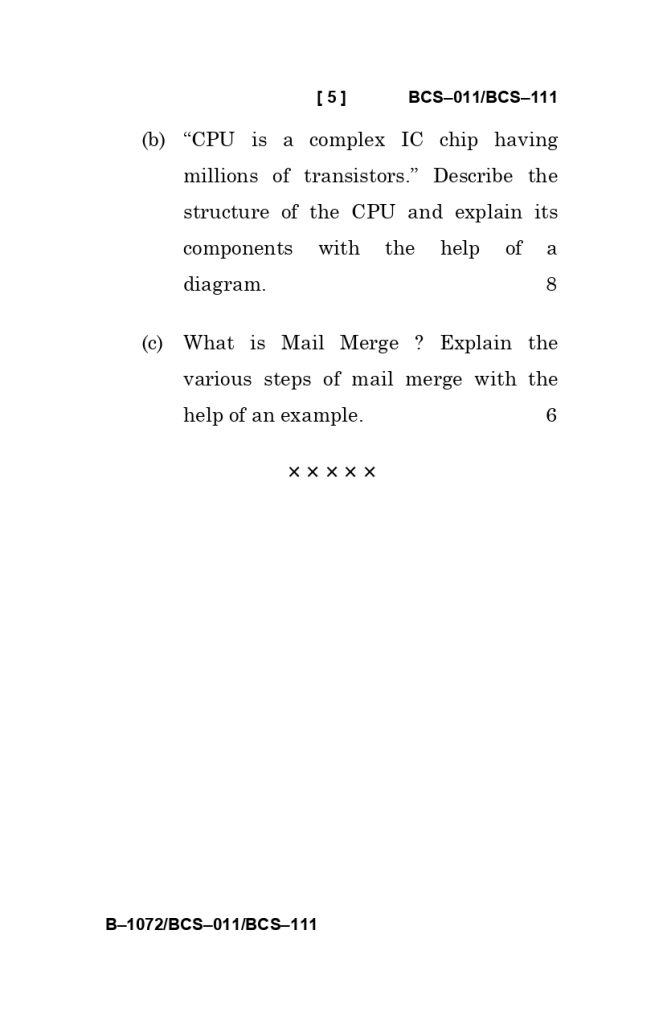
Q5(a) Operating systems + services to users/programs (6 marks) Services: process management, memory, file system, security, UI, and IO management. Q5(b) Structure + diagram + components of a CPU (8 marks) ALU, CU, Registers, Memory unit, Bus.
- Scoring move: Diagram + 6-8 bullets.
Q5(c) Mail merge + steps with example (6 marks) Define mail merge, followed by steps: main document, data source, insert fields, preview, and finish. For more IGNOU papers or support, you may visit: https://www.unnatieducations.com/ignou.
Comparison Table: What to Try and What to Avoid
| If you are good at… | Best picks | Avoid if you… |
|---|---|---|
| Diagrams + logic | Q2(b) Flowchart, Q5(b) CPU | Panic when drawing |
| Computer Networks Basics | Q1(f), Q2(c), Q4(a) | Mix up terms fast |
| Office tools | Q1(d), Q5(c), Q4(b) | Hate syntax/examples |
| Theory writing | Q3(b), Q5(a), Q2(a) | Write without headings |
This table saves time while reading the paper.
Exam Timeline Visualization (3 Hours Game Plan)
- 0-10 min: Read paper, select your 3 long questions.
- 10-85 mins: Finish Q1 fully (don't leave blanks).
- 85–165 min: Attempt Long Question #1 + #2.
- 165-175 min: Quick break + check if any part is left.
- 175–180 min: Attempt Long Question #3.
- Remaining time? (If you have the last 20-25 min): Revise, underline headings, fill in missing keywords.
If you're time-aware, your penmanship is neat. That alone protects marks.
Answer Writing Strategy: The Mark Obtaining Strategy
We follow a simple method:
- Definition (2 lines)
- Core points (bullets)
- Example/diagram (where necessary)
- Mini conclusion (1–2 lines)
What we do differently (pattern break): We don't write long paragraphs of emotion. We write blocks for the exam. That's the difference between "I know this" and "I scored for this."
Common Mistakes That Should Be Avoided by Students
- Writing conversions without steps.
- Skipping diagrams in IP and CPU questions.
- Writing Excel functions without syntax.
- Writing "cloud is the future" type lines (zero marks value).
- Overwriting an answer and leaving another half-finished.
- Marks are not charity. The examiner is looking for points.
BCS 011 Question Paper – See full question paper video
Want the Complete Solved Answers in IGNOU Format?
We've made the solved paper according to IGNOU's checking style: There are proper headings, short intros, step-based solutions, and diagram instructions for you. If you want complete solutions or you want us to guide you on how to write answers for maximum marks, then you can contact our team, or you can use the above video section as your reference. If you want any more IGNOU help notes or more question papers, you can visit: https://www.unnatieducations.com/ignou. (We keep it practical: what to write, how much to write, and what not to waste time on.) For more IGNOU paper solutions or support, you may visit: https://www.unnatieducations.com/ignou.
Frequently Asked Questions
What is the marking pattern of this paper? The exam is 100 marks for 3 hours. Question 1 is 40 marks, and you attempt any 3 questions from the rest of the questions for 60 marks. For example, even if you do Q1 well and pick 3 good long questions, you can cross 60+ with a clean structure very comfortably. Which section should we try first? We generally prefer to start from Question 1 because the question is compulsory and it contains a lot of short scoring questions. For example, you can complete the conversions and Excel early when your mind is fresh. Then you veer off into long answers with a loose pace. This prevents last-minute panic and incomplete answers. How much writing should we do for a 6-mark answer? For 6 marks, write 10-12 good lines or 6-8 bullet points and 1 small example. For example, in the case of antivirus software, write about 3 reasons why the system needs it and 3 detection techniques. That leaves the examiner with clear points to give marks rather than speculative ideologies as to what you meant. Are diagrams really important in BCS-011/BCS-111? Yes, when the question asks for it, diagrams are a direct mark area. For instance, IP address structure and CPU structure both refer to diagrams. Even a simple labeled block diagram can kick up your score due to clarity and time-saving for the examiner. What if we are 7 days late getting ready? Do it in layers:
- Day 1-2: Q1 Topics (conversions, Excel, IP/DNS).
- Day 3-5: Choose 3 long questions and get headings + examples ready.
- Day 6: Write one entire mock answer set.
- Day 7: Revising diagrams and common definitions. Only when late prep is structured will it work.
What practice should we do to get good marks? Practice conversion steps, Excel function syntax examples, and 2-3 neat diagrams (IP structure, CPU block diagram, and 1 flowchart). For example, if your flowchart is clean and your steps are labeled, then it is "easy marks" because it's objective and checker-friendly.
Final Thoughts on the BCS 011 Question Paper
The BCS 011 Question Paper of June 2025 is a fair paper for students who write like IGNOU expects: short definitions, clean steps, neat diagrams, and point-wise answers. If you take it as if it were a "writing exam" and not a "memory contest," then your score will jump. And if you need complete solutions or guided answer formats, you can use our video and support resources—but either way, your first priority is nailing the structure and time plan for the BCS 011 Question Paper. For more IGNOU paper solutions or support, you may visit: https://www.unnatieducations.com/ignou.