We are all familiar with the feeling of looking at a blank sheet of paper, trying to figure out what exactly the examiner wants. If you are a BAG student preparing for your term-end exams, the BPCC 132 Question Paper for Introduction to Social Psychology is likely on your mind. At Unnati Education, we believe that it is just as important to understand the logic behind the questions as well as memorising the answers. In this detailed guide, we will break down the paper of IGNOU June 2025, analyze the specific questions asked, and also provide you with an organized approach towards the marks. For more IGNOU papers or support, you may visit: https://www.unnatieducations.com/ignou.
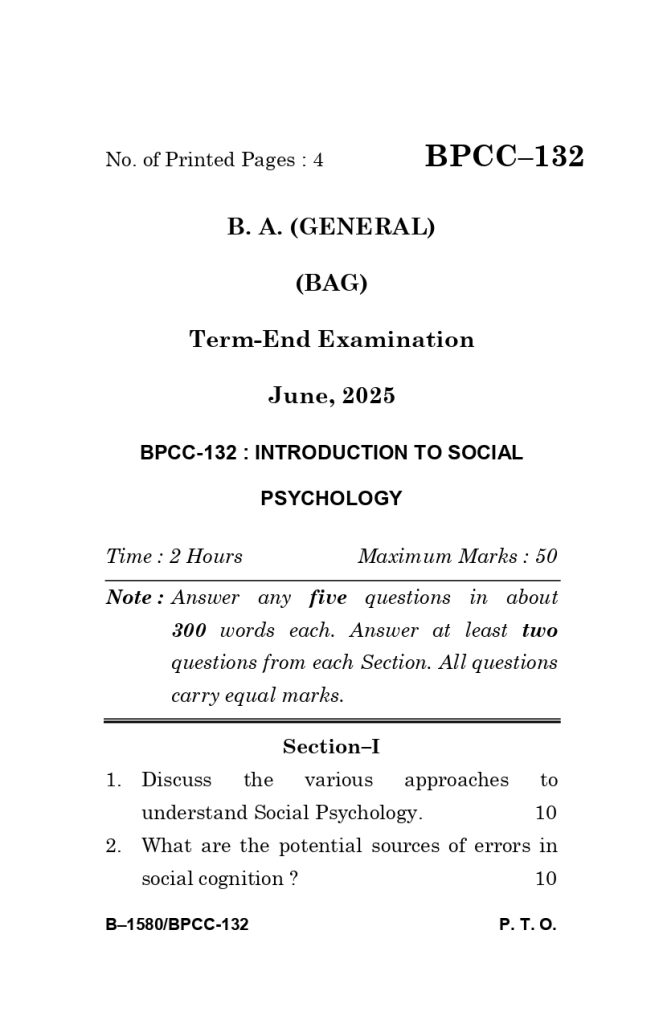
BPCC 132 Question Paper June 2025 – Quick Overview
Before we get into the deep analysis, let's try to see the structural facts of the exam. This "at-a-glance" table helps you to understand the technical constraints that you will be faced with in the examination hall.
| Exam Feature | Specific Details |
|---|---|
| Course Code | BPCC-132 |
| Course Title | Introduction to Social Psychology |
| Session | June 2025 |
| Maximum Marks | 50 Marks |
| Time Duration | 2 Hours |
| Word Limit | 300 Words per Answer |
| Requirement | Answer 5 questions (at least 2 from each section) |
Finding the right study materials is a hassle. You might be tirelessly searching for a BPCC 132 solved question paper to verify your answers or looking for a reliable BPCC 132 question paper solution that breaks down complex theories into simple language. Many students also prioritize their study time by looking for a list of Psychology Important Question topics that frequently repeat. Since the BPCC 132 question paper for June 2025 is the latest standard, using it as your primary roadmap is the smartest strategy for your upcoming exams.
BPCC 132 Question Paper June 2025 Sample Pages
Want BPCC 132 Question Paper Solutions?
Students who require full solutions or individual assistance in BPCC 132 can contact our team. We support the learners with notes, solutions, and exam guidance. However, if you are struggling to find the answers or just want to make sure that you are on the right track, just do not hesitate. We have compiled the 5-year papers, which generally decide the trend for the next exams. Getting help now can help save you from the stress of a retake later on. For more IGNOU papers or support, you may visit: https://www.unnatieducations.com/ignou.
Why the "BPCC 132 Question Paper" Feels Difficult for Students
Social Psychology is a tricky subject. It seems hard because it requires a certain scientific vocabulary for things that we do every day. You cannot simply write "people help others because they are nice." You have to explain it in terms like "Prosocial Behavior" and "Altruism." The tight word limit of 300 words for each answer is also another hurdle. It forces you to be concise. Many students find it difficult to reduce such enormous theories, such as the different approaches to the field of social psychology, into such a short space without missing out any important points. The pressure to explain the biological, cognitive, and cultural elements all in a few paragraphs can be overwhelming if you don't have a planned approach.
Why BPCC 132 is Easy for Students Seemingly
On the flip side, this paper can be surprisingly easy if you understand the main concepts. The topics are relatable. We all have attitudes, we all get angry (aggression), and we all communicate. Unlike abstract mathematics, the BPCC 132 Question Paper deals with human interaction. When you read a question about "styles of communication," you can immediately think of examples in your own life - a friend who is passive-aggressive or an assertive boss. This relatability enables you to come up with examples at a fast rate, which is a massive advantage in a timed exam.
BPCC 132 Question Paper June 2025 – Question-Wise Analysis
So let's go through the paper, question by question: We have analyzed the June 2025 paper to give you the exact content that you needed to write.
Section I Analysis
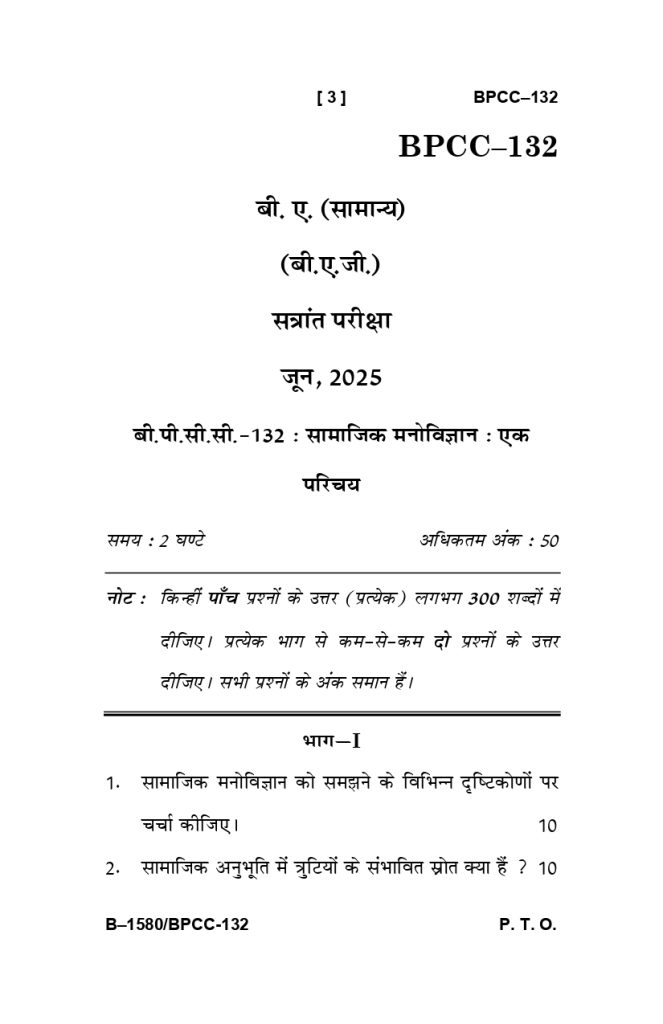
Explain the different ways of approaching the study of Social Psychology. (10 Marks)
- Such a question is fundamental. It queries how various scientific lenses perceive human behaviour. You have to provide an integrative point of view.
- Sociological Approach: This is looking at the "big picture" - social structures, institutions, and group processes. It points out the role that roles and class play in the individual.
- Psychological Approach: This is the closer look at the individual. It looks at mental processes such as perception, motivation, and attitude.
- Biological Approach: This emphasizes genetic and hormonal factors. It implies that our social behavior is at least partly biological.
- Evolutionary Approach: This is the explanation of behavior in terms of survival. We live in ways that helped our ancestors to survive.
- Learning Approach: Based on conditioning, observation. We learn social behavior from imitating others and through rewards/punishments.
- Cognitive Approach: Emphasizes "Social Cognition"- the way we process information, beliefs, and schemas.
- Cultural Approach: Focuses on the role of shared values and meaning across different cultures.
What are the possible sources of errors in social cognition? (10 Marks)
- We don't always think clearly. Our brains take shortcuts. This question you have been asked to list these particular mental errors.
- Schemas: These are mental frames that are based on experience. They help us to process information in a fast way, but it can distort our perception when it filters out new information.
- Stereotypes: Generalized beliefs about social groups, which do not consider individual differences.
- Mental Shortcuts (Heuristics): Quick decision-making rules that are efficient but often result in systematic errors.
- Availability Heuristic: Judgement based on the ease of examples being thought of (often influenced by the recent news).
- Representative Heuristic: Judging that something is probably true if it is like something that we think is true (we ignore actual statistics)
- Illusory Correlation: Seeing a relationship exist between two things when it does not exist.
- Confirmation Bias: The tendency to seek out information that confirms what we already believe and ignore evidence that runs contrary to our beliefs.
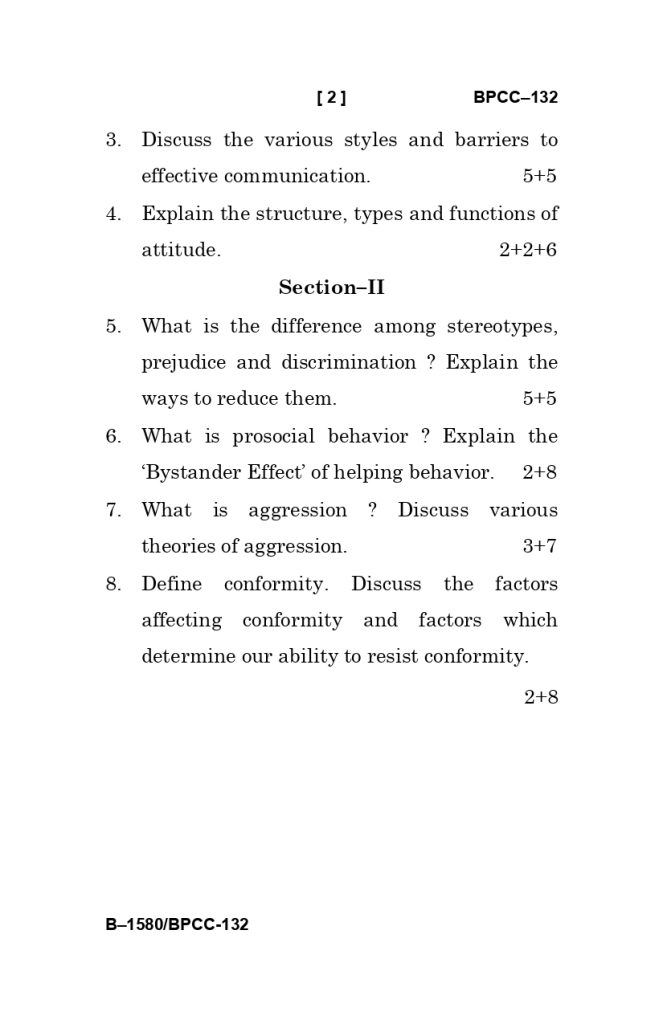
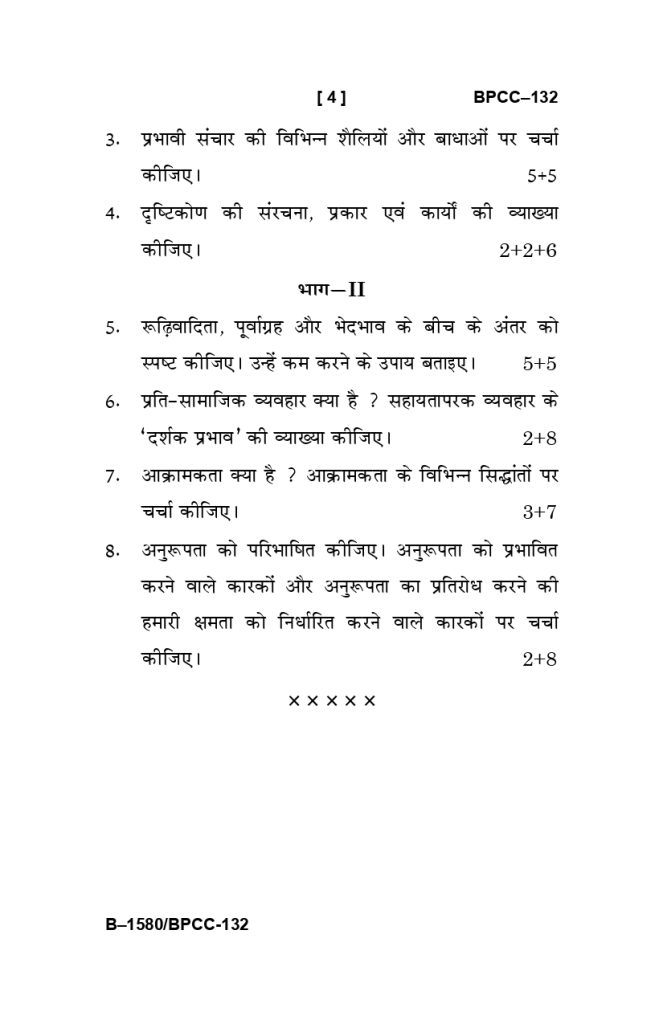
Discuss the different styles and obstacles to effective communication.' (5+5 Marks)
- This is a two-part question. Styles of Communication:
- Passive (avoiding feelings of expression, suppressing sentiments).
- Aggressive: Aggressive behaviour is forceful and will violate the rights of others.
- Passive-Aggressive - indirect resistance, sarcasm, silence.
- Assertive - Most ideal style; clear, direct, and respectful expression.
- Barriers to Communication:
- Physical: Noise, Distance, Poor Infrastructure.
- Psychological - anxiety, anger, stress will impact attention.
- Semantic: Language differences, jargon, or even symbols that have different meanings to different people.
- Perceptual: Different People Really Reading the Same Message Differently According to Experience
- Cultural: Difference in values and norms leading to misunderstanding.
Explain the structure of attitudes, types, and functions of attitude. (2+2+6 Marks)
- This question is seriously loaded with marks for 'Functions,' and therefore, this is where your attention should be. Structure (ABC Model):
- Affective: Emotional component (feelings).
- Behavioral: The tendency to behave in a certain manner.
- Cognitive: The belief or thought component
- Types: Positive, Negative, Neutral, Explicit (Conscious), and Implicit (Unconscious). Functions:
- Knowledge Function: Helps us to organize and make sense of the complex social world.
- Utilitarian Function: Everything in the hope of being rewarded and doing anything to avoid punishment.
- Value-Expressive Function: Gives us the ability to express our core values and sense of self.
- Ego-Defensive Function: Protects our self-esteem from anxiety or threat.
Section II Analysis
What is the difference between stereotypes, prejudice, and discrimination? Discuss how they can be minimized. (5+5 Marks)
-
- This is a classic distinction of social psychology.
| Concept | Nature of Process | Definition |
|---|---|---|
| Stereotype | Cognitive (Thought) | A generalized belief about a particular group of people. |
| Prejudice | Affective (Feeling) | A negative attitude or feeling toward a person because of group membership. |
| Discrimination | Behavioral (Action) | Unfair or unequal behavior directed toward individuals or groups. |
What is prosocial behavior? Explain the 'Bystander Effect' of helping behaviour. 2+8 Mark
- Prosocial Behavior: Voluntary behavior for the purpose of helping, sharing, or comforting others. The Bystander Effect: The effect where the presence of others decreases the likelihood of helping.
- Diffusion of Responsibility: Everyone assumes that someone else will help out, so nobody does.
- Pluralistic Ignorance: People seek out cues from other people. If nobody else seems concerned, we assume it's not an emergency.
What is aggression? Discuss different theories of Aggression. (10 Marks)
- Aggression: Behavior to injure another individual who doesn't want to be injured. Theories:
- Biological: Focuses on genetics, testosterone, and the structure of the brain.
- Frustration-Aggression Hypothesis: The hypothesis that frustration (blocking of a goal) generates an aggression drive.
- Social Learning Theory: We learn to be aggressive through the observation of others (like the Bobo Doll experiment)
Define conformity. Discuss what the factors affecting conformity are and those that determine our ability to resist conformity. (2+8 Marks)
- Conformity: Behaving and/or believing in a manner comparable to others/the group. Factors Having An Impact On It: Group size (conformity increases to a point with more people in a group), unanimity (if everyone agrees, you are likely to conform), and group status Resisting It: Want for individuation (want to be unique). Having an ally (just one other person disagreeing with the group breaks the spell)
Important Topics for BPCC 132 based on Previous Papers
Based on the analysis performed at Unnati Education, some themes reappear. While the BPCC 132 Question Paper changes every session, the core pillars of the syllabus remain constant.
- Attribution Theory: In particular, the Fundamental Attribution Error and the Actor-Observer Bias.
- Self-Concept: How we see ourselves and Self-Esteem maintenance.
- Group Dynamics: Ideas such as Groupthink, Social Loafing.
- Social Influence: Obedience to authority (Milgram's studies): A common alternative to Conformity.
Answer Writing Strategy for BPCC 132
To be able to score that 10/10 rating on your answers, you need a formula that appeals to the IGNOU evaluator.
- The Intro: Always begin with a clear-cut definition. If the question is "Attitude," then your 1st sentence will need to define the term.
- The Headings: Make use of the headings provided in the question. If your question asks for "Styles" and "Barriers," then your answer must be in two different sections with those headers at the top of the page.
- The Examples: Social Psychology about life. Use real-world examples. When discussing "Aggression," consider road rage or sports.
- The Conclusion: Sum up the paragraph in 2 lines. It demonstrates that you have control of the content to the examiner.
Frequently Made Mistakes that Students Should Try to Avoid
We see students losing marks not because of a lack of knowledge but because of presentation errors.
- Ignoring the Word Limit: Writing 600 words for one question means that you have no time for the last question. Stick to the 300-word mark17.
- Paragraph Walls: Writing one giant block of text is a Purgatory. Your answer should be divided into bullets and short paragraphs.
- Missing Citations: In the world of psychology, names matter. When talking about Social Learning, refer to Bandura. Where else is Obedience mentioned- in the reference to Milgram?
- Vague Explanations: It is not good enough to say "Communication stops." Say "Semantic barriers pervert meaning." Use the correct terminology.
Time Management while Taking the Exam
You have exactly 2 hours (120 minutes) for 50 marks18. For that, it requires military precision.
- Reading Time (5 Minutes): Scan the paper and choose your best 5 questions (remember to choose at least two questions from each section)19.
- Writing Time (20 Minutes per Question): Your test time is 5 questions. 20X5=100 Minutes.
- Review Time (15 Minutes): Use the rest of the time to review headings and underline important words.
BPCC 132 Question Paper – See full question paper video
Sometimes, reading isn't good enough. We have prepared a detailed video analysis in which we will solve this paper step-by-step. Watch this to understand exactly how to frame your answers for the best results.
Where to Find More IGNOU Help
Navigating university exams can be tough, but you don't have to do it by yourself. Whether you need Solved TMAs, practical files, or just exam updates, we are your one-stop solution. For access to more resources, previous year papers, and support, visit us at https://www.unnatieducations.com/ignou. We ensure that our content is updated with the latest trends of the exams, so you have no stress about outdated syllabus content.
Frequently Asked Questions
Based on the analysis of BPCC 132 June 2025 Question Paper and the current student search trends, here are the most searchable, high-intent FAQs. These are optimised for Google "People Also Ask" snippets, voice search. Q1: What is BPCC 132 Exam most important Topic? Ans: I think, based on the June 2025 question paper, the most important and must-include subjects are the ABC Model of Attitude, Bystander Effect, and Barriers to Communication. Students also should pay attention to the differences between Stereotypes, Prejudice, and Discrimination, as this 10-mark question comes up a lot in IGNOU Term End exams. Q2: What is the exam pattern of BPCC 132 (Introduction to Social Psychology)? Ans: The BPCC 132 exam is a 50-mark exam of 2 hours of duration. The paper has been split into two parts. You will need to attempt a total of 5 questions out of the 3 sections, including at least 2 questions from each section. Your answer to each question should be about 300 words. Q3: Where can I download the BPCC 132 Solved Question Paper for June 2025? Ans: You can get the fully explained BPCC 132 Solved Question Paper and detailed notes from Unnati Education. We provide step-by-step solutions and help you find the way to structure your answers, which will gain more marks. See our website or contact us directly for the PDF. Q4: Is the BPCC 132 Exam easy? Ans: The exam is conceptual and but no point in being frightened if you prepare correctly. Since it discusses familiar subjects like Aggression and Social Behavior, it is easy to understand. However, you have to be specific in behavioral psychological terms (e.g., "Cognitive Dissonance", "Pluralistic Ignorance") rather than general specifications to score high. Q5: What is the passing mark of BPCC 132 in IGNOU? Ans: For 50 50-mark theory paper like BPCC 132, the passing mark is normally 14 marks [ 35%]. However, to achieve a good mark, you want to aim to attempt all 5 questions required (as you will lose a large number of grade points if you don't answer questions). Q6: In BPCC 132, IGNOU repeats questions? Ans: Yes, concepts are repeated quite a few times. For instance, questions from "Social Cognition Errors" (Similar to Schemas and Heuristics) and "Theories of Aggression" were included in the June 2025 papers for both the past year papers. Solving the previous 3-5 years of question papers is highly recommended. Q7: How do I write a Good answer to "Prosocial Behavior"? Ans: To mark 10/10: Start the answer by defining Prosocial Behavior (voluntary action to help others). Then, explain the Bystander Effect using the case of Kitty Genovese or any similar case. Always end with a "Critical Note" that includes such factors as the Diffusion of Responsibility that decrease helping behavior in groups. For more IGNOU papers or support, you may visit: https://www.unnatieducations.com/ignou.
Final Thoughts on BPCC 132 Question Paper June 2025
The BPCC 132 Question Paper is a test of your ability to understand the social world scientifically. By deconstructing the June 2025 paper, it is clear that a pattern emerges with the examiners looking for structured thinking, correct terminology, and the ability to connect theory to practice. We hope this guide will help you feel more prepared. Remember to focus on the "why" and "how" of behavior and not just the "what." With the right strategy and with resources offered by Unnati Education, scoring a distinction in Social Psychology is well within your reach. Good luck.