BSOC 101 Question Paper June 2025 – Complete Student Guide with Analysis
Students appearing for the BSOC 101 Question Paper often feel unsure about what to study and how to write answers that match examiner expectations. We drew up this detailed guide to eliminate this confusion and help students clearly understand the pattern of this paper, the demand of the questions, and the direction of preparation for June 2025. This article contains writing notes for BA Sociology students who want to get clarity, structure, and confidence before the exam. Read it. We are targeting the way the paper is designed, what examiners actually look for, and what we can do as students to score better in the exams—not by guessing, but with the right strategy. For other IGNOU papers or support related to it, click: https://www.unnatieducations.com/ignou
Why the BSOC 101 Question Paper Feels Difficult for Students
Many students get nervous about BSOC 101, not because it has so many concepts, but because Sociology requires conceptual clarity as opposed to rote learning. The following are the real reasons students struggle:
- Questions are analytical rather than memory-based.
- Word limit discipline is very important.
- Concepts must be related to thinkers.
- Answers need structure, not stories.
Unlike some subjects, Sociology monitors how well you are connecting ideas, not how much you write. Once this clicks, the paper becomes manageable.
BSOC 101 Question Paper June 2025 – Quick Overview
Before planning answers, students need to know the framework of the paper.
| Component | Details |
|---|---|
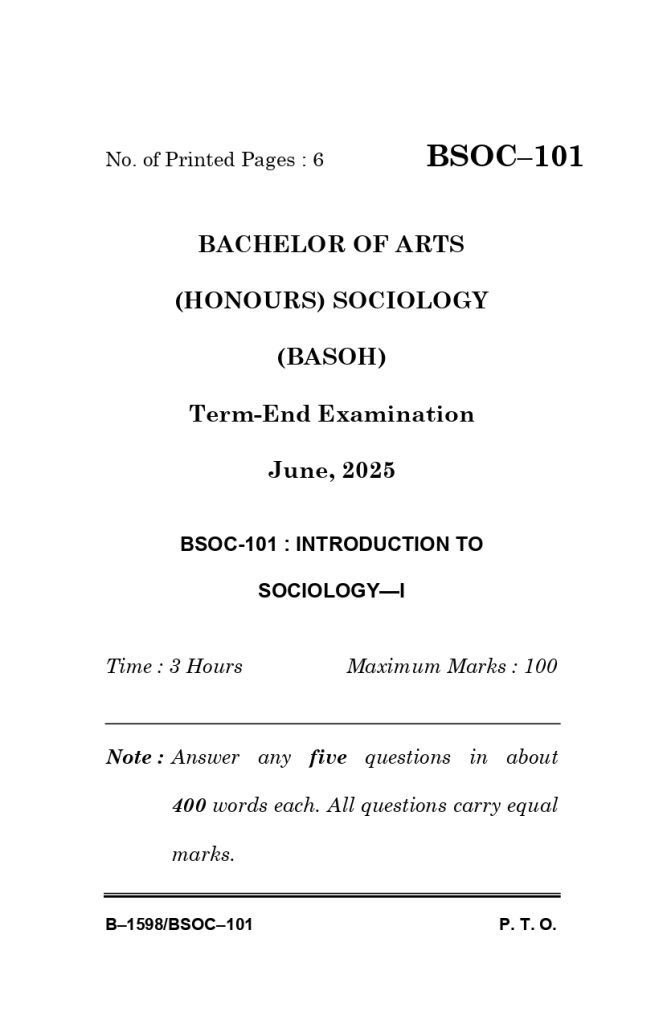
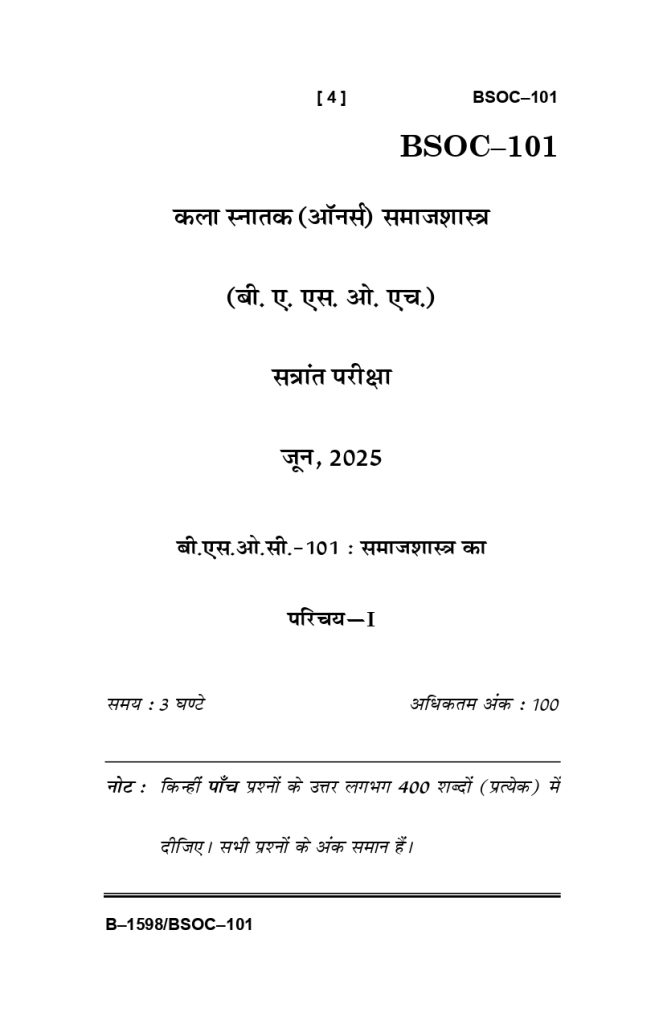
| Course Code | BSOC 101 |
| Course Title | Introduction to Sociology – I |
| Exam Duration | 3 Hours |
| Maximum Marks | 100 |
| Questions to Attempt | Any 5 |
| Word Limit | Around 400 words per question |
| Marking Scheme | All questions carry equal marks |
This structure is officially confirmed for the paper of June 2025.
BSOC-101: What the Examiner Wants
BSOC-101 is a foundation paper. Examiners don't expect fancy academic language, but they do expect:
- Clear definitions
- Correct sociological terms
- Logical flow
- Thinker-based explanations
- Balanced conclusions
Overwriting or underwriting both lose marks. Precision wins.
Section: Secondary Keywords Reference (Separately as Instructed)
Students tend to search using various variations. These common search terms mean the same paper and preparation intent: BSOC 101 question paper, BSOC 101 solved question paper, BSOC 101 question paper solution, IGNOU Sociology Important Question, BSOC 101 question paper June 2025. Understanding this helps students identify the right study resources without confusion.
BSOC 101 Sociology Question Paper June 2025

Want Help With BSOC-101 Answers?
Students who require full solutions, marked answers, or one-to-one academic support will often seek out structured guidance. Those who feel stuck or need to upgrade the quality of their answers can contact us for laser-focused help. Support is available for understanding the concepts, structuring your answers, and preparing with confidence.
Why BSOC 101 Appears Easier When You Have Understood the Pattern
Once students realize that:
- All questions carry equal marks
- There is no obligatory (compulsory) question
- Choice is flexible
...the pressure drops. The key to the paper is that they reward clarity over creativity. Students who stick to definitions, points, and examples often perform better than students with emotional answers.
BSOC 101 Question Paper June 2025 – Question-Wise Analysis
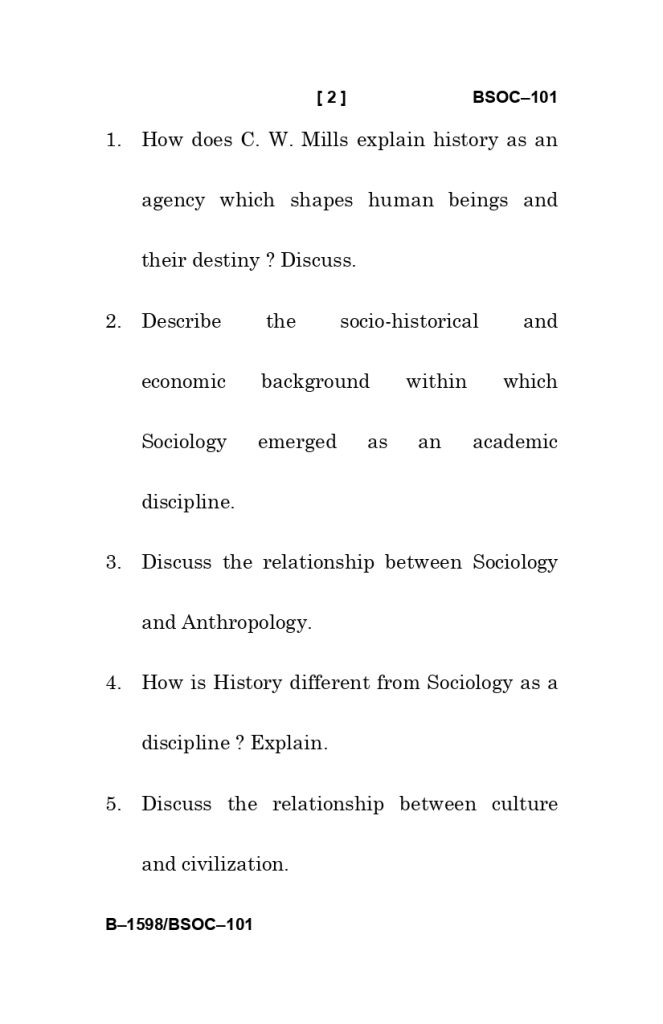
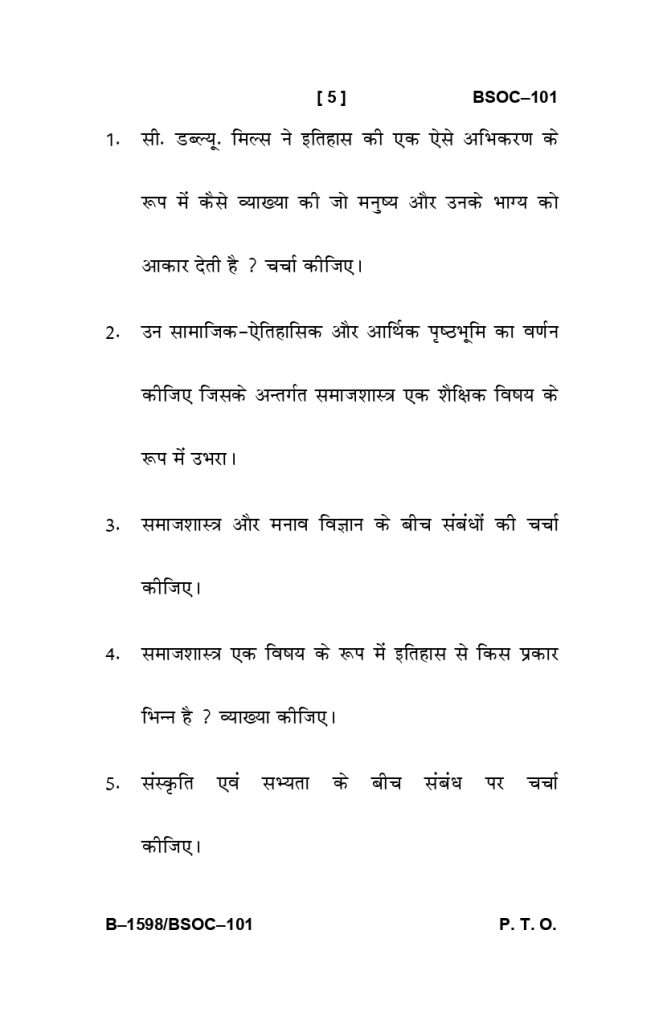
Below is a directional analysis rather than complete answers. This helps you know what to focus on rather than what to memorize. Question 1: C. Wright Mills & History as an Agency (BSOC-101) This question examines the understanding of:
- Sociological imagination
- The connection between history and biography
Students are to explain how a personal lifetime links with the social framework, using reasonable terms to explain Mills's main idea. Question 2: Emergence of Sociology as a Discipline (BSOC-101) This is a common theory-based question. Focus areas include:
- Enlightenment ideas
- The French Revolution
- Industrialization
- Social instability
Do not write too many dates. Explain not only why sociology was needed but also how it emerged. Question 3: Relationship between Sociology and Anthropology (BSOC-101) Here, examiners look for:
- Similarities
- Differences
- Overlapping areas
A balanced comparison works best. Don't show a preference for one discipline over the other. Question 4: History vs. Sociology Disciplines (BSOC-101) This question can best be answered with the help of a comparison format.
| Basis | History | Sociology |
|---|---|---|
| Focus | Past events | Social patterns |
| Approach | Narrative | Analytical |
| Nature | Particular | General |
| Aim | Record the past | Explain society |
Question 5: Relationship between Culture and Civilisation (BSOC-101) This is a concept-based question. Students should:
- Define both terms briefly
- Show how they differ
- Describe how they are dependent on one another
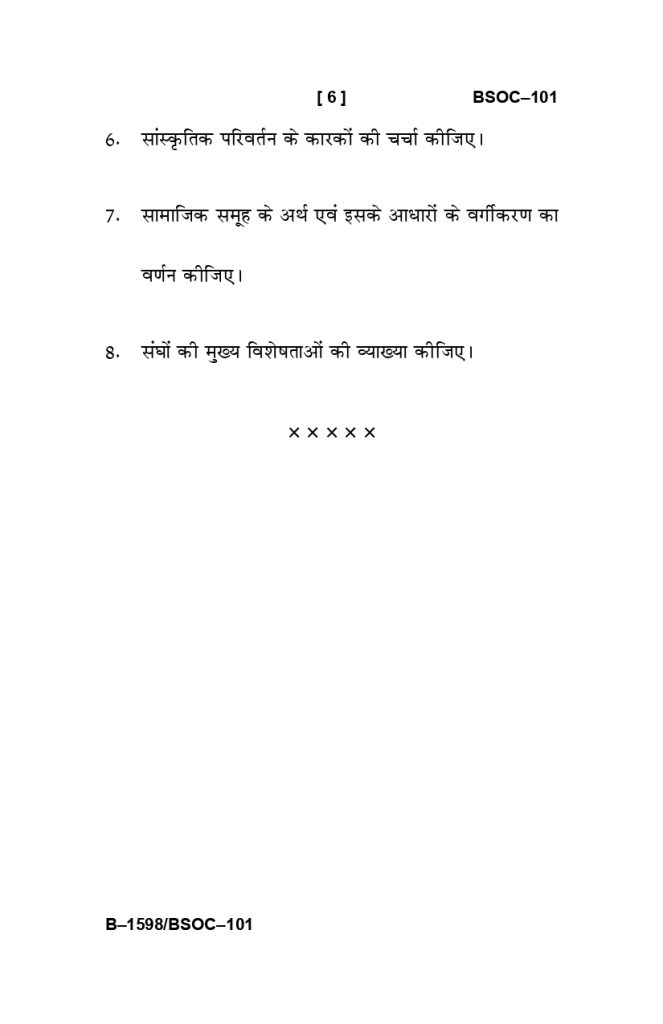
Avoid using philosophical language. Keep the explanation simple and grounded. Question 6: Factors of Cultural Change (BSOC-101) This is a question of scale to determine if the students understand that culture is dynamic, not static. Students should focus on:
- How change is brought about by new ideas and new technology
- The role of contact between societies
- The distinction between material and immaterial culture
- Explain why imbalance, at times, creates social tension
The examiner seeks clarity of classification, not a good storyteller. This is where writing in points works best. Question 7: Meaning of Social Group, Classification of Social Group (BSOC-101) Take this question as a concept-heavy one, but it is scoring if written clearly. Students are expected to:
- Define what a social group is
- Explain why interaction and a sense of belonging are important
- Classify social groups based on conventional bases
Here, the key is not length but definition and order. Question 8: Main Features of Association (BSOC-101) This question tests the understanding of formal social organization. Students should shortly explain:
- What an association is
- Why is it consciously constructed
- How rules, structure, and objectives define it
Do not confuse associations with communities or primary groups. Precision is more important than examples. For other IGNOU papers or support related to it, click: https://www.unnatieducations.com/ignou
BSOC-101 Question Paper June 2025 - At a Glance (Revision Table)
| Question Area | Core Focus |
|---|---|
| C. Wright Mills | History, Biography, Sociological imagination |
| Emergence of Sociology | Social change, revolution, industrialization |
| Sociology & Anthropology | Similarities, differences, overlap |
| History vs Sociology | Discipline-based comparison |
| Culture & Civilization | Meaning, distinction, relationship |
| Cultural Change | Innovation, diffusion, lag |
| Social Groups | Interaction, belonging, classification |
| Association | Formal structure, objectives, rules |
This table helps students to revise quickly before the examination.
BSOC 101 Question Paper – See full question paper video
Important Topics for BSOC-101 Students to Focus On
Based on the need to spot repetitive patterns, students should pay more attention to conceptual understanding than to memorization. Some high-value preparation areas include:
- Definitions having sociological meaning
- Differences and comparisons
- Thinker-based questions
- Classification-based answers
- Cause-and-effect explanations
These areas match examiner expectations very well.
Answer Writing Strategy BSOC-101 (What Actually Works)
Many students are aware of the syllabus but lose marks due to poor presentation. A high-scoring answer will typically include:
- A brief and relevant introduction
- Direct engagement with the question
- Clearly numbered/headed points
- Simple language using sociological terms
- A closing paragraph that helps pull together the ideas
Long paragraphs with no structure tend to lead to reduced readability and impact.
Common Mistakes That Students Should Try To Avoid
Students often make the same mistakes every year. Avoiding these can make scores immediately better.
- Writing beyond or below the word limit
- Using casual instead of academic language
- Intermingling the answers to two questions
- Forgetting conclusions
- Writing everything in paragraph form
Examiners want things to be clear and organized, not verbose.
Time Management During the Exam
Managing time is just as important as preparation.
| Exam Stage | Ideal Time |
|---|---|
| Reading the paper | 10 minutes |
| Writing each answer | 30 minutes |
| Buffer & revision | 10 minutes |
Following this structure helps you maintain calm and consistency.
Where to Find More IGNOU Help
Students who are looking for guidance beyond a single paper can look into structured academic support for IGNOU programs. Helpful resources, exam updates, and subject-wise guidance can be found here: https://www.unnatieducations.com/ignou This is useful to keep students informed each semester.
Questions From Students (Frequently Asked)
Is BSOC-101 a difficult paper?
BSOC-101 is not difficult if the concepts are clear. The paper tests understanding and not memorization. Students who are focused on definitions, structure, and clarity usually do well.
How many questions shall we try?
Students must attempt any five questions out of the total; each question will have equal marks. It is better to choose questions you are confident about rather than trying "popular" questions.
Is writing in points allowed?
Yes. Writing in points is recommended. It makes it easier to read and allows examiners to evaluate responses in no time.
Do examples increase marks?
Some relevant and short examples are helpful, but not required. Overuse of examples can be a waste of time and space.
Is time management important for BSOC-101?
Very important. Many students know the answers but do not complete all five properly because of poor time planning.
Final Thoughts: BSOC 101 Question Paper June 2025
The BSOC 101 Question Paper is designed to test how well students understand society through a sociological lens. It rewards clarity, structure, and proper use of concepts rather than lengthy and unorganized writing. Students who prepare with a clear plan, an understanding of the question demand, and practice with structured answers usually do quite well. This guide sets out to help students make better choices and also avoid common mistakes. Approach the Exam Calmly – Trust your preparation and focus on answering the question that is being asked, not everything that you know.