MCO 021 Question Paper June 2025: Exam Strategy & Analysis
If you're studying for the June 2025 exam, this guide lets you understand just what you do and don't need to know. We break down the paper pattern, write a few lines on what the questions really tested, tell you what to attempt and skip, and help you structure answers so they look assessable to an IGNOU evaluator. This is not theory dumping. It's examination strategy, clarity, and decision-making—just as managerial economics itself is.
MCO 021 Question Paper Pattern (Quick Answer Box)
| Aspect | Details |
|---|---|
| Pattern | Attempt 5 questions out of 8 |
| Time & Marks | 3 Hours | 100 Marks (All questions carry equal marks) |
| Core Focus | Cost analysis, market structures, pricing theory, elasticity, and applied managerial economics |
MCO 021 Question Paper June 2025 – Quick Overview
The June 2025 paper had a familiar structure, but the difficulty lay not in the syllabus, but in the execution. Every question had the same number of marks attached to it, which means that any poor choice is as bad as any good choice. There was no "safe" compulsory section for concealing mistakes.
What stood out clearly:
Why the MCO 021 Question Paper Feels Difficult for Students Let's not pretend that it's difficult because the topic is "too deep." Most students lose marks due to predictable reasons:
- They write definitions when the question requires them to draw a diagram + explanation.
- They forget about the "show it" part (table/graph/curves/conditions like MR=MC).
- They mix up concepts (average cost vs average variable cost, elasticity types, market structures).
- They use their time polishing a specific answer and rushing the other four.
- They write like a textbook—slow, long, and generic—so that the examiner has nothing to reward quickly.
The fix is not "study more." The remedy to this is: understand the expectations of the exam.
MCO 021 Managerial Economics Question Paper June 2025
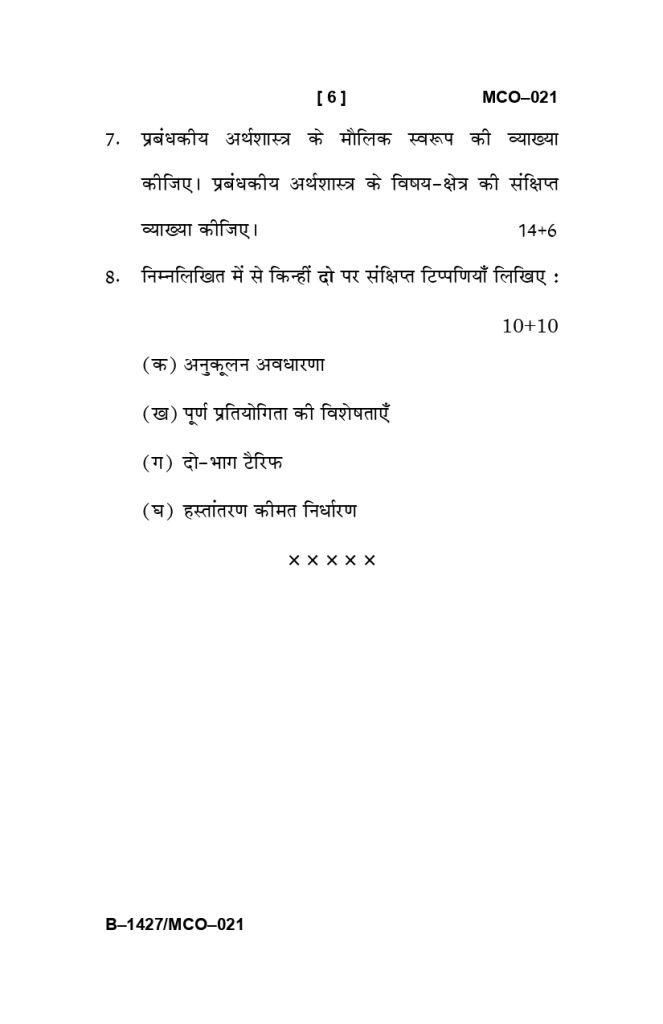
[caption id="attachment_2595" align="aligncenter" width="663"]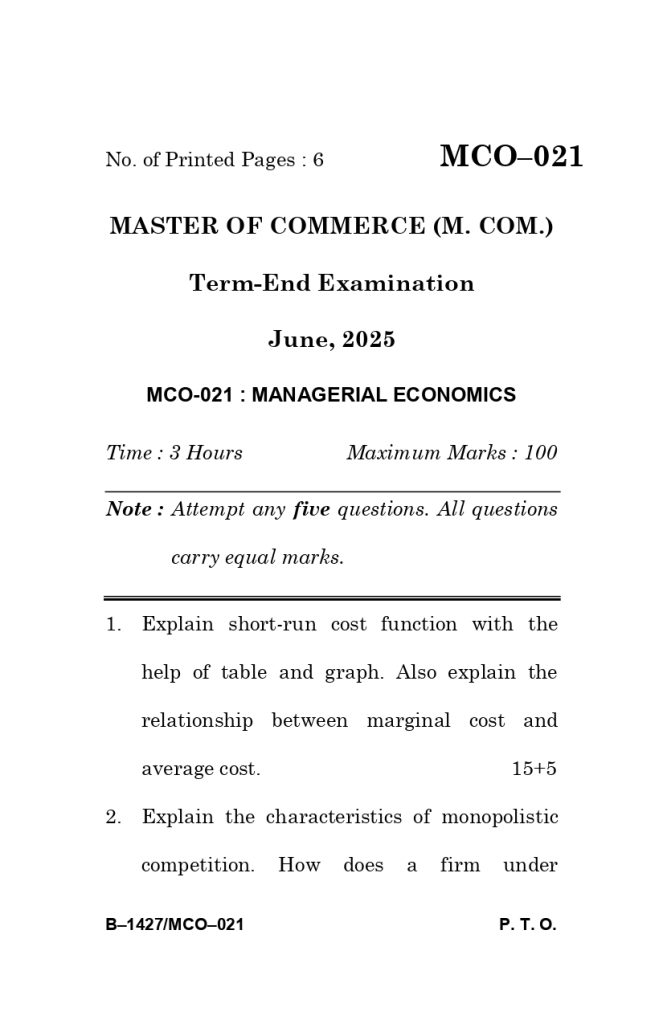 MCO 021 Question Paper June 2025[/caption]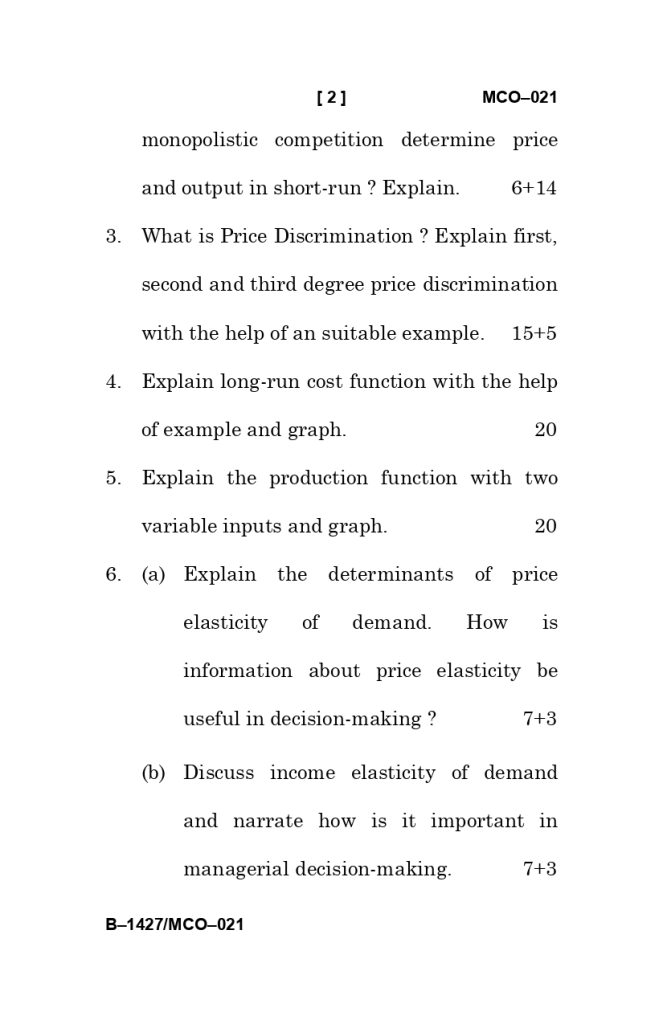
 For more IGNOU paper solutions or support, you may visit: https://www.unnatieducations.com/ignou.
Want MCO-021 Question Paper Solutions?
Lots of students grasp the chapter but still can't organise answers in a scoring manner—particularly for diagram questions, condition questions, or 'explain with table' type questions. If you need full-fledged solutions or personalised attention for this paper, you can contact our team at Unnati Education. We assist learners with notes, solutions, and exam strategy according to the checking style of IGNOU. For more IGNOU help and for more papers, please visit the site: https://www.unnatieducations.com/ignou. (That's the balanced CTA: Helpful, clear, not pushy.)
What MCO-021 Question Paper June 2025 Asked (and what they are testing for with each question)
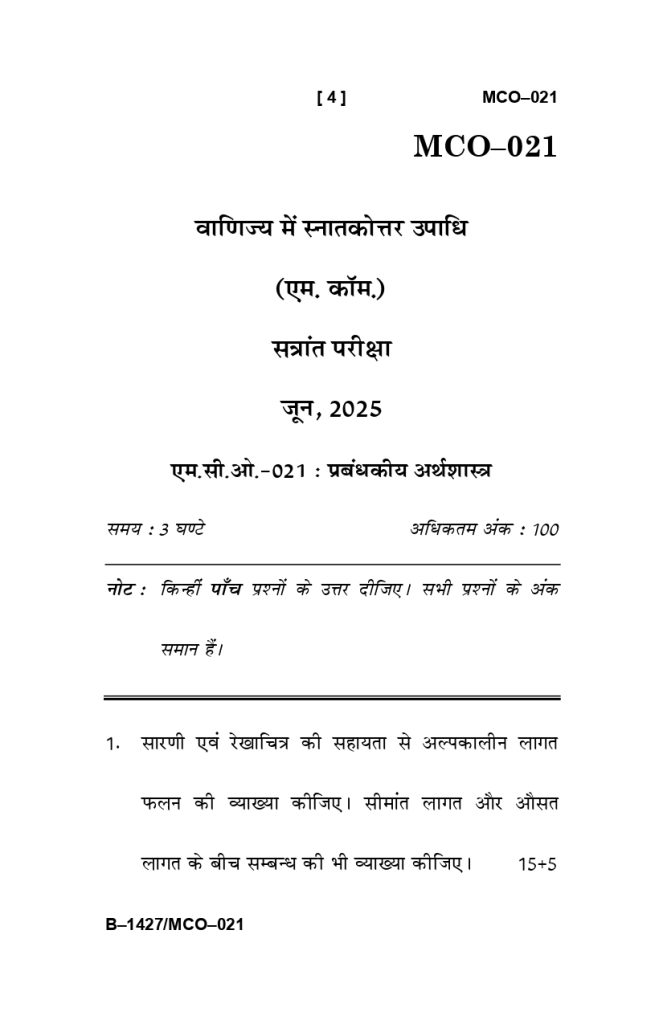
Below is the exact structure of what was seen in the paper, and what you need to learn from it. We're really not dumping full solutions here—just 1-2 lines per question, so your blog doesn't become useless or overwhelmed. Question 1: Short run cost function + table + graph + MC - AC This is a "diagram + logic" type question. It tests whether you can construct a cost table and explain why MC cuts AC at AC's minimum (same for AVC).
- What to prepare:
- Definitions: TFC, TVC, TC, AFC, AVC, AC, MC
- Sample cost table on output 0 to 6/7 units
- Clean curves: AFC falling, AVC U-shaped, AC U-shaped, MC cutting at minima
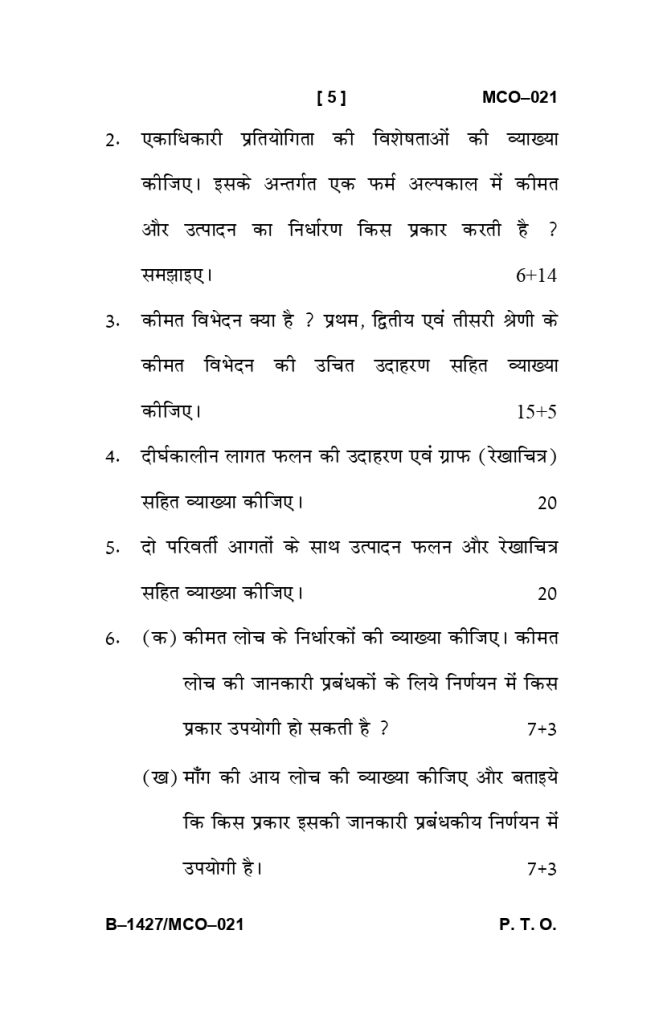
Question 2: Monopolistic competition + price & output of short run They want features + short run equilibrium logic: profit maximisation at MR=MC, then price from AR curve at that output.
- What to prepare:
- Features: numerous firms, product differentiation, cost of selling, free entry/exit
- Short-run: Super Normal Profit / Loss / Normal Profit possibilities
Question 3: Price discrimination + 1st / 2nd / 3rd degree + examples This tests classification + examples. You have to score by keeping it crisp and giving "real" examples that fit the degree.
- What to prepare:
- Conditions: Market power, separate market, cannot resell
- Degrees: Perfect discrimination (consumer surplus capture), Block pricing, Group pricing
Question 4: Long-run cost function + example + graph This is the classical LAC as an envelope curve of SACs, plus the economies/diseconomies of scale reasoning.
- What to prepare:
- SACs that are drawn like multiple U-shapes
- LAC touching their minima
- "Reasons Why LAC Falls, Flattens, And Rises" story
Question 5: Production function 2 variable input + graph They test isoquants and isocosts and the equilibrium condition: tangency = least cost combination.
- What to prepare:
- Q = f(L, K)
- Isoquant properties (down sloping, Convex)
- MRTS diminishing
- Isocost line & equilibrium
Question 6: Elasticity + managerial use Two parts—price and income elasticity + "why managers care."
- What to prepare:
- Determinants (substitutes, necessity/luxury, income share, time period)
- Revenue logic (elastic vs inelastic)
- Types of income elasticity (normal, inferior, luxury)
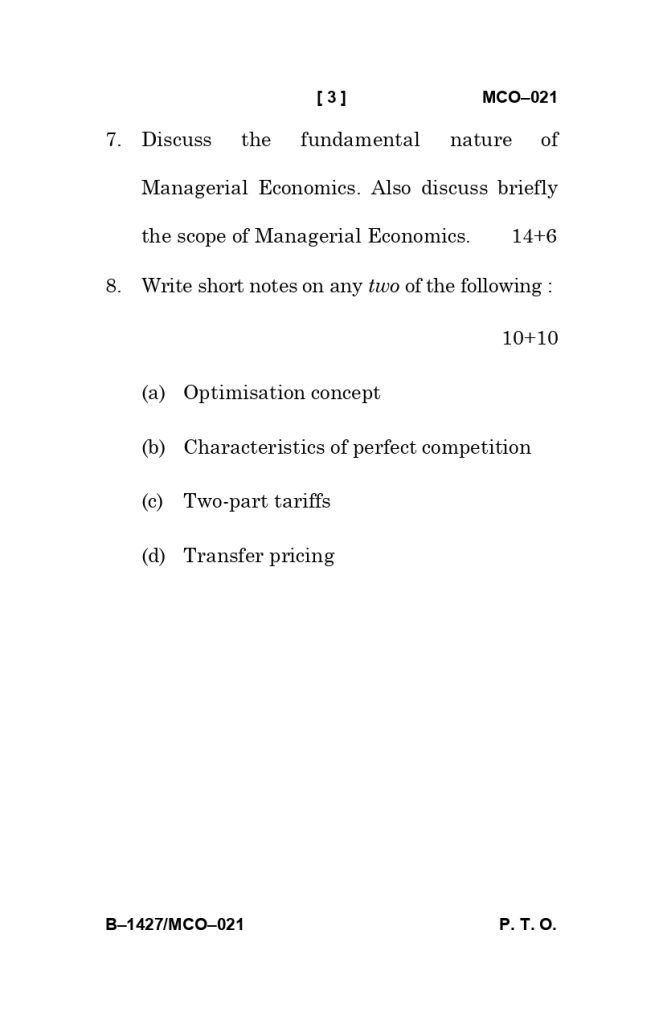
Question 7: Nature + scope of managerial economics This is where students get lazy and write fluff. Don’t. Write structured points such as "applied microeconomics," "decision making under scarcity," "firm theory," and "tools." Question 8: Short notes (any two) Options were: Optimisation, Perfect competition, Two-part tariff, Transfer pricing.
Question-Wise Strategy That Does Score
Strategy For Diagram Questions (Q1, Q4, Q5) Diagrams are scoring gifts if you draw them cleanly. The examiner isn't in the business of judging art—it's about judging correct labels and correct logic. Our rule is "Label first, beauty later."
- Axis labels: Output (Q) and Cost/Price
- Curve labels: MC, AC, AVC, AFC, LAC, SAC, Isoquant, Isocost
- Mark minima and intersection logic (MC cuts AC at minimum)
Small pattern break that works: Most students draw first and label second. We do the opposite: we draw the curves lightly to begin with, then label them. Fewer mistakes.
Important Topics For MCO-021 based on June 2025 (and past repeat behaviour)
If you revise all of it equally, then you revise nothing well. This is what was clearly favoured by the paper:
- Cost analysis (Short run + Long run, tables + curves)
- Forms of markets (Monopolistic competition)
- Pricing practices (Price discrimination, Two-part tariff)
- Theories of production (Isoquant/Isocost equilibrium)
- Elasticities (Determinants + business application)
- Managerial economics fundamentals (Nature/Scope, Optimisation)
This is not random. It's a very "core managerial economics" type of pattern. For more IGNOU paper solutions or support, you may visit: https://www.unnatieducations.com/ignou.
Answer Writing Strategy
Here's a structure that helps keep answers sharp and non-boring:
- Start with some form of definition (2-3 lines).
- Provide the framework (formula, condition, or classification).
- Just add the diagram/table (if asked).
- Explain the diagram (what does each curve represent).
- End with a conclusion of 2-3 lines (what the concept means in decision making).
One thing more—keep sentences short. Your evaluator reads hundreds of copies. Long sentences are a torment to their patience.
Time Management During the Exam
If you are going to try five questions of equal marks, time acts as a strict constraint.
| Task | Time | Why it works |
|---|---|---|
| Read paper + pick 5 | 10 min | Stops panic and avoids wrong question selection |
| Q1 | 35 min | Tables and curves need extra drawing and explanation time |
| Q2 | 30 min | Features with short-run equilibrium stay concise |
| Q3 | 30 min | Degrees with clear examples score better |
| Q4 | 35 min | Envelope curve with stepwise explanation takes time |
| Q5 | 35 min | Isoquant–isocost graph and condition need accuracy |
| Buffer + revise | 5–10 min | Fix labels, missing parts, and minor mistakes |
Common Mistakes That Students Should Try to Avoid
- Writing MC and AC relationships without stating the key line: MC cuts AC at AC's min.
- Drawing cost curves without labels and assuming that the examiner "gets it."
- Confusing monopoly and monopolistic competition.
- Writing elasticity determinants but not relating them to pricing and revenue decisions.
- Treating "scope of managerial economics" as a motivational essay.
Efficient Manoeuvring: How to Revise MCO 021 (Last 10 Days)
- Day 1–3: Cost curves + diagrams
- Day 4–5: Market structures + Pricing
- Day 6: Isoquant, elasticity
- Day 7: Nature & scope + short notes
- Day 8–9: Write 2 full answers daily
- Day 10: Diagram revision only
- No random reading. Only structured practice.
Mini Checklist before you submit your answer sheet:
- Did we define things at the beginning?
- Where asked, did we include the diagram/table?
- Did we label axes and curves?
- Did we end with a conclusion?
- Did we answer all parts (like 15+5, etc.)?
MCO 021 Question Paper – See Full Question Paper Video
Where to Find More IGNOU Help
If you are looking for more IGNOU previous papers and support materials, you can use our IGNOU section here: https://www.unnatieducations.com/ignou.
Final Thoughts on MCO 021 Question Paper June 2025
The MCO 021 Question Paper in June 2025 was not designed to trick you. It was designed to reward students who are able to present economics in a clear way: tables when asked for tables, graphs when asked for graphs, and short, decision-focused explanations rather than random shots at the reader's head with theory. If you practise the diagram sets and keep your headings crisp, your five answers would be easier to write and easier to mark. And before you submit, read your last paragraph once—because finishing strong matters, especially when your evaluator has seen the same MCO 021 Question Paper attempts all day.
Frequently Asked Questions
Is the MCO 021 Question Paper June 2025 difficult ? It is hard mostly because marks are not dependent on memory, but on structure. A student who does not use diagrams or fundamental rules loses marks very quickly. If you practise drawing curves and writing condition-based answers, then the paper is manageable and not unpredictable. How might we identify the very best five questions ? Choose questions in which you can outline the answer in 30 seconds. If you cannot immediately recall the diagram or decision rule, skip it. Strength-based selection works better than going for "interesting" questions. Are diagrams compulsory ? If the question is asking for a diagram or table, yes. Even a simple diagram gets marks. Skipping it almost always leads to a deduction, even if the theory is correct. How long do answers need to be ? About 2-3 pages (based on handwriting). Do not concentrate on the length of paragraphs, but rather on headings. Visible structure, rather than dense writing, is more desirable to the examiners. What's the quickest way to get better grades ? Practise composing the answers with: definition -> rule -> diagram -> conclusion. This one habit makes a bigger difference between clarity and scoring than the additional memorisation of theory.