MCS 220 Question Paper June 2025: Complete Analysis and Preparation Guide (Web Technologies)
The MCS 220 Question Paper (June 2025) is a solid reality check for IGNOU MCA students studying Web Technologies. It is no reward for shallow memorisation. Instead, it rewards clarity, diagrams, code logic, comparisons, and a practical understanding of frameworks. If you are searching for the MCS 220 Question Paper (June 2025) because you want to know what came, what repeats, and how to prepare smartly, this guide is made exactly for that. The June 2025 paper tests important aspects such as J2EE architecture, Servlets, JSP, Spring Boot, Spring MVC, IoC (Inversion of Control), Hibernate configuration, session management, and web security vulnerabilities (SQL injection, XSS, CSRF, session risks). It is a 3-hour, 100-mark exam in which Question 1 is compulsory, and you must choose 3 questions from Q2–Q5.
Paper Pattern in 60 Seconds
MCS 220 June 2025 Paper Pattern:
- Total Marks: 100
- Time: 3 hours
- Q1: Compulsory (8 × 5 marks = 40 marks)
- Q2–Q5: Attempt any 3 (Each question = 20 marks, usually divided into 2 parts of 10 marks each)
- Skills Tested: Diagrams + Short theory + Code + Comparisons + Security + ORM concepts
If you are familiar with this structure, you can plan your time and score safely.
Understanding the MCS 220 Question Paper Structure
The paper is divided into 2 layers: 1) Compulsory Section (Q1 – 40 marks)
- 8 sub-questions
- 5 marks each
- Addresses the "must-know" core topics
2) Optional Section (Q2–Q5 – 60 marks)
- 4 questions available
- You attempt any 3
- Each question comprises 20 marks, generally divided into (a) 10 + (b) 10
Here’s the structure cleanly:
| Section | Questions | Marks | Choice |
|---|---|---|---|
| Q1 (Compulsory) | 8 sub-questions | 40 | No |
| Q2–Q5 (Optional) | 4 questions (attempt any 3) | 60 | Yes |
| Total | — | 100 | — |
This paper reflects a deliberate balance. You are going to have to explain, make comparisons, code, and reason—not just define terms.
Why the MCS 220 Question Paper (June 2025) Challenged Students
This paper became a bit tricky for students mainly because it required mixed skills. A few examples:
- J2EE Architecture: It wasn't a plain definition; instead, it required a diagram + proper tier explanation.
- JSP Temp Conversion: Required Coding + Validation (many students do not consider validation).
- Spring Boot vs. Spring MVC & IoC vs. Traditional Programming: Required concept clarity (not just a "one-line difference").
- Hibernate Annotations vs. XML Configuration: Practical familiarity with both approaches was required.
- Security Vulnerabilities: This required both an identification + prevention approach.
Also, time pressure hits students hard: Q1 has 8 parts, followed by 3 long answers. If you write too much in Q1, your final 20-mark question gets rushed.
MCS 220 Web Technologies Question Paper June 2025
[caption id="attachment_2577" align="aligncenter" width="663"]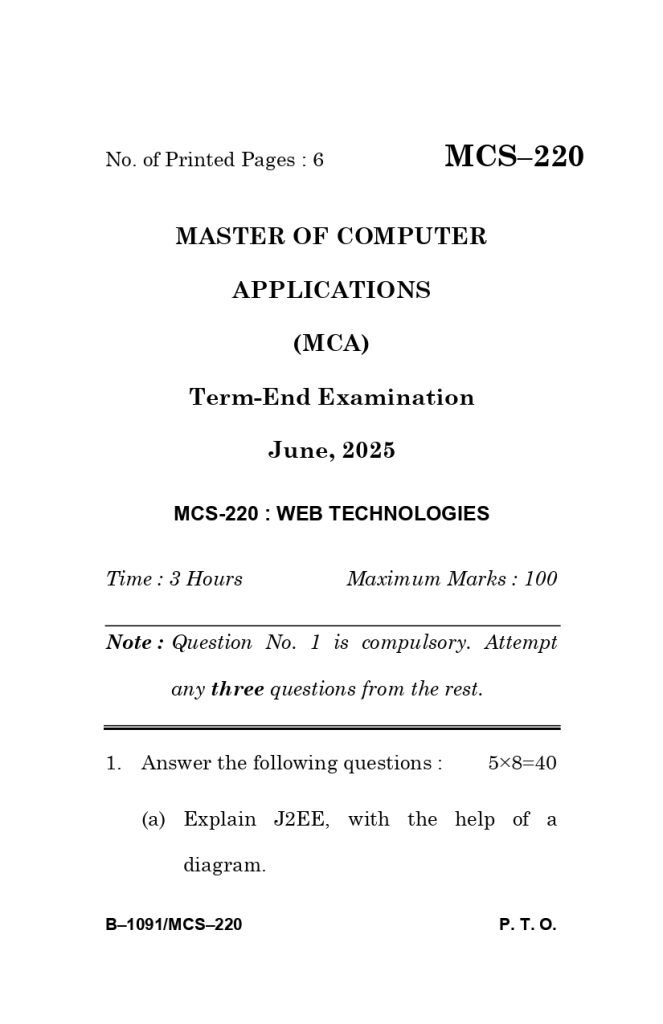 MCS 220 Question Paper June 2025[/caption]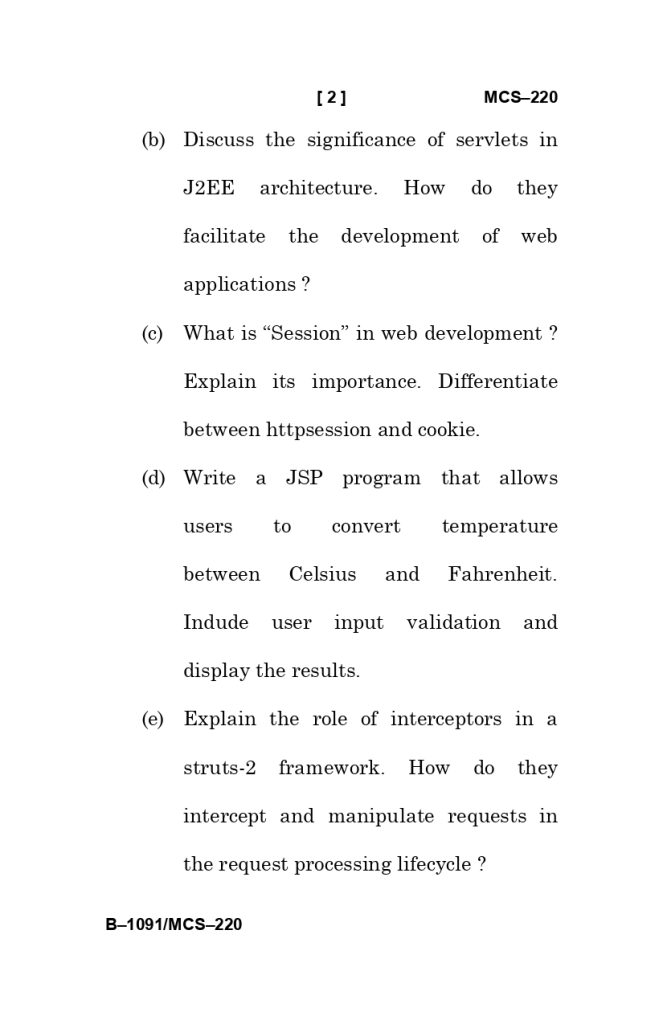
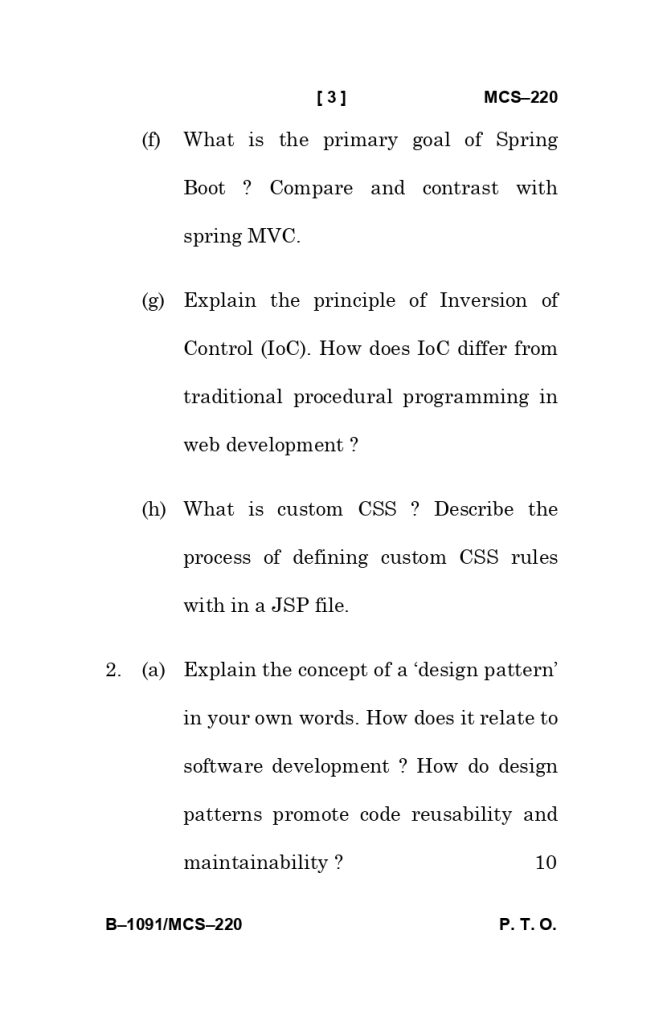

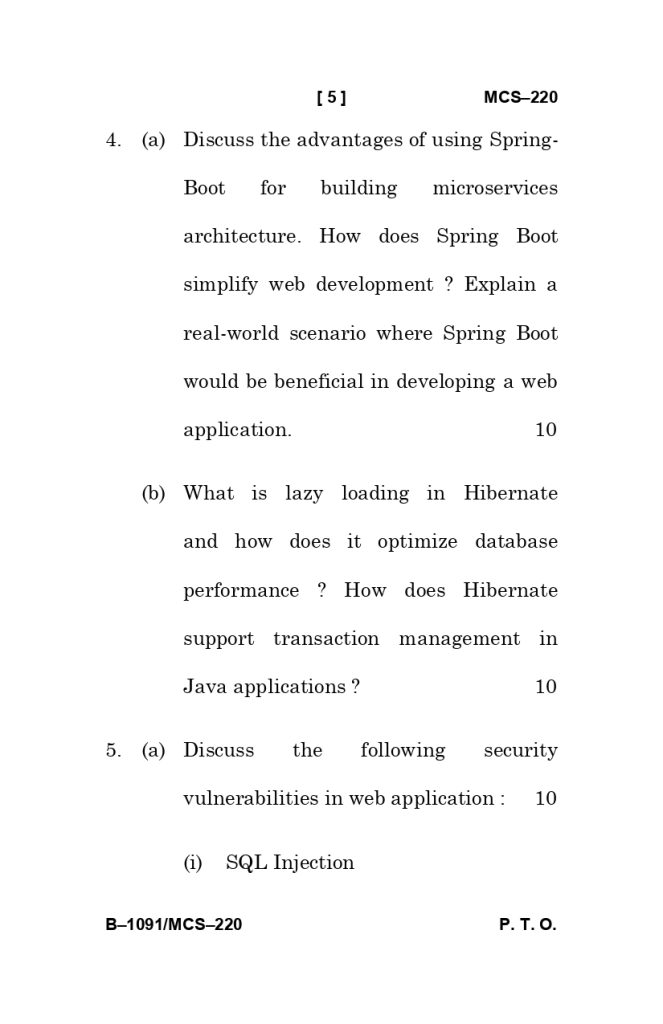
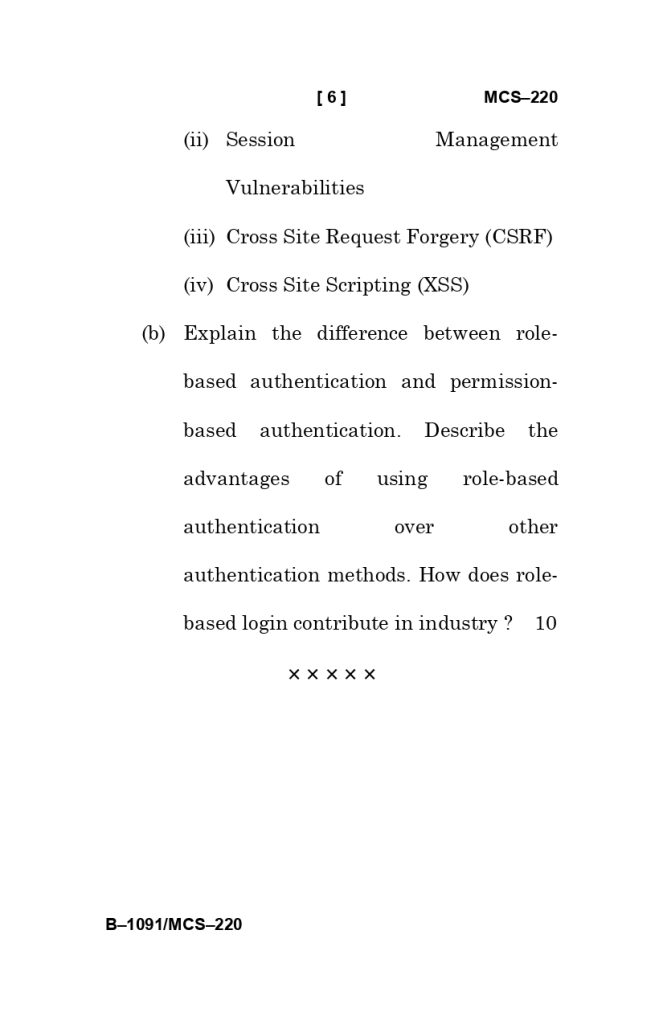 For more IGNOU papers or support, you may visit: https://www.unnatieducations.com/ignou.
How Difficult Was It Really?
MCS 220 (June 2025) was a moderate to tough paper as it combined short compulsory theory, practical coding, diagrams, and framework comparisons. For students who prepared from previous papers and structured their answers, it was manageable. However, students who just memorised definitions found it difficult to manage, especially regarding JSP validation, Hibernate configuration choices, and security-related topics.
MCS 220 Solved Question Paper: Why Students Search for It
When students search for "MCS 220 solved question paper," they usually want three things:
- Depth: How much to write for 5 vs. 10 marks.
- Correct Structure: Intro -> Points -> Diagram/Table -> Conclusion.
- Correct Language: Simple but technical enough for marks.
A smart-sounding answer doesn't look "smart." It looks clear.
High-Scoring Answer Template (for Most Questions)
- Definition/Introduction: 2-3 lines.
- Main Explanation: Using points (5-10 points depending upon marks).
- Diagram/Table: When asked or relevant.
- Significant Takeaway/Important Note: 1-2 lines.
- Conclusion: 2 lines.
Example: For J2EE Architecture, use the definition, a description of the 4 tiers, a diagram, and a summary of why containers lessen the system-level burden.
MCS 220 June 2025: Question by Question Demand
- Q1(a) J2EE architecture with diagram: Tests if you have the ability to clearly explain enterprise web architecture and draw a tiered diagram.
- Q1(b) Importance of servlets in J2EE: Tests your knowledge of the servlet role within the web tier, request processing, and why servlets are better than CGI (efficiency + server-side lifecycle).
- Q1(c) Sessions + HttpSession vs. Cookies: Tests state management, comparison ability, and security awareness.
- Q1(d) JSP temperature converter with validation: Tests JSP basics + input validation + output display logic.
- Q1(e) Interceptors in Struts-2: Test framework understanding of the lifecycle.
- Q1(f) Spring Boot goal + Comparison with Spring MVC: Tests conceptual clarity + practical differences.
- Q1(g) IoC principle and comparison with traditional programming: Tests what IoC actually is and why it decreases tight coupling.
- Q1(h) Custom CSS in JSP: Tests presentation layer understanding and separation of concerns.
Then Q2–Q5 covered:
- Design patterns
- Hibernate Configuration and Features
- Spring Boot microservices
- Lazy loading
- Web security flaws and methods of authentication
Most Repeated Topics
Here is what always happens from one session to the next: 1) J2EE + Servlets + JSP (Core Trio) You should know:
- Tiers + diagram
- Servlet lifecycle
- Elements of JSP and working flow
2) Sessions & State Management Cookies vs. HttpSession is one of the classic IGNOU comparatives. 3) Spring Boot & Spring MVC Spring Boot: "Why it exists" and how it simplifies configuration is a frequent pattern. 4) Hibernate ORM Config methods (annotations vs. XML), features, lazy loading, and advantages of ORM. 5) Security Vulnerabilities SQL injection, XSS, CSRF, and session hijacking are no longer new stories. 6) Design Patterns/Architecture MVC, DAO, Singleton, and Factory patterns tend to appear as theory-heavy 10-mark pieces.
Important Topics for MCS 220
If you want a smart order (high impact first):
- J2EE architecture + diagram + tiers
- Servlet lifecycle + CGI vs. Servlet + Request/Response
- HttpSession vs. Cookies (Table + security points)
- Form input + validation + output JSP programs
- Spring Boot vs. Spring MVC + IoC + DI
- Hibernate (ORM basics, styles of configuration, lazy loading, and caching)
- Web security for vulnerabilities + prevention
- Design patterns (MVC, DAO, Singleton, Factory)
For more IGNOU papers or support, you may visit: https://www.unnatieducations.com/ignou.
Answer Writing Strategy That Will Score
IGNOU examiners award marks for clear points, not long storytelling. Rule of Marks-to-Length (Practical):
- 5 marks: 6-8 good points + mini conclusion.
- 10 marks: 10-12 good points + diagram/table + conclusion.
- 20 marks: Treat as two 10-mark answers (usually split into parts).
Comparison Questions = Always Use a Table Example: HttpSession vs. Cookies
| Basis | HttpSession | Cookies |
|---|---|---|
| Storage | Server-side | Client-side |
| Security | More secure | Less secure |
| Capacity | Larger objects | Limited |
| Lifetime | Server-controlled | Expiry-based |
| Dependency | Server memory | Browser storage |
Time Management for a 3-Hour MCS 220 Exam
If you previously had a wrong timing table (one that required more than 3 hours), ignore it. Here is a correct 3-hour plan:
| Time Slot | Task | Duration |
|---|---|---|
| 0:00–0:05 | Read paper + select optional questions | 5 min |
| 0:05–1:05 | Q1 (8 sub-questions) | 60 min |
| 1:05–1:40 | Optional Q (20 marks) | 35 min |
| 1:40–2:15 | Optional Q (20 marks) | 35 min |
| 2:15–2:50 | Optional Q (20 marks) | 35 min |
| 2:50–3:00 | Quick review + insert missed points | 10 min |
Rule: Q1 must not cross 60–65 minutes. If it does, you lose quality on your last optional answer.
Common Mistakes That Cause Mark Deductions
- Skipping diagrams if asked.
- Writing generic filler lines like "it helps in developing" without specifics.
- Over-writing 5-mark answers (wastes time).
- Underwriting 10-mark answers (looks shallow).
- Lacking definitions (the first 2 lines matter).
- Ignoring keywords such as "differentiate" or "compare" (requires a table).
- Copy-pasting memorised code that isn't up to the mark of the question.
- Not applying a short conclusion (makes answers look incomplete).
Why This Paper Can Help Your Career
The paper is examination-oriented, but the topics are not useless. If you genuinely understand them:
- Servlets + Session Handling: You know the flow of server requests.
- Spring Boot: You can create real APIs and microservices.
- Hibernate: You can develop database-backed apps faster.
- Security Vulnerabilities: You avoid building unsafe projects.
This is why MCS 220 is more valuable than many papers that are theory-only.
MCS 220 Video Resource
Where to Find Other IGNOU Help and Study Materials
If you want students to go deeper into your ecosystem, don't just have one link at the end. Add a "resources hub" block as follows:
- Previous year papers (5 years)
- Solved assignments
- Notes and brief revision sheets
- Exam strategy and marking pattern guides (You are free to link internally to your IGNOU hub page.)
FAQs
Q1: What is the difficulty level of MCS 220 compared to other MCA papers? MCS 220 is of moderate difficulty because it combines theory with a practical understanding of code and frameworks. Students with basic Java web practice have no problem with it, but purely memorisation-type preparation struggles. Get into J2EE diagrams, JSP programs, Spring comparisons, and Hibernate concepts to earn safe marks. Q2: Can I score well in MCS 220 with two weeks of preparation only? Yes, you can get good marks in two weeks, but your plan should be structured and practice-based. Spend 3-4 days on core theory, 5-6 days solving previous papers, and the last few days on revision tables + diagrams + 5 key programs. Two Weeks of Smart Work is Better than Two Months of Random Reading. Q3: Are diagrams compulsory if asked in the question? Yes—if the paper calls for a diagram, marks are distributed for it. Even a basic tier diagram for J2EE or a labelled flow score marks quickly. Leaving it out results in direct mark loss. So, always draw neat diagrams with labels, even if they are simple in nature. Q4: How do I practice coding questions like JSP programs? Prepare by writing the code on paper, including validation steps and a clear output format. Practice 4-5 common JSP programs (converter, login/session, forms handling). Add comments to show logic. Even with imperfect syntax, as long as you have the correct structure + validation, you get partial marks. Q5: What if I don't recall precise syntax in the exam? Write out structured pseudocode and explain the logic in steps. IGNOU examiners give marks for the approach: input handling, validation, processing, and output. Add method names that you remember and describe what each block does. A logical answer with some small syntax holes scores better than a blank page.
Final Thoughts on MCS 220 Question Paper (June 2025)
The MCS 220 Question Paper (June 2025) is designed to test whether you can think like a web developer, not just repeat textbook lines. If you prepare yourself with the right pattern—core concepts + diagrams + comparison tables + a few programming practicals—you can score without any panic. Stick to structured answers, correct time management, and practice writing under exam conditions. Done right, this paper is not a matter of fear, but a scoring opportunity. For more IGNOU papers or support, you may visit: https://www.unnatieducations.com/ignou.