Dealing with linguistics can be like trying to step into a secret code with no key. We get it. When you first look at the MEG 04 Question Paper, the mix of phonetics, sociolinguistics, and grammar rules can be overwhelming. But here's the thing- once you crack into the pattern, it's actually one of the most scoring subjects in the course of your Master's degree. We are here to guide you on exactly what happened in the June 2025 exam and how you can crack it like a pro.
Why We Wrote This Guide
At Unnati Educations, we understand that students usually have trouble accessing quality resources to rely on. Whether you are hunting for specific MEG 04 question paper analysis, looking for a trustworthy source to help you prepare, or just need clarity on complex topics like "Language Planning," you are in the right place. We have analyzed the exam of June 2025 thoroughly so as to give you the edge that you need. Below is a list of some search terms students might use to locate this guide:
- MEG 04 question paper
- MEG 04 solved question paper
- MEG 04 question paper solution
- Aspects of Language Important Questions
- MEG 04 question paper June 2025
For more IGNOU papers or support, you may visit: https://www.unnatieducations.com/ignou.
Why the MEG 04 Question Paper Feels Difficult for Students
Let’s be real for a second. Why is there such panic about MEG-04 then? It's usually because this isn't just "stories" or "novels" as your other literature papers are. It is technical. It’s science meets language. Unlike a novel in which you interpret your character's feelings, linguistics requires precision. Students often are stuck because:
- Technical Jargon: Words such as "Morphemes," "Anaphors," and "Fricatives" are scary words if you haven't been doing the reading.
- Precision Required: You can't just fluff your way through an answer on "Manner of Articulation." You have to be precise about the position of the tongue over the roof of the mouth.
- The "Math" of English: Linguistics demands the logical approach, almost like solving an equation, which comes as a shock to students of literature.
However, this difficulty is also an unseen advantage. Because the answers are factual, it is often more objective to mark in this way than for literature papers. If you get the definition right, you get the marks.
MEG 04 Question Paper June 2025 – Quick Overview
To give you a snapshot of what we are dealing with here, here is the breakdown of the June 2025 exam structure. This helps you in knowing the weightage at a glance.
| Feature | Details |
|---|---|
| Course Code | MEG-04 (Aspects of Language) |
| Session | June 2025 |
| Max Marks | 100 Marks |
| Time Allowed | 3 Hours |
| Passing Strategy | Attempt any 5 Questions (20 Marks each) |
| Difficulty Level | Moderate to Technical |
| Key Blocks Covered | Phonetics Sociolinguistics Morphology Stylistics |
MEG 04 Question Paper June 2025 Sample Pages
[caption id="attachment_2316" align="aligncenter" width="663"]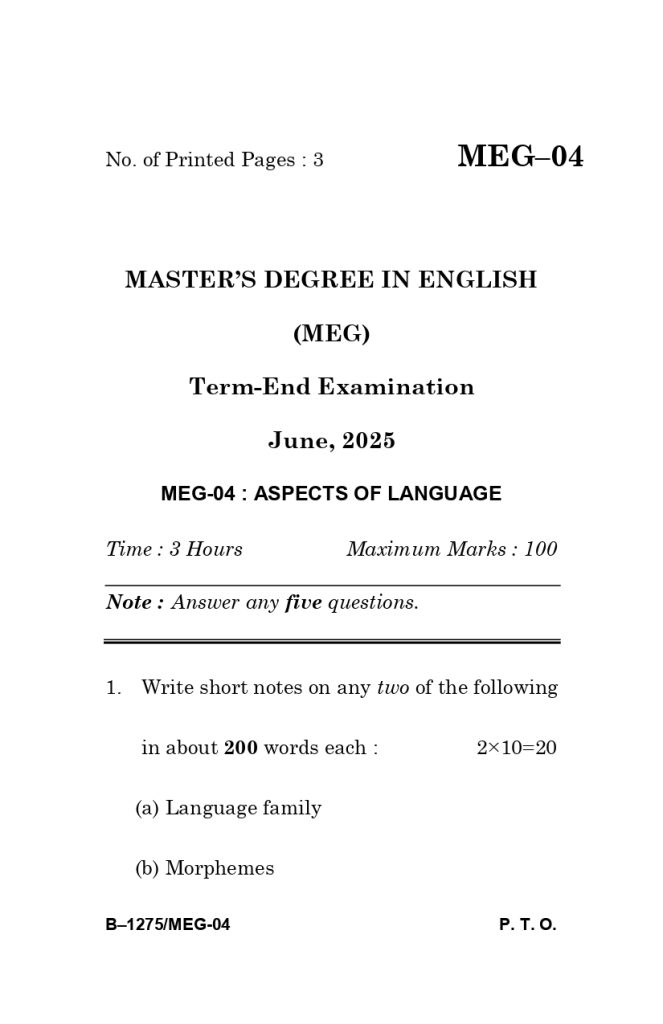 MEG 04 question paper June 2025[/caption] [caption id="attachment_2317" align="aligncenter" width="663"]
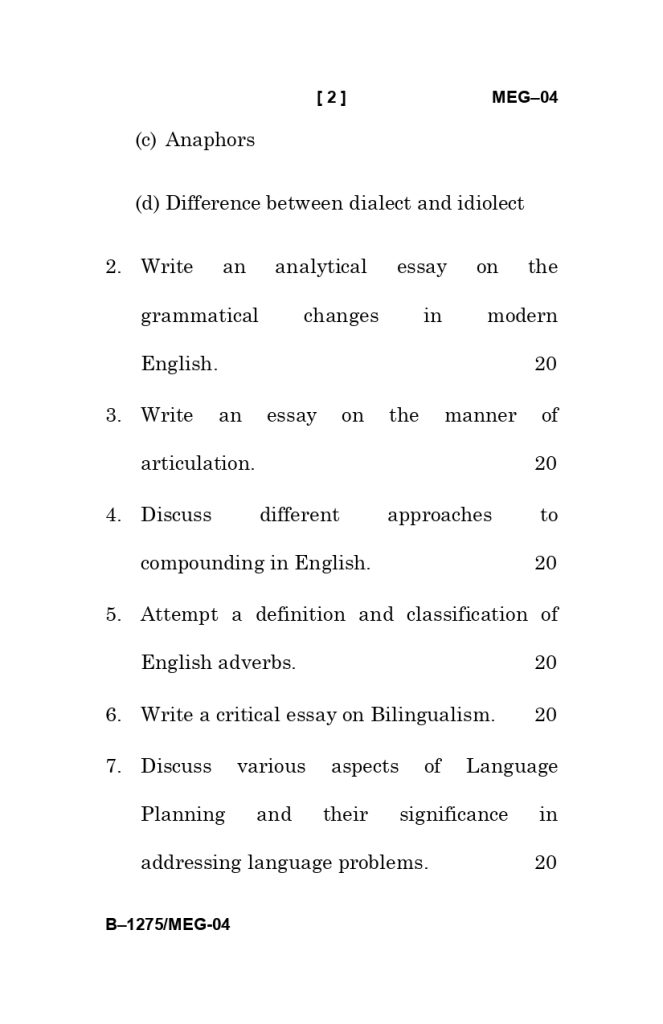 MEG 04 question paper June 2025[/caption] [caption id="attachment_2318" align="aligncenter" width="663"]
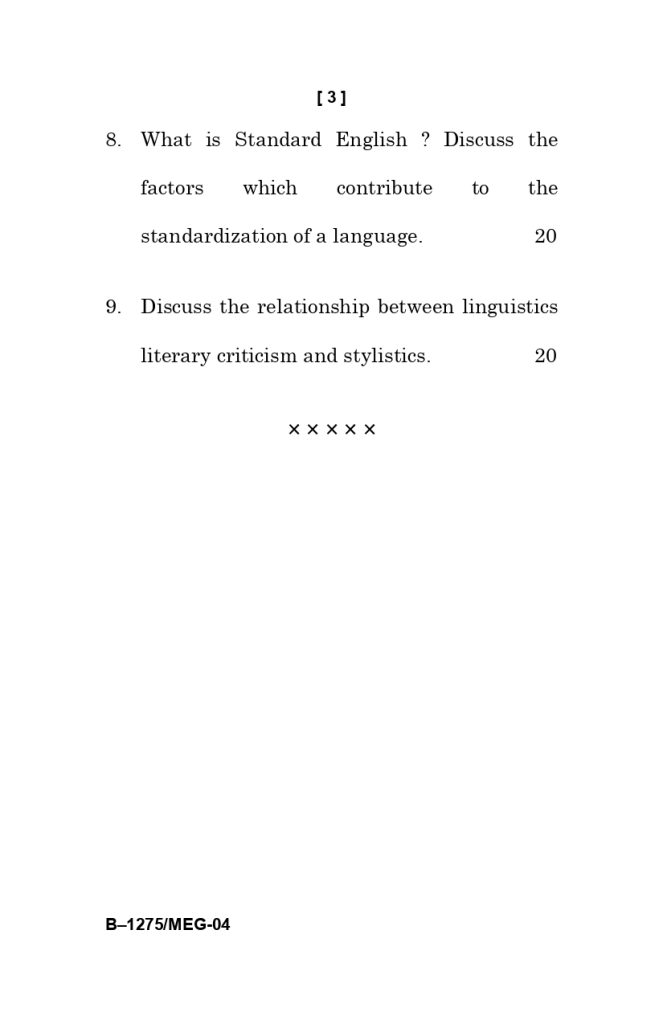 MEG 04 question paper June 2025[/caption]
Want MEG 04 Question Paper Solutions?
If you are reading these questions and thinking that I have no idea how to start this, then don't stress. We have taken the heavy lifting out of your hands. For MEG 04, complete solutions or personalised help can be sought by students by reaching out to our team. We support learners with notes, solutions, and exam guidance to ensure that you aren't just memorizing, but actually understanding. Visit us here for more IGNOU help https://www.unnatieducations.com/ignou.
Why MEG 04 appears to be Easy for Students
Wait, what didn't we just tell you that it was hard? Yes, but here is the flip side. Once you get the logic, MEG-04 is incredibly high scoring. Unlike the mark for literature essays, where marks can be based on the mood or interpretation of the examiner, linguistics answers are factual.
- Repeatable Patterns: The definitions of "Dialect" or "Standard English" don't vary from year to year.
- Key Concepts: If you are well-versed in the basics of Phonetics and Morphology, you can solve more answers on different exams.
- Structured Answers: You can use bullet points (like we are doing here!), tables, and diagrams. Examiners love this as it makes their job easier.
MEG 04 Question Paper June 2025 – Question-Wise Analysis
Let's get to the meat of the matter. We have analysed the June 2025 paper question by question to show you exactly what was asked and how we would go about it. This is the essence of your preparation.
1. Short Notes (The "Quick Wins")
The paper began with short notes in which you had to select the answers from two out of four. This is great for time management, as you can score a good 20 marks in a short period of time.
- (a) Language Family: This has asked about the history of the languages. You had to teach that languages are in the same way as families that descend from a common ancestor (like Indo-European). We always suggest mentioning "genetic relationships" and giving some examples, such as how Sanskrit and Latin are cousins.
- (b) Morphemes: This is the smallest unit of meaning. You had to explain the difference between Free morphemes (can stand alone, like "cat") and Bound morphemes (have to be attached, like the "-s" in "cats"). It is a component of words.
- (c) Anaphors: A bit trickier. This refers to words that are dependent on other words for their meaning (like "himself" or "each other"). It’s pure syntax. For instance, in "John hurt himself," himself is the anaphor that points back to John.
- (d) Dialect vs. Idiolect: This is a traditional sociolinguistic question. A Dialect is a variety shared by a group (like a region), whereas an Idiolect is your own unique and personal way of speaking that nobody speaks the same way as you.
2. Modern English: Grammatical Changes
This was a 20-marker question for an analytical essay. The basic answer to this is in the Loss of Inflections. Old English was synthetic, with tons of endings (case) to show grammar. Modern English is analytic; we make use of word order (Subject-Verb-Object) and helper verbs (auxiliaries). If you had said that we lost the grammatical gender (tables aren't male or female anymore) and we use prepositions now, you got this question right.
3. Manner of Articulation
This is pure phonetics and one of our favourite topics here at Unnati Educations, as it really feels like you can practically feel the answer in your mouth! One of the questions was how sound is created using the air flow. You had to have categories such as:
- Plosives (Stops): Full blocking of air with a raging air (p, b, t, d)
- Fricatives: Air squeezed through a narrow space producing a sound of friction (f, v, s, z).
- Nasals: Air shifted through the nose (m, n).
- Laterals: Air over the side of the tongue (l).
- Affricates: Combination of a stop and a fricative (ch, j).
4. Approaches to Compounding
Compounding is where we glue words together to create new words (e.g., 'Blackboard' or 'Daydream').
- Semantic Approach: What is the change in the meaning?
- Syntactic Approach: What parts of speech are put together?
- Orthographic Approach: How Do We Write Them?
5. English Adverbs, Definition and Classification
Adverbs are the workmen of grammar. They do modifications to verbs, adjectives, or other adverbs.
- Adverbs of Time
- Adverbs of Place
- Adverbs of Manner
- Adverbs of Degree
- Sentence Adverbs
6. Critical Essay on Bilingualism
This is a topic that is very relevant in today's day and age.
- Simultaneous Bilingualism
- Sequential Bilingualism
- Code-Switching
7. Language Planning
- Status Planning
- Corpus Planning
- Acquisition Planning
8. What is Standard English?
- Selection
- Codification
- Elaboration
- Acceptance
9. Linguistics, Literary Criticism, and Stylistics
Linguistics, Literary Criticism, and Stylistics are explained as given in the content. For more IGNOU papers or support, you may visit: https://www.unnatieducations.com/ignou.
Important topics for MEG 04 Based on Previous Papers
| Topic Area | Key Concepts to Study | Frequency |
|---|---|---|
| Sociolinguistics | Bilingualism and Code-Switching, and Language Planning | High |
| Phonetics | Position & Articulation of Speech, Vowels & Consonants | Very High |
| Morphology | Word Formation, inflection vs. derivation, Affixes | High |
| Syntax | Sentence Structure, Clause analysis | Medium |
| History of English | Old vs. Modern English, Standardisation | Medium |
Answer Writing Strategy
The answer is half the battle; presenting it is the other half. Here is how to score higher:
- Define Early Begin. Every answer with a crisp definition. If the question is on "Morphemes," then define it in the first sentence.
- Use Examples. In linguistics, the answer without examples is a fail. If you are speaking about "Plosives", write down / p and / b.
- Headings and Bullets: Make your 20-mark essay into sections. It makes it readable.
- Diagrams: For questions such as "Manner of Articulation," having a rough drawing of the vocal tract can be a game-changer.
Common Mistakes that Students Should Try to Avoid
We see these kinds of errors all the time in answer scripts. Don't go for them to save your grades:
- Writing General Summaries: Don't Do This as If It Were a Novel. Be technical.
- Ignoring Word Limits 1: For the short notes (200 words), stick to the limit. Writing for 500 words there you will not be able to complete the long answers.
- Forgetting Citations/Examples: Never state a rule without demonstrating how the rule works in English words.
- Poor Time Division: When you spend 1 hour on the first question, you will be rushing with the rest.
Time Management during an Exam
You have 180 minutes for 100 marks. Here is the math according to Unnati Educations:
- Reading Paper: 10 Minutes.
- 5 Questions x 32 Minutes: 160 Minutes.
- Revision: 10 Minutes.
For a question of 20 marks, stick with about 30-35 minutes. If you haven't completed an answer in 35 minutes, leave some space and go on. It's better to try all five adequately than three perfectly and miss two.
MEG 04 Question Paper – See full question paper video
No, reading is not always enough. If you want to see a deep dive into the paper where we explain the nuances of each and every question, watch our full breakdown below. We pass through the paper line by line. Boolean to String Converter. This option will show a pop-up dialog box with the following options: "Show Boolean to String Converter." Watch our detailed analysis of the MEG 04 June 2025 Paper.
Where to Find More IGNOU Help
If you are feeling a bit lost with your IGNOU studies or just want to make sure that you are on the right track, we have got resources that can help. From Solved Assignments to Previous Year Guess Papers is in our dedicated Section, check out here: https://www.unnatieducations.com/ignou. It's a goldmine for serious students.
Frequently Asked Questions
Here are the most searchable, high-intent FAQs for a blog post about the MEG 04 Question Paper June 2025. These are designed to capture voice search traffic and address common student anxieties. Q1: Is the MEG 04 June 2025 question paper difficult as compared to the previous year? Answer: The MEG 04 (Aspects of Language) paper for June 2025 was found to be moderately difficult. While the usual topics such as "Morphology" and "Sociolinguistics" were there, the application-based questions on "Sentence Structure" and "Language Planning" demanded in-depth analytical skills as compared to the previous years. Q2:What were the repeated topics in the MEG 04 June 2025 Exam? Answer: Yes, several core topics were being repeated. There were questions on Saussure's dichotomy (Langue and Parole), Grimm's Law, and Transformational Generative Grammar (TGG) again. Analyzing the last 5 years of papers that these theoretical concepts are the ones which have high weightage for almost every session. Q3: Where can I download the 04 June 2025 question paper MEG solved as a PDF? Answer: You can get complete and detailed solutions for the June 2025 paper directly from Unnati Education. We give step-by-step explanations for each question, including the complex sections of linguistic analysis, so that you can understand exactly how to score full marks. Q4: What is the passing mark of MEG 04 in IGNOU? Answer: In MEG (Master of Arts in English) courses, you usually should have not least 40% to pass the theory exam. Since, from the paper, it usually goes out of 100 marks, you must have a minimum of 40 marks to clear MEG 04. How to answer short notes "Short Notes" in MEG 04? How to answer the "Short Notes" section of MEG 04 to score high? Answer: With short notes (usually 200 words), do not go for a generic summary. Define the linguistic term right away (e.g., "Code-Switching is"), provide one concrete instance from English or your native language, and the significance. This structure ensures better marks than the writing of long and vague paragraphs. Q6: Does Unnati Education sell handwritten notes for MEG 04 Aspects of Language? Answer: Yes! We provide concise and exam-focused handwritten notes that make complex linguistic theories, such as Phonology and Syntax, easy in a simple way. These notes are especially prepared for last-minute preparation and cover all the questions that are repeatedly asked in the recent (June 2025 and past sessions.
Final Thoughts on MEG 04 Question Paper June 2025
The MEG 04 Question Paper for June 2025 was a balanced mix of theory and application. It rewarded students who understood the core concepts of linguistics rather than just the memorization of definitions. By knowing the structure of language families, the science of articulation, and the sociology of bilingualism, you should easily be able to get around this course. Remember, linguistics is about the "how" and "why" of human speech. Keep practicing, stick to the format, and don't be afraid to ask for help if you need it. We hope this guide has been useful! If you require further help, do not forget to check out our Unnati IGNOU for comprehensive materials. Good luck!