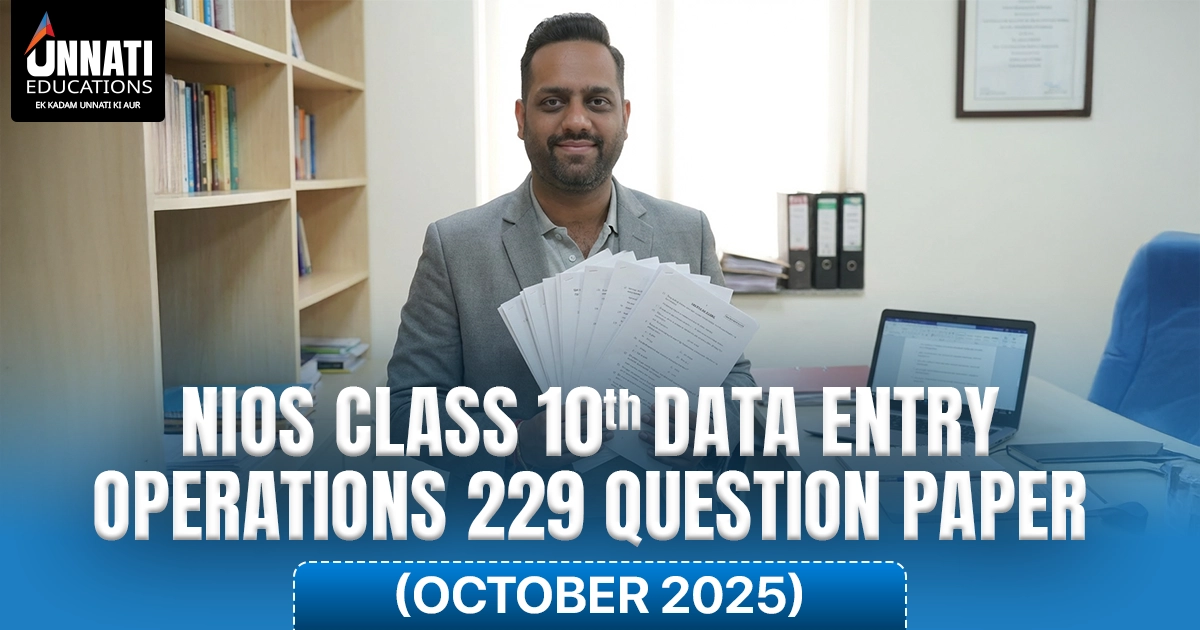
NIOS Class 10 Data Entry Operations 229 Question Paper October 2025 - Detailed Analysis Set A and Set B
The NIOS Class 10 Data Entry Operations 229 Question Paper from October 2025 provides a clear picture of how NIOS assesses practical computer knowledge at the secondary level. This paper is not about memorising theory alone. It checks whether students understand basic computer concepts, office tools, and real-life data handling skills. By carefully analysing Set A and Set B, students preparing for 2026 can plan smarter and score with confidence. This detailed analysis is prepared after closely reviewing both question papers. Every section, topic pattern, and repeated concept is explained in simple words so that even first-time NIOS learners can understand the exam approach clearly.
Quick Overview of NIOS Class 10 Data Entry Operations 229 Exam
| Exam Detail | Information |
|---|---|
| Subject | Data Entry Operations |
| Subject Code | 229 |
| Class | 10 |
| Board | NIOS |
| Exam Session | October 2025 |
| Sets Analysed | Set A And Set B |
| Total Marks | 40 |
| Time Duration | 2 Hours |
| Question Pattern | Objective + Short + Long Answer |
| Skill Focus | MS Word, Excel, PowerPoint, Computer Basics |
This structure is important because the same framework is expected to continue in the 2026 exams as well.
Exam Context: Why This Paper Matters for 2026 Students
The Data Entry Operations subject is designed to build job-ready computer skills at the school level. Unlike pure theory subjects, this paper checks whether students understand:
- How office software is actually used
- Why certain tools exist and where they are applied
- How data is entered, formatted, managed, and presented
From both Set A and Set B, it is clear that NIOS focuses on concept clarity + practical understanding, not advanced technical knowledge.
NIOS Class 10 Data Entry Operations Question Paper Showcase
(Set A and Set B – October 2025) Both sets follow the same blueprint, but the questions are twisted differently. This is very important for 2026 students.
- Set A leans slightly more toward MS Office tools and Excel usage.
- Set B leans slightly more toward computer fundamentals and system concepts.
NIOS Class 10 Data Entry Operations Question Paper Set A Oct 2025


Download Solved Question Paper PDF
NIOS Class 10 Data Entry Operations 229 Question Paper Set B October 2025


Download Solved Question Paper PDF
NIOS Class 10 Data Entry Operations 229 Question Paper Set C October 2025


Download Solved Question Paper PDF
However, the difficulty level remains balanced in both sets.
Structure of the NIOS Class 10 Data Entry Operations Question Paper
The paper is divided into clear sections, each testing a different skill level.
Overall Exam Structure
| Section | Question Numbers | Type | Marks |
|---|---|---|---|
| Section A | Q1–Q7 | MCQs | 7 |
| Section B | Q8–Q10 | Objective (2 Marks Each) | 6 |
| Section C | Q11–Q17 | Objective (1 Mark Each) | 7 |
| Section D | Q18–Q22 | Very Short Answer | 10 |
| Section E | Q23–Q24 | Short Answer | 6 |
| Section F | Q25 | Long Answer | 4 |
| Total | 25 Questions | — | 40 Marks |
This exact structure is repeated in both Set A and Set B, which strongly indicates it will continue in 2026.
Section-Wise Understanding (What NIOS Is Really Testing)
Section A: Questions of an Objective Type (MCQs)
This section checks basic awareness and quick recall. In both sets, MCQs are based on:
- MS Word formatting tools
- Excel function awareness
- PowerPoint basics
- System software identification
- Input and output device concepts
These questions are simple, but they are also score-deciders. One mistake here directly costs marks.
Section B: Objective Questions with Sub-Parts
These questions test clarity of understanding, not memorisation. Students are expected to:
- Identify the correct options
- Match tools with functions
- Recognise correct statements
Set A and Set B both include this section, but the topic selection changes slightly.
Section C: One-Mark Objective Questions
This section checks whether students know:
- Correct definitions
- Correct tool usage
- Correct terminology
Even a small confusion between similar terms (for example, system software vs application software) can lead to mistakes.
First Major Difference Between Set A and Set B (Initial Observation)
Before going deeper, it is important to understand one key thing:
- Set A focuses more on how tools are used
- Set B focuses more on why tools and systems exist.
This does not mean one set is harder. It simply means NIOS rotates focus while keeping the syllabus same. This rotation is the biggest clue for 2026 preparation.
Topics Introduced Early in Set A (Initial Analysis)
From the first half of Set A, students are tested on:
- Excel function usage and tool navigation
- Chart selection and understanding
- MS Word formatting and tools
- PowerPoint slide management
These questions expect students to visualise the software interface, not just remember names.
Topics Introduced Early in Set B (Initial Analysis)
From the first half of Set B, students are tested on:
- System software identification
- Computer language basics
- Input and output devices
- Control unit and operating system roles
These questions expect students to understand computer fundamentals, not just office software.
What This Means for 2026 Students
If you prepare only:
- MS Word, Excel, PowerPoint → you risk Set B-type questions If you prepare only:
- Computer theory → you risk Set A-type questions
For 2026, preparation must be balanced, not selective.
High-Priority Units Visible in Both Sets (Core Areas)
From Set A and Set B combined, these units clearly dominate:
- MS Word tools and formatting logic
- MS Excel basic functions and usage
- MS PowerPoint views and presentation tools
- Computer fundamentals (hardware + software)
- Computer language basics
- Mail merge and data source concepts
These are non-negotiable topics for 2026.
Eligibility and Important Dates (NIOS Class 10 – 2026)
NIOS Class 10 eligibility remains simple:
- Learners should meet the age criteria as per NIOS guidelines
- Admission streams open multiple times in a year.
- Exam forms and dates are announced through official notifications.
Students preparing using the October 2025 papers should track 2026 notifications early and not wait until exam form deadlines.
Unnati Education – Academic Support Note (Not Admission Pitch)
Unnati Education supports NIOS learners by providing:
- Previous year question paper explanations
- Structured topic-wise guidance
- Solved answers aligned with NIOS writing style
- Practical-oriented preparation resources
Students who need help with solutions, practice questions, or revision material can connect for guidance.
Quick recap of the paper pattern (same in Set A and Set B)
Both sets follow the same structure of 25 questions and 40 marks. The paper starts with MCQs, then objective questions, then very short answers, and one long answer. This is clearly mentioned in the instructions of both sets.
Marks breakup you should follow while preparing (practical weightage)
Use this as your working “weightage” model because it is literally how marks are distributed in the paper. Overview Table: Marks Distribution (Set A and Set B)
| Question Range | Type | Marks Per Q | Total Marks | What It Tests |
|---|---|---|---|---|
| 1–7 | MCQ | 1 | 7 | Quick Theory + Shortcuts + Basic Concepts |
| 8–10 | Objective With Sub-Parts | 2 | 6 | Mixed Basics, Often Application-Based |
| 11–17 | Objective | 1 | 7 | Facts, Features, Definitions, True/False, Fill-Ups |
| 18–22 | Very Short Answer | 2 | 10 | Clear Concepts In 30–50 Words |
| 23–24 | Short Answer | 3 | 6 | Steps, Features, Differences (50–80 Words) |
| 25 | Long Answer | 4 | 4 | A Complete Process Or Detailed Concept (80–120 Words) |
This breakdown is directly indicated by the paper instructions.
Set A vs Set B: What changed and what stayed the same
What stays the same (high-confidence repeated areas)
These topics appear in both sets in one form or another, so treat them as your “must-do” list:
- MS Word formatting tools and shortcut keys
- Alignment options and formatting copy tools
- Charts and understanding which chart fits which purpose
- PowerPoint basics like slides, views, spell check, and design templates
- Mail Merge and data source creation steps
- Computer language meaning and classification
- System software vs application software basics
You can see the overlap clearly through the MCQs and Section B questions in both sets.
High-impact comparison: MCQ + Objective zone (Q1–Q17)
Set an MCQ and an objective focus (what it pushed harder)
Set A tests office tools and Excel basics more directly. For example, it asks about Excel steps to see more functions, and it includes chart identification and PowerPoint slide tab questions. Key Set A signals:
- Excel functions and navigation appeared as direct MCQ and objective items.
- Formatting concepts came repeatedly: bold, format painter, alignment, underline/italics.
- Charts were asked in a simple, recognition-based way.
Set B MCQ and objective focus (what it pushed harder)
Set B leans more into system software understanding and language translation basics, while still keeping Word/PowerPoint formatting in place. It asks which is not system software, and also tests how high-level languages are translated. Key Set B signals:
- System software vs application software became more direct.
- Language translation tools and concepts show up early.
- The paper still checks shortcuts and formatting, like bold and alignment.
What does this mean for 2026 preparation?
Do not prepare like a “software user” only. Prepare like a student who understands why tools exist and what category they fall into. Set B clearly shows NIOS wants concept clarity, not just button knowledge.
Set A vs Set B: Section B (Q18–Q25) comparison
Q18–Q22: Very short answers (2 marks each)
Set A includes hardware-type clarity like printer and keyboard, plus common tool features like mail merge wizard, slide sorter view, and spell check. Set B includes spell check in PowerPoint, system software examples, and Control Unit functions, along with slide sorter view, mail merge wizard, and speaker vs microphone. What you should learn from this:
- NIOS is mixing hardware + software + office tools, even in short answers.
- Short answers are not “one-liners.” You must write clean and structured responses.
Q23–Q25: Short and long answers (3 and 4 marks)
Set A asks about computer language classification as a 3-mark question, and also asks steps to create a data source in MS Word, and design templates' importance as a long answer option, plus detailed Mail Merge with Excel as another. Set B asks similar areas: features to enhance presentation, steps for creating a data source in MS Word, and Mail Merge with a data source in Excel. It also asks for computer language classification with the advantages of each type. The real point: If you master Mail Merge + Data Source + PowerPoint enhancement + Computer Language classification, you cover the highest-value writing questions for both sets.
What topics were tested most in October 2025 (Set A and Set B combined)
Use this as your topic checklist for 2026 because it is based on what NIOS actually asked.
1) MS Word (Formatting + Tools)
- Font styles and shortcut keys like bold
- Format Painter and where it is used
- Indenting and paragraph layout basics
- Data source creation steps (connected to mail merge)
This appears repeatedly across the paper.
2) MS Excel (Functions + working logic)
- Finding more functions and using basic functions
- Understanding autosum and where it is found
- MAX/MIN/AVERAGE style ideas in objective form
Set A clearly pushes Excel functions, and Set B includes AutoSum placement too.
3) MS PowerPoint (Presentation creation + improvement)
- Insert tab for new slides
- Slide sorter view use
- Spell check use
- Design templates importance
- Features to enhance a presentation
These are visible in both sets of questions.
4) Computer Fundamentals (Hardware + OS + CU)
- Speaker vs microphone difference
- Output device concept (monitor mentioned appears)
- Operating system functions
- Control unit functions
- System software examples and definition logic
Set B leans more here, but Set A also touches OS functions and devices.
5) Computer Languages (Definition + classification)
This is one of the most important repeated writing topics.
- Meaning of computer language
- Classification
- Advantage of each type
It appears as a major question.
Expected trends for 2026 based on Set A and Set B
These are realistic trends you should prepare for, because both sets point in the same direction.
- More “why-based” objective questions They are already using assertion-reason style thinking in Set A and Set B, which means understanding matters. If you only memorise, you will get stuck.
- More integration questions across MS Word + Excel + PowerPoint Mail Merge and data sources connect Word and Excel. Presentation enhancement connects formatting logic. This is repeated in both sets, so it is likely to continue.
- Practical writing format will matter. NIOS clearly gives word limits for 2, 3, and 4-mark answers. If you write too short or too long, you risk losing marks for incomplete structure.
Preparation strategies that actually match this paper (for 2026)
Strategy 1: Build your “core notes” in 12 pages only
If your notes are huge, you will revise nothing properly. Keep it short but complete:
- One page: shortcuts and formatting tools
- Two pages: Word tools + paragraph + indentation
- Two pages: Excel functions and where they are found
- Two pages: PowerPoint views + spell check + design templates
- Two pages: Mail Merge steps + data source in Word/Excel
- Three pages: system software, OS functions, CU, languages
Strategy 2: Practice answers exactly within the NIOS word limits
- 2 marks: 30–50 words
- 3 marks: 50–80 words
- 4 marks: 80–120 words
Write your answers in clean steps, not paragraphs that ramble. This is not “English writing.” This is scoring writing.
Strategy 3: Prepare “two versions” for each big topic
Because Section B gives internal choices, you need backup. Example:
- If you do Mail Merge, also do the Data Source steps properly.
- If you do Design templates, also do Features to enhance a presentation.
This matches how choices are given.
Eligibility and important dates (NIOS Class 10, 2026)
NIOS Class 10 admission is generally open for multiple streams during the year. For 2026 planning, focus on this practical approach:
- Confirm your stream (Stream 1 is the common choice for most learners).
- Keep your documents ready: identity proof, photograph, and basic academic details.
- Track NIOS notifications for the exact 2026 admission window and exam form dates, because these are notification-based and can change.
If you are preparing for the October 2025 sets, your goal is simple: do not wait for the exam form deadline to start studying.
Unnati Education support note (keep this for your study plan)
Welcome to Unnati Education NIOS. We help students with:
- NIOS previous year papers to understand the real exam pattern
- Solved TMAs in typed or handwritten format, aligned with NIOS standards
- Ready practical files to reduce last-minute stress
- Clean notes for fast revision and better scoring
- Real-time updates on schedules and deadlines
For support: Phone/WhatsApp: 9654279279, 9899436384
Frequently Asked Questions (FAQ)
Q1. How should I use both sets for the best preparation in 2026? Use Set A to strengthen Excel and office-tool detail questions, and use Set B to strengthen fundamentals like system software and language translation. Study both sets topic-wise, not paper-wise. Make one combined notebook, then practice answers using the exact word limits for each mark category. Q2. What is the smartest way to score in objective questions? Objective questions reward accuracy, not explanation. Make a daily habit of revising shortcuts, tool names, tabs, and basic definitions in Word, Excel, and PowerPoint. Also, revise system software and OS basics because Set B shows NIOS can ask classification-style MCQs that trap students. Q3. Which long-answer topics are most important for this subject? Mail Merge and creating a data source are high-value because they combine steps, logic, and practical understanding. Design templates and presentation enhancement also matter because they appear as structured writing questions. Prepare each as a step-by-step answer with headings and short lines, not a messy paragraph. Q4. How do I write 2-mark and 3-mark answers correctly? Write a direct definition first, then give two points or two steps, and finish with one example if relevant. Stay inside the word limit range, because the paper clearly instructs the word range for very short and short answers. Your goal is structured clarity, not story writing. Q5. Are computer languages and system software really that important here? Yes, because both sets include computer language classification, and Set B directly tests system software understanding early in the paper. This means NIOS wants you to understand categories and functions, not just MS Office buttons. Learn definitions, types, and one advantage of each type clearly. Q6. Where should I get practice material besides this paper? Use topic-wise practice from multiple previous papers, then rewrite answers in your own words while keeping the same meaning. If you want guided practice, solved answers, or formatted writing practice, Unnati Education can help you build an exam-ready answer book style for better marks. Q7. Can I rely only on memorisation for Data Entry Operations? If you memorise without understanding, assertion-reason and category-based MCQs will confuse you. Both sets show NIOS tests “concept + usage,” like why system software matters, or how mail merge works with a data source. Learn the logic, then memorise the final wording for speed. Q8. What if I want solved answers and more papers for practice? If you want solutions for this paper, plus more practice sets, ask for Unnati Education’s solved resources. You can also request the NIOS Class 10 TMA and NIOS Class 10 previous year question paper to build a full preparation plan. For help, contact 9654279279 or 9899436384.
Quick Summary (for revision before the exam)
The October 2025 Set A and Set B show that Data Entry Operations (229) is not only about typing or software usage. It tests MS Office tools, shortcuts, presentation features, mail merge workflows, and core computer fundamentals, such as system software and languages. Prepare topic-wise, follow word limits, and practice structured answers.
Final Conclusion
If your goal is to score confidently in 2026, treat this as a pattern-based subject, not a guessing subject. The NIOS Class 10 Data Entry Operations 229 Question Paper teaches one clear lesson: NIOS repeats core areas, but changes the angle between Set A and Set B. Unnati Education provides solutions, practice resources, and support if you want extra papers, TMA help, or guidance.