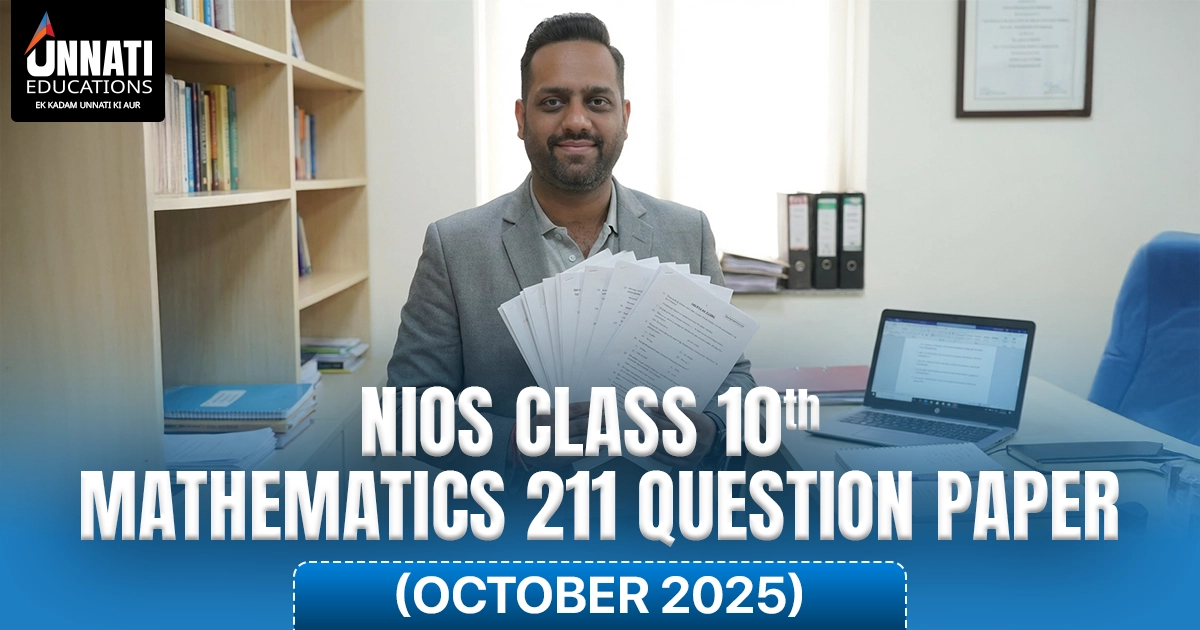
NIOS Class 10 Mathematics 211 Question Paper (Set B) October 2025: Full Analysis, Pattern, Weightage Clues, and Preparation Plan for 2026
If you are preparing for 2026, the NIOS Class 10 Mathematics 211 Question Paper (Set B) October 2025 is one of the most useful reality-check papers you can study. It shows what NIOS actually asks, how they mix easy scoring questions with thinking-based ones, and where students lose marks due to presentation and steps.
Download Solved Question Paper PDF
Introduction: Why This NIOS Class 10 Mathematics 211 Question Paper (Set B) Matters
Many students waste time solving random “important questions” from the internet. This Set B paper is different because it reflects the real exam approach, not guesswork. It also reminds you that NIOS Mathematics is not only about answers, but it is also about method, steps, and clean writing. This analysis is written in simple language for 2026 learners. You can use it even if you feel weak in Maths right now, because the plan is practical and repeatable.
Quick Summary (What You Will Learn In This Guide)
This breaks down what the Set B paper tells us about the NIOS Maths exam in 2026. You will understand the exam structure, the kind of questions asked, topic clusters that usually dominate, and a preparation plan that targets marks, not just “coverage.”
Overview Table: Nios Class 10 Maths 211 Exam (October 2025, Set B)
| Item | Details |
|---|---|
| Subject | Mathematics |
| Level | NIOS Secondary (Class 10) |
| Subject Code | 211 |
| Paper Set | Set B |
| Exam Session | October 2025 Public Exam |
| Time Duration | 2½ Hours (As Shown On The Paper) |
| Maximum Marks | 85 (As Shown On The Paper) |
| Question Count | 44 Questions (As Shown On The Paper) |
| Extra Sheet | The Graph Sheet Is Mentioned In The Paper |
Table Of Contents
- The NIOS Class 10 Mathematics 211 Question Paper (Set B) October 2025
- Exam context: What NIOS wants to test in Maths
- Structure clues from the paper: time, marks, question count, and skill mix
- What Set B usually reveals: difficulty, balance, and marking approach
- Topic clusters that typically dominate Mathematics 211 papers
- Step-by-step preparation strategy for NIOS Maths 2026 (score-first plan)
- Unnati Education support note (resources that match this paper style)
This paper is a strong sample because it is not built to surprise you. It is built to filter students who write steps properly, manage time, and avoid silly mistakes. The question count is high, which means speed and accuracy both matter. The paper also signals something many students ignore: you are expected to read carefully. Even a simple-looking question can become wrong if you skip a condition, units, or the required method. If your goal is 60+ or 70+ in 2026, this is the type of paper you should solve multiple times, not just read once.
NIOS Class 10 Mathematics 211 Question Paper (Set B) October 2025 Download Solution


Download Solved Question Paper PDF
Exam Context: What Nios Wants To Test In Maths
NIOS usually tests three things in Class 10 Maths:
- A) Concept clarity They check whether you understand the idea, not whether you memorised a format. This is why you see questions that look familiar but require correct interpretation.
- B) Process and steps Marks are often linked to steps. A correct final answer with missing steps can still lose marks. This is where many students fail silently.
- C) Application under time pressure With 44 questions, you cannot afford slow calculation habits. You must know when to move ahead and when to return later.
If you treat Maths like a “one correct answer” subject only, you will score below your potential. You need an exam writing strategy, not only practice.
Structure Clues: Time, Marks, Question Mix, Skills
Even without turning Maths into a complicated theory, the structure already tells you how to prepare:
- Time: 2½ hours This pushes you toward smart pacing. You cannot spend 8–10 minutes on every question. Your preparation must include timed practice.
- Maximum Marks: 85 This strongly suggests you should focus on scoring questions first. In most Maths papers, a big chunk of marks is available from direct methods if you stay calm.
- 44 Questions This shows a mixed pattern: some questions are short and fast, and some require full steps. Your job is to identify which is which quickly.
- Graph Sheet Mentioned This hints at questions where proper graph work, geometry, coordinate plotting, or construction-style thinking may be expected. Even one such question can be an easy 3–5 marks if you practice it properly.
What Set B Reveals: Difficulty Balance And Marking Approach
Many students ask, “Is Set B harder than Set A?” That’s the wrong question. The better question is: “How does Set B distribute marks across easy, medium, and tricky questions?” From the structure and typical NIOS approach, Set B usually follows this pattern: Easy scoring layer These are direct formula, direct simplification, direct substitution, or standard identity-based questions. If you practice them, you should not lose marks here. Medium thinking layer These questions test method selection. You know the chapter, but you must choose the right approach. This is where time gets wasted if you do not practice mixed sets. Tricky mistake layer This is not “tough maths.” It is usually a trap: sign error, unit error, wrong bracket handling, wrong reading of a condition, or incomplete steps. NIOS does not need to make the paper “hard” to differentiate students. They let students defeat themselves with haste and poor presentation.
Topic Clusters That Dominate Mathematics 211 Papers
I am not going to lie to you: if you try to study every chapter equally, you will burn time and still feel unprepared. You need a cluster approach. Below are the topic clusters that repeatedly appear in Class 10 Maths papers and should be treated as priority blocks for 2026. This also fits the kind of coverage expected when students search for NIOS Class 10 Mathematics Question Paper download PDF and compare patterns across sessions. A) Number system + basic algebra base
- Rational numbers, surds basics, simplification habits
- Algebraic identities and factorisation practice
- Linear equations approach and checking solutions cleanly
- Basic polynomials and substitution-type questions
B) Geometry core scoring block
- Triangles, similarity, and the basic theorem are used
- Circles basics and angle properties
- Constructions and reasoning-type steps (where applicable)
- Clear diagram drawing and labelling discipline
C) Mensuration and measurement block
- Areas, surface areas, volumes Units conversion and correct formula selection
- Word problems that look long but are direct once set up properly
D) Coordinate geometry + graphs
- Plotting points, reading graphs
- Distance formula, section formula basics
- Straight line understanding at a simple level
E) Trigonometry and applications (where included in your syllabus)
- Basic ratios, identity use
- Heights and distances style questions (often direct scoring if practised)
F) Statistics and probability (high return for time)
- Mean/median/mode basics
- Reading a table and concluding correctly
- Probability of simple cases
If you want a strong 2026 score, you should master the scoring blocks first before chasing advanced-looking questions.
Preparation Strategy For Nios Maths 2026 (Score-First Plan)
This is the plan most students avoid because it requires discipline. But it works. STEP 1: Build a “no-mistake” notebook (7 days) Write only these items in it:
- Formulas you actually use in questions
- Standard identity forms and factorisation patterns
- Common mistakes you personally make (sign, unit, rounding, wrong bracket) Revise this notebook daily for 10–15 minutes.
STEP 2: Do chapter practice in exam style, not in chapter style (2–3 weeks) Instead of finishing one chapter fully, do mixed practice:
- 10 questions per day
- 60-minute time cap
- Mark every mistake with reason (not just “wrong”)
This trains your brain for Set B-type papers, which are mixed by design. STEP 3: Weekly timed paper practice (minimum six papers before your exam) Follow this rule:
- First 20 minutes: attempt only sure-shot questions
- Next 60 minutes: do medium questions with full steps
- Last phase: attempt long problems and revise calculations This prevents early panic and reduces silly mistakes.
STEP 4: Presentation rule (this alone can lift your marks)
- Write Given, To Find, Solution when needed
- Draw diagrams for geometry even if not demanded.
- Box the final answer.r
- Keep steps aligned and readable. If your steps are messy, you force the examiner to work harder, and you pay for it in marks.
STEP 5: Fix the “calculation weakness” specifically Most students don’t lack concepts. They lack calculation stability. Do this daily:
- 15 minutes mental maths (tables, squares, fraction-decimal)
- 10 minutes speed simplification practice
- 10 minutes accuracy check (re-calc one solved question)
This is boring, but it’s how you beat the 44-question pressure. Important: if you are relying only on video lectures and not writing practice, you are lying to yourself. Maths scoring improves when you write, not when you watch.
Important Dates And Eligibility (2026)
Eligibility basics (NIOS Secondary / Class 10)
- You generally need to meet NIOS eligibility rules for secondary-level admission and subject selection. The exact eligibility can depend on your admission stream and your previous qualification status, so verify in your NIOS dashboard (this avoids last-minute problems).
Admission and exam timeline clues for 2026 (highly useful)
- For Oct–Nov 2026 public exams, several education portals report a Block II-style admission timeline and deadlines (normal fee and late fee windows). One widely cited timeline reports normal fee registration till January 31, 2026, and late fee till February 15, 2026, for the Oct–Nov cycle.
- For April–May 2026 exams, registration timelines were reported as starting in late 2025 with a no-late-fee deadline around December 20, 2025 and late fee windows extending into January 2026.
- For October–November 2025 public exams (your reference session), multiple outlets reported the exam window running from Oct 14 to Nov 18, which also shows how long the exam cycle can stretch.
Do not treat these as “final forever” dates. NIOS can update schedules. Use them as planning anchors, then confirm on the official portal when your exam session is near.
Unnati Education Note (Support That Matches This Paper Style)
Unnati Education focuses on exam-reality preparation, not motivational talk. If you are working toward 2026 and want structured support that matches the real NIOS pattern: Welcome to UNNATI EDUCATION NIOS – Your Ultimate NIOS Study Partner! Why Choose UNNATI EDUCATION NIOS?
- NIOS Previous Year Papers: practice papers aligned to real exam patterns
- Solved TMAs (Tutor Marked Assignments): accurate, NIOS-style, ready to submit
- NIOS Practical Files: complete, ready-to-upload files where applicable
- NIOS Notes: short, clear notes made for revision and exam writing
Set B difficulty signals: what this paper quietly tells you
The NIOS Class 10 Mathematics 211 Question Paper (Set B) does not try to scare students with very tough maths. Instead, it tests discipline. The difficulty comes from volume, accuracy, and consistency, not from advanced concepts. What Set B clearly signals:
- NIOS expects students to attempt most questions, not skip many
- Marks are distributed across the paper, not concentrated in one section.
- Students who panic midway usually lose marks on easy questions.
- Calm, step-by-step writers outperform fast but careless solvers.
This is why many students feel the paper was “easy but long.” That feeling is accurate.
Chapter-wise weightage clues from Set B (not official, but practical)
NIOS does not publish exact chapter-wise weightage. But from repeated papers and this Set B structure, you can infer practical weightage clusters. This is what matters for scoring.
Key Topic Clusters and Expected Mark Contribution
| Topic Cluster | Expected Mark Range | Why It Matters |
|---|---|---|
| Algebra (Identities, Equations) | 18–22 Marks | Direct Questions, Low Thinking Load |
| Geometry (Triangles, Circles) | 15–18 Marks | Step-Based, Marks For Method |
| Mensuration | 10–12 Marks | Formula Application Is Easy If Practised |
| Coordinate Geometry | 6–8 Marks | Graph Accuracy And Method Clarity |
| Statistics & Probability | 8–10 Marks | High Return, Low Effort Topics |
| Trigonometry (If Applicable) | 8–10 Marks | Repeated Identity Patterns |
If you prepare these clusters properly, crossing 60+ marks becomes realistic, not hopeful.
Where students lost marks in October 2025 (realistic mistakes)
These are not theoretical mistakes. These are human mistakes.
- Skipping steps and jumping to the final answer
- Wrong sign while simplifying expressions
- Writing the correct method, but stopping halfway
- Drawing incorrect or unclear geometry diagrams
- Forgetting to mention units in mensuration answers
- Misreading the question under pressure
None of these mistakes comes from “not knowing maths.” They come from rushing and poor habits.
How to attempt the Maths paper inside the exam hall (exact order)
This order works better than randomly starting from Question 1.
Step-by-step exam attempt order
- First round (20–25 minutes): Attempt MCQs, very short, and formula-based questions only
- Second round (60–70 minutes): Solve algebra, mensuration, statistics, and probability.
- Third round (40–45 minutes): Attempt geometry and graph-based questions
- Final round (15–20 minutes): Recheck calculations, diagrams, and skipped parts.
Never start with geometry if you are slow at drawing. That kills confidence early.
Presentation rules that quietly increase marks
Examiners do not “feel” your struggle. They scan your paper. Follow these rules strictly:
- Start each question clearly on a new line
- Write steps in logical order, not scattered.
- Box the final answer neatly.
- Use proper mathematical symbols consistently
- Keep diagrams clean and proportional.
A good presentation can save 5–8 marks without extra study.
How TMAs improve your Maths score indirectly
Many students treat TMAs as a burden. That is a mistake. When TMAs are done properly:
- You practice writing full steps regularly
- You build speed in structured solving.
- You reduce the fear of long questions.
This is why students who complete the NIOS TMA Class 10 sincerely usually perform better in theory exams.
How to use previous year papers the right way
Most students misuse previous papers. Wrong way:
- Solving only to check answers
- Skipping questions that look hard
- Doing papers without time limit
Correct way:
- Solve with a timer
- Write full steps as in exam
- Analyse every mistake carefully
Keeping a small notebook for mistakes from the NIOS Class 10 previous year question paper practice improves accuracy faster than endlessly solving new questions.
One-month revision plan for Maths 2026 aspirants
Week 1
- Revise algebra and mensuration
- Daily 20 mixed questions
- Fix calculation mistakes
Week 2
- Geometry and coordinate geometry focus
- Diagram practice daily
- One-time mock paper
Week 3
- Statistics, probability, and weak chapters
- Two full papers under exam conditions
Week 4
- Only revision and light practice
- Formula notebook daily
- No new concepts
This plan works even if Maths is your weakest subject.
Unnati Education academic support (not an admission pitch)
Unnati Education supports NIOS learners with exam-pattern-based resources, not random content. Students usually use:
- Solved previous year Maths papers
- Step-wise TMA solutions
- Short revision notes for formulas
- Practice guidance aligned with real NIOS checking
For support: Phone/WhatsApp: 9654279279, 9899436384
Frequently Asked Questions (FAQs)
Q1. Is the NIOS Class 10 Mathematics 211 Question Paper difficult?
The paper is not difficult concept-wise, but it is lengthy. Students lose marks due to calculation errors and poor time management. With structured practice and regular solving of the NIOS previous year question paper Class 10, the difficulty becomes manageable, and scoring improves significantly.
Q2. Can average students score well in NIOS Maths?
Yes. Average students often score better than “smart” students because they followthe steps properly. Maths rewards method and presentation. Regular writing practice, formula revision, and solving the NIOS Class 10 TMA can push scores above expectations.
Q3. How many hours daily are enough for Maths preparation?
One to two focused hours daily are enough if practice is disciplined. Writing solutions matters more than reading. Even 60 minutes of timed problem solving daily improves speed and confidence more than passive study.
Q4. Are previous year papers enough for Maths preparation?
Previous papers are essential but not sufficient alone. They show patterns, not mastery. Use them to identify weak areas, then practice similar problems. Combine them with revision notes and TMAs for balanced preparation.
Q5. What is the biggest mistake students make in Maths exams?
The biggest mistake is rushing. Students attempt too many questions too fast and lose marks on easy steps. Calm solving, clean writing, and checking calculations save more marks than attempting extra questions.
Quick Final Summary
The NIOS Class 10 Mathematics 211 Question Paper (Set B) October 2025 proves that Maths is not about brilliance but discipline. Students preparing for 2026 should focus on step-wise solving, accuracy, and time control. With smart preparation, Maths can become a strong scoring subject rather than a fear. If you want solved papers, help with TMAs, or structured Maths guidance, Unnati Education provides exam-aligned academic support for NIOS learners.