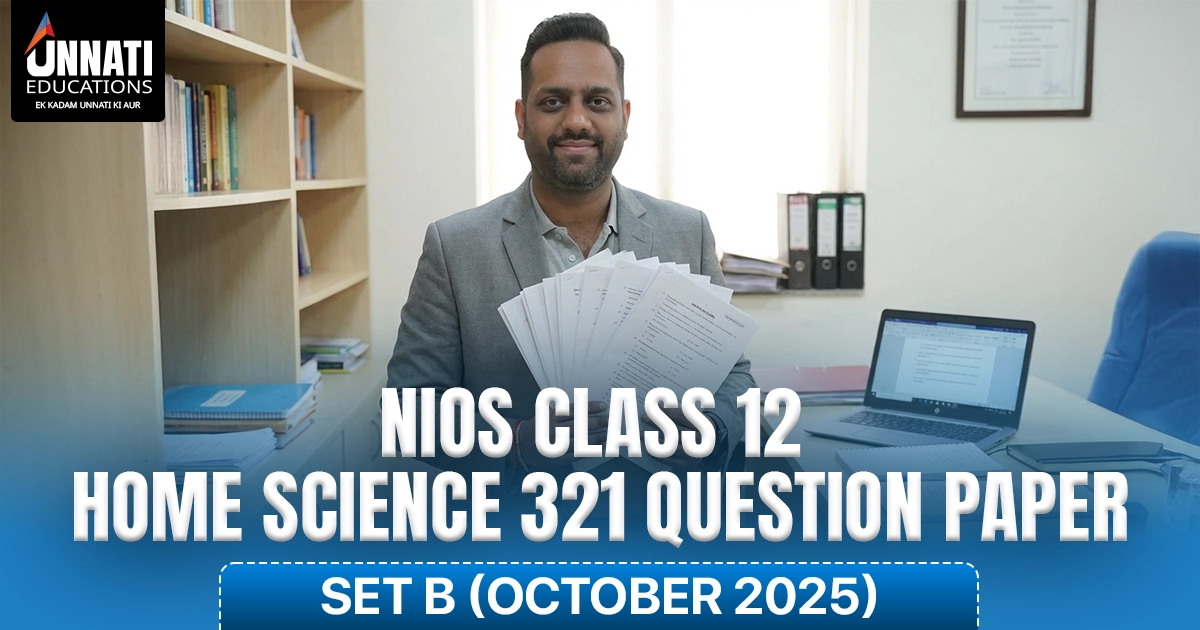
NIOS Class 12 Home Science 321 Question Paper (Set B) October 2025 – Complete Analysis, Weightage, Topics & Preparation Guide for 2026
The NIOS Class 12 Home Science 321 Question Paper (Set B) of October 2025 clearly shows that Home Science is a practical, concept-based, and life-oriented subject. The paper focuses on nutrition, human development, textiles, consumer awareness, housekeeping, and aesthetics, rather than rote learning. This detailed analysis explains the paper structure, section-wise weightage, important topics, and preparation strategy for students appearing in the 2026 examination.
Download Solved Question Paper PDF
Quick Summary
This complete guide on the NIOS Class 12 Home Science 321 Question Paper explains the structure of Set B, including MCQs, objective questions, very short answers, short answers, and long answers. It highlights topic-wise weightage, frequently asked themes, optional modules, and exam-focused preparation tips to help students score confidently in 2026.
Overview Table: NIOS Class 12 Home Science 321 Exam (October 2025 – Set B)
| Particulars | Details |
|---|---|
| Subject | Home Science (321) |
| Class | 12th |
| Board | National Institute of Open Schooling (NIOS) |
| Question Paper Set | Set B |
| Exam Month | October 2025 |
| Total Marks | 80 |
| Time Duration | 3 Hours |
| Total Questions | 43 |
| Sections | A and B |
| Question Types | MCQs, Objective, Very Short, Short, Long Answer |
| Optional Modules | Housekeeping / Creative Hand Embroidery |
| Medium | Multiple Indian Languages |
Understanding the NIOS Home Science 321 Question Paper Pattern
The NIOS Home Science 321 Question Paper follows a very clear and student-friendly structure. All questions are compulsory, but internal choices are provided through optional modules. The paper tests theoretical understanding, application in daily life, and awareness of health, nutrition, family welfare, textiles, and home management. Set B strictly follows the NIOS blueprint, making the exam predictable for students who prepare from the syllabus.
NIOS Class 12 Home Science 321 Question Paper (Set B) October 2025


Download Solved Question Paper PDF
Structure of the NIOS Class 12 Home Science Question Paper
Section-Wise Exam Structure (As per Set B)
| Section | Question Numbers | Question Type | Marks |
|---|---|---|---|
| Section A | 1–28 | MCQs + Objective | 1–2 Marks |
| Section B | 29–43 | Very Short, Short, Long Answer | 2–5 Marks |
Optional Module-A (Housekeeping) or Optional Module-B (Creative Hand Embroidery) must be chosen consistently across sections.
Section A: Multiple Choice Questions (MCQs)
Section A contained 16 MCQs, each carrying one mark. These questions tested everyday knowledge related to Home Science concepts.
Topics Covered in MCQs
- Child development and parenting practices
- Nutrition myths and dietary facts
- Textile weaves and fabric care
- Food preservation methods
- Consumer protection and quality marks
- Income types and household resources
- Health, hygiene, and sanitation
These questions were direct and based on practical understanding rather than memorisation.
Section A: Objective-Type Questions (2 Marks Each)
Objective questions included True/False, fill-in-the-blanks, matching columns, and short identification tasks.
Frequently Tested Areas
- Quality marks such as ISI, FPO, Woolmark, and Agmark
- Fabric durability, weave characteristics, and yarn behaviour
- Food preservation principles and spices
- Child health, anaemia, malnutrition, and adolescence
- Ethics, values, and workplace behaviour
Accuracy and correct terminology were essential for full marks.
Optional Module Choice in Section A
Students had to choose either Optional Module A (Housekeeping) or Optional Module B (Creative Hand Embroidery).
Optional Module-A: Housekeeping
- Flower arrangement principles
- Interior decoration basics
- Cleaning methods for metals and surfaces
- Use of acids and alkalis at home
Optional Module-B: Creative Hand Embroidery
- Types of stitches, such as cross stitch, chain stitch, and satin stitch
- Colour schemes and design principles
- Use of templates and embroidery tools
Choosing one module and preparing it thoroughly is critical.
Section B: Very Short Answer Questions (2 Marks)
Very short answers had to be written in 30 to 50 words, as clearly instructed in the paper.
Common Topics Asked
- Importance of food preservation
- Causes of malnutrition
- Symptoms of anaemia in children
- Buying low-cost, nutritious foods
- Safe use of kitchen equipment
- Ethical concerns in society and the workplace
Point-wise answers with clear language scored better.
Section B: Short Answer Questions (3 Marks)
Short answers required 50 to 80 words and tested explanation ability.
Key Themes Covered
- Differences between plain and twill weave
- Advantages of knitted fabrics over woven fabrics
- Effects of early and late maturation on adolescents
- Causes and consequences of child labour
- Working of optical brightening agents in textiles
Answers needed, clear explanation with examples.
Section B: Long Answer Questions (5 Marks)
Long answers required 80 to 120 words, focusing on application and understanding.
Long Answer Topics in Set B
- Gross and fine muscular coordination during middle childhood
- Language development during middle childhood
- Aesthetics and space management in homes
- Managing multiple work centres in one-room houses
Logical structure and real-life examples were essential.
Major Topics Covered in NIOS Home Science 321 Set B
Human Development
- Middle childhood and adolescence
- Physical, emotional, and language development
- Parenting practices and child labour
Nutrition and Health
- Malnutrition and anaemia
- Diet modification during illness
- Food myths and balanced diets
Textiles and Clothing
- Weaves, yarns, and fabric finishes
- Care and cleaning of fabrics
- Embroidery and design principles
Resource Management and Housekeeping
- Space management
- Safety in the kitchen and home
- Aesthetics and interior arrangement
NIOS Class 12 Home Science Question Paper Weightage 2025
| Area | Approximate Weightage |
|---|---|
| Human Development | 20–25 Marks |
| Nutrition and Health | 15–20 Marks |
| Textiles and Clothing | 15–20 Marks |
| Resource Management | 10–15 Marks |
| Optional Module | 10–15 Marks |
This balance is expected to continue in 2026.
NIOS Class 12 Home Science Question Paper Download PDF – Why Students Look for It
Students searching for the NIOS Class 12 Home Science Question Paper download PDF want real exam-level practice. Solving such papers helps them understand question framing, word limits, optional modules, and marking style, which directly improves exam confidence. Download Solved Question Paper PDF
Eligibility Criteria for NIOS Class 12 (2026)
| Requirement | Details |
|---|---|
| Minimum Age | 16 Years |
| Qualification | Class 10 or equivalent |
| Mode | Open Schooling |
| Medium | Multiple Indian Languages |
Important Dates for NIOS 2026 (Expected)
| Event | Tentative Timeline |
|---|---|
| Admission Window | January – March 2026 |
| Exam Form Submission | August – September 2026 |
| October Exam | October 2026 |
| Result Declaration | December 2026 |
How Unnati Education Supports Home Science Students
Unnati Education supports NIOS Home Science students with exam-focused guidance based strictly on actual question paper patterns. Support includes:
- NIOS Previous Year Papers for structured practice
- Solved TMAs prepared as per NIOS guidelines
- Simplified Home Science notes
- Support for NIOS previous year question paper Class 12practice
- Guidance for NIOS Class 12 TMA preparation
Deep Section-Wise Scoring Strategy for NIOS Class 12 Home Science 321 (Based on Set B)
After carefully analysing the NIOS Class 12 Home Science 321 Question Paper (Set B) October 2025, it becomes clear that Home Science is not a memory-based subject. Marks are awarded for practical understanding, correct terminology, structured answers, and real-life application of concepts.
How to Score Maximum in Section A (MCQs and Objective Questions)
Section A creates the scoring base of the paper and should never be underestimated.
What NIOS Tests Through MCQs and Objectives
- Every day nutrition and health awareness are linked to family life
- Basic textile knowledge related to fabric use and care
- Child development stages and common behavioural traits
- Consumer awareness, quality marks, and ethical practices
- Simple housekeeping and home management principles
Smart Scoring Strategy
- Revise definitions and short facts directly from the NIOS book.
- Focus on understanding terms instead of guessing answers.
- Avoid overthinking; questions are usually straightforward.
Students who prepared the basics thoroughly scored almost full marks here.
Very Short Answer Questions: Precision Is the Key
Very short answers test clarity, not explanation.
Examiner Expectations
- Answers written strictly within the given word limit
- Correct use of Home Science terms without unnecessary detail
- Simple language connected to daily life examples
Topics Where Students Scored Well
- Causes and prevention of malnutrition
- Importance of food preservation
- Symptoms of anaemia in children
- Safe handling of household equipment
One well-written paragraph or two clear points were enough for full marks.
Short Answer Questions: Balance Between Explanation and Length
Short answers usually decide whether a student moves from average to good scores.
High-Scoring Answer Format
- One introductory line defining the concept
- Two to three exclamation points written clearly.
- One short concluding line connecting to daily life
Topics That Appeared Frequently
- Differences between various textile weaves
- Advantages of knitted fabrics in daily clothing
- Child labour causes and consequences.
- Changes during adolescence
Answers written in simple points scored better than long paragraphs.
Long Answer Questions: Application and Real-Life Connection Matter Most
Long answers carry higher marks and test understanding deeply.
What NIOS Looked For in Long Answers
- Clear explanation of the concept
- Use of examples from daily life
- Logical flow from introduction to conclusion
- Proper use of Home Science terminology
Common Long Answer Themes in Set B
- Language development during middle childhood
- Gross and fine muscular coordination
- Space management in small homes
- Aesthetics in the home and workplace
Students who related answers to real-life situations scored higher.
Optional Module Strategy: Housekeeping vs Creative Hand Embroidery
Choosing the right optional module and preparing it well is crucial.
Optional Module-A: Housekeeping
This module is theory-based and suitable for students who are comfortable with written answers. Key focus areas:
- Cleaning methods and cleaning agents
- Flower arrangement principles
- Interior decoration basics
- Safety measures at home
Optional Module-B: Creative Hand Embroidery
This module is practical and suitable for creative students. Key focus areas:
- Types of stitches and their uses
- Colour schemes and design balance
- Tools and materials used in embroidery
- Basic design planning
Preparing one module thoroughly is better than partially preparing both.
Common Mistakes Students Made in October 2025 (Set B)
Many students lost marks because they:
- Crossed word limits unnecessarily
- Used vague language instead of correct terms
- Ignored the optional module preparation
- Wrote textbook lines without understanding
- Failed to give real-life examples in long answers
Avoiding these mistakes alone can improve scores significantly.
Expected Trends for NIOS Home Science 321 Exam 2026
Based on Set B analysis, students can expect:
- Similar paper structure and marking pattern
- Continued importance of nutrition and child development
- Regular inclusion of textiles and resource management
- Optional modules remaining unchanged
NIOS prefers consistency and practical relevance.
Smart 2026 Preparation Plan for Home Science 321
Daily Preparation
- 20 minutes reading one Home Science topic
- 15 minutes revising definitions and terms
- 10 minutes practising short answers
Weekly Preparation
- One full-length practice paper
- One revision of nutrition and health units
- One revision of the optional module topics
Regular, small efforts give better results than last-minute study.
Time Management Strategy for Exam Day
| Section | Suggested Time |
|---|---|
| MCQs and Objective | 30 minutes |
| Very Short Answers | 25 minutes |
| Short Answers | 40 minutes |
| Long Answers | 45 minutes |
| Revision | 20 minutes |
Following this plan helps avoid rushing and mistakes.
Presentation Tips That Improve Home Science Marks
- Write answers in clear points wherever possible.
- Leave space between answers for better readability.
- Underline important terms like anaemia, malnutrition, and weave.
- Use simple examples related to home and family life.
A good presentation makes answers easier to evaluate positively.
How Unnati Education Helps Home Science Students
Unnati Education supports NIOS Home Science students with exam-focused academic guidance. Support includes:
- Solved Home Science question papers
- Simplified notes with real-life examples
- Structured answer-writing guidance
- Help with NIOS Class 12 previous year question paper practice
- Complete assistance for NIOS TMA Class 12 preparation
For academic support: Phone/WhatsApp: 9654279279, 9899436384
Frequently Asked Questions (FAQs)
Q1. Is the NIOS Class 12 Home Science 321 Question Paper difficult for average students? The Home Science 321 paper is not difficult if the concepts are understood clearly. Questions are practical, syllabus-based, and linked to daily life. Average students who revise topics regularly and practise structured answers can score well without stress. Q2. Which section is the most scoring in Home Science 321? MCQs and very short answer questions are the most scoring sections. They test basic understanding and everyday knowledge. Students who prepare definitions, key terms, and simple facts properly can secure a strong base score. Q3. How important are previous year question papers for Home Science preparation? Previous year papers are very important because NIOS repeats themes and question formats. Practising them helps students understand word limits, optional modules, and examiner expectations, which improves confidence and final performance. Q4. How should long answers be written to score full marks in Home Science? Long answers should be written with a clear introduction, explanation in points, and a short conclusion. Using real-life examples related to home, family, and health improves answer quality and helps secure full marks. Q5. Can Home Science be prepared well in the last three months before the exam? Yes, Home Science can be prepared effectively in three months with a focused plan. Regular reading, revision of key terms, and practising answers based on previous papers are enough to score confidently.
Final Conclusion
The NIOS Class 12 Home Science 321 Question Paper (Set B) October 2025 clearly shows that Home Science is a practical, scoring, and life-oriented subject. Students preparing for 2026 should focus on understanding concepts, using correct terminology, and writing structured answers with real-life relevance. Unnati Education provides Home Science solutions, TMAs, and previous year question papers to support students throughout their preparation. If you need solved papers, TMA support, or academic guidance, you can contact Unnati Education for reliable assistance. Download Solved Question Paper PDF