NIOS Class 12 Mass Communication 355 Question Paper (Set B) October 2025 – Complete Analysis, Pattern, Weightage & 2026 Preparation Guide
The NIOS Class 12 Mass Communication 355 Question Paper (Set B) from October 2025 clearly shows how NIOS evaluates students’ understanding of media, journalism, broadcasting, advertising, public relations, and new media. This paper focuses on concepts, real-world media awareness, and clarity of expression rather than rote memorisation. Students preparing for 2026 can use this paper as a strong reference point. This guide is written after carefully analysing the attached question paper page by page. It explains the exam pattern, section-wise structure, topic coverage, marks distribution, and preparation direction in simple language so that every student can understand and benefit.
Download Solved Question Paper PDF
Quick Summary: NIOS Class 12 Mass Communication 355 Question Paper
This detailed guide on the NIOS Class 12 Mass Communication 355 Question Paper explains the full exam structure, objective and descriptive sections, topic-wise weightage, optional modules, and important themes such as journalism, radio, television, advertising, public relations, traditional media, photojournalism, and new media. It also highlights expected trends for 2026 and smart preparation strategies.
Overview Table: NIOS Class 12 Mass Communication Exam (October 2025 – Set A)
| Particulars | Details |
|---|---|
| Subject | Mass Communication (355) |
| Class | 12th |
| Board | National Institute of Open Schooling (NIOS) |
| Question Paper Set | Set A |
| Exam Month | October 2025 |
| Total Marks | 80 |
| Time Duration | 3 Hours |
| Total Questions | 43 |
| Question Types | MCQs, Objective, Very Short, Short, Long Answer |
| Optional Modules | Traditional Media / Photojournalism |
Understanding the NIOS Mass Communication 355 Question Paper Format
The NIOS Mass Communication Question Paper is structured to test awareness of media systems, communication processes, and media roles in society. The paper gradually moves from simple recall-based questions to analytical and application-based answers. The exam is divided into three main sections. Each section checks a different skill, such as factual knowledge, conceptual understanding, and expressive ability. Students who understand this structure can easily manage time and marks.
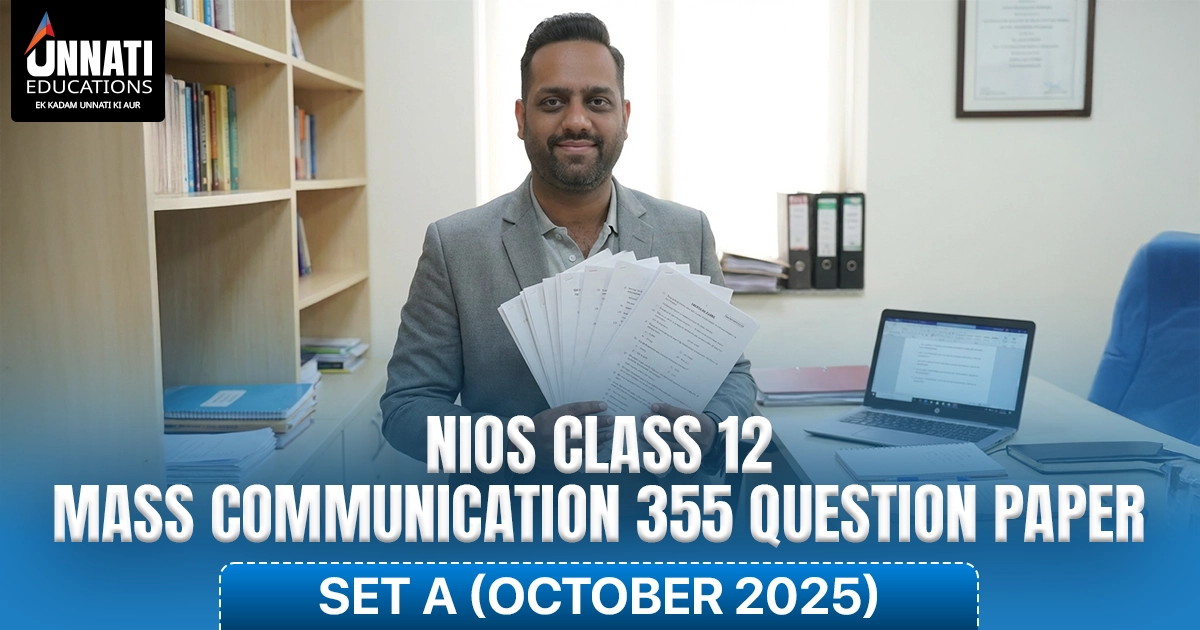
NIOS Class 12 Mass Communication 355 Question Paper (Set B) October 2025 Showcase


Download Solved Question Paper PDF
Structure of the NIOS Class 12 Mass Communication Question Paper
Section-Wise Exam Structure
| Section | Question Numbers | Marks per Question | Nature |
|---|---|---|---|
| Section A | 1–16 | 1 mark | MCQs |
| Section B | 17–28 | 2 marks | Objective / Fill / Match |
| Section C | 29–43 | 2–4 marks | Descriptive |
Optional modules are included in Sections B and C.
Section A: Multiple Choice Questions (MCQs)
Section A consists of 16 MCQs carrying one mark each. These questions test basic awareness of media history, institutions, terminology, and concepts.
Topics Asked in Section A (Set B)
- Indian cinema history, including Dadasaheb Phalke
- Growth of newspapers and language press in India
- Investigative reporting and in-depth journalism
- AIR, Gyan Vani, and educational broadcasting
- IPTV, fictional and non-fictional programmes
- Advertising ethics and information overload
- Press Information Bureau and government communication
How to Score Full Marks in Section B
- Revise factual media history and institutions
- Understand definitions instead of guessing
- Read options carefully before selecting
- Focus on standard NIOS textbook terminology
Students who revised the basics scored almost full marks here.
Section B: Objective-Type Questions (2 Marks Each)
Section B includes fill-in-the-blanks, true or false, match the following, and multiple-choice objective questions. This section tests conceptual clarity.
Key Areas Covered in Section B
- Tools used by sub-editors
- Hard news versus soft news
- Functions of the radio station wings
- Studio equipment like microphones and sound recorders
- Advertising elements such as jingles, slogans, and spots
- Employee communication tools like house journals
Optional Modules in Section B
Students had to choose either:
- Optional Module A: Traditional Media
- Optional Module B: Photojournalism
Only one optional module must be attempted.
Optional Module A: Traditional Media (Section B Focus)
This module focuses on folk media, traditional communication forms, and their relevance today. Key themes included:
- Role of traditional media in social communication
- Continued relevance of folk and traditional forms
- Cultural and emotional connection with audiences
Answers required a clear understanding of Indian communication traditions.
Optional Module B: Photojournalism (Section B Focus)
This module tested visual communication awareness. Key areas included:
- Impact of technology on newspapers
- Growth of photographs in news reporting
- Camera angles and their visual effects
- Role of images in strengthening news credibility
Students familiar with visual media concepts found this section scoring.
Section C: Very Short Answer Questions (2 Marks Each)
Section C begins with very short answer questions that require brief and precise responses.
Topics Asked in Very Short Answers
- Functions of mass media
- Factors contributing to newspaper growth
- Limitations of radio broadcasting
- Definition of non-fiction programmes
- Differences between advertising and public relations
- Impact of new media on small businesses
Answer Writing Strategy
- Write answers in two clear points
- Use simple language and correct terms
- Avoid long explanations
- Stick strictly to the question
These questions are easy marks if written correctly.
Section C Continued: Short Answer Questions (3 Marks Each)
Short answer questions test understanding and comparison skills.
Topics Covered
- Development communication and its core areas
- Investigative versus interpretative reporting
- News versus information with examples
- Public versus private broadcasting
- Studio production equipment and functions
- Media convergence and its impact
Answers required a structured explanation with examples.
Optional Module in Short Answer Section
Traditional Media Option
Questions focused on:
- Importance of traditional media in developing countries
- Flexibility and the live nature of traditional communication
Photojournalism Option
Questions covered:
- Responsibilities of photo editors
- Ethical practices in photojournalism
Students needed conceptual clarity rather than memorised answers.
Long Answer Questions: Highest Weightage Section
Long answer questions carried four marks each and required depth and structure.
Topics Asked in Set B
- Narrative style of journalism in new media
- Process of writing narrative news stories
- Government initiatives for traditional media revival
- Sustainability challenges of traditional media
- Importance of composition in photojournalism
- Role of photojournalists during disasters
This section decided the final score for many students.
NIOS Class 12 Mass Communication Question Paper Weightage 2025
| Area | Approximate Weightage |
|---|---|
| Journalism & Reporting | 20–25 Marks |
| Radio & Television | 15–20 Marks |
| Advertising & Public Relations | 15–20 Marks |
| New Media | 10–15 Marks |
| Optional Module | 10–15 Marks |
This distribution is expected to remain stable for 2026.
Eligibility Criteria for NIOS Class 12 Mass Communication (2026)
| Requirement | Details |
|---|---|
| Minimum Age | 16 years |
| Educational Qualification | Class 10 pass or equivalent |
| Mode | Open schooling |
| Medium | Multiple Indian languages |
Important Dates for NIOS 2026 (Expected)
| Event | Tentative Timeline |
|---|---|
| Admission Window | January – March 2026 |
| Exam Form Submission | August – September 2026 |
| Theory Exam | October 2026 |
| Result Declaration | December 2026 |
How Unnati Education Supports Mass Communication Students
Unnati Education helps NIOS students understand media subjects with clarity and confidence. Support includes:
- Solved Mass Communication question papers
- Simple notes for journalism and media studies
- Guidance for nios class 12 tma preparation
- Help with NIOS Class 12 previous year question paper practice
NIOS Class 12 Mass Communication 355 Solved Question Paper Download (Based on Set B)
Many students look for NIOS Class 12 Mass Communication 355 solved question paper download PDF since working on actual exams reveals preferred formats, marking criteria, and recurring themes like media types, communication models, journalism ethics, advertising techniques, and new media impacts that NIOS emphasizes. This solved Set A version serves as an excellent tool for effective 2026 exam readiness.
Download Solved Question Paper PDF
How to Score Maximum in Section B (MCQs)
Section A is the easiest and most scoring part of the paper if prepared properly.
What NIOS Tests Through MCQs
- Basic history of Indian cinema, newspapers, and broadcasting
- Understanding of journalism types, such as investigative and narrative
- Awareness of institutions like AIR, PIB, and Gyan Vani
- Knowledge of television programme formats and new media terms
- Ethical aspects of advertising and media responsibility
Smart Scoring Strategy
- Revise factual topics from the NIOS textbooks carefully
- Avoid overthinking because questions are direct
- Read all options before selecting the answer
- Focus on the standard terminology used by NIOS
Students who revised the basics properly could score almost full marks here.
How to Score High in Section B (Objective Questions)
Section B checks conceptual clarity rather than memory.
Examiner Expectations
- Correct identification of media tools and techniques
- Clear distinction between similar media concepts
- Proper matching and classification
- Accurate true or false reasoning
High-Scoring Preparation Tips
- Understand differences such as hard news versus soft news
- Revise radio station departments and studio equipment
- Learn advertising elements like slogans, jingles, and spots
- Practice objective questions from previous papers
Accuracy is more important than speed in this section.
Optional Module Strategy: Traditional Media vs Photojournalism
Choosing the right optional module and preparing it well is critical.
Optional Module A: Traditional Media
This module suits students who are comfortable with theory and cultural topics. Key preparation areas include:
- Importance of folk and traditional media in India
- Emotional and cultural connection with audiences
- Role of traditional media in development communication
- Challenges faced by traditional media today
Optional Module B: Photojournalism
This module suits students interested in visual storytelling. Key preparation areas include:
- Importance of photographs in newspapers
- Role and responsibilities of photo editors
- Ethics in photojournalism
- Use of composition and camera angles
Preparing one module thoroughly is far better than partial preparation of both.
Very Short Answer Questions: Simple and Direct Wins Marks
Very short answers test clarity and precision.
Topics Where Students Scored Well
- Functions of mass media in society
- Growth factors of newspapers
- Limitations of radio broadcasting
- Differences between advertising and public relations
- Role of media in small business promotion
Answer Writing Tips
- Answer strictly in two or three lines
- Use simple language with correct media terms
- Avoid unnecessary explanations
This section rewards clear thinking.
Short Answer Questions: Explanation with Example Matters
Short answers usually carry three marks and test understanding.
High-Scoring Answer Structure
- One line defining the concept
- Two exclamation points
- One simple example is required
Common Topics Asked
- Development communication and its objectives
- Investigative versus interpretative reporting
- Public broadcasting versus private broadcasting
- Media convergence and digital platforms
Answers written in points scored better than long paragraphs.
Long Answer Questions: Structure Decides Final Scores
Long answers carry the highest weightage and need planning.
What Makes a High-Scoring Long Answer
- Clear introduction explaining the topic
- Well-structured points with headings
- Use of real-world media examples
- Short conclusion summarising the answer
Major Long Answer Topics in Set A
- Narrative journalism in new media
- Writing narrative news stories
- Sustainability of traditional media
- Role of photojournalists during disasters
Unstructured writing often resulted in a loss of marks.
Common Mistakes Students Made in October 2025 (Set A)
Many students lost marks because they:
- Wrote vague answers without media terminology
- Memorised definitions without understanding
- Ignored the optional module preparation
- Exceeded word limits unnecessarily
- Failed to give examples from real media situations
Avoiding these mistakes alone can improve scores significantly.
Expected Trends for NIOS Mass Communication 355 Exam 2026
Based on Set A analysis, students can expect:
- Similar paper structure and marking pattern
- Continued focus on journalism and new media
- Regular questions from advertising and broadcasting
- Optional modules remaining unchanged
NIOS prefers consistency and practical relevance.
Smart 2026 Preparation Plan for Mass Communication 355
Daily Preparation
- 30 minutes reading one media topic
- 15 minutes revising media terms and definitions
- 10 minutes practising short answers
Weekly Preparation
- One full-length practice paper
- One revision of journalism topics
- One revision of the optional module topics
Regular practice improves writing clarity and confidence.
Time Management Strategy for Exam Day
| Section | Suggested Time |
|---|---|
| MCQs | 30 minutes |
| Objective Section | 30 minutes |
| Short Answers | 40 minutes |
| Long Answers | 50 minutes |
| Revision | 20 minutes |
Following this plan helps avoid rushing.
Presentation Tips That Improve Mass Communication Scores
- Write answers in points where possible
- Underline important media terms
- Leave space between answers
- Keep handwriting neat and readable
A good presentation improves examiner readability.
How Unnati Education Helps Mass Communication Students
Unnati Education supports NIOS Mass Communication students with exam-focused academic guidance. Support includes:
- Solved Mass Communication question papers
- Simplified notes with real-world examples
- Guidance for NIOS TMA Class 12 preparation
- Support for NIOS Class 12 previous year question paper practice
For academic support: Phone/WhatsApp: 9654279279, 9899436384
Frequently Asked Questions (FAQs)
Q1. Is the NIOS Class 12 Mass Communication 355 Question Paper difficult for average students? The Mass Communication paper is not difficult if the concepts are clear. Questions are practical and society-based. Average students who understand media basics, revise regularly, and practise structured answers can score well without stress.
Q2. Which section is the most scoring in Mass Communication 355? MCQs and short answer sections are the most scoring. They test basic understanding and terminology. Students who revise media history, definitions, and differences can easily secure strong marks.
Q3. How important are previous year question papers for Mass Communication preparation? Previous year papers are very important because NIOS repeats themes and formats. Practising them helps students understand answer depth, word limits, and examiner expectations clearly.
Q4. How should long answers be written to score full marks in Mass Communication? Long answers should include a clear introduction, well-explained points using media terms, real-world examples, and a short conclusion. Structured writing helps secure full marks.
Q5. Can Mass Communication be prepared well in three months? Yes, Mass Communication can be prepared effectively in three months with focused reading, concept revision, and answer practice based on previous papers. Consistency matters more than long study hours.
Final Conclusion
The NIOS Class 12 Mass Communication 355 Question Paper (Set A) October 2025 clearly shows that Mass Communication is a scoring, practical, and expression-based subject. Students preparing for 2026 should focus on understanding media concepts, using correct terminology, and writing structured answers with real-life relevance. Unnati Education provides Mass Communication solutions, TMAs, and previous year question papers to support students throughout their preparation. If you need solved papers, TMA help, or academic guidance, you can contact Unnati Education for reliable support.