Accountancy is one of those subjects where the marks are sitting right there in the objective section, waiting for the student who practised. That is the thinking behind this set of NIOS Class 12 Accountancy 320 Objective Type Questions. Before you ask us for the full pack, read the real samples below, taken straight from the document, and judge the quality for yourself.
Nothing here is padding. Each sample is a genuine objective question we prepared for the Accountancy 320 paper, with the correct answer and a short reason attached, exactly the way the complete set is laid out. Work through a few, test them against what you already know, and decide whether this is the practice that gets you across the line.
NIOS Class 12 Accountancy 320 Objective Type Questions for 2026
The Accountancy 320 paper mixes numerical problems with a solid objective portion, and the objective portion is where careful preparation pays off first. Multiple choice items, fill in the blanks and one word answers together cover a real slice of the paper, and they are the fastest marks to lock in once you have seen the pattern. Our set pulls together the most repeated and most likely of these from every important chapter.
We keep the wording plain so an English medium learner can follow the question, see why the answer is right, and move on. If your revision is still taking shape, lining this practice up with the official NIOS Syllabus keeps you pointed at what the board actually tests this session.
Why these NIOS Accountancy 320 questions speed up revision
Accountancy rewards students who have the definitions, rules and formats at their fingertips. A learner who has drilled the rules of debit and credit, the treatment of goodwill and the classification of cash flow activities finishes the objective section quickly and keeps more time for the long numerical answers.
That is the whole point of this pack. Rather than re-reading the entire textbook, you revise the exact lines examiners keep coming back to. Voucher types, the meaning of reconstitution on admission, par value of shares, the standard that governs cash flow statements, these are the small facts that decide one and two mark objective questions. Making them automatic is the difference between a comfortable score and a shaky one.
How we prepared these NIOS Accountancy 320 objective type questions
These were not thrown together at speed. Our team went through the previous year question papers of Accountancy 320 and marked every objective item that had appeared, tracking which chapters the board leans on year after year. That reading of past papers is the foundation of the whole pack.
We then worked through the complete NIOS text for the subject, chapter by chapter, and lifted the factual points that turn cleanly into objective questions. Where a topic showed a clear examination pattern, we framed fresh questions in the same style, so you practise the format rather than memorise a fixed list. Every answer was checked against the textbook before it went in.
What you get is a set shaped by both what has been asked and what is likely to be asked next. If you are putting together a wider revision plan, our organised NIOS Study Material sits beside this practice and covers the worked numerical answers too.
Sample multiple choice questions from NIOS Accountancy 320
Here are six multiple choice questions taken directly from the pack, spread across different chapters so you can see the range. Each carries the correct option and a short reason, which is how every question in the full set is presented.
Journal
Q1. The journal is primarily known as the book of original record because it:
(A) Records transactions after posting to ledger
(B) Records transactions in classified form
(C) Records transactions for the first time in chronological order
(D) Records only cash transactions
Answer: (C)
Explanation: The journal is the first book in which transactions are recorded, entered as they occur and in date order, which is why it is called the book of original entry.
Journal
Q2. Which of the following best explains the process of journalising?
(A) Summarising ledger balances
(B) Recording transactions after trial balance
(C) Recording transactions by applying debit and credit rules
(D) Recording only cash and bank transactions
Answer: (C)
Explanation: Journalising means analysing a transaction, identifying the accounts affected, applying the rules of debit and credit, and recording it with a narration.
Admission of a Partner
Q3. Admission of a new partner results in which of the following?
(A) Dissolution of the firm
(B) Continuation of the firm without change
(C) Reconstitution of the firm
(D) Closure of books of accounts
Answer: (C)
Explanation: Admission does not dissolve the firm. The old partnership deed ceases and a new one comes into force, so the firm is reconstituted.
Financial Statements II
Q4. The main purpose of incorporating adjustments while preparing final accounts is to ensure:
(A) Only the gross profit is correctly shown
(B) Correct profit or loss and true financial position are shown
(C) Only the cash position is correctly shown
(D) Only the balance sheet totals match
Answer: (B)
Explanation: Some incomes and expenses may be outstanding, prepaid or accrued. Without adjustments the profit or loss is wrong and the balance sheet gives a misleading position.
Computer and Computerised Accounting
Q5. Arithmetic calculations and logical comparisons are performed by:
(A) Control Unit
(B) Memory Unit
(C) Arithmetic and Logic Unit
(D) Output Unit
Answer: (C)
Explanation: The Arithmetic and Logic Unit performs the mathematical calculations and logical comparisons required during processing.
Admission of a Partner
Q6. Admission of a new partner requires the consent of:
(A) Majority of existing partners
(B) New partner only
(C) All existing partners
(D) Any one existing partner
Answer: (C)
Explanation: Partnership rests on mutual trust, so no new partner can be admitted without the agreement of every existing partner.
Fill in the blanks practice from NIOS Accountancy 320
Fill in the blanks questions check whether a term is truly fixed in your memory. The samples below run from the recording basics through to company accounts, and each blank is followed by the exact answer we give in the pack.
Accounting for Business Transactions
1. A transaction which involves exchange of values between two parties is known as a __________ transaction.
Answer: Business
Accounting for Business Transactions
2. The document which provides primary evidence of a business transaction is called a __________.
Answer: Source document
Issue of Shares
3. The face value of a share is also known as its __________ value.
Answer: Par
Issue of Shares
4. Shares issued to promoters for services rendered at the time of incorporation are debited to __________ Account.
Answer: Goodwill
One word answer questions from NIOS Accountancy 320
One word answers test precise recall, and Accountancy is full of terms that must be exact. The pack includes a full one word set for each chapter, and here are a few samples from the opening and closing chapters of the course.
Accounting for Business Transactions
1. What is the basic nature of a business transaction involving give and take?
Answer: Exchange
Accounting for Business Transactions
2. What is the first written evidence on which accounting records are based?
Answer: Voucher
Cash Flow Statement
3. What term is used for short term highly liquid investments readily convertible into cash with insignificant risk of value change?
Answer: Cash equivalents
Cash Flow Statement
4. Which accounting standard governs the preparation of the cash flow statement?
Answer: AS-3
Preview pages from our NIOS Accountancy 320 question pack
The samples above are only a slice of the material. To show you the depth and the tidy formatting, here are a few page previews from the actual document, so you know exactly what reaches your phone after you contact us.
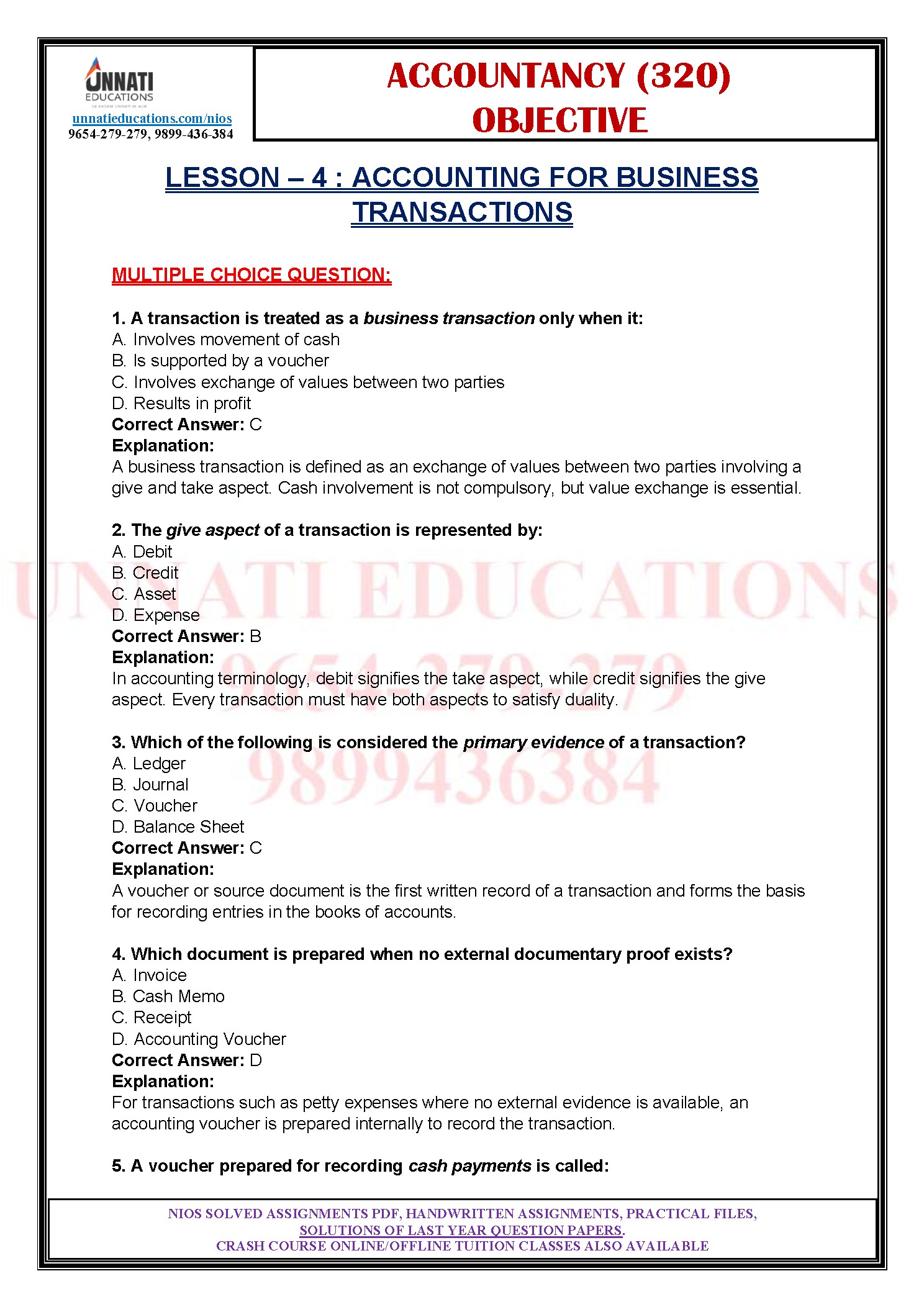
Preview one, multiple choice questions with answers and explanations.
 Preview two, fill in the blanks and one word answers from a single chapter.
 Preview three, chapter wise objective questions laid out for quick revision.
Chapter list covered in NIOS Accountancy 320 objective type questions
The full Accountancy 320 course runs across seven modules and thirty eight lessons. Our question pack concentrates on the exam heavy chapters listed below, and each row shows the specific topics we turn into objective questions so you can see the depth before you buy. Learners who also want the descriptive practice can pair this with our chapter wise NIOS Class 12 Objective Type Questions booklet.
| Lesson | Chapter name | Key topics turned into questions |
|---|---|---|
| 4 | Accounting for Business Transactions | Exchange of values, source documents, voucher types, accounting equation |
| 5 | Journal | Book of original entry, rules of debit and credit, journalising, narration |
| 6 | Ledger | Posting from journal, types of ledger, balancing of accounts |
| 12 | Errors and their Rectification | Types of errors, errors affecting trial balance, suspense account, rectifying entries |
| 13 | Computer and Computerised Accounting System | Input and output units, CPU, arithmetic and logic unit, control unit |
| 16 | Financial Statements, an Introduction | Capital and revenue items, trading account, purpose of final accounts |
| 17 | Financial Statements I | Trading and profit and loss account, gross profit, net profit, horizontal and vertical formats |
| 18 | Financial Statements II | Balance sheet, closing adjustments, outstanding and prepaid items, double effect rule |
| 19 | Not for Profit Organisation, an Introduction | Receipts and payments account, general and specific donations, service objective |
| 20 | Financial Statements of Not for Profit Organisation | Income and expenditure account, surplus and deficit, balance sheet of an NPO |
| 21 | Accounts from Incomplete Records | Single entry system, statement of affairs, net worth method, suitable business units |
| 23 | Admission of a Partner | Reconstitution, sacrificing ratio, goodwill treatment, revaluation of assets |
| 24 | Retirement and Death of a Partner | Gaining ratio, goodwill on retirement, settlement of the outgoing partner |
| 25 | Dissolution of Partnership Firm | Realisation account, settlement of accounts, order of payment of liabilities |
| 27 | Issue of Shares | Par value, shares at premium, application allotment and calls, promoters and goodwill |
| 28 | Forfeiture of Shares | Calls in arrears, forfeiture entries, share forfeiture account |
| 29 | Reissue of Forfeited Shares | Reissue at discount, capital reserve, treatment of forfeited amount |
| 32 | Accounting Ratios I | Liquidity ratios, current ratio, quick ratio, meaning and objectives |
| 33 | Accounting Ratios II | Solvency ratios, profitability ratios, turnover ratios, interpretation |
| 34 | Cash Flow Statement | Operating investing and financing activities, cash equivalents, AS-3 |
| 36 | Use of Spreadsheet in Business Applications | Cell referencing, formulas and functions, spreadsheet in accounting |
| 37 | Graphs and Charts | Chart types, plotting data, reading and building graphs |
| 38 | Database Management System | Database concepts, tables and records, queries in a DBMS |
Students preparing across classes sometimes ask for the lower level map as well, and our NIOS Class 10 Syllabus page lays that out clearly for anyone helping a younger sibling revise at the same time.
How to get the complete NIOS Class 12 Accountancy 320 Objective Type Questions
Getting the full pack is quick. Message us on WhatsApp, tell us you want the Accountancy 320 objective set for the 2026 session, and we send the complete chapter wise document across so you can start practising the same day. You get every multiple choice item, all the fill in the blanks and the one word answers for the important chapters, with the answers and short reasons attached.
Get the full pack on WhatsApp, 9654 279 279
If you have questions before you order, or you want to know what other Accountancy 320 material we stock, the same number works for a quick chat. Many students also add the NIOS Previous Year Question Paper collection so they can sit full papers under timed conditions once the objective section feels solid.
Ask a question on WhatsApp, 9899 436 384
NIOS Accountancy 320 Objective Type Questions frequently asked
Are these NIOS Accountancy 320 Objective Type Questions enough to pass the exam?
These NIOS Accountancy 320 Objective Type Questions cover the objective section thoroughly, which is a dependable scoring area in the paper. They give you a firm base for multiple choice, fill in the blanks and one word answers. For a full pass you should still practise the numerical problems and past papers, so treat this pack as the objective backbone of your revision rather than your only resource.
Which chapters do the NIOS Accountancy 320 objective questions come from?
The NIOS Accountancy 320 objective questions are drawn from the exam heavy chapters across the course, including journal and ledger, financial statements, partnership accounts, shares, accounting ratios and cash flow. The chapter table on this page lists each lesson with its specific topics so you can see the coverage. Our pack focuses on the chapters that appear most often in the objective section.
Are the answers in the NIOS Accountancy 320 pack correct and verified?
Yes, every answer in the NIOS Accountancy 320 pack is checked against the official NIOS textbook before it goes in. We build the questions from previous year papers and the prescribed text, then verify each answer and add a short reason where it helps. If you ever spot something that reads oddly, message us and we review it, since accuracy is the whole point of this set.
Is the NIOS Accountancy 320 question set updated for the 2026 session?
Yes, the NIOS Accountancy 320 question set is prepared for the 2026 session and reflects the current syllabus and recent paper trends. We revisit the pack against the latest patterns and official notifications so your practice stays relevant. When the board releases fresh sample papers, we update the objective questions to match, so you are not revising from an outdated list.
How do I receive the full NIOS Accountancy 320 Objective Type Questions after paying?
You receive the full NIOS Accountancy 320 Objective Type Questions as a document on WhatsApp soon after you confirm. Message the number on this page, ask for the Accountancy 320 objective set, and our team shares the complete chapter wise file so you can start the same day. Delivery is digital, so you can revise on your phone or print the pages you want to keep beside you.
Disclaimer: Unnati Educations is an independent academic support provider and is not affiliated with, endorsed by or associated with the National Institute of Open Schooling (NIOS). All chapter names and syllabus references belong to NIOS. Our material is prepared to help students practise and revise. Sources, the official NIOS Accountancy 320 curriculum and course text at nios.ac.in, and analysis of previous year Accountancy 320 question papers.