Every NIOS Class 12 Chemistry 313 Objective Type Questions set on this page has been built for learners who want to revise smart and walk into the 2026 examination with real confidence. We have picked the objective type questions that come up again and again, arranged them chapter by chapter, and paired each one with a clear answer and a short explanation.
Written by Prateek Talwar and reviewed by Jyoti Sharma, Senior NIOS Counsellor. Last updated on 17 July 2026.
Right below you will find genuine samples pulled straight from our full question bank, so you can judge the quality yourself before you decide to reach out. These samples form only a small slice of our wider NIOS NIOS Study Material collection that senior secondary students rely on through the year.
NIOS Class 12 Chemistry 313 Objective Type Questions for 2026
Chemistry 313 carries a heavy share of objective marks in the senior secondary paper, and that is exactly where a focused revision set makes the biggest difference. Instead of flipping through hundreds of pages, you get the questions that examiners keep returning to, sorted the way the NIOS textbook itself is sorted.
The set spans all twenty lessons of the course, from the mole concept and atomic structure right through to biomolecules and polymers. Each question mirrors the style of the actual paper, so your practice feels like the real thing rather than random guesswork.
If you are stepping up from the NIOS Class 10 Syllabus into senior secondary science, the jump in Chemistry can feel steep, which is one more reason we keep every objective question short, exam focused and easy to recall. You can review the full NIOS Class 10 Syllabus if you need to bridge any gaps before starting.
How We Prepared the NIOS Chemistry 313 Objective Type Questions
These questions were not thrown together overnight. Our subject team studied the pattern of recent papers, read through the entire NIOS Chemistry 313 textbook lesson by lesson, and marked the concepts that carry the most weight in the objective section.
We cross checked every recurring theme against each NIOS Previous Year Question Paper we could gather, so the final set reflects what actually gets asked rather than what merely looks important on paper. Where a topic appeared in more than one session, we kept the sharpest version of the question.
Every answer was then verified against the textbook and standard reference values before it went into the bank. That is why you will see worked explanations under tougher numericals, not just a bare letter as the answer.
Sample NIOS Chemistry 313 Multiple Choice Questions with Answers
Here are a few multiple choice questions from the collection so you can see the level and the clarity of the explanations for yourself.
1. Which of the following correctly represents Avogadro's constant?
(A) 6.022 × 10²³ mol
(B) 6.022 × 10²³ mol⁻¹
(C) 1.66 × 10⁻²⁴ g
(D) 3.011 × 10²² mol⁻¹
✅ Answer: (B)
Explanation: Avogadro's constant is the number of particles in one mole of a substance. It has the unit mol⁻¹, and its value is 6.022 × 10²³ mol⁻¹.
2. The empirical formula of a compound with 75% carbon and 25% hydrogen by mass is:
(A) CH (B) CH₂ (C) C₂H₄ (D) C₃H₈
✅ Answer: (B)
Explanation: Moles of C = 75 ÷ 12 = 6.25 and moles of H = 25 ÷ 1 = 25. Ratio = 6.25 : 25 = 1 : 4, giving the empirical formula CH₂.
3. How many molecules are present in 44 g of CO₂ gas?
(A) 6.022 × 10²² (B) 3.011 × 10²³ (C) 1.204 × 10²⁴ (D) 2.2 × 10²³
✅ Answer: (C)
Explanation: Molar mass of CO₂ = 44 g/mol, so 44 g = 1 mol. Since 1 mol = 6.022 × 10²³ molecules, 44 g of CO₂ contains 1.204 × 10²⁴ molecules.
4. Which of the following statements contradicts Heisenberg's Uncertainty Principle?
(A) We can simultaneously know the exact position and momentum of an electron.
(B) An orbital is a region where the probability of finding an electron is maximum.
(C) Electrons exhibit wave nature.
(D) Measurement of position affects momentum.
✅ Answer: (A)
Explanation: Heisenberg's principle states that we cannot simultaneously know the exact position and momentum of an electron.
Sample NIOS Chemistry 313 Fill in the Blanks with Answers
Fill in the blanks reward precise recall of definitions, units and constants. These four samples show the kind of clean, one line answers you can revise in seconds.
1. The molar volume of an ideal gas at STP is __________ L.
✅ Answer: 22.7
Explanation: At standard temperature and pressure, one mole of an ideal gas occupies 22.7 litres, as per the IUPAC 2009 standard.
2. One mole of a substance contains __________ elementary entities.
✅ Answer: 6.022 × 10²³
Explanation: This is Avogadro's constant, which defines the number of atoms, molecules, ions or formula units in one mole.
3. The SI unit for amount of substance is __________.
✅ Answer: mole
Explanation: The mole is the base SI unit used to count chemical particles by number, not by mass or volume.
4. The empirical formula of glucose (C₆H₁₂O₆) is __________.
✅ Answer: CH₂O
Explanation: Simplifying the ratio 6:12:6 gives 1:2:1, so the empirical formula of glucose is CH₂O.
Sample NIOS Chemistry 313 True or False Statements with Answers
True or false items test whether you can spot a small but decisive error in a statement. Read each one carefully before checking the answer.
1. Avogadro's constant has the same numerical value for atoms, molecules and ions.
✅ True
Explanation: One mole of any entity contains 6.022 × 10²³ particles, whatever the type.
2. The SI unit of luminous intensity is mole.
❌ False
Explanation: The SI unit of luminous intensity is the candela. The mole is the unit for amount of substance.
3. One mole of CO₂ contains more atoms than one mole of O₂.
✅ True
Explanation: One mole of CO₂ gives three moles of atoms while one mole of O₂ gives only two, so CO₂ has more atoms per mole.
4. The molar volume of a gas is constant at all temperatures and pressures.
❌ False
Explanation: The molar volume of 22.7 L/mol is valid only at STP. Volume changes with temperature and pressure.
Sample NIOS Chemistry 313 Match the Following with Answers
Match the following sets link related terms across two columns and appear regularly in the objective section. Here are two solved sets from the first lesson.
Set 1: Match the SI Units
| Column I (Physical Quantity) | Column II (SI Unit) |
|---|---|
| A. Amount of substance | 1. kelvin |
| B. Temperature | 2. second |
| C. Time | 3. ampere |
| D. Electric current | 4. mole |
✅ Answers: A→4, B→1, C→2, D→3. Amount of substance is measured in mole, temperature in kelvin, time in second and electric current in ampere.
Set 2: Match the Type of Chemical Species
| Column I (Compound) | Column II (Classification) |
|---|---|
| A. NaCl | 1. Diatomic molecule |
| B. CO₂ | 2. Triatomic covalent molecule |
| C. H₂ | 3. Ionic formula unit |
| D. NH₃ | 4. Molecular compound with lone pair |
✅ Answers: A→3, B→2, C→1, D→4. NaCl is an ionic formula unit, CO₂ is triatomic covalent, H₂ is diatomic and NH₃ carries a lone pair on nitrogen.
Chapter Wise NIOS Class 12 Chemistry 313 Objective Type Questions
The full bank follows the exact lesson order of the NIOS textbook, so you can revise one chapter and match it straight to the syllabus you are studying. The table below lists every lesson we cover along with the key topics that the objective questions focus on.
This chapter set sits alongside our other NIOS Class 12 Objective Type Questions resources, so you can build a complete revision routine across your subjects.
| Chapter | NIOS Chemistry 313 Lesson | Key Topics for Objective Questions |
|---|---|---|
| Lesson 1 | Atoms, Molecules and Chemical Arithmetic | Mole concept, Avogadro's constant, empirical formula, molar mass |
| Lesson 2 | Atomic Structure | Quantum numbers, orbitals, electronic configuration, uncertainty principle |
| Lesson 4 | Chemical Bonding | Ionic and covalent bonds, VSEPR shapes, hybridisation, bond polarity |
| Lesson 7 | Solutions | Concentration terms, molarity, molality, colligative properties |
| Lesson 9 | Chemical Thermodynamics | Enthalpy, entropy, Gibbs energy, first and second laws |
| Lesson 12 | Ionic Equilibrium | Acids and bases, pH, buffers, solubility product, ionisation constants |
| Lesson 13 | Electrochemistry | Electrode potential, cells, Nernst equation, conductance |
| Lesson 17 | Hydrogen and s-Block Elements | Properties of hydrogen, alkali and alkaline earth metals |
| Lesson 18 | General Characteristics of p-Block Elements | Group trends, oxidation states, inert pair effect |
| Lesson 20 | p-Block Elements and their Compounds II | Group 15 to 18 elements, oxides, oxoacids, noble gases |
| Lesson 21 | d-Block and f-Block Elements | Transition metals, variable valency, lanthanoids, actinoids |
| Lesson 22 | Coordination Compounds | Ligands, coordination number, isomerism, nomenclature |
| Lesson 23 | Nomenclature and General Principles | IUPAC naming, functional groups, isomerism basics |
| Lesson 24 | Hydrocarbons | Alkanes, alkenes, alkynes, aromatic reactions, mechanisms |
| Lesson 25 | Compounds of Carbon Containing Halogens | Haloalkanes, haloarenes, substitution and elimination |
| Lesson 26 | Alcohols, Phenols and Ethers | Preparation, properties, acidity of phenols, reactions |
| Lesson 27 | Aldehydes, Ketones and Carboxylic Acids | Carbonyl reactions, oxidation, acidity, common name tests |
| Lesson 28 | Compounds of Carbon Containing Nitrogen | Amines, basicity, diazonium salts, preparation routes |
| Lesson 29 | Biomolecules | Carbohydrates, proteins, vitamins, nucleic acids |
| Lesson 31 | Soaps, Detergents and Polymers | Cleansing action, types of polymers, addition and condensation |
What You Get in the Complete NIOS Chemistry 313 Question Bank
The samples above are only a taste. The complete bank carries a much deeper set of objective questions for every one of the twenty lessons listed in the table, all with answers and explanations in the same clean format you have just seen.
Every chapter includes four dedicated sections, namely multiple choice questions, fill in the blanks, true or false statements and solved match the following. The whole set is mapped against the latest NIOS Syllabus so nothing outside the current course sneaks in.
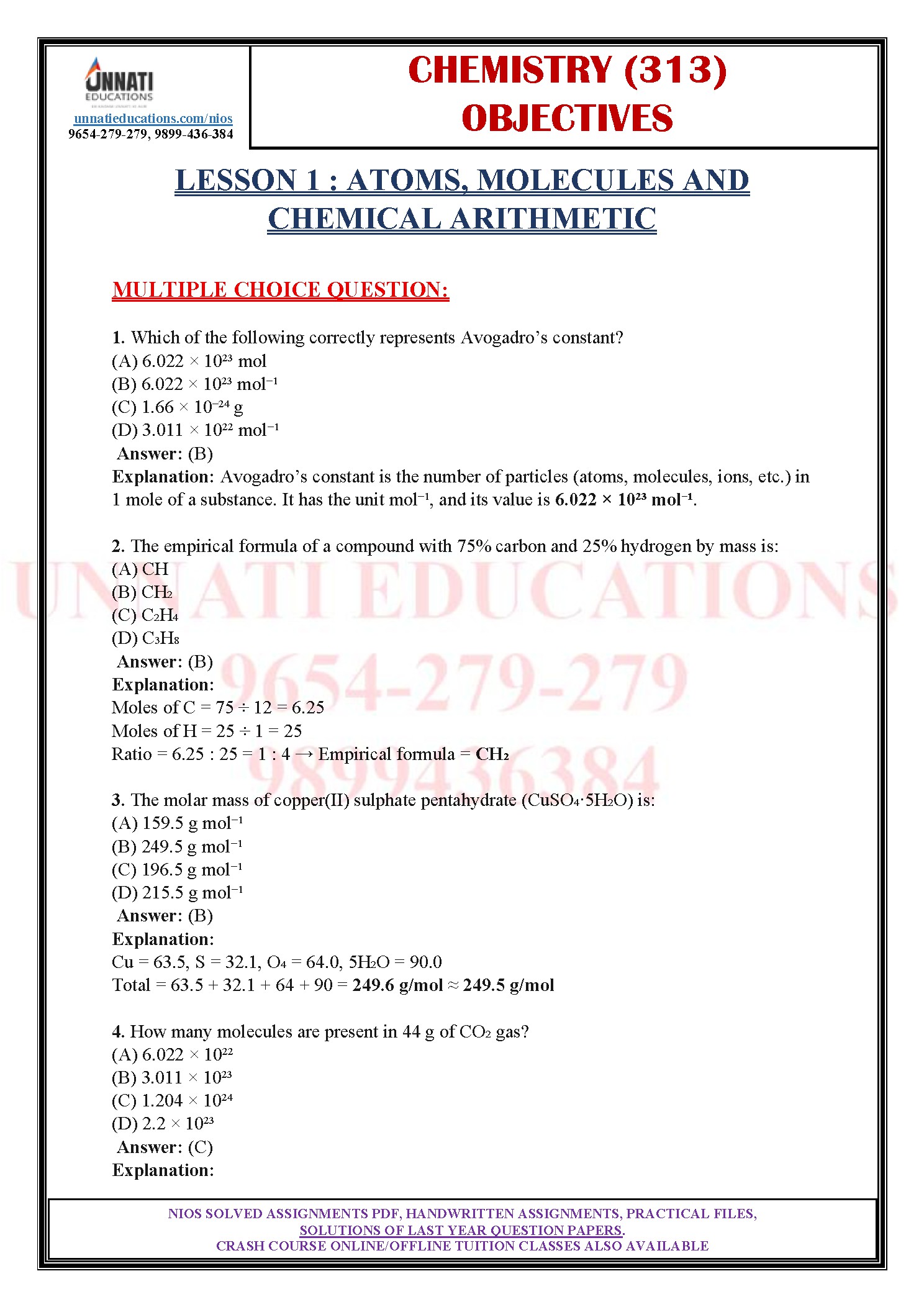
Preview page from the NIOS Chemistry 313 objective question bank.
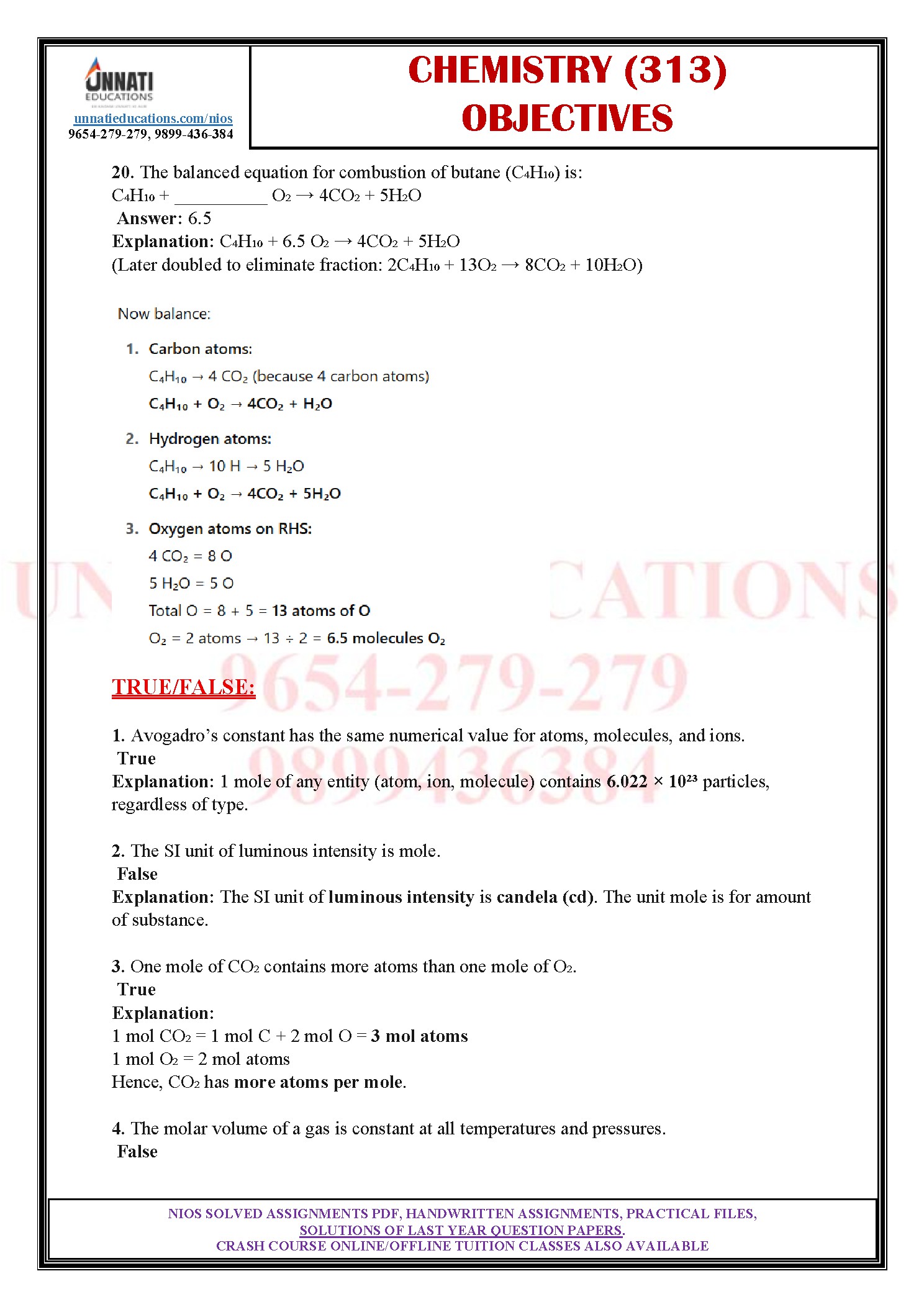 Preview page from the NIOS Chemistry 313 objective question bank." loading="lazy" />
Sample fill in the blanks and true or false statements with answers.
You get a resource that is easy to read, quick to revise and built to help you clear Chemistry 313 with room to spare. There is no filler, only the questions that give you the best return for your study time.
Want the full NIOS Chemistry 313 question bank with every chapter solved?
How to Get NIOS Class 12 Chemistry 313 Objective Type Questions for 2026
Getting the complete set is simple. Send us a message on WhatsApp telling us that you want the Chemistry 313 objective question bank, and our team will share the details and guide you through the rest. We usually reply quickly during working hours.
Reach us on 9654279279 as the first option, or on 9899436384 if the first line is busy. Mention your session year so we hand you the version prepared for the 2026 examination.
Get your copy today and start revising the smart way.
NIOS Chemistry 313 Objective Type Questions Frequently Asked Questions
What are the NIOS Chemistry 313 Objective Type Questions for 2026?
The NIOS Chemistry 313 Objective Type Questions are a curated set of objective type questions built for the 2026 senior secondary examination. They cover multiple choice questions, fill in the blanks, true or false statements and match the following across all twenty lessons, each paired with a verified answer and a short explanation so you can revise the whole course efficiently and with real understanding.
Are these NIOS Chemistry 313 objective questions based on previous year papers?
Yes, the NIOS Chemistry 313 objective questions are drawn from a careful study of recent question papers and the full textbook. Our team marked the concepts that appear most often, then framed questions in the same style examiners use. This means your practice closely matches the pattern and difficulty you will meet in the actual paper rather than random or off syllabus content.
How many chapters are covered in the NIOS Chemistry 313 Objective Type Questions?
All twenty lessons of the NIOS Chemistry 313 course are covered, from Atoms and Molecules through to Soaps, Detergents and Polymers. Each lesson has its own set of four question types, so you can revise chapter by chapter in the same order as your textbook. The full chapter list with key topics is shown in the table earlier on this page for quick reference.
Can I get the full NIOS Class 12 Chemistry objective type questions PDF?
Yes, the complete NIOS Class 12 Chemistry objective type questions set is available on request. The samples on this page show the quality and format, and the full bank carries many more solved questions for every chapter. To receive it, send us a message on WhatsApp mentioning Chemistry 313, and our team will share the details and help you get started right away.
Will these NIOS Chemistry 313 Objective Type Questions help me pass the 2026 exam?
The NIOS Chemistry 313 Objective Type Questions are designed to strengthen exactly the objective section where marks are quickest to secure. By practising recurring questions with clear answers, you sharpen recall and reduce silly mistakes. Combined with steady study of the textbook, this focused set gives you a strong, reliable base for scoring well in the 2026 Chemistry paper.
How do I contact Unnati Educations for NIOS Chemistry 313 Objective Type Questions?
You can reach Unnati Educations for the NIOS Chemistry 313 Objective Type Questions on WhatsApp at 9654279279, or on 9899436384 if the first number is engaged. Simply tell us the subject and your session year, and our team will respond with everything you need. We are happy to answer any query about the content before you decide to get the full set.
Unnati Educations is an independent academic support platform and is not affiliated with, endorsed by, or connected to the National Institute of Open Schooling (NIOS). All institution names, subject codes and question paper references are used only for identification and belong to their respective owners. Content is provided as study support based on our own analysis of publicly available material.