Every NIOS Class 12 Computer Science 330 Objective Type Questions set on this page is built from how the paper actually behaves, not from guesswork. Learners sitting the 330 exam usually want a straight answer to one thing: which objective questions keep returning, and which chapters carry the marks. Our team read the full 330 textbook lesson by lesson and worked through past papers, then shortlisted the objective questions that match the examiner's real pattern most closely.
Written by Prateek Talwar. Reviewed by Jyoti Sharma, Senior NIOS Counsellor. Last updated on 17 July 2026.
The 330 course runs from number systems and operating systems into networking, C++ programming and object oriented concepts, then finishes with databases and web design. That is a wide spread of theory and code to revise, so scoring well is less about reading everything once and more about drilling the ideas that come back paper after paper. The samples below let you judge our quality before you ask for the complete file.
NIOS Class 12 Computer Science 330 Objective Type Questions Overview
The 330 objective section rewards learners who spot patterns. Number system bases, logic gate behaviour, C++ statement types, class access rules and the purpose of a DBMS turn up in familiar shapes session after session. Our compilation groups these recurring ideas by lesson so your revision time lands on what the paper tends to ask rather than on rarely tested corners.
This page is a preview. What you see here is a real slice of our work, and the same care runs through every lesson in the full set. If you have already collected our NIOS Class 12 Objective Type Questions for other subjects, you will find the 330 file follows the same tested, chapter by chapter method.
Each objective question here carries a worked explanation, not just a letter. That matters in computer science, where a small detail decides the answer, so understanding why an option is correct helps you handle a reworded version in the exam hall.
Question Formats in NIOS Class 12 Computer Science Objective Type Questions
The full file organises every lesson into three objective formats, because the 330 paper mixes these styles and each one builds a different skill. Keeping your practice tied to the NIOS Syllabus for 330 means you meet each format in the shape the examiner prefers.
Multiple choice questions test quick recognition of a concept, a syntax rule or a number conversion. Fill in the blanks push you to recall an exact term, such as a base value, a keyword or a data structure. True and false statements sharpen your eye for the small traps that separate a correct definition from a plausible wrong one.
The samples below show three to six questions from each format so you can check the depth and accuracy for yourself. The complete file carries the full bank across every lesson listed in the coverage table further down.
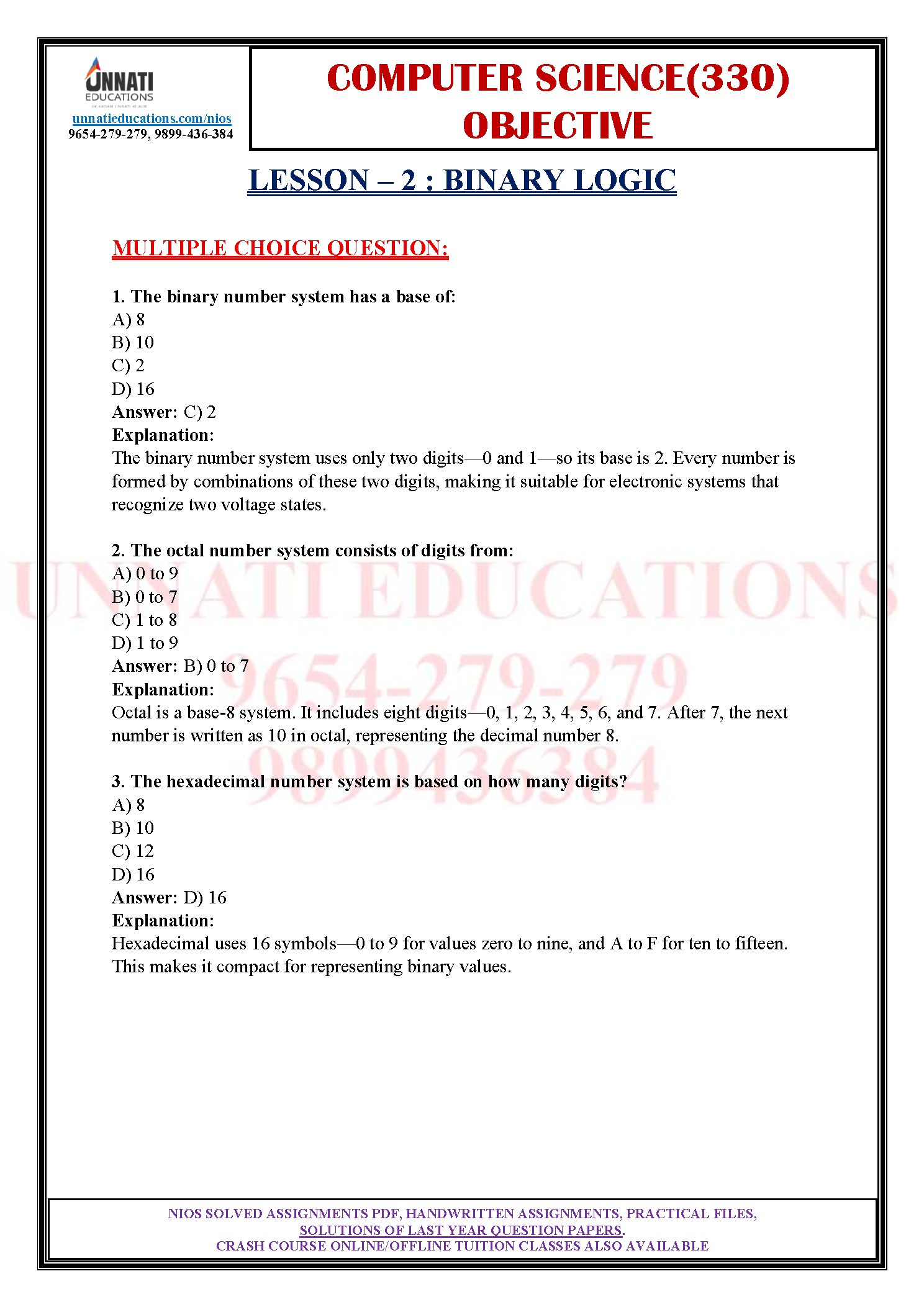
A sample page from our NIOS Computer Science 330 objective type questions file.
Sample NIOS Computer Science 330 Multiple Choice Questions with Answers
These multiple choice questions span number systems, C++ statements, classes and databases, so you can see the breadth of the full file at a glance. The chip beside each question shows which lesson it comes from.
Lesson 2
Q1. The binary number system has a base of:
A) 8 B) 10 C) 2 D) 16
Answer: C) 2. Binary uses only two digits, 0 and 1, which suits electronic systems that recognize two voltage states.
Lesson 2
Q2. The hexadecimal number system is based on how many digits?
A) 8 B) 10 C) 12 D) 16
Answer: D) 16. Hexadecimal uses 0 to 9 and A to F, which makes it a compact way to represent binary values.
Lesson 14
Q3. In C++, which of the following denotes a compound statement?
A. ; B. { a = b + c; } C. a = b + c; D. if (x > 0) x = 1;
Answer: B. A compound statement is one or more statements enclosed within braces, treated as a single unit.
Lesson 18
Q4. A class in C++ is best described as:
A) A predefined library type B) A user-defined data type that binds data and functions together C) A pointer variable D) A template function
Answer: B. A class groups related data and functions into one logical unit, which supports encapsulation.
Lesson 18
Q5. By default, members of a class are declared as:
A) Public B) Private C) Protected D) Global
Answer: B) Private. With no access specifier given, members are private, so direct external access is restricted.
Lesson 23
Q6. The main purpose of a Database Management System is:
A. To print data B. To manage hardware C. To control, organize and share data D. To delete old files
Answer: C. A DBMS gives centralized control over data, allowing storage, retrieval and multi-user access without duplication.
Sample NIOS Computer Science 330 Fill in the Blanks with Answers
Fill in the blanks reward exact recall of a key term. In the full file these run across every lesson, and the examples below mix number systems with databases to show the range.
Lesson 2
Q1. The binary number system has a base of ________.
Answer: 2
Lesson 2
Q2. In hexadecimal notation, the symbol 'A' represents the decimal value ________.
Answer: 10
Lesson 23
Q3. A ________ is an organized collection of interrelated data stored for easy access and processing.
Answer: Database
Lesson 23
Q4. A ________ is a software system that enables users to define, create and manipulate databases.
Answer: Database Management System (DBMS)
Sample NIOS Computer Science 330 True and False Statements with Answers
True and false statements catch the small misreadings that cost easy marks. Decide your answer first, then confirm with the short reasoning we provide in the full file.
Lesson 2
Q1. Digital computers internally represent and process data using the binary number system. Answer: True. Circuits store information as 0 and 1, matching two stable on and off states.
Lesson 2
Q2. Representing numbers in binary form is more efficient for humans than for computers. Answer: False. Binary suits computers, but long strings of 0s and 1s are hard for humans, who prefer decimal.
Lesson 2
Q3. Binary, octal, decimal and hexadecimal can each represent any numeric value without loss of information. Answer: True. Each system is mathematically complete, so values convert exactly between them.
Lesson 2
Q4. The octal number 10 is equivalent to decimal 8. Answer: True. In base eight, 10 means one eight and zero units, which is 8 in decimal.
 True and false statements as they appear in our NIOS Computer Science 330 file.
High Scoring Areas in NIOS Computer Science 330 Objective Type Questions
Some chapters simply pay back more revision time than others. Across recent 330 papers, the C++ programming block gives the most reliable objective marks for learners who practise steadily.
Control statements, functions, arrays and classes with constructors form a cluster where questions repeat in predictable shapes, so learners who master these rarely lose easy marks. Inheritance and pointers add a slightly harder band that still rewards clear understanding of base and derived classes and of address handling.
On the theory side, binary logic, database management systems and web designing with HTML reward accurate recall of definitions and syntax. Our file front-loads extra questions in these areas because a small, well-chosen set of facts converts into marks quickly here.
Chapter Wise NIOS Class 12 Computer Science Objective Type Questions Coverage
The complete file covers every public examination lesson in the 330 course, with the key topics you should expect in each. The table below lists each lesson we include, along with the specific ideas the objective questions focus on, so you can see exactly where your revision effort will go.
If you are still assembling your wider preparation, our broader NIOS Study Material collection sits alongside this file and covers solved assignments, question papers and notes for the same session.
| Lesson | Chapter Name | Key Topics in the Questions |
|---|---|---|
| 2 | Binary Logic | Number systems and bases, logic gates, binary states |
| 4 | Operating Systems | Functions of an OS, Windows basics, process and file handling |
| 5 | Data Communication and Networking | Transmission modes, network protocols, topologies |
| 6 | Communications on Internet | Internet services, email and the web, common protocols |
| 8 | Digital Documentation | Word processing, text formatting, tables in documents |
| 9 | Spreadsheets | Cells and formulae, built-in functions, charts |
| 10 | Digital Presentation | Slides and layouts, transitions, multimedia objects |
| 14 | Control Statements | Compound and null statements, if and else, loops |
| 15 | Functions | Function definition, arguments, return values |
| 16 | Array | One and two dimensional arrays, indexing, traversal |
| 17 | Structure, Typedef and Enumerated Data Type | Structures, typedef, enumerated types |
| 18 | Classes and Objects with Constructors and Destructors | Class and object, access specifiers, constructors |
| 19 | Inheritance: Extending Classes | Base and derived classes, modes of inheritance, reusability |
| 20 | Pointer | Address and dereference operators, pointer arithmetic, dynamic memory |
| 21 | Files | File streams, reading and writing, file modes |
| 23 | Database Management Systems | Database and DBMS, data redundancy, keys |
| 24 | Web Designing using HTML | HTML tags, page structure, attributes |
| 25 | Inserting Images and Lists in a Web Page | Image tag, ordered and unordered lists, attributes |

A lesson opening from our NIOS Computer Science 330 objective questions file.
How We Prepared These NIOS Computer Science 330 Objective Type Questions
These questions did not come from a single source. The shortlist grew out of three readings run side by side, and only the questions that survived all three made the final file.
First, we mapped the topics that repeat across earlier 330 papers. Studying a stack of our NIOS Previous Year Question Paper archives made it clear which areas of theory, programming and databases the examiner returns to almost every session.
Second, we read the entire NIOS 330 textbook, lesson by lesson, so no examinable idea was skipped. Every check your progress prompt and terminal exercise was treated as a hint about what the board sees as core.
Third, we weighed each lesson by its likely exam value. The programming chapters on control statements, functions, arrays and classes tend to carry dependable marks, while binary logic, networking and databases reward learners who remember precise definitions. The number of questions per lesson in our file reflects that balance.
This is why the set reads like exam preparation and not like a padded worksheet. Nothing here is stretched to look longer, and nothing that matters is quietly dropped.
Get the Complete NIOS Class 12 Computer Science 330 Objective Type Questions
The samples above are a small share of the file. The complete NIOS Computer Science 330 objective file carries the full question bank for all eighteen public examination lessons, every question answered and explained, in the three formats you saw here.
To receive the full file, message us on WhatsApp and tell us you want the 330 Computer Science objective set for 2026. We will share the details and help you get started the same day.
Message us on WhatsApp for the full 330 file
FAQs on NIOS Computer Science 330 Objective Type Questions
Are these NIOS Class 12 Computer Science 330 Objective Type Questions updated for the 2026 exam?
Yes. This NIOS Computer Science 330 set is prepared for the 2026 session by reading recent 330 papers and the current textbook. We refresh the shortlist each session so the objective questions stay aligned with the pattern the board is using now, rather than an older one that no longer reflects how the paper is framed today for this subject.
Which lessons do the NIOS Computer Science 330 Objective Type Questions cover?
The full NIOS Computer Science 330 file covers all eighteen public examination lessons, from binary logic and operating systems through networking, C++ programming, classes, pointers, databases and web design. Every lesson in the coverage table above appears with multiple choice, fill in the blanks and true and false questions, so no examinable chapter is left out of your revision.
Do the NIOS Class 12 Computer Science 330 objective questions come with answers?
Every question in the NIOS Computer Science 330 file has a worked answer. For concept and syntax based items we add a short explanation, not only the correct option, so you understand the reasoning. This helps you handle a reworded version of the same idea in the exam, which is often how objective marks are gained or lost on the day.
How do the NIOS Computer Science 330 Objective Type Questions help me pass the exam?
The NIOS Computer Science 330 questions focus your revision on ideas the examiner repeats, so your effort lands where the marks are. Objective questions are often the steadiest scoring part of the paper, and practising the recurring definitions, syntax rules and conversions builds the speed and accuracy you need to clear the 330 exam with real confidence.
Alongside Computer Science 330, where can I find NIOS syllabus for other classes?
Beyond this NIOS Computer Science 330 file, we keep resources across the board, including the NIOS Class 10 Syllabus for learners at the secondary stage. Senior secondary students can pair the 330 questions with our subject notes and past papers to build a complete revision plan for whichever subjects they have registered for this year.
How do I get the complete NIOS Computer Science 330 Objective Type Questions file?
Message us on WhatsApp and ask for the NIOS Computer Science 330 objective set for 2026. We will confirm the details and share access quickly, usually the same day. The samples on this page reflect the quality of the full file, so you know exactly what standard of objective questions and answers you will receive before you decide to reach out to us.
Unnati Educations is an independent academic support platform and is not affiliated with, endorsed by, or officially connected to the National Institute of Open Schooling (NIOS). The 330 course code and NIOS name are used only for identification and reference. Sources: NIOS senior secondary Computer Science (330) textbook and previous year 330 question papers.