Economics rewards students who revise the right questions rather than reading every chapter end to end, and that is exactly what this page is built for. Here you will find a hand-picked set of NIOS Class 12 Economics 318 Objective Type Questions with answers for the 2026 session, put together after studying past papers and working through the full NIOS Economics textbook. Real samples from each objective format are shown below so you can judge the quality before you ask for the complete set.
Written by Prateek Talwar · Reviewed by Jyoti Sharma, Senior NIOS Counsellor · Last updated 17 July 2026
We have kept the wording plain and the answers short, since most learners revising for the paper want a clear yes or no and a quick reason, not long theory. Every sample carries the correct answer with a one-line explanation, so you learn why an option is right instead of memorising it blindly. Read the samples first, then decide.
NIOS Class 12 Economics 318 Objective Type Questions for the 2026 Session
Economics 318 blends statistics with microeconomics and macroeconomics, so a learner needs to be comfortable with numbers, diagrams and definitions in equal measure. This collection distils the ideas that examiners return to most often into three objective formats, giving you a resource you can finish across a few focused sittings and still feel ready for the objective section of the paper.
The set is aligned to the current session so the coverage matches what students can expect in 2026. If you want to see how this subject sits within the wider course before you begin revising, our NIOS Syllabus page lays out the structure clearly, which pairs neatly with the topic table further down.
How These NIOS Class 12 Economics Objective Type Questions Were Prepared
These NIOS Class 12 Economics Objective Type Questions were not lifted from a single guide. Our team went through several years of question papers to see which concepts keep coming back, then read the complete NIOS Economics textbook lesson by lesson so that no examinable idea was missed. Only after that groundwork did we frame the questions, which is why each one reflects both the book and the real examination style.
To keep the practice grounded in reality, we checked those recurring patterns against the actual papers in our NIOS Previous Year Question Paper collection. That comparison shaped the three formats you see on this page, namely multiple choice, fill in the blanks, and true and false statements.
The three objective formats you get for every lesson
Multiple choice questions build quick recognition of the right option under exam pressure. Fill in the blanks test whether you recall exact terms, formulae and definitions. True and false statements catch the fine misconceptions that quietly cost marks, especially in national income and money topics. Together these formats mirror the objective portion of the Economics 318 paper closely.
Chapter Wise List of NIOS Economics 318 Topics Covered
The full booklet covers all eighteen lessons of the Economics 318 course, moving from statistical methods into microeconomics and then macroeconomics. The table below lists each lesson with its NIOS code and the specific topics it focuses on, so you can head straight to the areas you find trickiest. The samples further down are drawn from a few of these lessons.
| S. No. | Lesson | Chapter Name | Key Topics in This Lesson |
|---|---|---|---|
| 1 | L-8 | Measures of Central Tendency | Mean, median and mode; positional averages; step deviation method |
| 2 | L-9 | Measures of Dispersion | Range and quartile deviation; mean deviation; standard deviation |
| 3 | L-10 | Correlation Analysis | Karl Pearson coefficient; rank correlation; scatter diagram |
| 4 | L-11 | Index Numbers | Laspeyres and Paasche; cost of living index; base year |
| 5 | L-13 | Central Problems of an Economy | What, how and for whom to produce; production possibility curve |
| 6 | L-15 | Demand | Law of demand; demand schedule; individual and market demand |
| 7 | L-16 | Price Elasticity of Demand | Elastic and inelastic demand; percentage method; total outlay method |
| 8 | L-18 | Cost of Production | Explicit and implicit cost; fixed and variable cost; opportunity cost |
| 9 | L-19 | Supply | Law of supply; supply schedule; determinants of supply |
| 10 | L-20 | Price Elasticity of Supply | Elastic and inelastic supply; measurement; role of time |
| 11 | L-21 | Forms of Market | Perfect competition; monopoly; oligopoly features |
| 12 | L-22 | Price Determination under Perfect Competition | Equilibrium price; demand and supply intersection; market clearing |
| 13 | L-24 | National Income and Related Aggregates | GDP and GNP; factor cost and market price; gross and net |
| 14 | L-25 | National Income and its Measurement | Value added method; income method; expenditure method |
| 15 | L-26 | Consumption, Saving and Investment | Consumption function; MPC and MPS; investment demand |
| 16 | L-27 | Theory of Income Determination | Aggregate demand; the multiplier; equilibrium income |
| 17 | L-28 | Money and Banking | Functions of money; measures M1 to M4; credit creation |
| 18 | L-29 | Government and the Budget | Revenue and capital budget; fiscal deficit; direct and indirect taxes |
If you would like the same lesson wise treatment for your other subjects, our NIOS Class 12 Objective Type Questions section groups these booklets subject by subject so your revision stays tidy through the whole year.
Sample NIOS Economics 318 Multiple Choice Questions
Here are six multiple choice samples taken straight from the booklet, drawn from statistics, microeconomics and macroeconomics so you can see the spread. Each carries the correct option and a short reason, and every extract is kept word for word from the source.
Measures of Central Tendency
Q1. Which of the following is not a positional average?
A) Median
B) Mode
C) Arithmetic Mean
D) Quartile
Answer: C
Explanation: Arithmetic Mean is a mathematical average, while median, mode, and quartile are positional averages.
Measures of Central Tendency
Q2. Which of the following is least affected by extreme values?
A) Mean
B) Mode
C) Median
D) Weighted Mean
Answer: C
Explanation: Median is based on the central position, not magnitude, so it's robust to extremes.
Demand
Q3. In economics, a desire becomes a demand only when it is backed by:
A) Need
B) Willingness to buy
C) Ability and willingness to pay
D) Government support
Answer: C
Explanation: Demand = desire + purchasing power + willingness to spend.
Demand
Q4. Which of the following statements qualifies as demand?
A) Mr. Raj wants a car.
B) Mr. Raj has money but doesn't want a car.
C) Mr. Raj wants and is willing to buy a car for ₹10 lakhs.
D) Mr. Raj is thinking about cars.
Answer: C
Explanation: Demand requires both desire and ability/willingness to pay.
Money and Banking
Q5. The main reason barter system failed in a complex economy is:
A) Use of metallic money
B) Invention of double entry bookkeeping
C) Lack of double coincidence of wants
D) Rise in inflation
Answer: C
Explanation: Without double coincidence, direct exchange becomes inefficient.
Money and Banking
Q6. Which component is not included in M1?
A) Currency with the public
B) Demand deposits
C) Time deposits
D) Other deposits with RBI
Answer: C
Explanation: M1 includes only liquid forms of money.
Sample Economics 318 Fill in the Blanks Questions
The fill in the blanks format checks whether you remember the exact term, formula or definition. These samples come from the statistics and cost of production lessons, and they appear here exactly as in the booklet.
Measures of Central Tendency
Q1. The arithmetic mean of a continuous series is calculated using __________ of class intervals and corresponding frequencies.
Answer: mid-points
Explanation: Mid-points represent central values of each class and are used in the calculation.
Cost of Production
Q2. The cost incurred by a firm for which there is an actual cash payment is called __________ cost.
Answer: explicit
Explanation: Explicit costs involve direct monetary outlay, e.g., wages, rent.
Cost of Production
Q3. The opportunity cost of using self-owned resources in production is known as __________ cost.
Answer: implicit
Explanation: It refers to the income foregone from self-used inputs like land or labour.
Measures of Central Tendency
Q4. Median is a measure of __________ average.
Answer: positional
Explanation: It depends on the position, not the magnitude.
Cost of Production
Q5. Total cost is the sum of total fixed cost and total __________ cost.
Answer: variable
Explanation: TC = TFC + TVC
Sample Economics 318 True and False Statements
True and false statements are where small slips cost marks, because a single word flips the meaning. Read each one slowly. These samples are from the central tendency and national income lessons and are reproduced without any change.
Measures of Central Tendency
Q1. The arithmetic mean is always equal to the median.
Answer: False
Explanation: Only true in symmetric distributions. Otherwise, they differ.
Measures of Central Tendency
Q2. Mode is not affected by extremely high values in the dataset.
Answer: True
Explanation: Mode depends on frequency, not magnitude.
National Income and Related Aggregates
Q3. Transfer payments are included in national income since they increase household wealth.
Answer: False
Explanation: They are non-factor incomes, not earned via production.
National Income and Related Aggregates
Q4. GDP at market price includes only final goods and services.
Answer: True
Explanation: Intermediate goods are excluded to avoid double counting.
National Income and Related Aggregates
Q5. Depreciation increases the value of national income.
Answer: False
Explanation: Depreciation is deducted to arrive at net values.
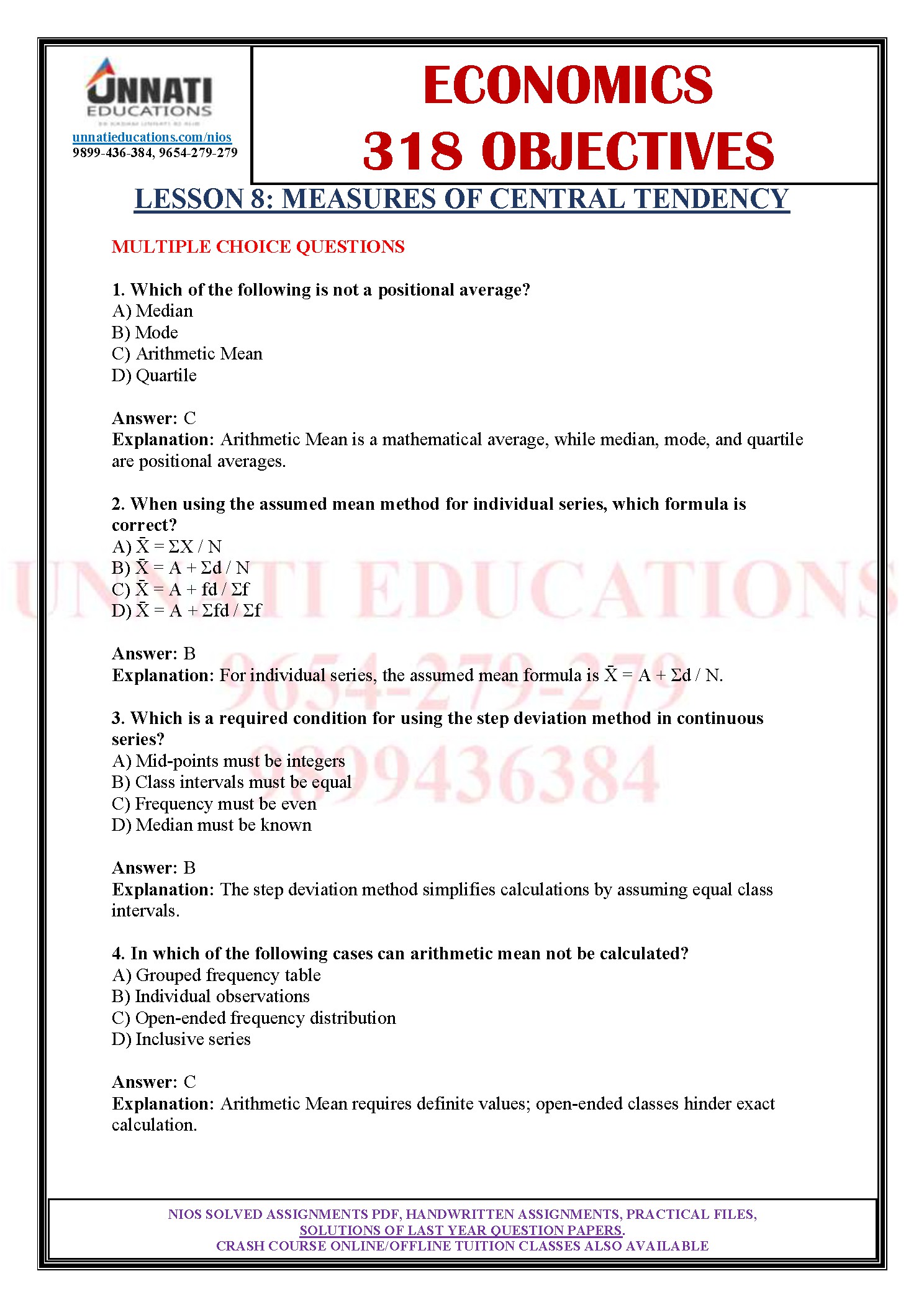
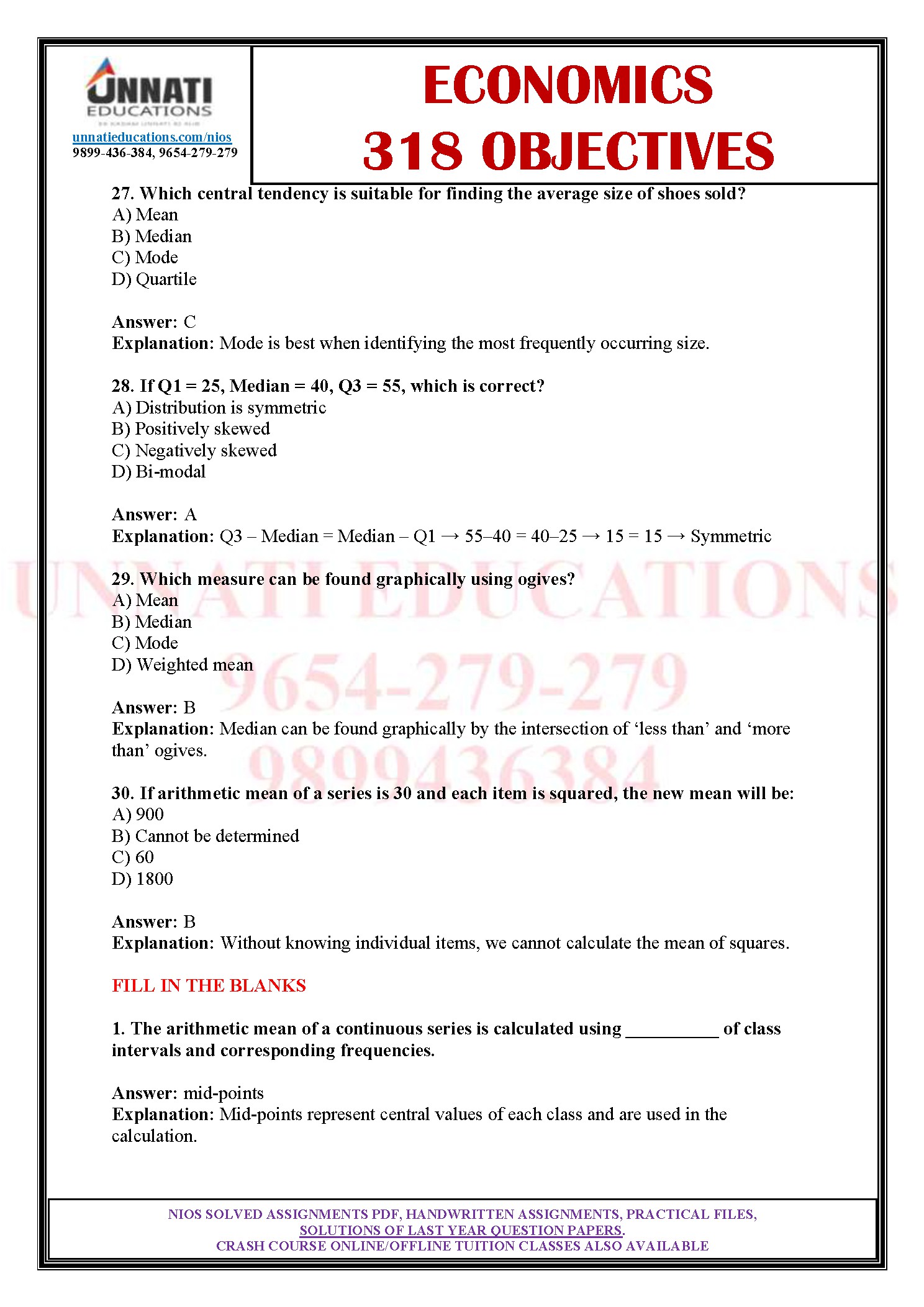
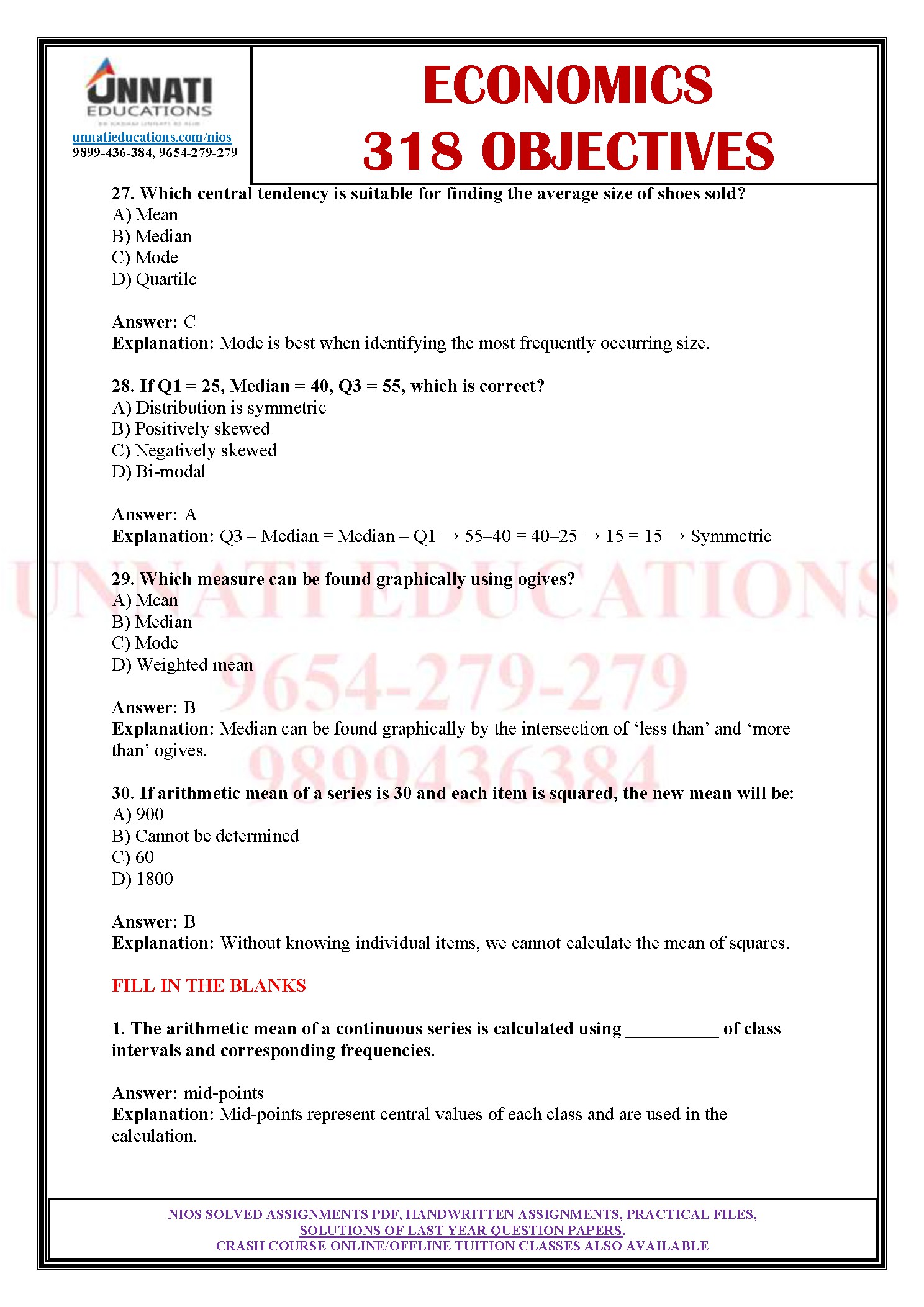
Sample Pages from the NIOS Economics 318 Booklet
To show you the format and print quality, here are a few sample pages from the actual booklet. The full version keeps this same clean layout across all eighteen lessons, so revision stays comfortable on both phone and paper.
 " loading="lazy" />Fill in the blanks and true false sample
 " loading="lazy" />Fill in the blanks and true false sample" loading="lazy" />
Multiple choice sample page
Want the complete Economics 318 question set?
These are only a handful of samples. The full booklet carries every multiple choice, fill in the blanks, and true and false question with answers for all eighteen lessons. Message us on WhatsApp and we will share the details.
Get the Complete NIOS Class 12 Economics 318 Objective Type Questions Booklet
The complete Economics 318 objective question booklet is built for one job, helping you clear the paper with less guesswork. It brings every objective format for all eighteen lessons into one document, with a correct answer and a short reason under each question. That means your time goes into practising, not hunting through scattered notes and old files.
You also get answers explained in plain words, so a topic like the multiplier or credit creation that felt hard in class starts to click on revision. If you prefer to study several subjects together, browse our wider NIOS Study Material so your Economics preparation sits alongside the rest of your session in one place.
Request your copy today
Send a quick message and tell us you need the Economics 318 objective question booklet for 2026. Our team replies with the sample check, pricing and delivery over WhatsApp so you can decide with full clarity.
Who Benefits Most from These NIOS Economics 318 Objective Questions
Repeaters and first-time candidates both gain from these NIOS Economics 318 Objective Questions, because objective marks are the easiest to lock in with focused practice. Learners short on time can revise the whole objective section quickly, while those chasing a higher score can use the explanations to close gaps in the numerical and theory parts alike.
Self-study candidates find the set especially handy, since it replaces guesswork with a clear map of what to expect. If you are a junior still choosing your stream, comparing the study load through the NIOS Class 10 Syllabus can help you plan ahead before you reach the senior secondary Economics paper.
NIOS Class 12 Economics Objective Type Questions FAQs
How many questions does the full NIOS Economics 318 booklet contain?
The full NIOS Economics 318 booklet carries a large question bank spread across all eighteen lessons of the course. Each lesson includes multiple choice questions, fill in the blanks, and true and false statements with answers. The exact count is shared over WhatsApp when you request the booklet, since we refresh the set every session so it stays aligned with the current examination pattern for the year.
Do these NIOS Class 12 Economics Objective Type Questions include answers and explanations?
Yes, every item in the NIOS Class 12 Economics Objective Type Questions set comes with a clearly marked correct answer. Most questions also carry a short one-line explanation that tells you why the answer is right. This helps you grasp the concept during revision instead of only memorising options, which is what makes the objective section of the paper far easier to score.
Are the NIOS Economics 318 objective type questions based on the 2026 pattern?
These NIOS Economics 318 objective type questions are prepared for the 2026 session and follow the current examination pattern. We build them by studying recent question papers and the complete NIOS Economics textbook, so the topics and formats reflect what students can realistically expect. The set is updated each session, which keeps your practice matched to the latest structure of the paper.
Which chapters of Economics 318 are covered in these Objective Type Questions?
All eighteen lessons of Economics 318 are covered, running from Measures of Central Tendency through to Government and the Budget. The chapter table on this page lists every lesson with its code and key topics. Samples shown here are drawn from central tendency, demand, cost of production, money and national income, while the full booklet spans the entire course from statistics to macroeconomics.
Can I get the NIOS Economics 318 Objective Type Questions in PDF on WhatsApp?
Yes, the NIOS Economics 318 Objective Type Questions are delivered conveniently once you contact us on WhatsApp. Simply send a message saying you need the Economics 318 objective booklet for 2026, and our team replies with the format details, pricing and delivery. Sharing over WhatsApp keeps the process quick and lets you clear any doubt about the material directly with us.
Do these Economics 318 objective questions cover both statistics and theory topics?
Yes, these Economics 318 objective questions span the full range of the course. You get numerical based items from statistics lessons like central tendency and dispersion, alongside conceptual questions from microeconomics and macroeconomics such as demand, cost, money and national income. This balance mirrors the real paper, where both calculation and theory carry weight in the objective section.
Disclaimer: Unnati Educations is an independent academic support platform and is not affiliated with, endorsed by, or officially connected to the National Institute of Open Schooling (NIOS). All study material is prepared for learning and revision assistance only. Learners should always confirm the current syllabus and examination pattern on the official NIOS portal.
Sources and references: Questions prepared from the NIOS Economics (318) senior secondary textbooks and analysis of previous year question papers. Syllabus and examination details verified against the official NIOS website at nios.ac.in. Booklet edition updated for 2026.