Every NIOS Class 12 Environmental Science 333 Objective Type Questions set on this page is built for learners who want to revise with purpose and sit the 2026 examination feeling prepared. We have gathered the objective questions that keep coming back, kept them in the same lesson order as your textbook, and attached a clear answer with a short explanation to each one.
Written by Prateek Talwar and reviewed by Jyoti Sharma, Senior NIOS Counsellor. Last updated on 17 July 2026.
Just below, you can read genuine samples taken straight from our full question bank and judge the quality for yourself before you get in touch. These form a small part of our wider NIOS Study Material collection that senior secondary students rely on through the year.
NIOS Class 12 Environmental Science 333 Objective Type Questions for 2026
Environmental Science 333 rewards students who can recall definitions, classifications and cause and effect links quickly, and that is precisely what the objective section tests. Rather than rereading the whole book, you get the questions examiners return to most, sorted the way the syllabus itself is arranged.
The set spans every lesson in the course, from Environment and Human Society and Principles of Ecology through to Global Environmental Issues, Sustainable Development and Energy Conservation. Each item matches the tone of the real paper, so your practice feels like sitting the exam rather than guessing at random.
If you are stepping up from the NIOS Class 10 Syllabus into senior secondary science, the jump in depth can feel steep, which is why we keep every objective question short and firmly exam focused. You can review the full NIOS Class 10 Syllabus if you want to close any gaps before you begin.
Sample NIOS Environmental Science 333 Multiple Choice Questions with Answers
Here are a few multiple choice questions from the collection so you can see the level and how clearly each answer is explained.
Lesson 2 · Environment and Human Society
Q1. Which of the following statements correctly explains the limitation of fresh water availability on earth?
A) All fresh water is available in rivers and lakes
B) 80% of fresh water is frozen at higher latitudes and mountain tops
C) 80% of fresh water is available for human consumption
D) Most fresh water is stored in oceans
Correct Answer: B
Explanation: Although water is abundant on earth, almost 80% of fresh water remains frozen at higher latitudes and mountain tops. Only about 20% is available in liquid form, which explains rising water scarcity even though water is a renewable resource.
Lesson 2 · Environment and Human Society
Q2. Which of the following is correctly classified as an abiotic resource?
A) Microorganisms B) Metal ores C) Silk worm D) Goat
Correct Answer: B
Explanation: Abiotic resources are non-living physical resources of nature such as land, water, energy, fossil fuels and minerals. Metal ores like aluminium, iron and copper are abiotic, while the other options are living, and therefore biotic, resources.
Lesson 10 · Environmental Pollution
Q3. Environmental pollution can be best defined as:
A) Increase in population density
B) Undesirable change in physical, chemical or biological characteristics of the environment
C) Natural climatic variation
D) Seasonal fluctuation in temperature
Correct Answer: B
Explanation: Pollution refers to any undesirable alteration in the physical, chemical or biological components of air, water or land that harms living organisms and property. It is not merely population growth or seasonal change but a damaging shift in environmental quality.
Lesson 10 · Environmental Pollution
Q4. A pollutant is:
A) Any natural component of the biosphere
B) A substance present in excess concentration causing harm
C) A nutrient required for plant growth
D) A biodegradable household waste
Correct Answer: B
Explanation: A pollutant is any solid, liquid or gaseous substance present in the environment in such concentration that it produces harmful effects. Even useful substances can become pollutants once their concentration crosses permissible limits.
Sample NIOS Environmental Science 333 Fill in the Blanks with Answers
Fill in the blanks reward precise recall of key terms and figures. These samples show the kind of clean, one line answers you can revise in seconds.
Lesson 2 · Environment and Human Society
Q1. Almost 80% of the earth's fresh water remains __________ at higher latitudes and mountain tops.
Answer: frozen
Explanation: Most fresh water is locked in frozen form in glaciers and polar regions. Only a small portion remains liquid and available for human use, which explains growing scarcity even though water is renewable.
Lesson 2 · Environment and Human Society
Q2. Petroleum and natural gas are classified as __________ energy resources.
Answer: non-renewable
Explanation: Petroleum and natural gas are fossil fuels formed over millions of years. Since they cannot be replenished within a human lifetime, they are non-renewable and are being depleted rapidly through overuse.
Lesson 2 · Environment and Human Society
Q3. The prime source of energy for the earth is __________ radiation.
Answer: solar
Explanation: Solar radiation provides the basic energy for life processes, climate systems and even the indirect formation of fossil fuels. Other forms such as wind and biogas are ultimately derived from solar energy.
Lesson 2 · Environment and Human Society
Q4. Plants, animals and microorganisms together constitute the __________ resources of nature.
Answer: biotic
Explanation: Biotic resources are the living components of the environment. They supply food, fibre and many raw materials, and they can renew themselves through natural biological processes.
Sample NIOS Environmental Science 333 True or False Statements with Answers
True or false items check whether you can spot a small but decisive error in a statement. Read each one carefully before you look at the answer.
Lesson 14 · Global Environmental Issues
Q1. Environmental issues remain confined within national boundaries and do not affect other regions.
Answer: False
Explanation: Environmental issues are global in nature because the environment has no frontiers. Air, water, radiation and pollutants move across regions, so problems that begin in one area can affect distant ecosystems.
Lesson 14 · Global Environmental Issues
Q2. The greenhouse effect occurs because incoming solar radiation is completely blocked by the atmosphere.
Answer: False
Explanation: Solar radiation is not blocked. It enters the atmosphere and reaches the surface. The warming arises when outgoing infrared radiation from the earth is trapped by greenhouse gases, not from any blocking of incoming sunlight.
Lesson 14 · Global Environmental Issues
Q3. Infrared radiations emitted by the earth's surface are absorbed and reradiated by atmospheric gases.
Answer: True
Explanation: The earth emits long wavelength infrared radiation after absorbing solar energy. These radiations are absorbed by atmospheric gases and sent back towards the earth, warming the lower atmosphere, which is central to the greenhouse effect.
Lesson 14 · Global Environmental Issues
Q4. Without the natural greenhouse effect, the earth's average temperature would be suitable for life.
Answer: False
Explanation: The natural greenhouse effect keeps the earth's average temperature at about 15 degrees Celsius. Without it, the temperature would fall to around minus 17 degrees Celsius, far too cold for life to survive.
Sample NIOS Environmental Science 333 Match the Following with Answers
Match the following sets link related ideas across two columns and appear regularly in the objective section. Here is one solved set on human evolution.
Set 1: Human Evolution
| Column I | Column II |
|---|---|
| (i) Australopithecus | (A) Big game hunters |
| (ii) Homo erectus | (B) Discovered fire |
| (iii) Common ancestor of apes and humans | (C) Divergence about 6 million years ago |
| (iv) Homo sapiens sapiens | (D) Modern humans |
| (v) Neanderthals | (E) First bipedal human ancestor |
Answers: (i)→(E), (ii)→(B), (iii)→(C), (iv)→(D), (v)→(A). Australopithecus was the first bipedal ancestor, Homo erectus discovered fire, apes and humans diverged around 6 million years ago, Homo sapiens sapiens are modern humans and Neanderthals were big game hunters.
Chapter Wise NIOS Class 12 Environmental Science 333 Objective Type Questions
The full bank follows the exact lesson order of the NIOS textbook, so you can revise one lesson and line it up directly with what you are studying. The table below lists every lesson we cover along with the key topics the objective questions focus on.
This chapter set sits alongside our other NIOS Class 12 Objective Type Questions resources, so you can build one steady revision routine across all your subjects.
| Lesson | NIOS Environmental Science 333 Lesson | Key Topics for Objective Questions |
|---|---|---|
| Lesson 2 | Environment and Human Society | Biotic and abiotic resources, renewable and non-renewable resources, human evolution |
| Lesson 3 | Degradation of Natural Environment | Causes of degradation, resource depletion, soil and land degradation |
| Lesson 4 | Principles of Ecology | Levels of ecology, adaptations, population and community |
| Lesson 5 | Ecosystem | Components, food chain and food web, energy flow, ecological pyramids |
| Lesson 6 | Natural Ecosystem | Forest and grassland, aquatic ecosystems, desert ecosystem |
| Lesson 8 | Human Societies | Hunting and gathering, agricultural and industrial society, impact on nature |
| Lesson 9 | Deforestation | Causes and effects, afforestation, forest conservation measures |
| Lesson 10 | Environmental Pollution | Pollutants, air and water pollution, primary and secondary pollutants |
| Lesson 11 | Environment and Health | Water borne diseases, air pollution and health, vector borne diseases |
| Lesson 13 | National Environmental Issues | Floods and droughts, waste management, problems of urbanisation |
| Lesson 14 | Global Environmental Issues | Greenhouse effect, global warming, ozone depletion, acid rain |
| Lesson 15 | Biodiversity Conservation | Biodiversity hotspots, in situ and ex situ conservation, endangered species |
| Lesson 18 | Water and Energy Conservation | Need for conservation, efficient use, conservation methods |
| Lesson 19 | Concept of Sustainable Development | Meaning and need, guiding principles, balancing resource use |
| Lesson 21 | Concept of Sustainable Agriculture | Organic farming, crop rotation, integrated pest management |
| Lesson 23 | Environmental Legislation | Major environmental Acts, Wildlife Protection Act, pollution control boards |
| Lesson 24 | Environmental Impact Assessment | EIA process, objectives, screening and scoping stages |
| Lesson 29A | Fresh Water Resources | Distribution of water, surface water and groundwater, water scarcity |
| Lesson 29B | Renewable Sources of Energy I | Solar and wind energy, advantages, everyday applications |
| Lesson 30A | Methods of Water Harvesting | Rainwater harvesting, recharge techniques, watershed management |
| Lesson 30B | Renewable Sources of Energy II | Biogas and biomass, geothermal and tidal energy |
| Lesson 31A | Water Conservation at Different Levels | Household and community measures, reuse and recycling |
| Lesson 31B | Energy Conservation | Efficient appliances, reducing wastage, conservation at home |
What You Get in the Complete NIOS Environmental Science 333 Question Bank
The samples above are only a preview. The complete bank carries a much wider set of objective questions for every one of the twenty three lessons listed in the table, all with answers and explanations in the same clean format you have just seen.
Most lessons include four dedicated sections, namely multiple choice questions, fill in the blanks, true or false statements and solved match the following. The whole set is mapped against the latest NIOS Syllabus so nothing outside the current course slips in.
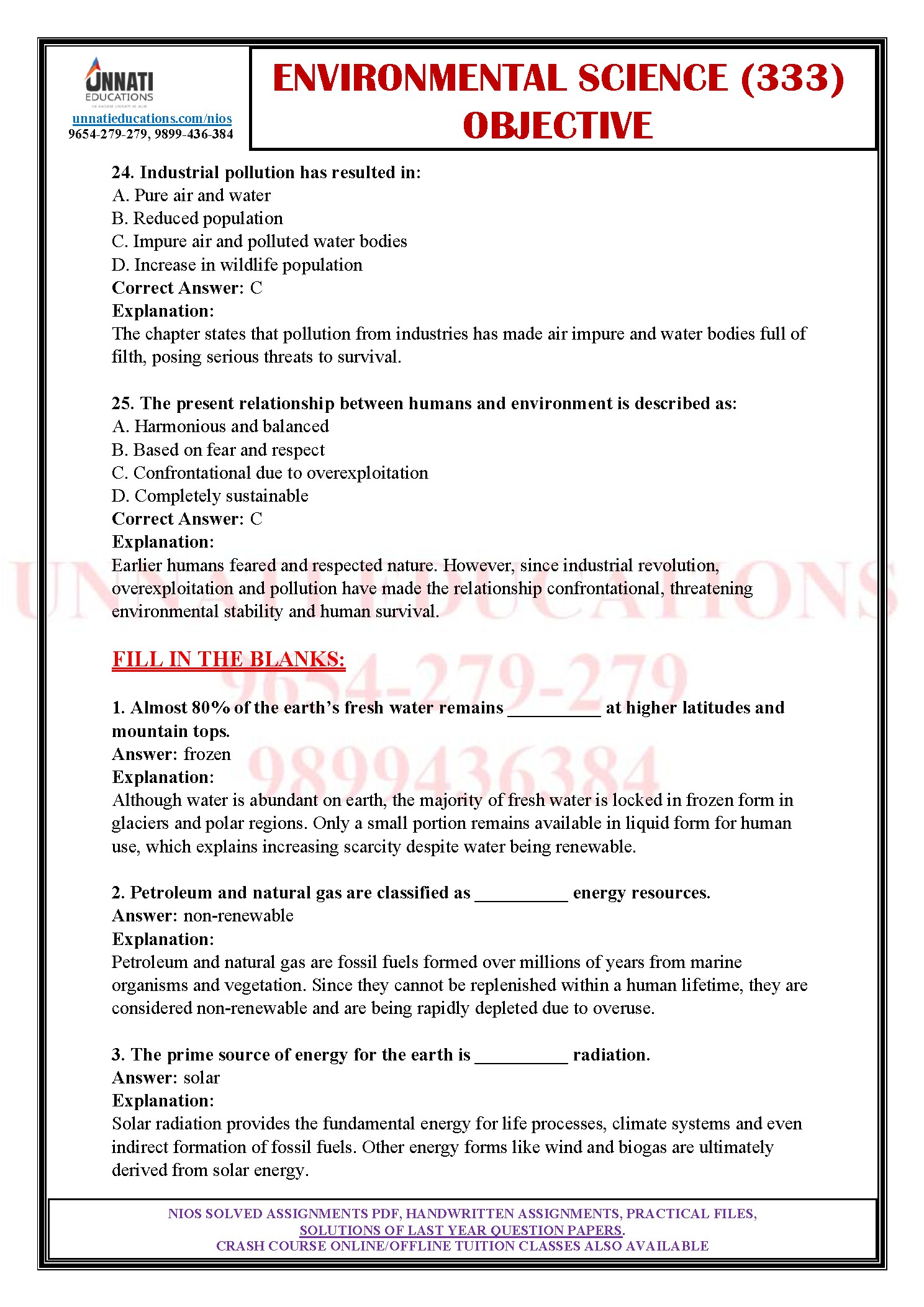
Preview page from the NIOS Environmental Science 333 objective question bank.
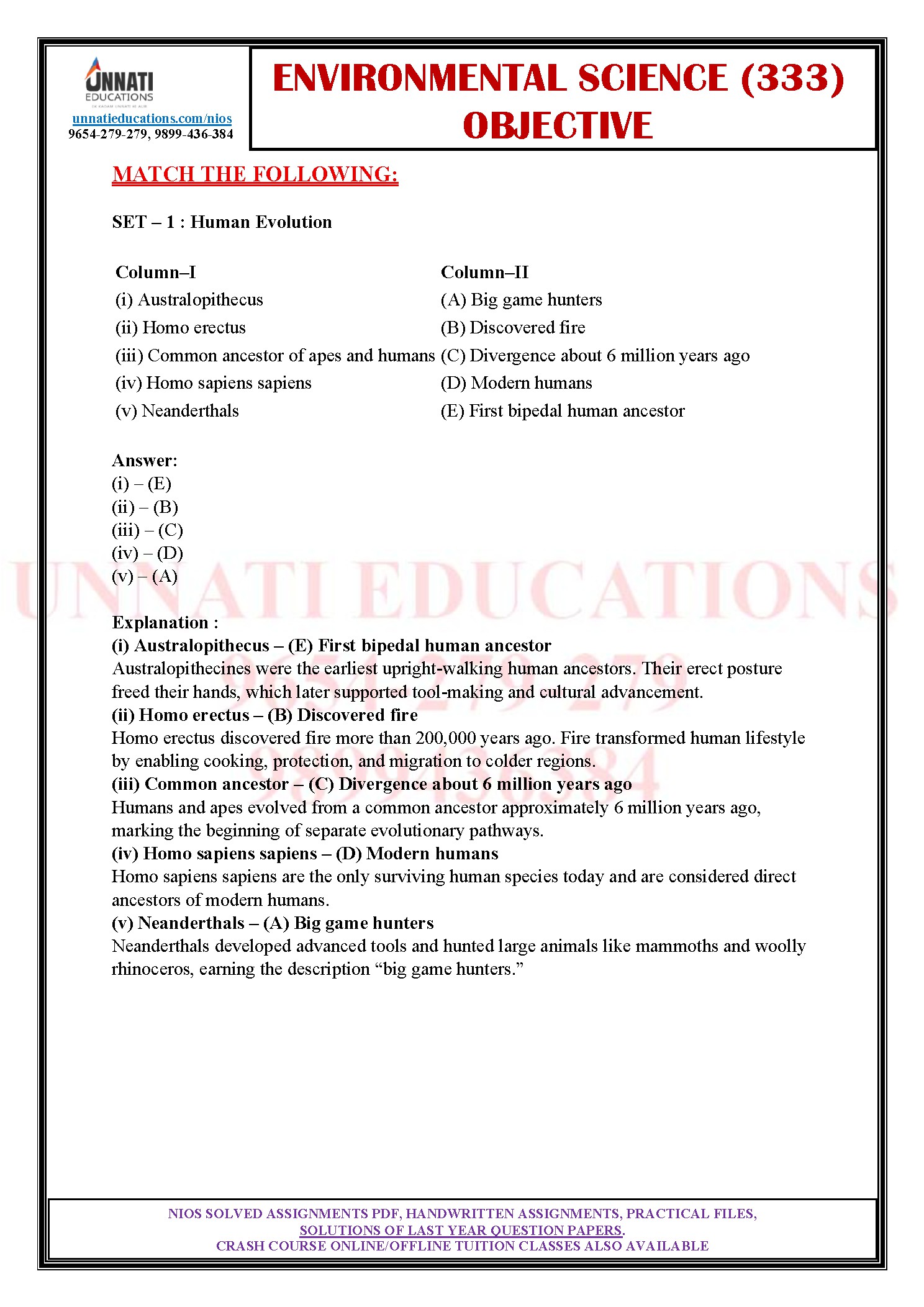 Preview page from the NIOS Environmental Science 333 objective question bank.
 Sample match the following and true or false statements with answers.
You get a resource that is easy to read, quick to revise and built to help you clear Environmental Science 333 comfortably. There is no filler here, only the questions that give you the best return for the time you spend.
Want the full Environmental Science 333 question bank with every lesson solved?
How We Prepared the NIOS Environmental Science 333 Objective Type Questions
None of this was put together in a rush. Our subject team read the entire Environmental Science 333 textbook lesson by lesson, tracked the pattern of recent papers, and marked the concepts that carry the most weight in the objective section.
We matched every recurring theme against each NIOS Previous Year Question Paper we could gather, so the final set reflects what genuinely gets asked rather than what only looks important. Where a topic appeared across sessions, we kept the sharpest version of the question.
Every answer was then checked against the textbook before it entered the bank, which is why the trickier items carry a short worked explanation rather than a bare letter. The aim is understanding that stays with you, not blind memorising.
How to Get NIOS Class 12 Environmental Science 333 Objective Type Questions for 2026
Getting the complete set is simple. Send us a message on WhatsApp saying you want the Environmental Science 333 objective question bank, and our team will share the details and guide you through the rest. We usually reply quickly during working hours.
Reach us on 9654279279 as the first option, or on 9899436384 if the first line is busy. Do mention your session year so we hand you the version prepared for the 2026 examination.
Get your copy today and start revising the smart way.
NIOS Environmental Science 333 Objective Type Questions Frequently Asked Questions
What are the NIOS Environmental Science 333 Objective Type Questions for 2026?
The NIOS Environmental Science 333 Objective Type Questions are a curated set of objective type questions built for the 2026 senior secondary examination. They cover multiple choice questions, fill in the blanks, true or false statements and match the following across the lessons of the course, each paired with a verified answer and a short explanation so you can revise the whole syllabus efficiently.
Are these NIOS Environmental Science 333 objective questions based on previous year papers?
Yes, the NIOS Environmental Science 333 objective questions come from a careful study of recent question papers and the full textbook. Our team marked the concepts that appear most often, then framed questions in the style examiners use. This means your practice closely matches the pattern and difficulty of the actual paper rather than random or off syllabus content.
How many lessons are covered in the NIOS Environmental Science 333 Objective Type Questions?
All twenty three lessons of the NIOS Environmental Science 333 course are covered, from Environment and Human Society through to Energy Conservation. Each lesson has its own set of objective questions, so you can revise lesson by lesson in the same order as your textbook. The full lesson list with key topics appears in the table earlier on this page for quick reference.
Can I get the full NIOS Class 12 Environmental Science objective type questions PDF?
Yes, the complete NIOS Class 12 Environmental Science objective type questions set is available on request. The samples on this page show the quality and format, while the full bank carries many more solved questions for every lesson. To receive it, send us a message on WhatsApp mentioning Environmental Science 333, and our team will share the details straight away.
Will these NIOS Environmental Science 333 Objective Type Questions help me pass the 2026 exam?
The NIOS Environmental Science 333 Objective Type Questions target exactly the objective section where marks are quickest to secure. By practising recurring questions with clear answers, you sharpen recall and cut down on avoidable mistakes. Combined with steady study of the textbook, this focused set gives you a strong and reliable base for the 2026 paper.
How do I contact Unnati Educations for NIOS Environmental Science 333 Objective Type Questions?
You can reach Unnati Educations for the NIOS Environmental Science 333 Objective Type Questions on WhatsApp at 9654279279, or on 9899436384 if the first number is engaged. Simply tell us the subject and your session year, and our team will respond with everything you need. We are glad to answer any query about the content before you decide.
Unnati Educations is an independent academic support platform and is not affiliated with, endorsed by, or connected to the National Institute of Open Schooling (NIOS). All institution names, subject codes and question paper references are used only for identification and belong to their respective owners. Content is provided as study support based on our own analysis of publicly available material.