Scoring well in the Geography paper often comes down to how confidently you handle the objective section, and that is exactly where a sharp set of NIOS Class 12 Geography 316 Objective Type Questions makes the difference. This page gathers objective type questions with answers for the 2026 session, prepared after working through the full prescribed textbook and a spread of past papers. You can preview genuine samples below at no cost, then reach us for the complete bank whenever you feel ready.
Written by Prateek Talwar and reviewed by Jyoti Sharma, Senior NIOS Counsellor. Last updated on 17 July 2026.
How These NIOS Class 12 Geography 316 Objective Type Questions Help You Score in 2026
The objective portion of the Geography 316 paper is where careful candidates quietly build their lead. A single mark for naming the right instrument, the correct wind reversal, or a soil horizon adds up fast, and these are the marks most students leave on the table for want of focused revision.
Because objective items test precise recall, they respond very well to short, repeated practice. Running through a curated list lets you sweep the whole syllabus, catch the lessons where you feel shaky, and lock in the small facts long before you sit the exam.
If you are planning the wider session and not just this one subject, our broader set of NIOS Class 12 Objective Type Questions works alongside this Geography paper, so your revision stays organised subject by subject.
The Method Behind Our NIOS Geography 316 Objective Type Questions
Nothing here is filler. Our team read each prescribed lesson of the Geography 316 book from cover to cover, marked the facts and concepts that examiners return to, and then turned those points into clean objective questions with verified answers and short explanations.
We also studied how questions repeat over the years by going through the NIOS Previous Year Question Paper record lesson by lesson. That trend analysis is what keeps this bank tied to the actual exam rather than random facts pulled from the book.
Every explanation is written to teach, not just to state an answer. You learn why Eratosthenes matters, why India is called a monsoon land, or why the hydrological cycle is a closed system, so a slightly reworded question in the real paper no longer catches you off guard.
Lesson Wise Topics in the NIOS Geography 316 Question Bank
The bank runs across the physical and human geography lessons of the course, so no scoring area is skipped. Instead of a generic list, the table shows the specific topics you will practise inside each lesson, which is a quick way to see where you stand.
| Lesson | Chapter Name | Key Topics You Will Practise |
|---|---|---|
| 1 | Nature and Subject Matter of Geography | Origin of the term Geography, systematic and regional approaches, pioneers from Eratosthenes to Humboldt |
| 3 | Exogenic Forces and Their Resultant Landforms | Exogenic forces and their energy sources, degradation and aggradation, types of weathering |
| 5 | Hydrological Cycle and Ocean Water | The hydrological cycle as a closed system, evaporation and precipitation, ocean water balance |
| 7 | Atmospheric Pressure and Winds | Barometer and isobars, pressure gradient, fall of pressure with altitude |
| 9 | Climate and Climate Change | Weather instruments, factors shaping local climate, altitude and oceanic influence |
| 10 | Biosphere, Biomes and Biodiversity | Lithosphere hydrosphere atmosphere and biosphere, producers consumers and decomposers, world biomes |
| 11 | Soil: Formation and Classification | Soil forming factors, soil horizons and profile, weathering and leaching |
| 12 | Climate of India | Monsoon type climate, origin of the word monsoon, Tropic of Cancer and the Himalayan barrier |
| 15 | Forests and Biodiversity | Forest measurement parameters, tropical evergreen forests, mangrove forests of the Sundarbans |
| 16 | Water Resources | Renewable water and scarcity, falling per capita availability, sector wise water use |
| 17 | Agriculture and Food Security | Subsistence and commercial agriculture, rabi and kharif crops, the Green Revolution |
| 18 | Mineral and Energy Resources | Mineral distribution belts, petroleum and iron ore reserves, uranium and energy minerals |
| 20 | Foreign Direct Investment, Transport, Communication and Trade | FDI routes and prohibited sectors, transport for bulky goods, trade and communication |
| 22 | Population Composition | Rural and urban classification, sex ratio across states, Census 2011 figures |
| 23 | Human Development | Pillars of equity and empowerment, health education and income dimensions, human capabilities |
| 24 | Sustainable Development Goals | The Brundtland report, Earth Summit and Agenda 21, the shift from MDGs to the SDGs |
This Geography paper is one shelf in a much larger library, so once your objective practice is done you can move to full solutions and notes from our NIOS Study Material collection for your remaining subjects.
Sample Multiple Choice Questions from NIOS Geography 316
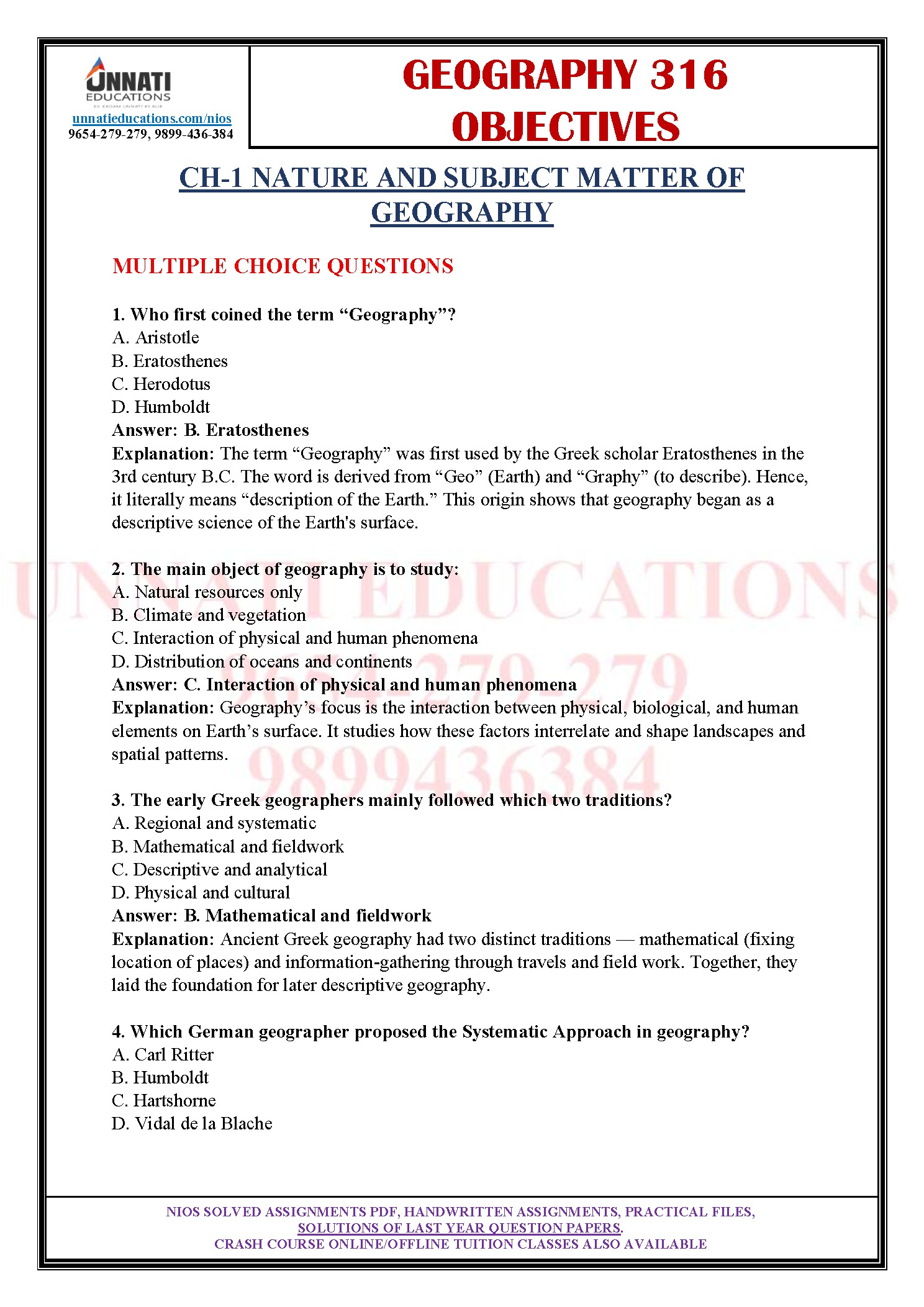
Here is a no-cost preview drawn straight from our Geography 316 bank so you can judge the standard before asking for the full set. The chips show which lesson each question belongs to.
Lesson 1 Nature of Geography
Q1. Who first coined the term "Geography"?
- A. Aristotle
- B. Eratosthenes
- C. Herodotus
- D. Humboldt
Answer: B. Eratosthenes
Explanation: The term was first used by the Greek scholar Eratosthenes in the 3rd century B.C. It comes from "Geo" (Earth) and "Graphy" (to describe), so it literally means description of the Earth.
Lesson 3 Exogenic Forces
Q2. Which of the following best defines exogenic forces?
- A. Forces originating within the Earth's interior
- B. Forces caused by tectonic plate movement
- C. Forces deriving their energy from the Earth's exterior
- D. Forces responsible for the formation of volcanoes
Answer: C. Forces deriving their energy from the Earth's exterior
Explanation: Exogenic forces are powered by solar radiation and gravitational potential energy. They act on the surface to wear down irregularities and reshape landscapes through denudation and deposition.
Lesson 5 Hydrological Cycle
Q3. The continuous circulation of water between the Earth's surface and the atmosphere is known as the ________.
- A. Water conservation cycle
- B. Water balance system
- C. Hydrological cycle
- D. Oceanic circulation
Answer: C. Hydrological cycle
Explanation: The hydrological cycle involves the cyclic movement of water through evaporation, condensation, precipitation, infiltration and runoff, keeping the balance of water between oceans, land and the atmosphere.
Lesson 7 Pressure and Winds
Q4. Atmospheric pressure is measured by which instrument?
- A. Hygrometer
- B. Thermometer
- C. Barometer
- D. Anemometer
Answer: C. Barometer
Explanation: Atmospheric pressure is the force exerted by the weight of air per unit area and is measured with a barometer. The unit is the millibar, with standard sea level pressure at about 1013.2 mb.
Lesson 12 Climate of India
Q5. The word Monsoon is derived from which language?
- A. Greek
- B. Latin
- C. Arabic
- D. Persian
Answer: C. Arabic
Explanation: The term Monsoon comes from the Arabic word "Mousim" meaning season, referring to the periodic reversal of winds that shapes India's wet and dry seasons.
Lesson 24 Sustainable Development
Q6. The term "Sustainable Development" was first introduced in which report?
- A. Rio Declaration
- B. Brundtland Commission Report
- C. Stockholm Declaration
- D. Agenda 21
Answer: B. Brundtland Commission Report
Explanation: The World Commission on Environment and Development, chaired by Gro Harlem Brundtland, introduced the term in its 1987 report Our Common Future, defining it as meeting present needs without harming future generations.
Sample Fill in the Blanks from NIOS Geography 316
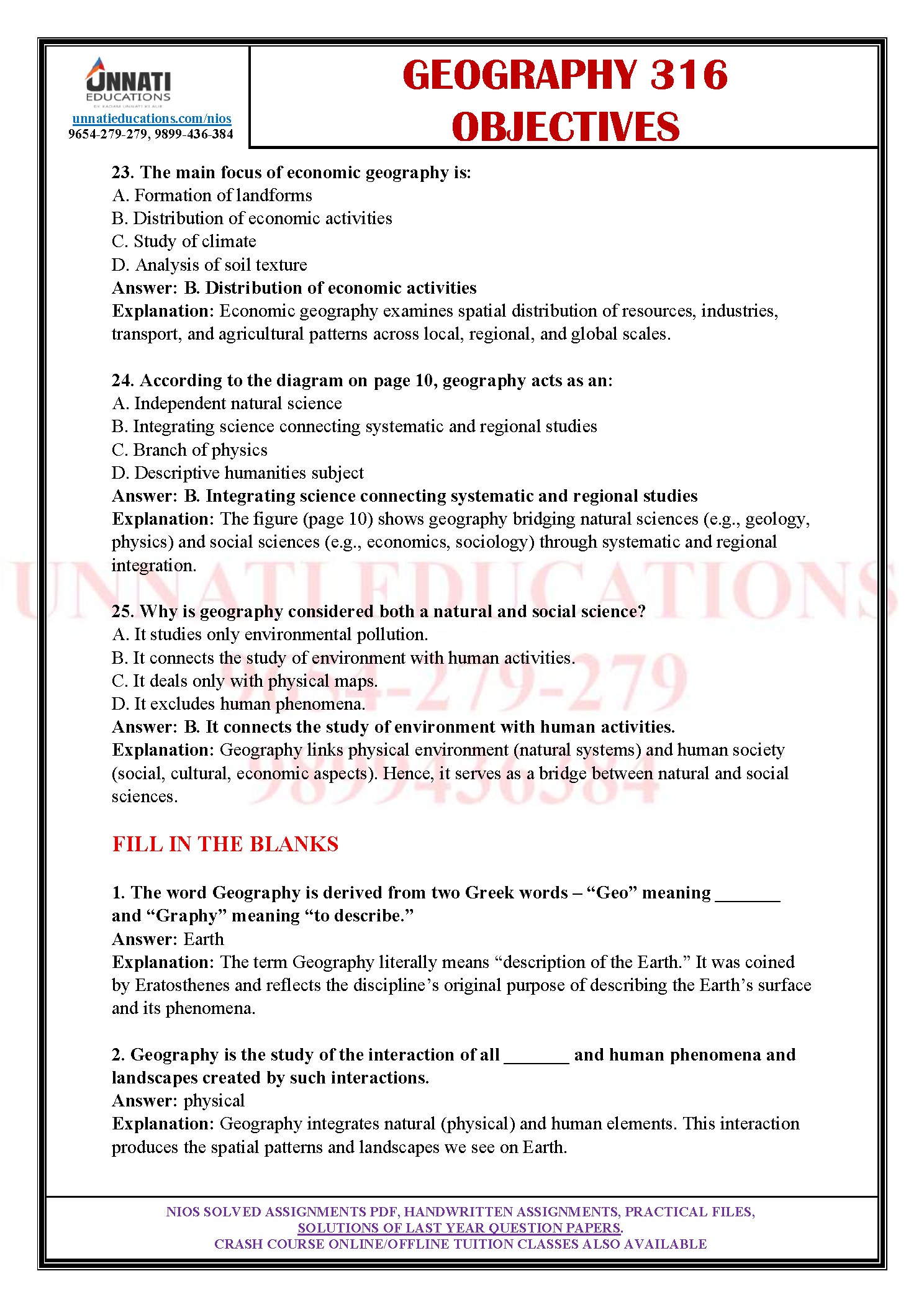
Fill in the blanks reward exact terms, so read each explanation to fix the keyword in memory for the Geography 316 paper.
Lesson 1
The word Geography is derived from two Greek words, "Geo" meaning __________ and "Graphy" meaning "to describe."
Answer: Earth
Explanation: The term literally means description of the Earth. It was coined by Eratosthenes and reflects the discipline's original purpose of describing the Earth's surface and its phenomena.
Lesson 1
Geography is the study of the interaction of all __________ and human phenomena and the landscapes created by such interactions.
Answer: physical
Explanation: Geography integrates natural and human elements. This interaction produces the spatial patterns and landscapes we see across the Earth.
Lesson 12
The term "Monsoon" has been derived from the __________ word "Mousim" meaning season.
Answer: Arabic
Explanation: The word Monsoon comes from the Arabic term "Mousim", which means season, highlighting the periodic reversal of winds in India that defines its seasonal climate.
Lesson 12
India's climate is described as the __________ type of climate.
Answer: Monsoon
Explanation: India's climate is called the monsoon type because the seasonal reversal of winds causes alternating wet and dry seasons across the country.
Sample True or False Statements for NIOS Geography 316
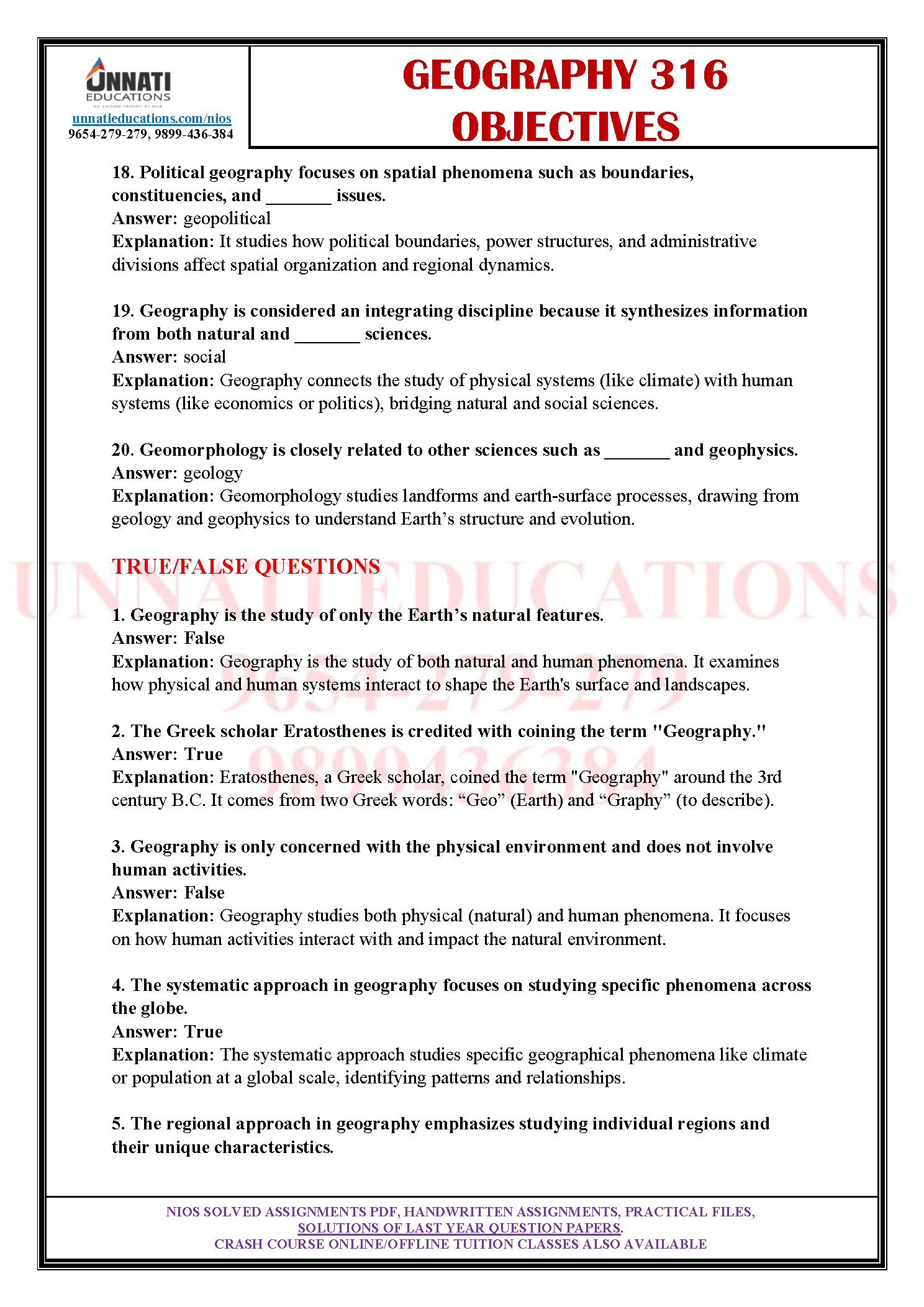
These statements look easy until a half-remembered detail trips you up, so use the explanations to learn the exact point being tested in Geography 316.
Lesson 1
Geography is the study of only the Earth's natural features.
Answer: False
Explanation: Geography is the study of both natural and human phenomena. It examines how physical and human systems interact to shape the Earth's surface and its landscapes.
Lesson 1
The Greek scholar Eratosthenes is credited with coining the term "Geography."
Answer: True
Explanation: Eratosthenes coined the term around the 3rd century B.C. It comes from two Greek words, "Geo" meaning Earth and "Graphy" meaning to describe.
Lesson 24
The concept of sustainable development was first introduced in the 1987 Brundtland Commission Report.
Answer: True
Explanation: The World Commission on Environment and Development, chaired by Gro Harlem Brundtland, presented the report Our Common Future in 1987, defining sustainable development for present and future generations.
Sample Match the Following from NIOS Geography 316
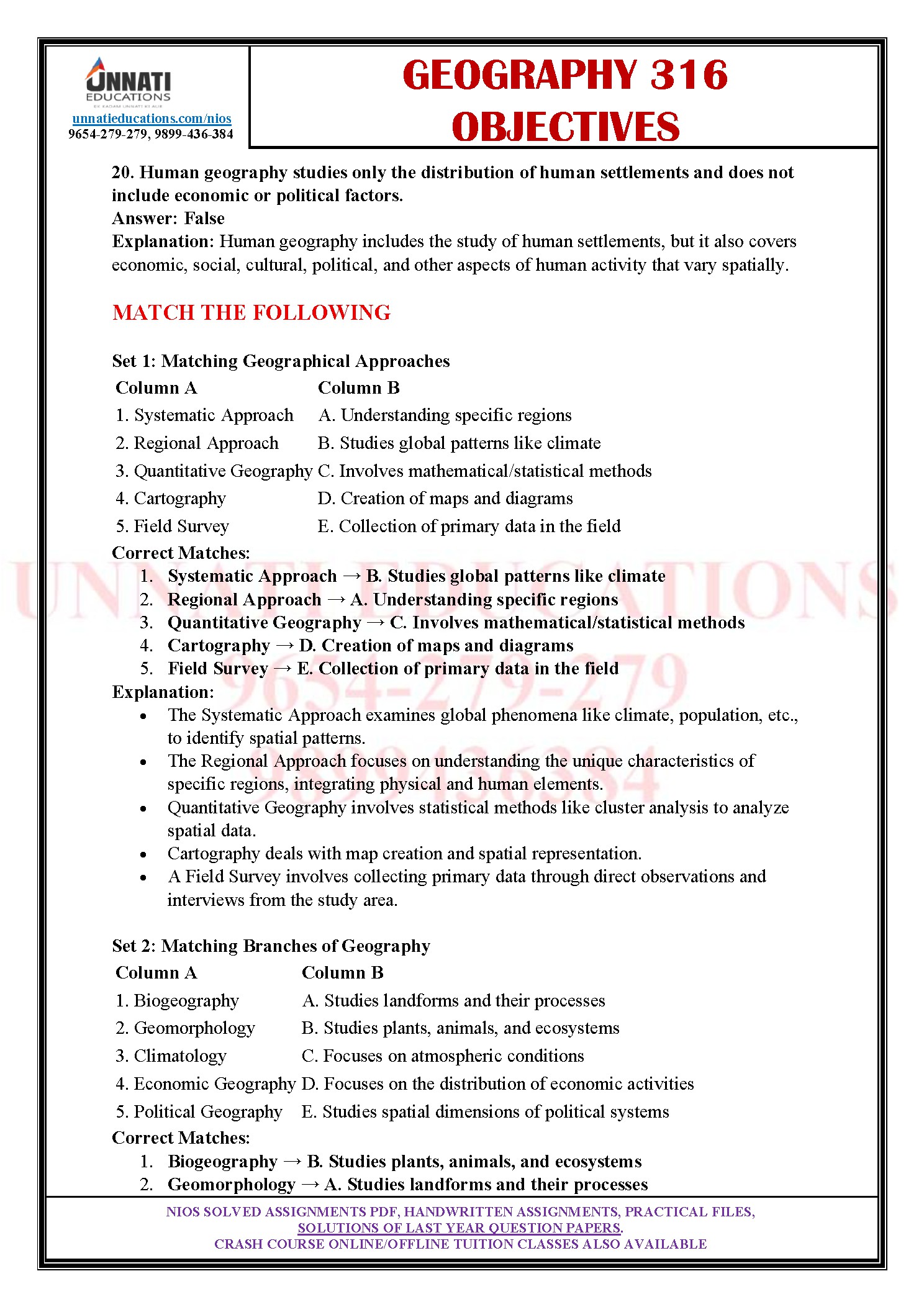
Match the following checks whether you can connect terms with their meaning. Below is one complete set on the components of the biosphere, shown with the correct pairs.
| Column A | Correct Match from Column B |
|---|---|
| 1. Lithosphere | Solid outer layer of Earth |
| 2. Hydrosphere | Water bodies like oceans and rivers |
| 3. Atmosphere | Air layer surrounding Earth |
| 4. Biosphere | Zone where life exists through interaction of all three spheres |
| 5. Biotic component | Living organisms such as plants and animals |
The lesson explains that the lithosphere forms the crust, the hydrosphere holds water bodies, and the atmosphere surrounds the planet with gases, while the biosphere is the life zone where all three interact. That reasoning is what helps the matching stay in memory during the exam.
Inside the Complete NIOS Class 12 Geography 316 Objective Type Questions
The previews above are only a taste. The complete pack works through every lesson listed in the topics table, giving you many more questions per chapter than any sample can show.
For each lesson you receive multiple choice questions, fill in the blanks, true or false statements and match the following sets, each with a verified answer and a short explanation. That mix mirrors how the objective section of the paper is actually framed.
The bank follows the current course, so if you want to cross-check the lessons yourself you can view the official structure through the NIOS Syllabus before you begin. This keeps your revision aligned with what appears in the 2026 paper.
Message us on WhatsApp for the full Geography 316 question bank
Tap to chat on 9654 279 279
Steps to Receive the Full NIOS Geography 316 Objective Type Questions
Getting the full set is simple. Send us a message with the subject code, Geography 316, and mention the 2026 session. Our counselling team confirms what is included and shares the complete objective bank with you directly.
Delivery is over WhatsApp, so there is no random link to chase and nothing to sign up for. You receive the material and start practising the same day, and you can ask about any tricky lesson while you are on the chat.
Request the Geography 316 Objective Type Questions now
WhatsApp 9654 279 279 or 9899 436 384
Who Benefits Most from These NIOS Geography 316 Questions
These questions suit first-time Geography 316 candidates who want a clear, lesson-linked way to revise, as well as repeaters aiming to finally clear the objective section with confidence. They also help students completing tutor marked assignments who need quick, dependable answers.
If a younger family member is preparing for the secondary stage at the same time, they may find our NIOS Class 10 Syllabus useful too, so the whole household can study from one trusted source across levels.
Frequently Asked Questions on NIOS Geography 316 Objective Type Questions
What are the NIOS Geography 316 Objective Type Questions based on?
These Geography 316 Objective Type Questions are drawn from the prescribed NIOS textbook and a review of several past papers. Our team studied each lesson closely, then shortlisted the objective items that appear most often and carry easy scoring value. Every question carries a verified answer and a short explanation, so you grasp the reasoning rather than memorising blindly before the exam.
Do the Geography 316 objective questions cover both physical and human geography?
Yes, the Geography 316 bank spans both halves of the course. You practise physical topics such as exogenic forces, the hydrological cycle and soil formation, alongside human topics like agriculture, population composition and sustainable development. This balanced coverage matches the way the paper draws its objective questions from lessons right across the syllabus, so you are never caught out by a section you quietly skipped during revision.
Are these Geography 316 Objective Type Questions useful for the 2026 exam?
Yes, the Geography 316 set is prepared specifically for the 2026 session and follows the current course pattern. Objective questions carry dependable one-mark scoring, and revising a focused list helps you cover every lesson without wasting time. Regular practice builds the speed and accuracy the short-answer part of the paper rewards, and because each item carries an explanation you also reinforce the concept behind it while you revise.
Do the Geography 316 questions include answers and explanations?
Every Geography 316 question comes with a confirmed answer and a brief explanation. The explanation shows why the answer is correct and points to the exact detail in the lesson being tested. This means you learn the reasoning, not just one answer, so a reworded version of the same question in the real paper does not throw you.
How many chapters of Geography 316 are covered in the question bank?
The Geography 316 question bank covers sixteen lessons, from the nature of geography and exogenic forces to water resources, human development and the sustainable development goals. The full list with lesson-specific topics appears in the coverage table on this page. Each lesson carries mcqs, fill in the blanks, true or false and match the following sets.
How do I get the complete NIOS Geography 316 Objective Type Questions?
To get the complete Geography 316 pack, send us a WhatsApp message mentioning the subject code and the 2026 session. Our counselling team confirms the contents and shares the full objective bank with you over chat. There is no complicated process and no sign-up, so you can begin your revision the same day you contact us.
Sources: NIOS prescribed Geography (316) textbook and Unnati Educations analysis of previous year NIOS question papers, 2026 edition.
Disclaimer: Unnati Educations is an independent academic support platform and is not affiliated with, endorsed by, or officially connected to the National Institute of Open Schooling (NIOS). All trademarks and course names belong to their respective owners. Students should verify the current syllabus and examination pattern from the official NIOS website.