Preparing for the History 315 paper usually comes down to one habit, revising the questions that keep coming back year after year. These NIOS Class 12 History 315 Objective Type Questions with answers for 2026 are shaped around that idea. Our team went through past NIOS papers, read the History textbook lesson by lesson, and picked the objective questions that carry the most weight, so your revision feels focused rather than endless.
Last updated on 17 July 2026 · Written by Prateek Talwar · Reviewed by Jyoti Sharma, Senior NIOS Counsellor
You will find real sample questions below, taken straight from our full objective set, one small slice from each format we build for every chapter. Read them, judge the quality for yourself, and if they fit what you are after, the complete pack is a short message away.
Quick answer: NIOS History 315 Objective Type Questions are objective style questions with answers, drawn from every lesson of the Class 12 History syllabus. They include multiple choice questions, fill in the blanks, and true or false statements, each with a clear answer and a short reason, so you can revise fast and remember the facts for longer.
| Item | Detail |
|---|---|
| Subject and code | History (315) |
| Class and board | Class 12, Senior Secondary, NIOS |
| Question formats | MCQs, fill in the blanks, true or false |
| Answers included | Yes, with a short explanation each |
| Prepared for | 2026 exam cycle |
| Medium | English |
NIOS Class 12 History 315 Objective Type Questions for the 2026 Exam
The 2026 revision cycle for History 315 rewards students who practise objective questions early rather than saving them for the final week. This set sits right beside our wider NIOS Study Material, so you can move from reading a lesson to testing yourself on it without hunting across scattered resources.
Every question here is tied to a specific lesson from the NIOS History textbook, not thrown together at random. That lesson mapping is what lets you revise chapter by chapter, close your weak spots, and walk into the hall knowing the objective section is already handled.
Why Our NIOS History 315 Objective Type Questions Are Different
Plenty of question banks simply repeat whatever floats around online. We work the other way. Each objective question is built after reading the actual lesson and cross checking it against a real NIOS Previous Year Question Paper, so the pattern you practise is close to the pattern the examiner tends to follow.
We also keep the answers honest and the explanations short. A single line under every answer tells you why the option is correct, which is what turns a lucky guess into real understanding. Whether you are stepping up from the NIOS Class 10 Syllabus or already settled into senior secondary, that clarity saves you hours of confused revision.
NIOS History 315 Multiple Choice Questions with Answers
Multiple choice questions carry a steady share of marks in History 315, and they reward careful reading far more than long writing. Here are a few samples from our full set so you can weigh the depth and wording before you decide.
Q1. The Harappan Civilization is regarded as the first urban culture of India mainly because it shows:
A. Nomadic pastoral life
B. Stone-age hunting traditions
C. Planned towns with specialized crafts and trade
D. Tribal village organization
Correct Answer: C
Explanation: An urban culture is identified by planned settlements, specialization of crafts, trade networks, surplus production, and writing. The Harappan Civilization fulfilled all these conditions, making it the earliest urban civilization in India.
Q2. Which phase of Harappan culture is marked by well-developed towns, burnt brick houses, and foreign trade?
A. Early Harappan Phase
B. Mature Harappan Phase
C. Late Harappan Phase
D. Chalcolithic Phase
Correct Answer: B
Explanation: The Mature Harappan Phase represents the peak of urban development, characterized by standardized architecture, extensive crafts, and long-distance trade.
Q3. The Indian National Congress was founded in 1885 mainly to:
A. Organise armed resistance
B. Demand immediate independence
C. Provide a common platform for political discussion
D. Support British imperial interests
Correct Answer: C
Explanation: The Congress initially worked as a forum for educated Indians to express grievances, discuss reforms, and develop political consciousness rather than demanding complete freedom.
Q4. The Swadeshi and Boycott Movement began primarily in response to the:
A. Rowlatt Act
B. Partition of Bengal
C. Arrest of nationalist leaders
D. First World War
Correct Answer: B
Explanation: The partition of Bengal was seen as an attempt to divide Indians, provoking a powerful nationalist response through boycott and promotion of indigenous goods.
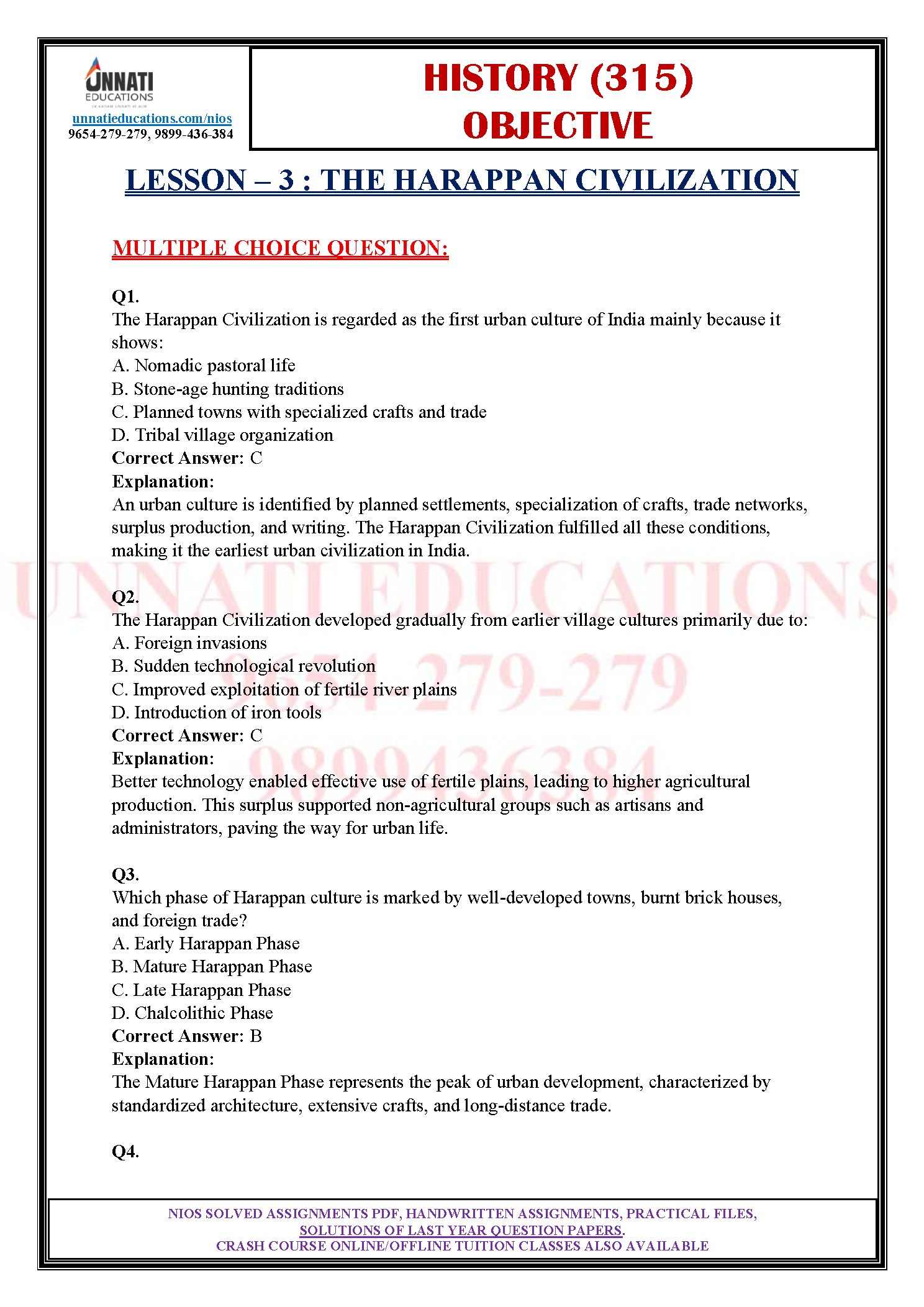
Sample page from the NIOS History 315 objective set showing multiple choice questions with answers.
NIOS History 315 Fill in the Blanks with Answers
Fill in the blanks reward your memory of names, dates, and key terms. In History 315 these small answers often decide the gap between a safe pass and a strong score. The samples below show how we phrase each blank and give the exact answer with a reason.
Q1. Harappa, one of the earliest discovered sites of this civilization, is located on the banks of the river __________.
Answer: Ravi
Explanation: The geographical location of Harappa on the Ravi river played an important role in agricultural development and early settlement growth.
Q2. Among the crops cultivated by the Harappans, __________ was used for making cloth.
Answer: cotton
Explanation: Cotton cultivation reflects technological advancement and the development of textile production.
Q3. Babur defeated Ibrahim Lodi in the First Battle of Panipat in the year ________.
Answer: 1526
Explanation: The First Battle of Panipat in 1526 marked the foundation of Mughal rule in India by ending the Lodi dynasty's control over Delhi.
Q4. The Rajput confederacy under Rana Sanga was defeated by Babur at the Battle of ________.
Answer: Khanwa
Explanation: The Battle of Khanwa consolidated Mughal authority by breaking the strongest Rajput challenge in northern India.
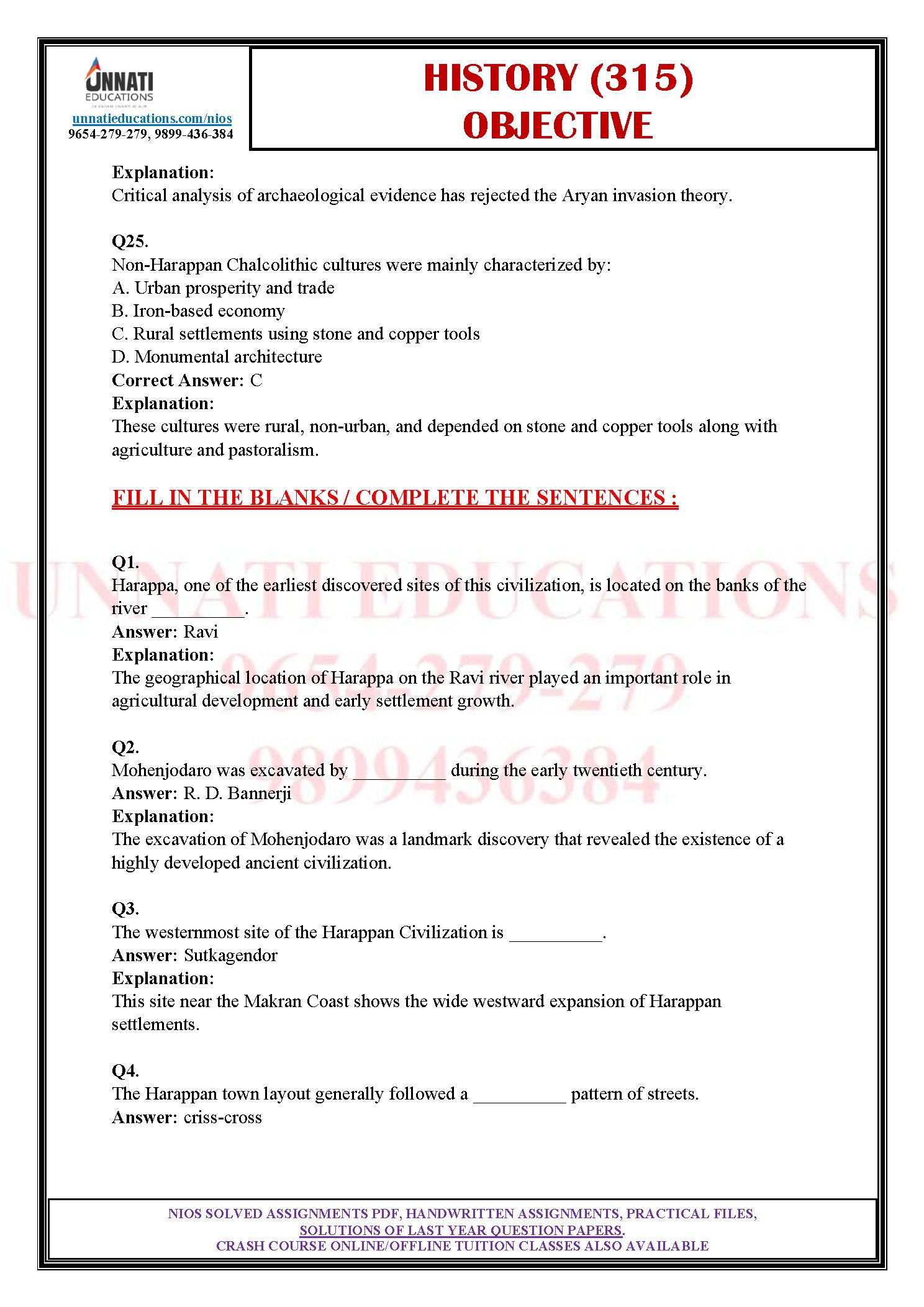
Sample page from the NIOS History 315 objective set showing fill in the blanks with answers.
NIOS History 315 True and False Statements with Answers
True or false statements test whether you can spot a small twist inside a familiar fact. Our History 315 statements are written to catch the same traps the exam likes to set, then explained so the correct reasoning stays with you.
Q1. The Harappan Civilization emerged suddenly without any connection to earlier village cultures.
Answer: False
Explanation: The civilization developed gradually from earlier village cultures. Archaeological evidence shows continuity from Neolithic settlements, indicating a slow transition to urban life rather than a sudden emergence.
Q2. The Mature Harappan phase represents the peak of urban development in the Harappan Civilization.
Answer: True
Explanation: This phase shows well-planned cities, standardized burnt-brick structures, extensive crafts, and internal as well as external trade, marking the height of Harappan urbanism.
Q3. Alamgirpur marks the westernmost limit of the Harappan Civilization.
Answer: False
Explanation: Alamgirpur marks the easternmost limit. The westernmost extent is represented by Sutkagendor, indicating the wide geographical spread of the civilization.
Q4. Harappan towns were randomly planned without any standard layout.
Answer: False
Explanation: Harappan towns followed a highly organized plan with streets intersecting at right angles, reflecting careful planning and uniformity.

Sample page from the NIOS History 315 objective set showing true or false statements with answers.
Liked the sample questions? The samples above are only a small taste. The complete lesson by lesson set is ready to share on WhatsApp.
Get the full History 315 objective set on WhatsApp
WhatsApp 9654 279 279, or 9899 436 384 as an alternate.
Chapters Covered in the NIOS History 315 Objective Set
The objective set spans the History 315 course across ancient, medieval, and modern India, plus world history and the optional module. The table below lists the lessons included, so you can match your revision to the official NIOS Syllabus and be sure nothing important is slipping through.
| Group | Lesson | Chapter |
|---|---|---|
| Ancient India | Lesson 3 | The Harappan Civilisation |
| Ancient India | Lesson 4 | The Vedic Age (1500 BC to 600 BC) |
| Ancient India | Lesson 6 | Post Mauryan Developments |
| Ancient India | Lesson 7 | The Guptas and Their Successors (A.D. 300 to 750) |
| Medieval India | Lesson 9 | Establishment and Expansion of the Delhi Sultanate |
| Medieval India | Lesson 10 | Establishment of the Mughal Rule |
| Medieval India | Lesson 12 | Administrative System and Institutions |
| Medieval India | Lesson 14 | Cultural Developments in Medieval India |
| Modern India | Lesson 16 | Establishment of British Rule in India till 1857 |
| Modern India | Lesson 18 | Social Changes in Modern India |
| Modern India | Lesson 19 | Popular Resistance to Company Rule |
| Modern India | Lesson 20 | Nationalism |
| Modern India | Lesson 21 | Indian National Movement |
| World History | Lesson 23 | World War I and the Russian Revolution |
| World History | Lesson 24 | The Inter-War Period and the Second World War |
| World History | Lesson 25 | The Cold War Era and Its Politics |
| Cultural Change | Lesson 28 | Cultural Change in the Twentieth Century |
| Cultural Change | Lesson 29 B | Contemporary Cultural Situation |
| Optional Module | Lesson 30 A | Early States |
| Optional Module | Lesson 30 B | Cultural Production |
| Optional Module | Lesson 31 A | The Medieval State |
| Optional Module | Lesson 31 B | Cultural Communication |
Group labels follow the broad ancient to modern arrangement of the NIOS History 315 course.
How to Revise with NIOS History 315 Objective Type Questions
A question bank only works when you use it in the right order. Read a lesson first, then attempt the objective questions for that same lesson before you move on. Pairing this set with our chapter wise NIOS Class 12 Objective Type Questions gives you the objective drill and the descriptive practice inside one steady flow.
Give the harder formats a second pass. Fill in the blanks and true or false statements are easy to forget, so revisit them two or three days before the paper. Say the answer out loud, check the one line reason, and mark anything you missed for a final quick review.
Keep a small error list as you go. Every question you get wrong is worth more than ten you already know, because it points straight at a weak lesson. Clear those first and your History 315 score usually climbs without any extra hours of study.
Get the Full NIOS Class 12 History 315 Objective Type Questions Pack
You have seen the samples and how each answer is explained. The complete pack covers every lesson with full multiple choice questions, fill in the blanks, and true or false statements, each carrying an answer and a short reason. It is written to be simple to follow and genuinely useful in the last stretch before your exam.
To receive the full set, send us a message on WhatsApp with your subject and class, and our team will share how to get it along with the current details. Students preparing across other NIOS subjects can ask for those objective sets in the same chat.
Message us on WhatsApp for the full History 315 pack
WhatsApp 9654 279 279, or 9899 436 384 as an alternate.
FAQs on NIOS Class 12 History 315 Objective Type Questions
Are these NIOS History 315 Objective Type Questions enough to pass the exam?
These objective questions cover a large share of the History 315 objective section, which alone can carry you close to a comfortable pass. For a strong score you should still practise descriptive answers and map work. Used together with lesson reading and past papers, this set removes most of the guesswork from your objective preparation and builds steady exam confidence.
How are the NIOS History 315 Objective Type Questions for Class 12 prepared?
Each question is prepared by reading the full NIOS History textbook lesson by lesson and studying several previous year papers. We note the topics and phrasing that repeat, then write clear objective questions with correct answers and short reasons. This method keeps the questions close to the real exam pattern instead of copying unverified material found online.
Do the NIOS Class 12 History Objective Type Questions come with answers?
Yes, every objective question comes with its correct answer and a one line explanation. The reason under each answer tells you why that option is right, which helps you understand the concept rather than memorise blindly. This is true across all formats, including multiple choice questions, fill in the blanks, and true or false statements in the History 315 pack.
Which chapters do the NIOS History 315 Objective Type Questions cover?
The set covers lessons across ancient, medieval, and modern India, along with world history and the optional module of the History 315 course. You can see the full lesson list in the chapter table above. Because the questions are mapped to specific lessons, you can revise one chapter at a time and track exactly which topics you have already finished.
How can I get the complete NIOS History 315 Objective Type Questions set?
Send a message on WhatsApp to 9654 279 279, or 9899 436 384 as an alternate, and mention that you want the History 315 objective pack. Our team will reply with how to receive the complete lesson by lesson set and the current details. You can also ask about objective questions for other NIOS Class 12 subjects in the same conversation.
Are the NIOS Class 12 History 315 Objective Type Questions updated for 2026?
Yes, this objective set is prepared for the 2026 exam cycle using the current History 315 lessons and recent question papers. We review the questions each session so the wording, answers, and lesson coverage stay in step with the latest pattern. If NIOS revises the syllabus, we update the affected lessons and refresh the set before the next exam window.
Disclaimer: Unnati Educations is an independent academic support platform and is not affiliated with, endorsed by, or officially connected to the National Institute of Open Schooling (NIOS). All subject names and codes are used only to help students identify the correct study material.
Sources: NIOS Senior Secondary History (315) course material and official syllabus (nios.ac.in), previous year NIOS History 315 question papers, and the NIOS History textbook, 2025 edition.