Home Science rewards students who practise the objective section properly, because a good chunk of the paper is decided by short, factual answers. These NIOS Class 12 Home Science 321 Objective Type Questions with answers for 2026 are built for exactly that part of your revision. We read the NIOS Home Science book chapter by chapter, studied past papers, and shortlisted the objective questions that tend to repeat, so your preparation stays tight instead of drifting across the whole syllabus.
Last updated on 17 July 2026 · Written by Prateek Talwar · Reviewed by Jyoti Sharma, Senior NIOS Counsellor
Below you will find real sample questions pulled straight from our full objective set, a small slice from each format we prepare for every chapter. Look them over, check how the answers are explained, and if the quality fits your needs, the complete pack is one message away.
Quick answer: NIOS Home Science 321 Objective Type Questions are objective style questions with answers, drawn from every chapter of the Class 12 Home Science syllabus. They include multiple choice questions, true or false statements, and match the following sets, each with a correct answer and a short reason, so you can revise the factual part of the paper quickly and hold on to it.
| Item | Detail |
|---|---|
| Subject and code | Home Science (321) |
| Class and board | Class 12, Senior Secondary, NIOS |
| Question formats | MCQs, true or false, match the following |
| Answers included | Yes, with a short explanation each |
| Prepared for | 2026 exam cycle |
| Medium | English |
NIOS Class 12 Home Science 321 Objective Type Questions for the 2026 Exam
The 2026 exam cycle for Home Science 321 favours students who treat the objective section as a scoring area rather than an afterthought. This set sits right next to our wider NIOS Study Material, so you can read a chapter and immediately test yourself on it without jumping between unrelated resources.
Each question is tied to a specific chapter of the Home Science 321 course, from food and nutrition to textiles and human development. That mapping is what lets you revise one chapter at a time, fix your weak spots, and reach the exam with the objective marks already worked out in your head.
Why Our NIOS Home Science 321 Objective Type Questions Are Different
Most question banks just recycle whatever is floating around online. We build ours the slower way. Every objective question is written after reading the actual chapter and comparing it with a genuine NIOS Previous Year Question Paper, so the style you practise stays close to what the examiner tends to ask.
We also explain the reasoning in plain language. A single line under every answer says why the option is correct, which is what changes a shaky guess into something you actually remember. Whether you are moving up from the NIOS Class 10 Syllabus or already settled into Class 12, that clarity spares you a lot of muddled revision.
NIOS Home Science 321 Multiple Choice Questions with Answers
Multiple choice questions carry a reliable share of marks in Home Science 321 and reward careful reading over long writing. Here are a few samples from different chapters, so you can weigh the depth and wording before deciding.
Ethics in Daily Life
Q1. The term 'Ethics' primarily deals with:
A. Political responsibilities
B. Moral issues of right and wrong behaviour
C. Legal obligations only
D. Religious duties
Answer: B. Moral issues of right and wrong behaviour
Explanation: Ethics are defined as principles concerning moral duties and obligations that guide our actions to be right, truthful, and just at home or work. They help maintain a disciplined and honest life.
Meal Planning
Q2. The food group that provides both energy and fibre is:
A. Fats and sugars
B. Cereals, grains, and products
C. Milk and milk products
D. Fruits only
Answer: B. Cereals, grains, and products
Explanation: The cereals group provides energy, protein, iron, B vitamins, and fibre, making it an essential part of the daily diet.
Food Preservation
Q3. The process of boiling milk is an example of:
A. Pasteurization
B. Dehydration
C. Freezing
D. Canning
Answer: A. Pasteurization
Explanation: Boiling or mild heating of milk kills micro-organisms and delays souring, a simple form of preservation by heat treatment similar to pasteurization.
Adolescence
Q4. The onset of adolescence is generally associated with the beginning of:
A. Formal schooling
B. Puberty
C. Cognitive maturity
D. Employment
Answer: B. Puberty
Explanation: Although exact timing varies, the lesson accepts the onset of puberty as the beginning of adolescence.
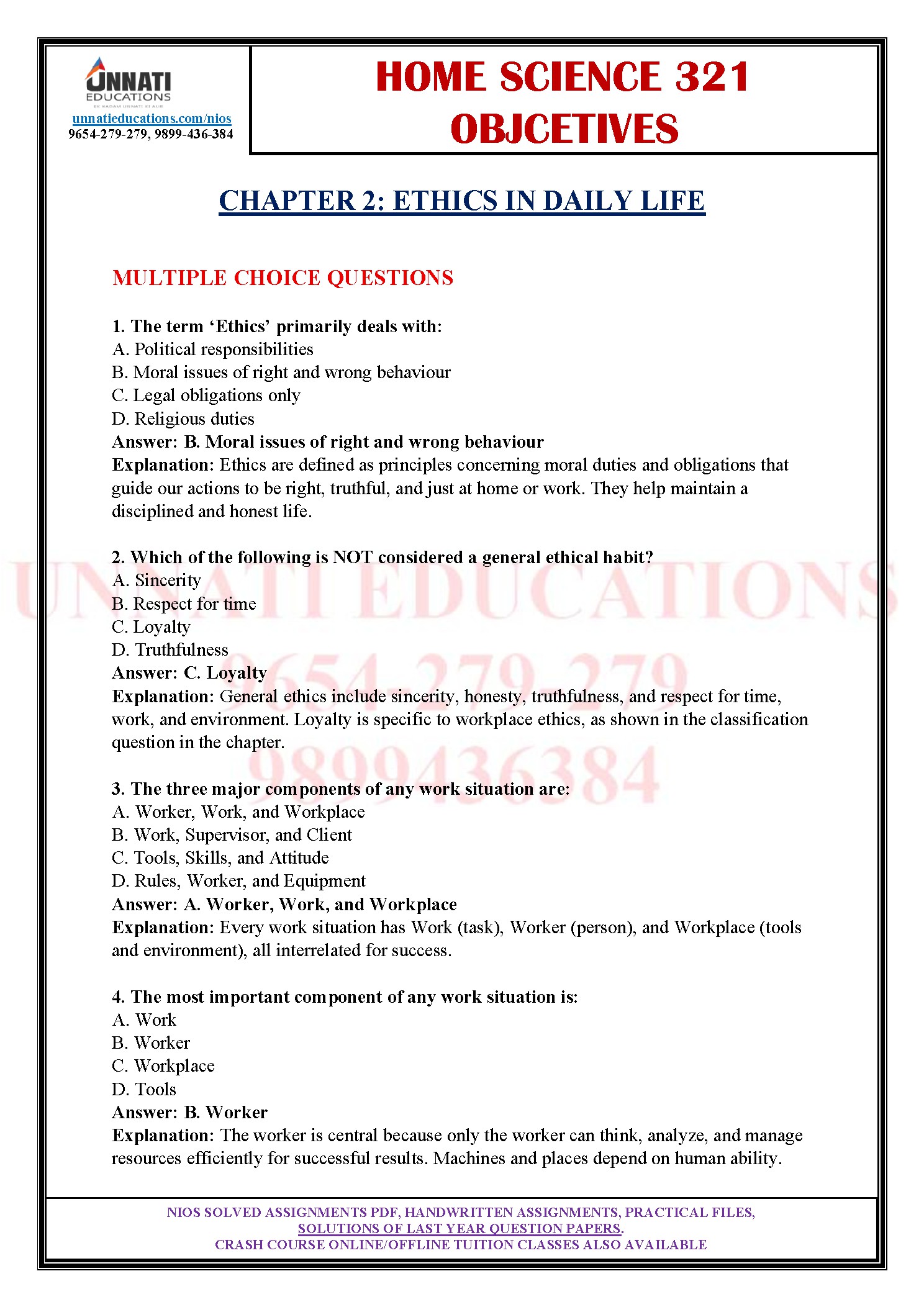
Sample page from the Home Science 321 objective set showing multiple choice questions with answers.
NIOS Home Science 321 True and False Statements with Answers
True or false statements test whether you can catch a small twist in a familiar idea. Our Home Science 321 statements are written to mirror the traps the exam likes to set, then explained so the correct reasoning stays with you.
Ethics in Daily Life
Q1. Ethics help individuals distinguish between right and wrong behaviour.
Answer: True
Explanation: Ethics defines as principles dealing with moral duties and obligations that guide our behaviour to be truthful, right, and just both at home and at work. Without ethics, one cannot decide what is morally acceptable in personal or professional life.
Nutritional Status
Q2. Malnutrition only means the lack of nutrients in the body.
Answer: False
Explanation: Malnutrition includes both undernutrition (deficiency) and overnutrition (excess). People who consume excessive energy-rich foods may also be malnourished due to nutrient imbalance.
Food Preservation
Q3. The shelf life of food refers to the time taken to cook a particular dish.
Answer: False
Explanation: Shelf life means the period during which a food item remains fit for consumption at the right temperature, not the cooking time.
Adolescence
Q4. The onset of menstruation in girls is called menarche.
Answer: True
Explanation: Menarche is the first menstrual period in girls, marking the beginning of sexual maturity. It is one of the earliest and most important signs of puberty in females, though initial cycles may be irregular or even painful.
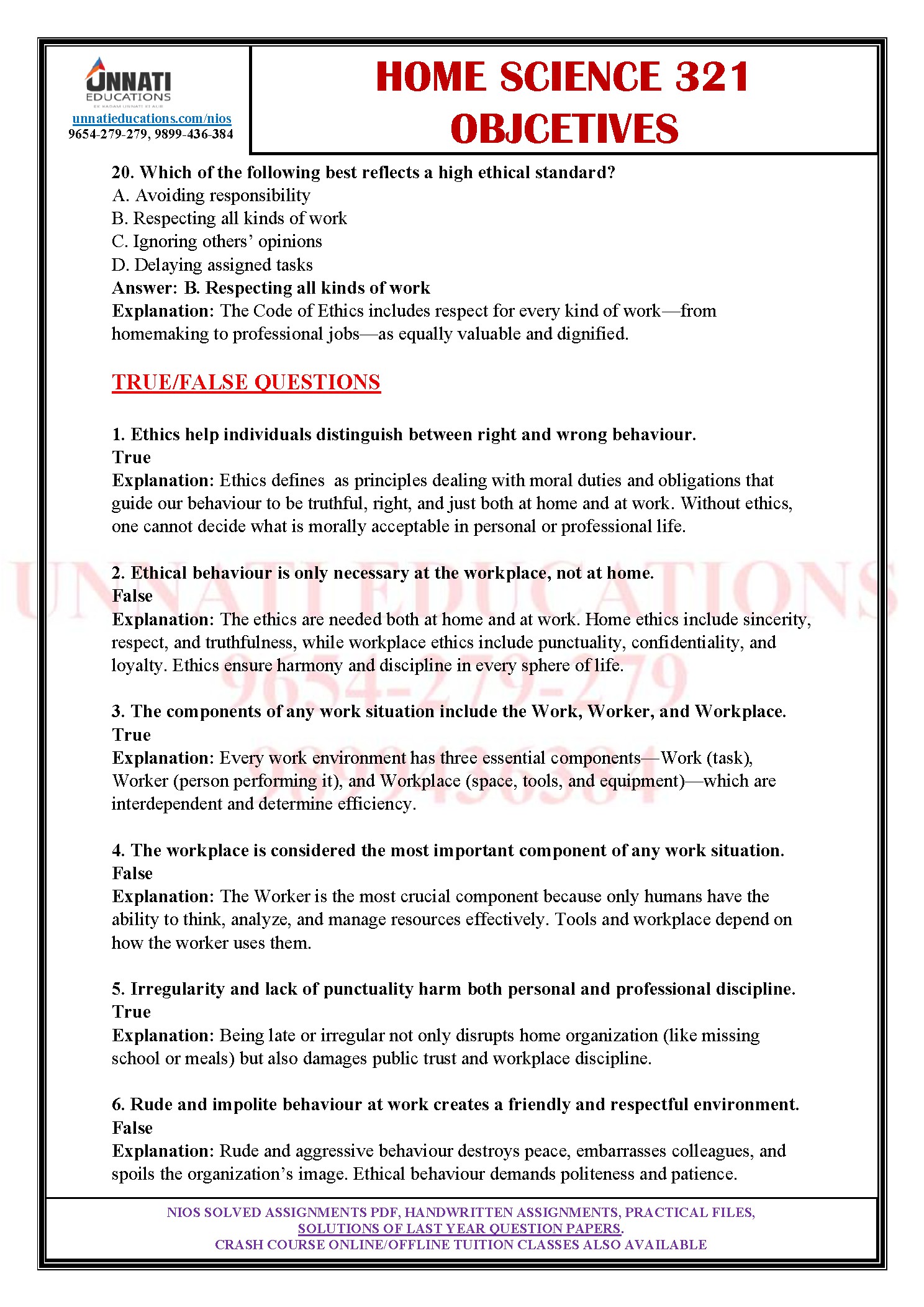
Sample page from the Home Science 321 objective set showing true or false statements with answers.
NIOS Home Science 321 Match the Following with Answers
Match the following sets reward you for linking a term to its exact meaning, which is where careless marks usually slip away. This sample from the Home Science 321 pack shows how we lay out Column A, the correct match, and a short reason for each pair.
Ethics in Daily Life Set: Components, Ethics, and Ethical Problems
| Column A | Correct match (Column B) |
|---|---|
| 1. Worker | Person who does the task and manages others |
| 2. Work ethics | Encourages fair, just, and impartial performance |
| 3. Wastage of resources | Lights and fans left running unnecessarily |
| 4. Disloyalty | Misuse of office property for personal use |
| 5. Respect for time | Completing tasks punctually and with discipline |
Why: The Worker is the most important component of any work situation, since only a person can plan, manage, and use tools and space. Work ethics set the standard for fair conduct, while wastage and disloyalty are examples of unethical behaviour the chapter warns against.
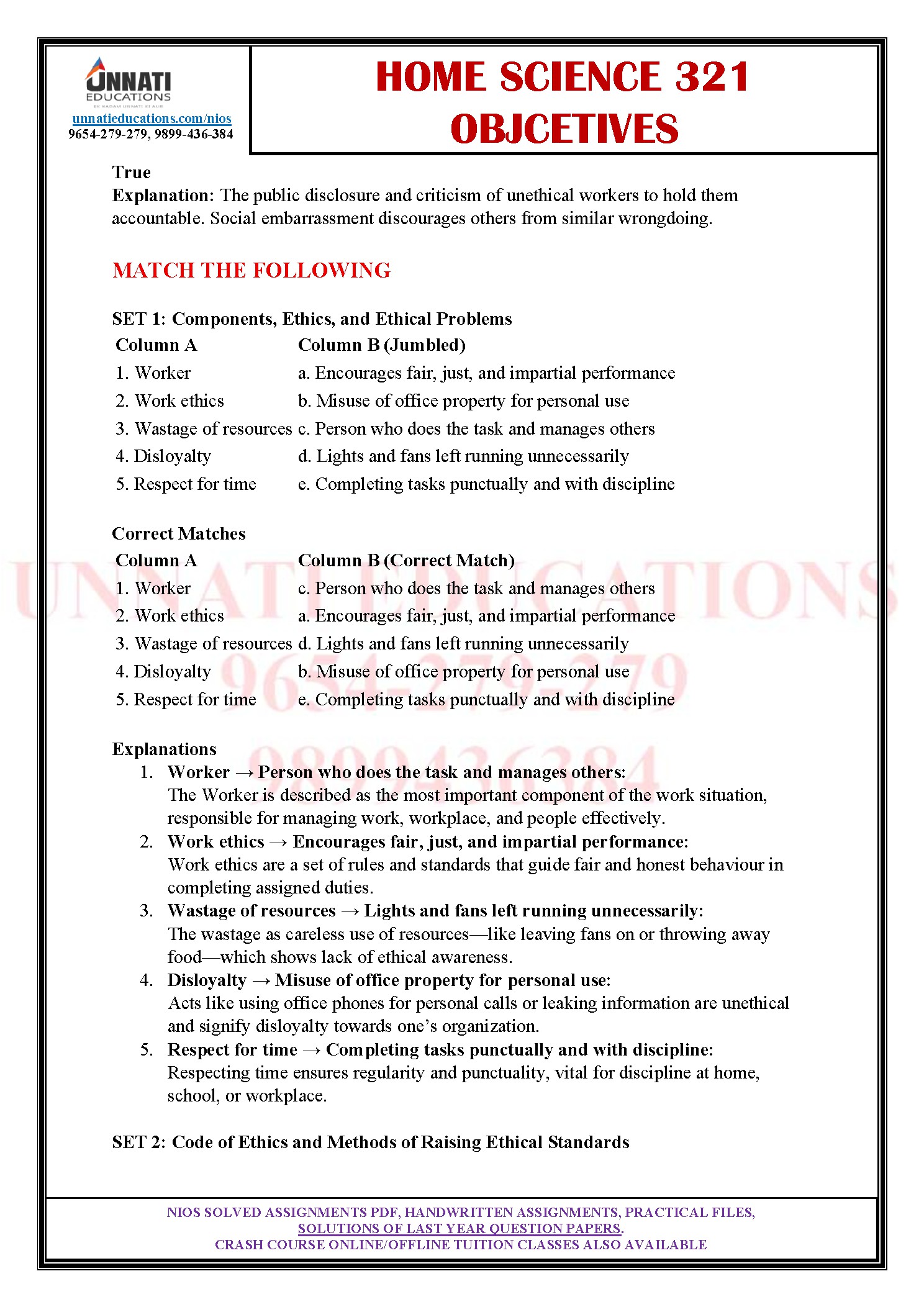
Sample page from the Home Science 321 objective set showing a match the following set with answers.
Liked the samples? These are just a handful from the full pack. The complete chapter by chapter set is ready to share on WhatsApp.
Get the full Home Science 321 objective set on WhatsApp
WhatsApp 9654 279 279, or 9899 436 384 as an alternate.
Chapters Covered in the NIOS Home Science 321 Objective Set
The objective set runs across every module of the Home Science 321 course, from managing the home and food and nutrition to textiles, human development, and the two optional modules. The table below lists each chapter with the key topics its questions focus on, so you can match your revision to the official NIOS Syllabus and see where your weak areas sit.
| Module | Chapter | Key topics the questions focus on |
|---|---|---|
| Art and Science of Managing Home | Chapter 2: Ethics in Daily Life | General and workplace ethics, work situation components, wastage and disloyalty |
| Food and Nutrition | Chapter 5: Meal Planning | Food groups, food exchange, factors that shape a balanced diet |
| Food and Nutrition | Chapter 6: Nutritional Status | Undernutrition and overnutrition, causes of malnutrition, assessing status by height and weight |
| Food and Nutrition | Chapter 9: Food Preservation | Shelf life, pasteurisation, reasons for preserving seasonal foods |
| Resource Management | Chapter 12: Space Management | Functional storage, dual-purpose space, principles of space organisation |
| Resource Management | Chapter 13: Income Management | Types of family income, real and psychic income, the total income formula |
| Resource Management | Chapter 14: Energy Conservation | Renewable and non-renewable sources, fossil fuels, everyday energy saving |
| Resource Management | Chapter 15: Environment Management | Environmental degradation, its causes, and population pressure |
| Resource Management | Chapter 16: Household Equipment | Electrical and non-electrical equipment, classification, care and selection |
| Resource Management | Chapter 17: Consumer Education | Consumer rights, steps in wise buying, off-season purchasing |
| Human Development | Chapter 19: Growth and Development (6 to 11 years) | Middle childhood, the growth spurt, permanent teeth and body proportion |
| Human Development | Chapter 20: Adolescence | Puberty and its signs, menarche, the WHO adolescent age group |
| Human Development | Chapter 21: Concerns and Issues in Human Development | Juvenile delinquency, discrimination against the girl child, effects of poverty |
| Textiles and Clothing | Chapter 24: Fabric Construction | Weaving, warp and weft, methods of fabric construction |
| Textiles and Clothing | Chapter 26: Selection of Textiles and Clothing | Fibre properties, seasonal suitability, choosing baby garments |
| Textiles and Clothing | Chapter 27: Care and Maintenance | Laundering steps, sorting before washing, everyday clothes care |
| Optional: Housekeeping | Chapter 29A: Cleaning and Cleaning Materials | Dry and wet cleaning, dust, common cleaning agents |
| Optional: Housekeeping | Chapter 30A: Maintenance of Premises | Cleaning painted walls, removing grease stains, caring for marble and granite |
| Optional: Housekeeping | Chapter 31A: Aesthetics at Home | Furniture arrangement, flower arrangement, balance in home decor |
| Optional: Creative Hand Embroidery | Chapter 29B: The Design | Types of design, geometric and stylised designs, sources of design |
| Optional: Creative Hand Embroidery | Chapter 30B: Colour | Primary and secondary colours, tertiary colours, colour mixing |
| Optional: Creative Hand Embroidery | Chapter 31B: Embroidery Stitches | Stem stitch, satin stitch, starting embroidery without a knot |
Module labels follow the official NIOS Home Science 321 course structure of five core modules and two optional modules.
How to Revise with NIOS Home Science 321 Objective Type Questions
An objective bank only helps if you use it in order. Read a chapter first, then attempt its multiple choice, true or false, and match questions before moving on. Pairing this set with our chapter wise NIOS Class 12 Objective Type Questions gives you both the objective drill and the descriptive practice inside one steady routine.
Give the match the following sets a second look. In Home Science these pair terms with definitions that sound alike, so revisit them a few days before the paper. Cover the answer column, test yourself, and note any pair you keep confusing for a final quick review.
Keep a short list of the questions you get wrong. Each mistake points straight at a topic that needs another read, whether it is food preservation methods or types of embroidery stitches. Clear those gaps first and your Home Science 321 score usually rises without extra hours of study.
Get the Full NIOS Class 12 Home Science 321 Objective Type Questions Pack
You have seen the samples and how each answer is explained. The complete pack covers every chapter with full multiple choice questions, true or false statements, and match the following sets, each carrying an answer and a short reason. It is written to be easy to follow and genuinely useful in the final weeks before your exam.
To receive the full set, message us on WhatsApp with your subject and class, and our team will share how to get it along with the current details. If you are preparing for other NIOS subjects too, you can ask for those objective packs in the same chat.
Message us on WhatsApp for the full Home Science 321 pack
WhatsApp 9654 279 279, or 9899 436 384 as an alternate.
FAQs on NIOS Class 12 Home Science 321 Objective Type Questions
Are these NIOS Home Science 321 Objective Type Questions enough to pass the exam?
These objective questions cover a large share of the Home Science 321 objective section, which on its own can take you close to a comfortable pass. For a higher score you should still practise the descriptive answers and the practical work. Used together with chapter reading and past papers, this set removes most of the guesswork from your objective preparation and steadies your exam nerves.
How are the NIOS Home Science 321 Objective Type Questions for Class 12 prepared?
Each question is prepared by reading the full NIOS Home Science book chapter by chapter and studying several previous year papers. We note the topics and phrasing that keep returning, then write clear objective questions with correct answers and short reasons. This keeps the questions close to the real exam pattern rather than copying unverified material found on random websites.
Do the NIOS Class 12 Home Science Objective Type Questions come with answers?
Yes, every objective question comes with its correct answer and a one line explanation. The reason under each answer tells you why that option is right, which helps you understand the concept instead of memorising blindly. This holds across all formats, including the multiple choice questions, true or false statements, and match the following sets in the Home Science 321 pack.
Which chapters do the NIOS Home Science 321 Objective Type Questions cover?
The set covers every module of the Home Science 321 course, including managing the home, food and nutrition, resource management, human development, textiles and clothing, and the two optional modules. You can see the full chapter list with key topics in the table above. Because questions are mapped to chapters, you can revise one topic at a time and track your progress.
How can I get the complete NIOS Home Science 321 Objective Type Questions set?
Send a message on WhatsApp to 9654 279 279, or 9899 436 384 as an alternate, and mention that you want the Home Science 321 objective pack. Our team will reply with how to receive the complete chapter by chapter set and the current details. You can also ask about objective questions for other NIOS Class 12 subjects in the same conversation.
Are the NIOS Class 12 Home Science 321 Objective Type Questions updated for 2026?
Yes, this objective set is prepared for the 2026 exam cycle using the current Home Science 321 chapters and recent question papers. We review the questions each session so the wording, answers, and chapter coverage stay in line with the latest pattern. If NIOS revises the syllabus, we update the affected chapters and refresh the set before the next exam window.
Disclaimer: Unnati Educations is an independent academic support platform and is not affiliated with, endorsed by, or officially connected to the National Institute of Open Schooling (NIOS). All subject names and codes are used only to help students identify the correct study material.
Sources: NIOS Senior Secondary Home Science (321) course material and official syllabus (nios.ac.in), previous year NIOS Home Science 321 question papers, and the NIOS Home Science textbook, 2026 edition.