Dates, wars, commanders and reforms pile up fast in this paper, and the surest way to keep them straight is a focused set of NIOS Class 12 Military History 375 Objective Type Questions. This page pulls together objective type questions with answers for the 2026 session, prepared after reading the full prescribed textbook and studying a spread of past papers.
Written by Prateek Talwar and reviewed by Jyoti Sharma, Senior NIOS Counsellor. Last updated on 17 July 2026.
You can go through genuine samples below at no cost, then reach us for the complete Military History 375 bank whenever you are ready.
Why These NIOS Class 12 Military History 375 Objective Type Questions Matter for 2026
The objective section of the Military History 375 paper is where attentive students quietly build a cushion of marks. A single mark for the right year, the correct commander, or the reason behind a reform adds up quickly, and these are the marks most candidates give away for want of focused revision.
Because objective items test exact recall, they reward short, repeated practice. Running through a curated list lets you cover the whole course, catch the lessons where dates and names blur together, and lock the facts in place well before you sit the exam.
If you are planning the wider session and not just this subject, our broader set of NIOS Class 12 Objective Type Questions works alongside this Military History paper, so your revision stays organised subject by subject.
Lesson Wise Topics in the NIOS Military History 375 Question Bank
The bank runs across the ancient, medieval and modern lessons of the course, so no scoring period is skipped. Instead of a generic list, the table shows the specific topics you will practise inside each lesson, which is a quick way to see where you stand.
| Lesson | Chapter Name | Key Topics You Will Practise |
|---|---|---|
| 2 | Armies in Ancient Age | Emergence of regular armies, Janapadas to Mahajanapadas, standing force versus mercenaries |
| 4 | Maurya and Gupta Armies | Recruitment criteria and army symbols, the rise of Magadh, founding of the Mauryan dynasty in 321 BC |
| 5 | Establishment of the Delhi Sultanate | Span of the medieval period, rise of the Sultanate, cavalry based warfare |
| 6 | Military System of the Mughals | What set the Mughals apart from the Sultans, Persian influence, the mansabdari organisation |
| 11 | Revolt of 1857 and Reforms in the Indian Army | The Vellore Mutiny of 1806, causes of 1857, post-revolt British reorganisation |
| 12 | Indian Army in World War I and II | Causes of the Great War, the Central Powers and Allies, Indian troops fighting overseas |
| 13 | Indian Army | Modernisation after the World Wars, new technology and structure, role of the modern army |
| 14 | Indian Navy | Chola naval expeditions, defeat of the Portuguese by Captain Best in 1612, the Royal Indian Navy |
| 15 | The Indian Air Force | Establishment in 1932, the Royal prefix of 1945, renaming after the 1950 Constitution |
| 17 | Sino-Indian War 1962 | Hindi-Chini Bhai Bhai, the McMahon Line of 1914, the 1959 turning point |
| 19 | India-Pakistan War 1971 | East and West Pakistan tensions, economic and political causes, the course of the 1971 war |
| 20 | Kargil Conflict 1999 | The Drass and Batalik sectors, Tololing and Tiger Hill, high-altitude warfare |
| 21 | Insurgency | How an insurgency begins, insurgency versus terrorism, guerrilla warfare and civil resistance |
| 22 | Terrorism | Definition of terrorism, use of fear against the state, unlawful violence and its aims |
This Military History paper is one shelf in a much larger library, so once your objective practice is done you can move to full solutions and notes from our NIOS Study Material collection for your remaining subjects.
Sample Multiple Choice Questions from NIOS Military History 375
Here is a no-cost preview drawn straight from our Military History 375 bank so you can judge the standard before asking for the full set. The chips show which lesson each question belongs to.
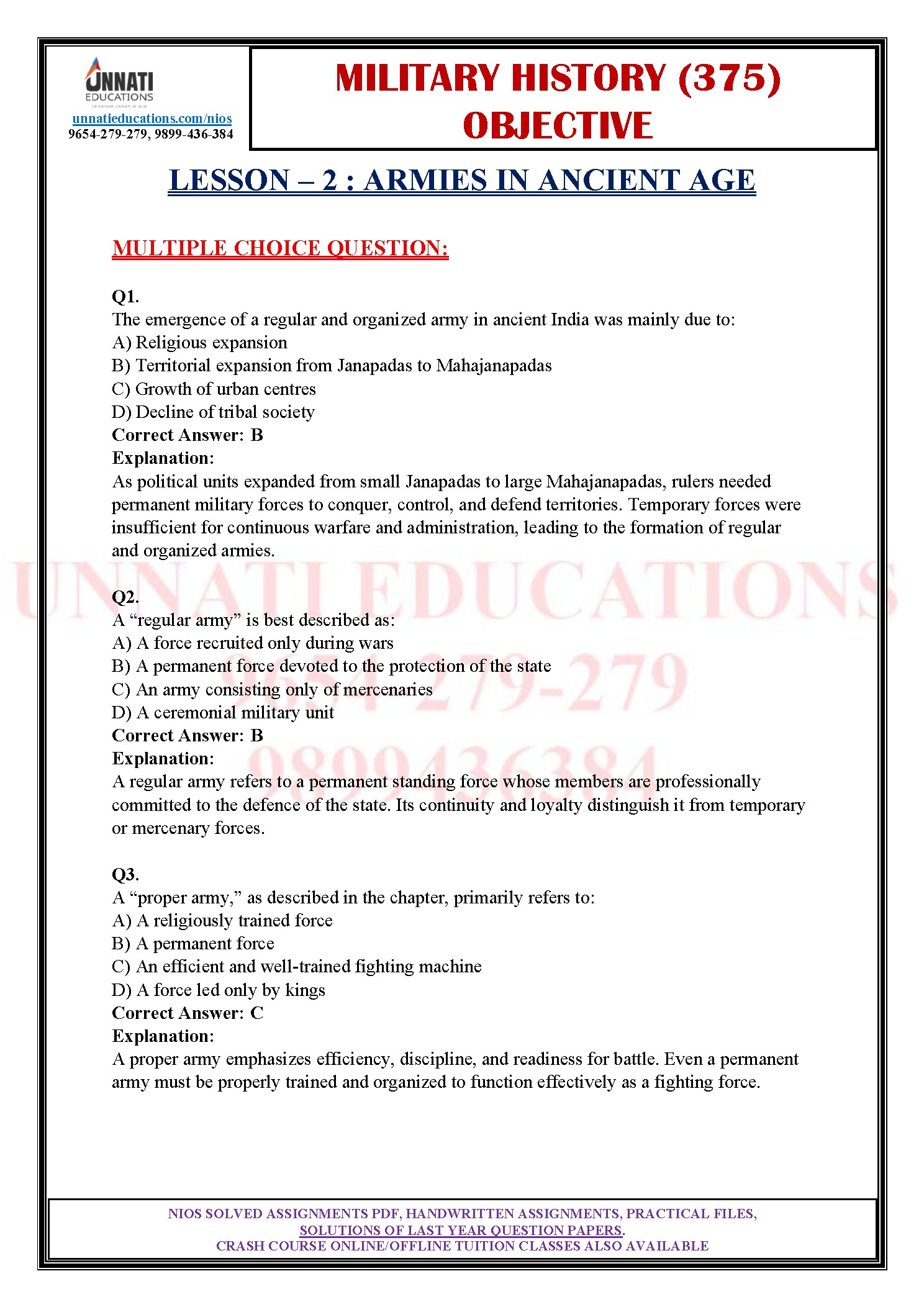
Lesson 2 Armies in Ancient Age
Q1. The emergence of a regular and organised army in ancient India was mainly due to:
- A. Religious expansion
- B. Territorial expansion from Janapadas to Mahajanapadas
- C. Growth of urban centres
- D. Decline of tribal society
Answer: B. Territorial expansion from Janapadas to Mahajanapadas
Explanation: As political units expanded from small Janapadas to large Mahajanapadas, rulers needed permanent forces to conquer, control and defend territory. Temporary forces could not sustain continuous warfare, so regular armies were formed.
Lesson 4 Maurya and Gupta Armies
Q2. The Mauryan dynasty was founded in:
- A. 544 B.C.
- B. 321 B.C.
- C. 269 B.C.
- D. A.D. 300
Answer: B. 321 B.C.
Explanation: The founding of the Mauryan dynasty around 321 B.C. marked a major political turning point, bringing a large and organised military under a single centralised authority.
Lesson 11 Revolt of 1857
Q3. The Vellore Mutiny of 1806 is regarded as historically important because it:
- A. Ended British control in South India
- B. Was the first organised revolt by Indian sepoys against British rule
- C. Resulted in the formation of the British Indian Army
- D. Was led by Indian princes
Answer: B. Was the first organised revolt by Indian sepoys against British rule
Explanation: The Vellore Mutiny is seen as the first organised military revolt by Indian soldiers against British authority. Though limited in scale, it marked the earliest open resistance within the ranks.
Lesson 12 World War I and II
Q4. Which group of countries formed the Central Powers during World War I?
- A. Britain, France, Russia, Italy
- B. Germany, Austria-Hungary, Bulgaria, Ottoman Empire
- C. USA, Japan, Romania, Britain
- D. France, Russia, Japan, Italy
Answer: B. Germany, Austria-Hungary, Bulgaria, Ottoman Empire
Explanation: The Central Powers consisted of Germany, Austria-Hungary, Bulgaria and the Ottoman Empire, ranged against the Allied Powers during the First World War.
Lesson 14 Indian Navy
Q5. The formal beginning of the Indian Navy is historically traced to which event?
- A. Establishment of Royal Indian Navy
- B. Naval expeditions of the Cholas
- C. Defeat of the Portuguese by Captain Best
- D. Formation of Bombay Marine
Answer: C. Defeat of the Portuguese by Captain Best
Explanation: The origin of the Indian Navy is linked to the year 1612, when Captain Best defeated the Portuguese, an event traditionally treated as the formal beginning of Indian naval history.
Lesson 17 Sino-Indian War 1962
Q6. The McMahon Line was drawn in the year:
- A. 1865
- B. 1914
- C. 1947
- D. 1956
Answer: B. 1914
Explanation: The McMahon Line was drawn in 1914. China never accepted it, and it later became a major source of dispute in the eastern sector during the Sino-Indian conflict.
Sample Fill in the Blanks from NIOS Military History 375
Fill in the blanks reward the exact term or year, so read each explanation to fix the detail in memory for the Military History 375 paper.
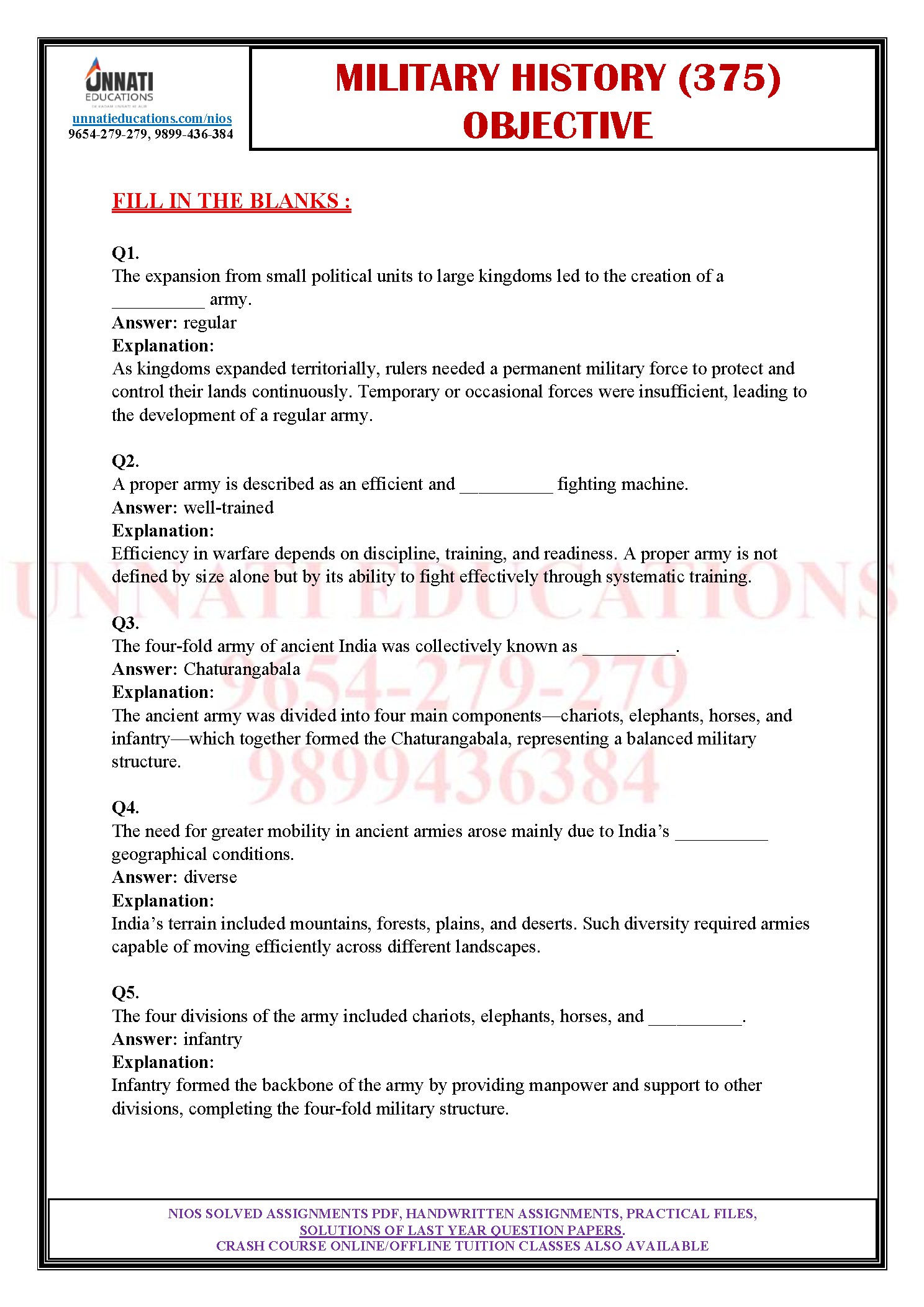
Lesson 2
The expansion from small political units to large kingdoms led to the creation of a __________ army.
Answer: regular
Explanation: As kingdoms expanded, rulers needed a permanent force to protect and control their lands continuously. Temporary or occasional forces were not enough, which led to the development of a regular army.
Lesson 15
The Indian Air Force was officially established in the year __________.
Answer: 1932
Explanation: The chapter states that the Indian Air Force came into existence in 1932, marking the beginning of organised air power in India.
Lesson 15
The Indian Air Force was granted the prefix "Royal" in the year __________.
Answer: 1945
Explanation: The title "Royal" was awarded in 1945 in recognition of the services rendered by the force during the Second World War.
Sample Match the Following from NIOS Military History 375
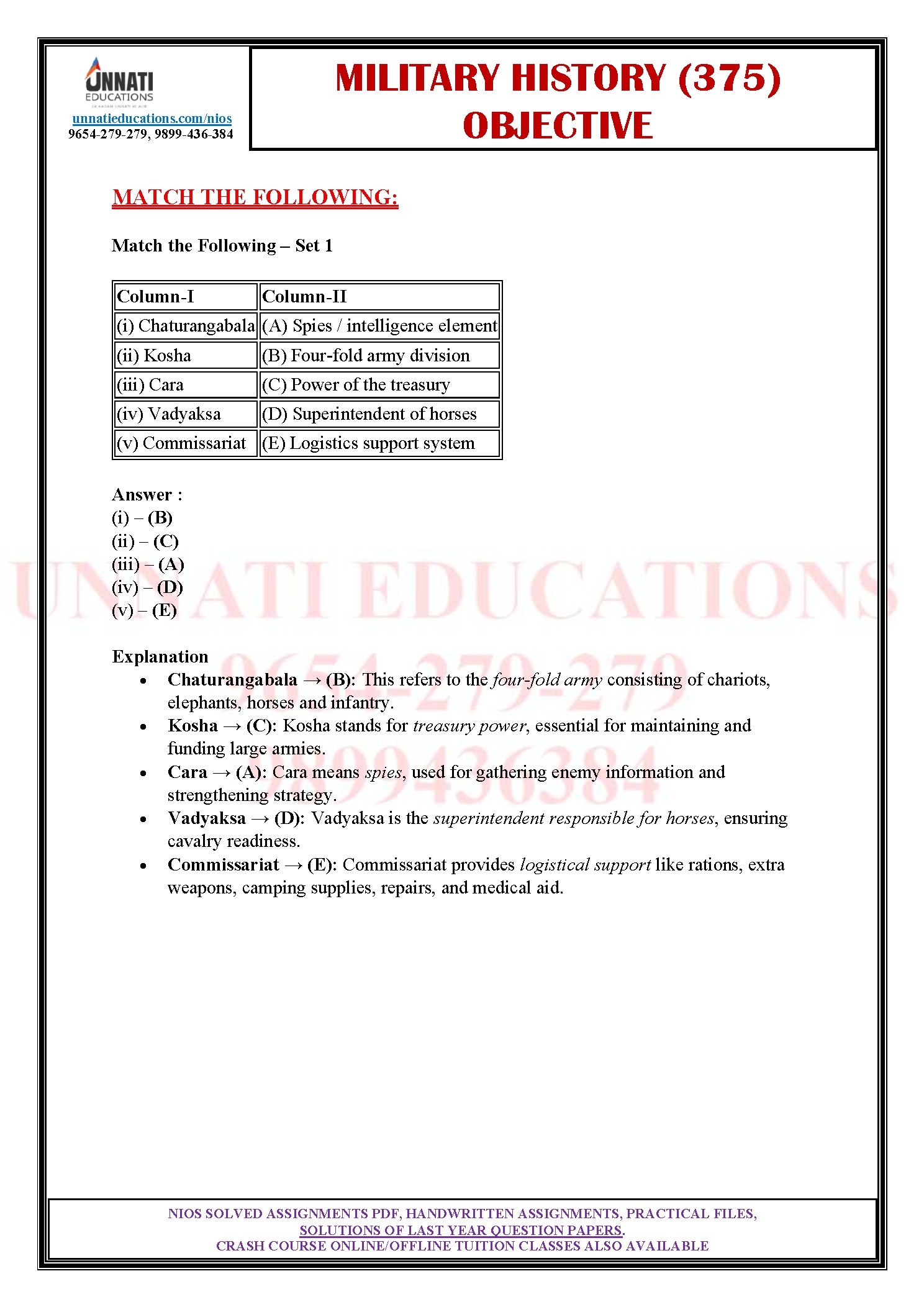
Match the following checks whether you can tie a fact to the right year or role. Below is one complete set on the Indian Air Force, shown with the correct pairs.
| Column I | Correct Match from Column II |
|---|---|
| Indian Air Force | Defence of Indian airspace |
| Year of establishment | 1932 |
| Royal prefix | 1945 |
| Renamed Indian Air Force | 1950 |
| Primary role | Air defence |
The lesson explains that the Indian Air Force was established in 1932, gained the Royal prefix in 1945 for its wartime service, and dropped that title in 1950 after the Constitution was adopted, with air defence remaining its foremost role. That reasoning is what helps the matching stay in memory during the exam.
How We Prepared the NIOS Military History 375 Objective Type Questions
None of this is filler. Our team read each prescribed lesson of the Military History 375 book from start to finish, marked the dates, battles and reforms that examiners keep returning to, and turned those points into clean objective questions with verified answers and short explanations.
We also studied how questions repeat over the years by working through the NIOS Previous Year Question Paper record lesson by lesson. That trend analysis is what keeps this bank tied to the real exam rather than stray facts pulled from the book.
Every explanation is written to teach, not just to state an answer. You learn why the Mughals broke from the Delhi Sultans, why the McMahon Line still stirs dispute, or why the Vellore Mutiny mattered, so a reworded question in the real paper no longer catches you off guard.
What the Complete NIOS Class 12 Military History 375 Objective Type Questions Include
The previews above are only a small slice. The complete pack works through every lesson listed in the topics table, giving you many more questions per chapter than any preview can show.
For each lesson you receive multiple choice questions, fill in the blanks and match the following sets, each with a verified answer and a short explanation. That mix mirrors how the objective section of the paper is actually framed.
The bank follows the current course, so if you want to cross-check the lessons yourself you can view the official structure through the NIOS Syllabus before you begin. This keeps your revision aligned with what appears in the 2026 paper.
Message us on WhatsApp for the full Military History 375 question bank
Tap to chat on 9654 279 279
How to Get the Full NIOS Military History 375 Objective Type Questions
Getting the full set is simple. Send us a message with the subject code, Military History 375, and mention the 2026 session. Our counselling team confirms what is included and shares the complete objective bank with you directly.
Delivery is over WhatsApp, so there is no random link to chase and nothing to sign up for. You receive the material and start practising the same day, and you can ask about any tricky lesson while you are on the chat.
Request the Military History 375 Objective Type Questions now
WhatsApp 9654 279 279 or 9899 436 384
Who Should Practise These NIOS Military History 375 Questions
These questions suit first-time Military History 375 candidates who want a clear, lesson-linked way to revise, as well as repeaters aiming to finally clear the objective section with confidence. They also help students completing tutor marked assignments who need quick, dependable answers.
If a younger family member is preparing for the secondary stage at the same time, they may find our NIOS Class 10 Syllabus useful too, so the whole household can study from one trusted source across levels.
Frequently Asked Questions on NIOS Military History 375 Objective Type Questions
What are the NIOS Military History 375 Objective Type Questions based on?
These Military History 375 Objective Type Questions are drawn from the prescribed NIOS textbook and a review of several past papers. Our team studied each lesson closely, then shortlisted the objective items that appear most often and carry easy scoring value. Every question carries a verified answer and a short explanation, so you grasp the reasoning rather than memorising blindly before the exam.
Which periods of history do the Military History 375 questions cover?
The Military History 375 bank stretches from the ancient age through to recent conflicts. You practise ancient and medieval armies such as the Maurya, Gupta and Mughal forces, then move to modern lessons on the World Wars, the 1962, 1971 and Kargil conflicts, and finally insurgency and terrorism. This wide span matches the way the paper draws its objective questions across the whole course.
Are these Military History 375 Objective Type Questions useful for the 2026 exam?
Yes, the Military History 375 set is prepared specifically for the 2026 session and follows the current course pattern. Objective questions carry dependable one-mark scoring, and revising a focused list helps you cover every lesson without wasting time. Regular practice builds the speed and accuracy the short-answer part of the paper rewards, and each item reinforces the fact behind it.
Do the Military History 375 questions include answers and explanations?
Every Military History 375 question comes with a confirmed answer and a brief explanation. The explanation shows why the answer is correct and points to the exact detail in the lesson being tested. This means you learn the reasoning, not just one answer, so a reworded version of the same question in the real paper does not throw you off.
How many chapters of Military History 375 are covered in the question bank?
The Military History 375 question bank covers fourteen lessons, from armies in the ancient age and the Mughal military system to the Indian Navy, the Air Force, the major wars and modern insurgency. The full list with lesson-specific topics appears in the coverage table on this page, so you can see exactly what each lesson holds before you begin.
How do I get the complete NIOS Military History 375 Objective Type Questions?
To get the complete Military History 375 pack, send us a WhatsApp message mentioning the subject code and the 2026 session. Our counselling team confirms the contents and shares the full objective bank with you over chat. There is no complicated process and no sign-up, so you can begin your revision the same day you contact us.
Sources: NIOS prescribed Military History (375) textbook and Unnati Educations analysis of previous year NIOS question papers, 2026 edition.
Disclaimer: Unnati Educations is an independent academic support platform and is not affiliated with, endorsed by, or officially connected to the National Institute of Open Schooling (NIOS). All trademarks and course names belong to their respective owners. Students should verify the current syllabus and examination pattern from the official NIOS website.