Preparing for the Physics paper feels far less stressful once you practise the questions that actually tend to appear, rather than reading the whole book blindly. This page gives you a hand-picked set of NIOS Class 12 Physics 312 Objective Type Questions with answers for the 2026 session, prepared after studying past papers and going through the complete NIOS Physics textbook. Every objective format is covered, and you can check real samples below before you ask for the full booklet.
Written by Prateek Talwar · Reviewed by Jyoti Sharma, Senior NIOS Counsellor · Last updated 17 July 2026
We have kept the language simple and the answers short, because most learners revising for the examination want clarity and not long theory. Each question here carries a correct answer and a one-line reason, so you understand why an option is right instead of memorising it. Treat this page as a quality check first, and then decide.
NIOS Class 12 Physics 312 Objective Type Questions for the 2026 Session
Physics 312 has a wide syllabus that runs from mechanics to modern physics, so knowing where to focus saves a lot of revision time. This collection pulls together the most repeated and most examinable ideas from every lesson into four objective formats. The aim is a resource that a learner can finish in a few focused sittings and still feel ready for the objective section of the paper.
The set is refreshed for the current session so the pattern matches what learners can expect in 2026. If you are also mapping the wider course before you revise, our NIOS Syllabus page lays out the subjects and structure in one place, which pairs well with the topic list further down.
How These NIOS Class 12 Physics Objective Type Questions Were Prepared
These NIOS Class 12 Physics Objective Type Questions were not written in a hurry or copied from one guide. Our team studied several years of question papers to see which concepts return again and again, then read through the complete NIOS Physics textbook lesson by lesson to make sure nothing important was left out. Only after that did we frame the questions, so each one reflects both the book and the real examination style.
To keep the practice realistic, we cross-checked the recurring patterns against the actual papers on our NIOS Previous Year Question Paper collection. That comparison is what shapes the four formats you see here, namely multiple choice, fill in the blanks, true and false, and match the following.
The four objective formats you get for every chapter
Multiple choice questions train quick recognition of the correct option. Fill in the blanks test exact terms and units. True and false statements catch the small misconceptions that lose marks. Match the following builds links between laws, formulae and their meaning. Together these formats mirror the objective portion of the Physics 312 paper closely.
Chapter Wise List of NIOS Physics 312 Topics Covered
The full booklet covers all eighteen lessons of the Physics 312 course. The table below lists every chapter with its NIOS lesson code and the core idea it deals with, so you can jump straight to the topics you find hardest. Sample questions later on this page are drawn from a few of these lessons.
| S. No. | Lesson Code | Chapter Name | Key Concept Area |
|---|---|---|---|
| 1 | L-3 | Laws of Motion | Inertia, momentum, impulse and friction |
| 2 | L-6 | Work, Energy and Power | Work done, energy forms and power |
| 3 | L-9 | Properties of Fluids | Pressure, viscosity and surface tension |
| 4 | L-11 | Thermodynamics | Heat, laws of thermodynamics and processes |
| 5 | L-14 | Wave Phenomena | Wave motion, sound and superposition |
| 6 | L-15 | Electric Charge and Electric Field | Coulomb law, charge and field lines |
| 7 | L-16 | Electric Potential and Capacitors | Potential, potential energy and capacitance |
| 8 | L-17 | Electric Current | Ohm law, resistance and circuits |
| 9 | L-18 | Magnetism and Magnetic Effect of Electric Current | Magnetic field, force and moving charges |
| 10 | L-19 | Electromagnetic Induction and Alternating Current | Induced emf, flux and AC circuits |
| 11 | L-21 | Dispersion and Scattering of Light | Prism, spectrum and scattering |
| 12 | L-22 | Wave Phenomena and Light | Interference, diffraction and polarisation |
| 13 | L-24 | Structure of Atom | Atomic models and spectra |
| 14 | L-25 | Dual Nature of Radiation and Matter | Photoelectric effect and matter waves |
| 15 | L-26 | Nuclei and Radioactivity | Nucleus, decay and half life |
| 16 | L-27 | Nuclear Fission and Fusion | Fission, fusion and energy release |
| 17 | L-28 | Semiconductors and Semiconducting Devices | Diodes and junction behaviour |
| 18 | L-29 | Applications of Semiconductor Devices | Rectifiers, transistors and logic |
If you want the same chapter wise approach for other subjects too, our NIOS Class 12 Objective Type Questions section groups these booklets by subject so your revision stays organised across the whole year.
Sample NIOS Physics 312 Multiple Choice Questions
Here are a few multiple choice samples taken directly from the booklet, drawn from more than one lesson so you can judge the range. Each carries the correct option and a short reason. These are exact extracts, kept word for word from the source.
Laws of Motion
1. Which physical quantity is the best measure of the inertia of an object?
A) Volume
B) Acceleration
C) Mass
D) Force
Answer: C) Mass
Explanation: Inertia is the tendency of an object to resist changes in motion. The mass of a body quantifies its inertia — higher mass implies greater inertia.
Laws of Motion
2. A marble rolls on a frictionless horizontal surface indefinitely. This illustrates:
A) Newton's third law
B) Inertia of direction
C) Newton's first law
D) Kinetic energy conservation
Answer: C) Newton's first law
Explanation: In the absence of net external force, an object continues in its state of uniform motion. This is Newton's First Law of Motion.
Electric Charge and Electric Field
3. Coulomb's force acts between:
A) Two neutral bodies
B) Two moving charges only
C) Two static point charges
D) Two dipoles only
Correct Answer: C
Explanation: Coulomb's law is valid only for static (stationary) point charges.
Electric Charge and Electric Field
5. Coulomb force in air is stronger than in water because:
A) Water has high density
B) Water has low permittivity
C) Water has high permittivity
D) Air molecules are polar
Correct Answer: C
Explanation: Coulomb's force decreases with increasing permittivity; water has a higher permittivity than air.

Sample Physics 312 Fill in the Blanks Questions
The fill in the blanks format checks whether you remember the exact term, unit or value. These samples come from the Work, Energy and Power lesson and appear here exactly as they do in the booklet.
Work, Energy and Power
1. Work done by a force is defined as the dot product of __________ and __________.
Answer: Force; displacement
Explanation: Work W=F⃗⋅d⃗ , meaning it's the scalar product of two vectors.
Work, Energy and Power
2. If the angle between force and displacement is 90°, then the work done is __________.
Answer: Zero
Explanation: Because cos 90°= 0, hence W = Fd cos 90°= 0.
Work, Energy and Power
3. The SI unit of work is __________, and its dimensional formula is __________.
Answer: Joule; [ML²T⁻²]
Explanation: 1 Joule = 1 N × 1 m, and work = force × distance → [MLT⁻²] × [L] = [ML²T⁻²].
Work, Energy and Power
7. The unit of energy used in electrical appliances is __________, and 1 such unit equals __________ joules.
Answer: Kilowatt-hour; 3.6 × 10⁶
Explanation: 1 kWh = 1000 W × 3600 s = 3.6 × 10⁶ J

Sample Physics 312 True and False Statements
True and false statements are where careless mistakes happen, because a single word changes the meaning. Read each one slowly. These samples are from the Laws of Motion lesson and are reproduced without any change.
Laws of Motion
1. A body cannot be in uniform motion if there is no net external force acting on it.
False
Explanation: Newton's First Law states that a body remains in uniform motion in a straight line unless acted upon by a net external force. Thus, motion can exist without a force.
Laws of Motion
3. A marble on a perfectly smooth horizontal floor would never stop moving unless a force is applied.
True
Explanation: On a frictionless surface, no net force implies no change in motion. According to Newton's First Law, the marble continues indefinitely.
Laws of Motion
9. Action and reaction forces always act on the same object.
False
Explanation: They act on different objects. That's why they do not cancel out.
Laws of Motion
12. Rocket propulsion works on the principle of Newton's Third Law and conservation of momentum.
True
Explanation: Thrust is produced as gases are ejected downward; rocket moves upward. Total momentum of the system is conserved.

Sample Physics 312 Match the Following Sets
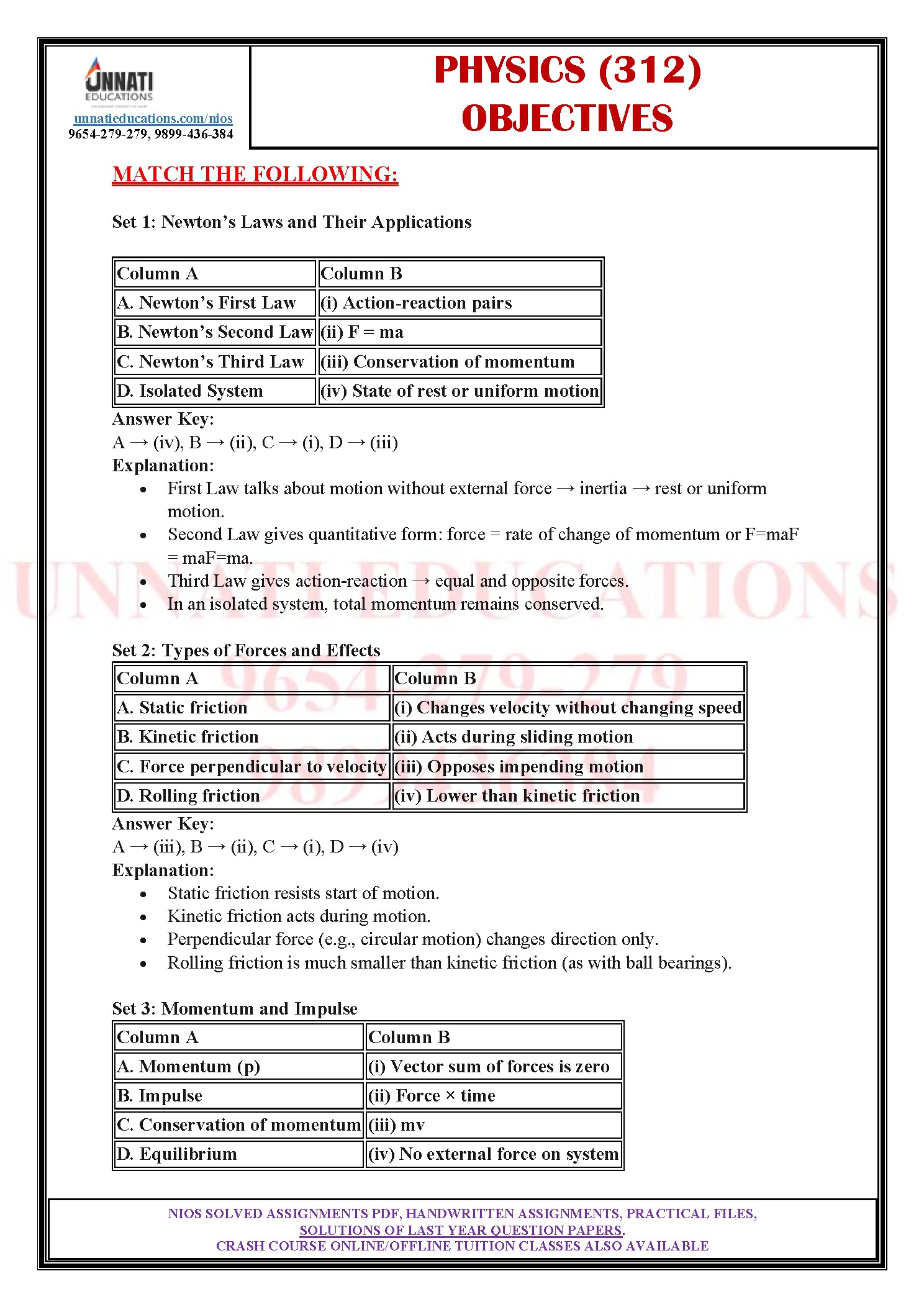
Match the following rewards a clear grasp of how laws, quantities and their meanings connect. Two full sets from the Laws of Motion lesson are shown below with their answer keys, exactly as in the booklet.
Set 1: Newton's Laws and Their Applications
| Column A | Column B |
|---|---|
| A. Newton's First Law | (i) Action-reaction pairs |
| B. Newton's Second Law | (ii) F = ma |
| C. Newton's Third Law | (iii) Conservation of momentum |
| D. Isolated System | (iv) State of rest or uniform motion |
Answer Key: A → (iv), B → (ii), C → (i), D → (iii)
Set 3: Momentum and Impulse
| Column A | Column B |
|---|---|
| A. Momentum (p) | (i) Vector sum of forces is zero |
| B. Impulse | (ii) Force × time |
| C. Conservation of momentum | (iii) mv |
| D. Equilibrium | (iv) No external force on system |
Answer Key: A → (iii), B → (ii), C → (iv), D → (i)
Want the complete Physics 312 question set?
These are only a handful of samples. The full booklet carries every multiple choice, fill in the blanks, true and false, and match the following question with answers for all eighteen lessons. Message us on WhatsApp and we will share the details.
Get the Complete NIOS Class 12 Physics 312 Objective Type Questions Booklet
The complete Physics 312 objective question booklet is built for one purpose, helping you clear the paper with less guesswork. It gathers every objective format for all eighteen lessons in one document, with a correct answer and a short reason under each question. That means you spend your time practising, not searching across scattered notes and old files.
You also get answers explained in plain words, so even a topic you found hard in class starts to make sense on revision. If you like to study more than one subject together, browse our wider NIOS Study Material so your Physics preparation sits alongside the rest of your session in one place.
Request your copy today
Send a quick message and tell us you need the Physics 312 objective question booklet for 2026. Our team replies with the sample check, pricing and delivery over WhatsApp so you can decide with full clarity.
Who Benefits Most from These NIOS Physics 312 Objective Questions
Repeaters and first-time candidates both gain from these NIOS Physics 312 Objective Questions, because objective marks are the easiest to secure with focused practice. Learners short on time can revise the whole objective section quickly, while those aiming for a strong score can use the explanations to close gaps in understanding.
Self-study candidates find the set especially useful, since it replaces guesswork with a clear map of what to expect. If you are still selecting your subjects for the coming session, comparing the load through the NIOS Class 10 Syllabus can help juniors plan ahead before they reach the senior secondary Physics paper.
NIOS Class 12 Physics Objective Type Questions FAQs
How many questions does the full NIOS Physics 312 booklet contain?
The full NIOS Physics 312 booklet carries a large question bank spread across all eighteen lessons of the course. Each lesson includes multiple choice, fill in the blanks, true and false, and match the following items with answers. The exact count is shared over WhatsApp when you request the booklet, since we update the set for every session to match the current pattern.
Do these NIOS Class 12 Physics Objective Type Questions include answers and explanations?
Yes, every question in the NIOS Class 12 Physics Objective Type Questions set comes with a clearly marked correct answer. Most items also carry a short one-line explanation that tells you why the answer is right. This helps you understand the concept during revision instead of only memorising options, which is what makes the objective section easier to score in the paper.
Are the NIOS Physics 312 objective type questions based on the 2026 pattern?
These NIOS Physics 312 objective type questions are prepared for the 2026 session and follow the current examination pattern. We build them by studying recent question papers and the complete NIOS Physics textbook, so the topics and formats reflect what learners can realistically expect. The set is refreshed each session, which keeps your practice aligned with the latest structure.
Which chapters of Physics 312 are covered in these Objective Type Questions?
All eighteen lessons of Physics 312 are covered, running from Laws of Motion through to Applications of Semiconductor Devices. The chapter table on this page lists every lesson with its code and key concept area. Sample questions shown here are drawn from Laws of Motion, Work and Energy, and Electric Charge, while the full booklet spans the entire course.
Can I get the NIOS Physics 312 Objective Type Questions in PDF on WhatsApp?
Yes, the NIOS Physics 312 Objective Type Questions are delivered conveniently once you contact us on WhatsApp. Simply send a message saying you need the Physics 312 objective booklet for 2026, and our team replies with the format details, pricing and delivery. Sharing over WhatsApp keeps the process quick and lets you ask any doubt about the material directly.
Will these Physics 312 objective questions help in the final theory exam?
These Physics 312 objective questions target the objective portion of the paper, which is a reliable source of marks. Strong objective practice also strengthens your grip on definitions, units and laws that support longer theory answers. So while the booklet focuses on objective formats, the concept clarity it builds carries over and supports your performance across the whole Physics examination.
Disclaimer: Unnati Educations is an independent academic support platform and is not affiliated with, endorsed by, or officially connected to the National Institute of Open Schooling (NIOS). All study material is prepared for learning and revision assistance only. Learners should always confirm the current syllabus and examination pattern on the official NIOS portal.
Sources and references: Questions prepared from the NIOS Physics (312) senior secondary textbooks and analysis of previous year question papers. Syllabus and examination details verified against the official NIOS website at nios.ac.in. Booklet edition updated for 2026.