A confident run through the objective section is often what separates a safe pass from a nervous one, and a well-chosen set of NIOS Class 12 Psychology 328 Objective Type Questions is the quickest way to build that confidence. This page collects objective type questions with answers for the 2026 session, prepared after reading the full prescribed textbook and studying a spread of past papers.
Written by Prateek Talwar and reviewed by Jyoti Sharma, Senior NIOS Counsellor. Last updated on 17 July 2026.
You can look through genuine samples below at no cost, then reach us for the complete Psychology 328 bank when you feel ready.
How We Built the NIOS Psychology 328 Objective Type Questions
None of this is padding. Our team read each prescribed lesson of the Psychology 328 book in full, marked the concepts and definitions examiners keep returning to, and reshaped those points into clean objective questions with verified answers and short explanations.
We also traced how questions repeat over the years by going through the NIOS Previous Year Question Paper record lesson by lesson. That trend work is what ties this bank to the real exam instead of stray facts lifted from the book.
Each explanation is written to teach rather than merely state an answer. You learn why Wundt used introspection, why encoding begins the memory process, or why the James-Lange theory sequences feeling and arousal the way it does, so a reworded question in the actual paper no longer unsettles you.
Lesson Wise Topics in the NIOS Psychology 328 Question Bank
The bank runs across the foundational, developmental and social lessons of the course, so no scoring area is left aside. Rather than a generic list, the table shows the specific topics you will practise inside each lesson, which is a fast way to gauge where you stand.
| Lesson | Chapter Name | Key Topics You Will Practise |
|---|---|---|
| 1 | Understanding Psychology | Schools of thought from structuralism to behaviourism, psychodynamic and cognitive perspectives, roots in philosophy |
| 3 | Methods of Psychological Enquiry | Descriptive and experimental research, independent and dependent variables, positive and negative correlation |
| 5 | Basic Statistics | Mean median and mode, effect of extreme scores, histograms and frequency |
| 6 | Attention and Perceptual Processes | Selective and automatic attention, the cocktail party effect, Gestalt principles of grouping |
| 8 | Human Memory | Encoding storage and retrieval, the Atkinson and Shiffrin model, explicit and implicit memory |
| 10 | Emotion | Components of emotion, James-Lange and Cannon-Bard theories, the Schachter-Singer two factor view |
| 11 | Thinking and Problem Solving | Concepts prototypes and schemas, autistic and realistic thinking, algorithms and heuristics |
| 13 | Infancy and Childhood | Gross and fine motor milestones, Piaget's assimilation and preoperational stage, egocentrism |
| 14 | Adolescence and Young Adulthood | Puberty and growth spurt, formal operational thinking, Erikson's identity crisis |
| 17 | Self and Personality | Self concept and self-efficacy, real and ideal self, Sheldon's body types |
| 18 | Intelligence | The IQ formula of Stern, Spearman's g and s factors, Gardner's multiple intelligences |
| 19 | Group Processes | Features of a group, Tuckman's stages of group formation, primary and secondary groups |
| 20 | Attitude | The ABC model of attitude, affective and behavioural components, sources of attitude formation |
| 23 | Mental Health Problems | Marks of a mentally healthy person, predisposing and precipitating factors, social causes of illness |
This Psychology paper is one shelf in a far larger library, so once your objective practice is done you can move to full solutions and notes from our NIOS Study Material collection for the rest of your subjects.
Sample Multiple Choice Questions from NIOS Psychology 328
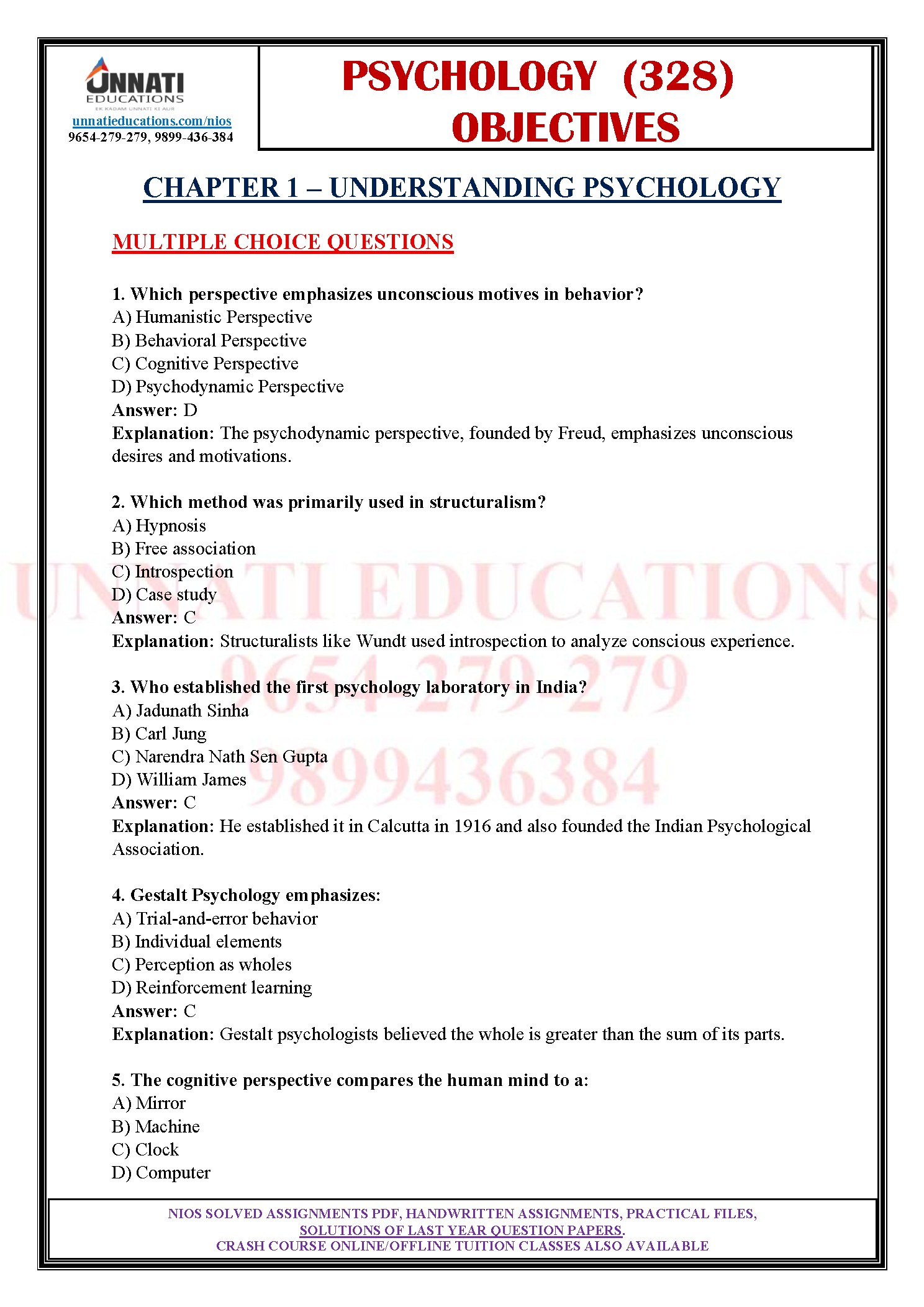
Here is a no-cost preview taken straight from our Psychology 328 bank so you can weigh the standard before asking for the full set. The chips show which lesson each question belongs to.
Lesson 1 Understanding Psychology
Q1. Which perspective emphasizes unconscious motives in behaviour?
- A. Humanistic Perspective
- B. Behavioural Perspective
- C. Cognitive Perspective
- D. Psychodynamic Perspective
Answer: D. Psychodynamic Perspective
Explanation: The psychodynamic perspective, founded by Freud, emphasises unconscious desires and motivations as the driving forces behind much of human behaviour.
Lesson 8 Human Memory
Q2. The process of converting sensory input into a storable form in memory is called:
- A. Retrieval
- B. Storage
- C. Encoding
- D. Rehearsal
Answer: C. Encoding
Explanation: Encoding is the first stage of memory, where incoming input is transformed into a mental representation that can then be stored and later retrieved.
Lesson 10 Emotion
Q3. What is the Latin origin of the word "emotion"?
- A. Emovere, to stir up
- B. Emotio, to react
- C. Emo, to suppress
- D. Emora, to eliminate
Answer: A. Emovere, to stir up
Explanation: The term emotion comes from the Latin word emovere, meaning to agitate or stir up, which captures the aroused state that emotions produce.
Lesson 5 Basic Statistics
Q4. If a score appears most frequently in a data set, it is the:
- A. Mean
- B. Median
- C. Mode
- D. Range
Answer: C. Mode
Explanation: The mode is the value that occurs most often in a distribution. It is the only measure of central tendency that can also be used with categorical data.
Lesson 18 Intelligence
Q5. Which psychologist proposed the concept of IQ with the formula IQ = MA divided by CA times 100?
- A. Binet
- B. Thurstone
- C. Stern
- D. Spearman
Answer: C. Stern
Explanation: William Stern developed the intelligence quotient formula in 1912, relating mental age to chronological age to give a single comparable score.
Lesson 20 Attitude
Q6. The ABC model of attitude includes affective, behavioural, and __________ components.
- A. Cultural
- B. Cognitive
- C. Conditioned
- D. Conscious
Answer: B. Cognitive
Explanation: The ABC model describes attitude through three parts, the affective feeling, the behavioural tendency to act, and the cognitive belief or thought about the object.
Sample Fill in the Blanks from NIOS Psychology 328
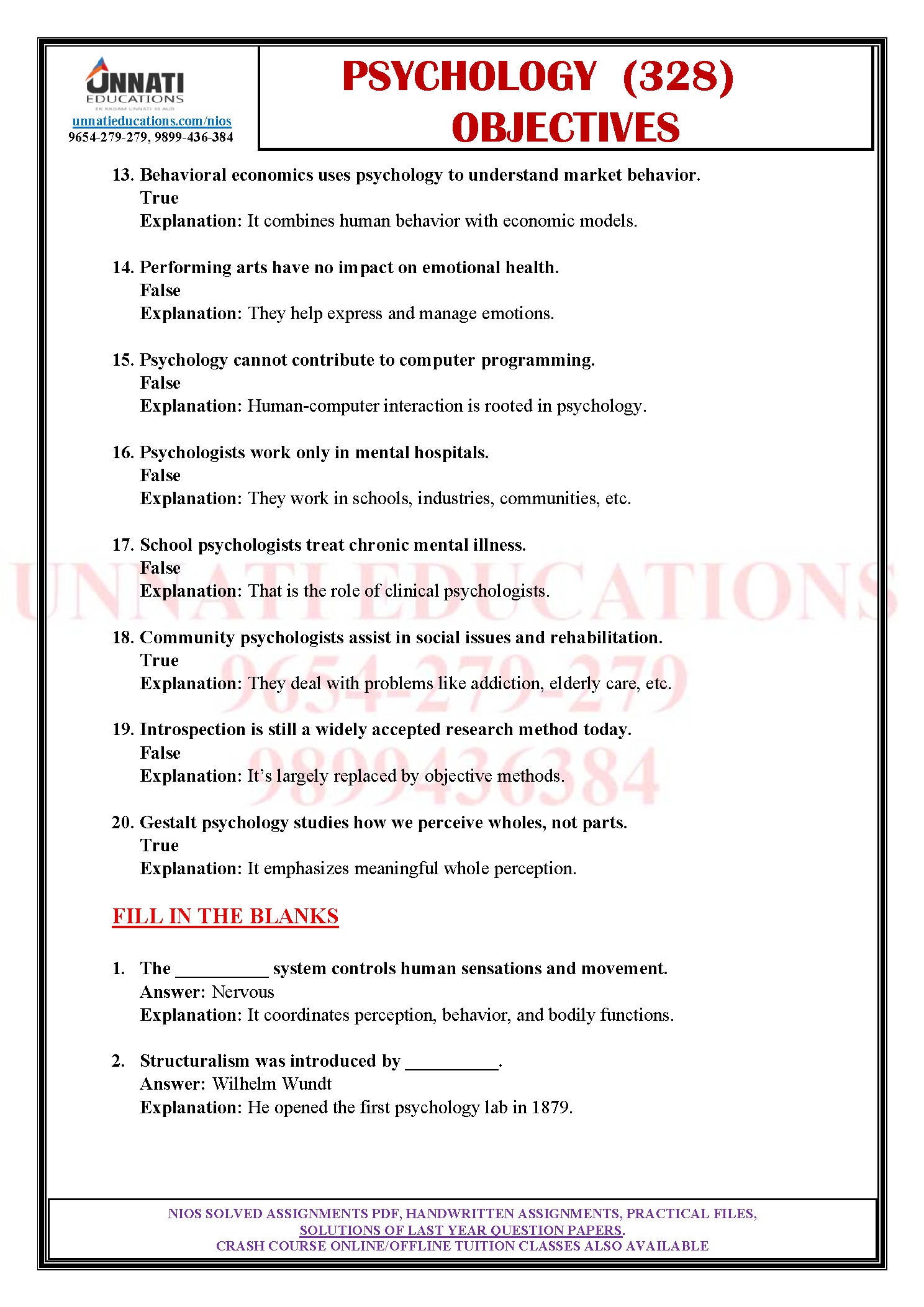
Fill in the blanks reward the precise term, so read each explanation to fix the keyword in memory for the Psychology 328 paper.
Lesson 1
Structuralism was introduced by __________.
Answer: Wilhelm Wundt
Explanation: Wundt opened the first psychology laboratory in 1879 and used introspection to study the structure of conscious experience.
Lesson 1
Freud's theory emphasises the role of the __________ mind.
Answer: Unconscious
Explanation: Freud held that the unconscious mind influences our actions without our awareness, shaping behaviour through hidden desires and conflicts.
Lesson 1
Psychology evolved from __________.
Answer: Philosophy
Explanation: Early thinkers speculated about the mind and behaviour long before psychology became an experimental science, giving the discipline its philosophical roots.
Lesson 1
The __________ system controls human sensations and movement.
Answer: Nervous
Explanation: The nervous system coordinates perception, behaviour and bodily functions, linking the brain and body in every response we make.
Sample True or False Statements for NIOS Psychology 328
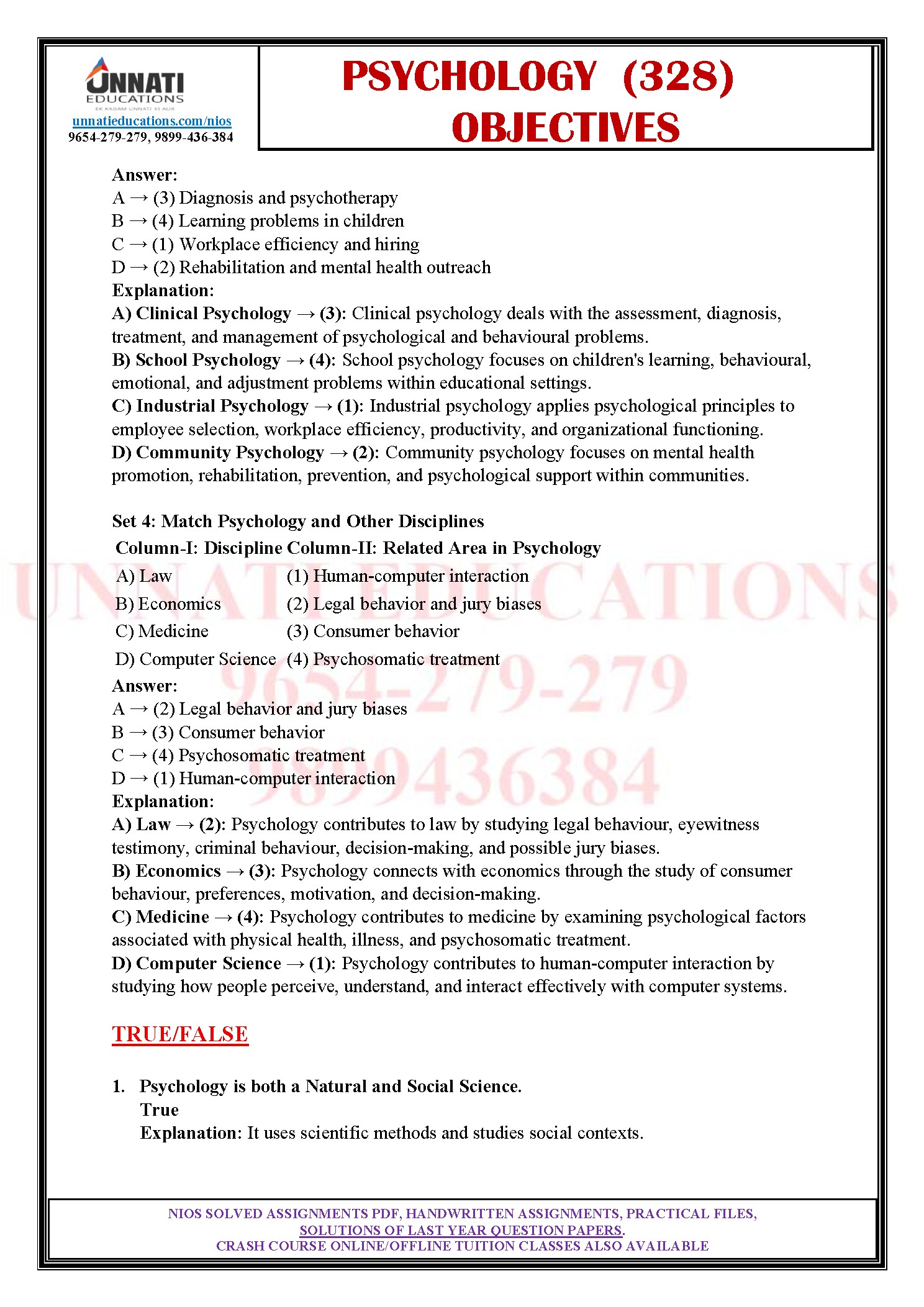
These statements feel easy until a half-remembered detail catches you, so use the explanations to learn the exact point being tested in Psychology 328.
Lesson 1
Psychology is both a natural and a social science.
Answer: True
Explanation: Psychology uses scientific methods to study behaviour while also examining people within their social contexts, which places it across both natural and social science.
Lesson 1
Structuralism studies the function of the mind.
Answer: False
Explanation: Structuralism focuses on the structure of conscious experience, breaking it into basic elements. It is functionalism that studies the function or purpose of the mind.
Lesson 1
Introspection was a method used by functionalists.
Answer: False
Explanation: Introspection was the method of the structuralists like Wundt, who trained observers to report their inner conscious experiences in detail.
Sample Match the Following from NIOS Psychology 328
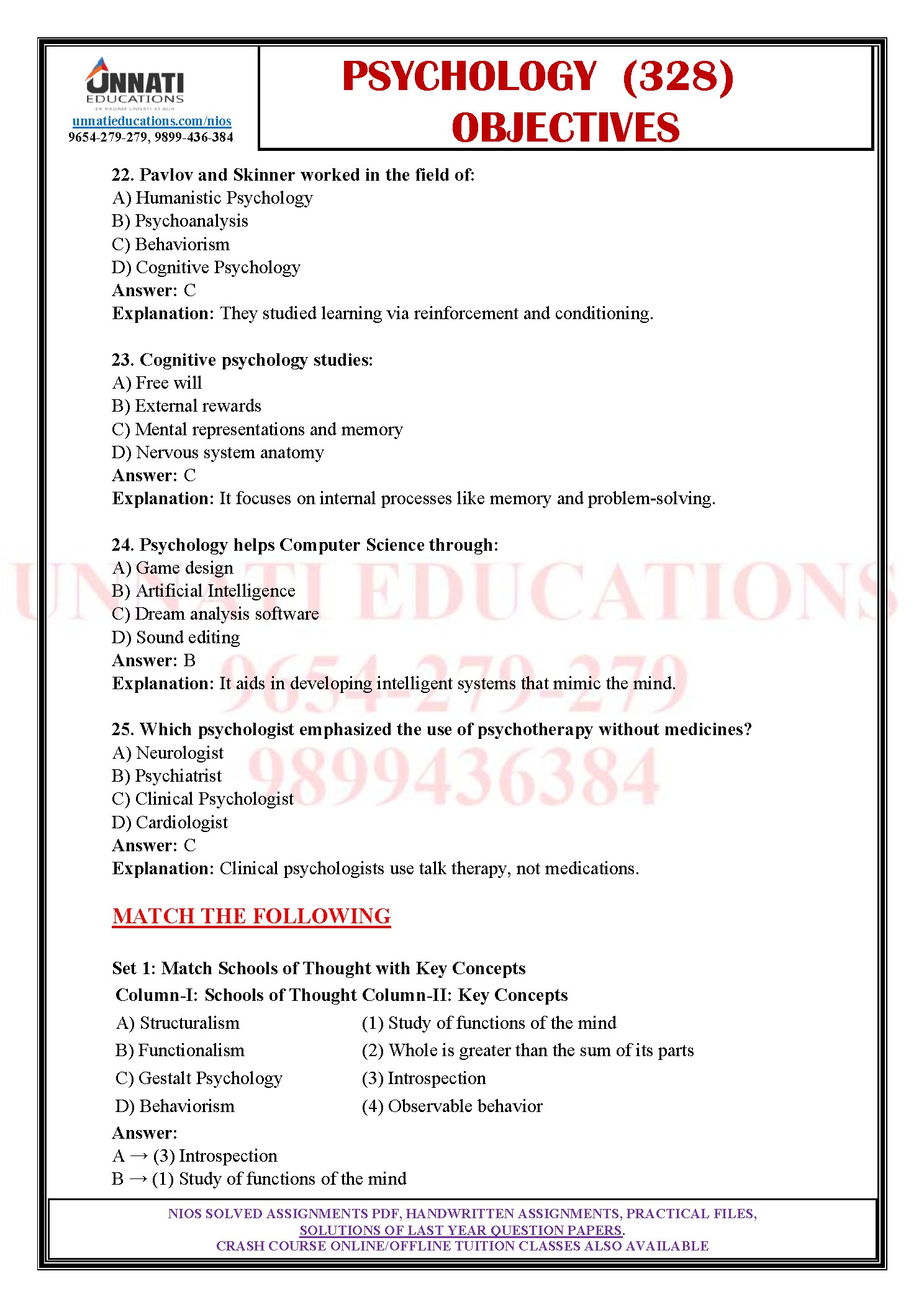
Match the following checks whether you can link a school of thought with its core idea. Below is one complete set on schools of thought, shown with the correct pairs.
| Column A (School of Thought) | Correct Match from Column B (Key Concept) |
|---|---|
| Structuralism | Introspection |
| Functionalism | Study of functions of the mind |
| Gestalt Psychology | Whole is greater than the sum of its parts |
| Behaviourism | Observable behaviour |
The lesson explains that each school carries a distinct approach, where structuralists used introspection, functionalists studied adaptive functions, Gestalt emphasised the perception of wholes, and behaviourists focused only on observable behaviour. That reasoning is what makes the matching stay put during the exam.
What the Complete NIOS Class 12 Psychology 328 Objective Type Questions Include
The previews above are only a small sample. The complete pack works through every lesson listed in the topics table, giving you many more questions per chapter than any preview can show.
For each lesson you receive multiple choice questions, fill in the blanks, true or false statements and match the following sets, each with a verified answer and a short explanation. That mix mirrors how the objective section of the paper is actually framed.
The bank follows the current course, so if you want to cross-check the lessons yourself you can view the official structure through the NIOS Syllabus before you begin. This keeps your revision aligned with what appears in the 2026 paper.
Message us on WhatsApp for the full Psychology 328 question bank
Tap to chat on 9654 279 279
Why These NIOS Class 12 Psychology 328 Objective Type Questions Matter for the 2026 Exam
The objective part of the Psychology 328 paper is quietly where careful students pull ahead. A single mark for naming the right perspective, the correct memory stage, or a theory of emotion adds up quickly, and these are precisely the marks most candidates surrender for lack of pointed revision.
Since objective items reward exact recall, they respond very well to short bursts of repeated practice. Working through a focused list lets you cross the whole syllabus, notice the lessons that feel shaky, and settle the small definitions in memory well before exam day.
If you are shaping revision for the whole session rather than one subject, our wider collection of NIOS Class 12 Objective Type Questions sits neatly beside this Psychology paper, so your planning stays tidy from one subject to the next.
How to Receive the Full NIOS Psychology 328 Objective Type Questions
Getting the full set is simple. Send us a message with the subject code, Psychology 328, and mention the 2026 session. Our counselling team confirms what is included and shares the complete objective bank with you directly.
Delivery is over WhatsApp, so there is no random link to chase and nothing to sign up for. You receive the material and start practising the same day, and you can ask about any tricky lesson while you are on the chat.
Request the Psychology 328 Objective Type Questions now
WhatsApp 9654 279 279 or 9899 436 384
Who Should Practise These NIOS Psychology 328 Questions
These questions suit first-time Psychology 328 candidates who want a clear, lesson-linked way to revise, as well as repeaters aiming to finally clear the objective section with confidence. They also help students completing tutor marked assignments who need quick, dependable answers.
If a younger family member is preparing for the secondary stage at the same time, they may find our NIOS Class 10 Syllabus useful too, so the whole household can study from one trusted source across levels.
Frequently Asked Questions on NIOS Psychology 328 Objective Type Questions
What are the NIOS Psychology 328 Objective Type Questions based on?
These Psychology 328 Objective Type Questions are drawn from the prescribed NIOS textbook and a review of several past papers. Our team studied each lesson closely, then shortlisted the objective items that appear most often and carry easy scoring value. Every question carries a verified answer and a short explanation, so you grasp the reasoning rather than memorising blindly before the exam.
Do the Psychology 328 objective questions cover the whole syllabus?
Yes, the Psychology 328 bank reaches across the entire course. You practise foundational lessons such as understanding psychology and research methods, cognitive topics like memory and thinking, developmental stages, and social areas including group processes and attitude. This spread matches the way the paper pulls objective questions from lessons right across the syllabus, so no section is left unprepared.
Are these Psychology 328 Objective Type Questions useful for the 2026 exam?
Yes, the Psychology 328 set is prepared specifically for the 2026 session and follows the current course pattern. Objective questions carry dependable one-mark scoring, and revising a focused list helps you cover every lesson without wasting time. Regular practice builds the speed and accuracy the short-answer part of the paper rewards, and each item reinforces the concept behind it.
Do the Psychology 328 questions include answers and explanations?
Every Psychology 328 question comes with a confirmed answer and a brief explanation. The explanation shows why the answer is correct and points to the exact detail in the lesson being tested. This means you learn the reasoning, not just one answer, so a reworded version of the same question in the real paper does not throw you off balance.
How many chapters of Psychology 328 are covered in the question bank?
The Psychology 328 question bank covers fourteen lessons, from understanding psychology and research methods to memory, intelligence, group processes and mental health problems. The full list with lesson-specific topics appears in the coverage table on this page, so you can see exactly what each lesson holds. Each lesson carries mcqs, fill in the blanks, true or false and match the following sets.
How do I get the complete NIOS Psychology 328 Objective Type Questions?
To get the complete Psychology 328 pack, send us a WhatsApp message mentioning the subject code and the 2026 session. Our counselling team confirms the contents and shares the full objective bank with you over chat. There is no complicated process and no sign-up, so you can begin your revision the same day you contact us.
Sources: NIOS prescribed Psychology (328) textbook and Unnati Educations analysis of previous year NIOS question papers, 2026 edition.
Disclaimer: Unnati Educations is an independent academic support platform and is not affiliated with, endorsed by, or officially connected to the National Institute of Open Schooling (NIOS). All trademarks and course names belong to their respective owners. Students should verify the current syllabus and examination pattern from the official NIOS website.