NIOS Class 10 Indian Culture And Heritage 223 Notes 2026 – Lesson Wise Short Notes with Sample Pages
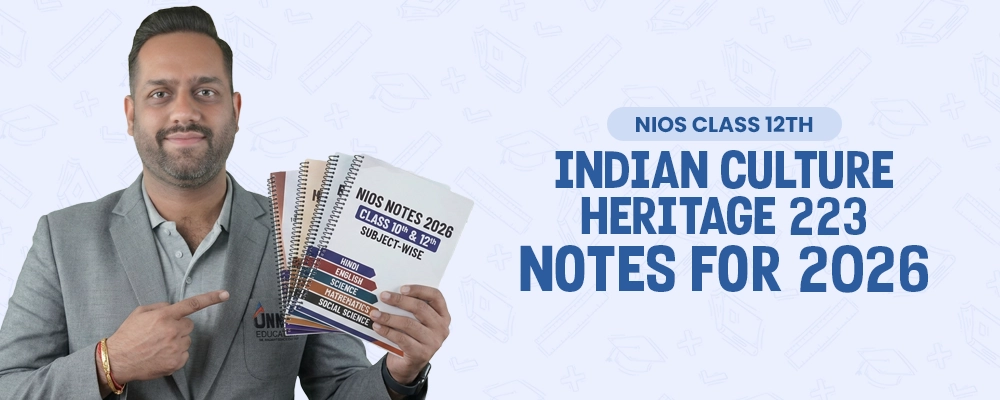
NIOS Class 10 Indian Culture And Heritage 223 Notes for the 2026 session are ready, prepared by studying the complete Indian Culture and Heritage (223) book from start to finish. These notes turn a long textbook into short, clear and easy to revise pages that cover every examinable lesson of the course. On this page you can read a no-cost preview of a few real pages, judge the quality for yourself and then request the full set for exam preparation.
NIOS Class 10 Indian Culture And Heritage 223 Notes for 2026
The 2026 edition follows the current NIOS secondary scheme for subject code 223. Every lesson has been condensed into revision friendly pages so you spend time understanding, not searching. The aim is simple: help a working student or a repeat candidate finish the whole subject in far less time.
Instead of a general summary, these notes stay close to the official lessons and the way questions are actually framed in the paper. Each concept is written in plain language with the key points a student needs to reproduce in the answer sheet.
Want to see the full set of Indian Culture and Heritage 223 Notes before deciding?
Sample Pages from Our Indian Culture and Heritage 223 Notes
Below are four short excerpts taken directly from the full notes. They are shared as a no-cost preview so you can check the depth, language and layout before you request the complete file. The full set carries this same standard across every lesson.
Sample Page 1 · Lesson 1 · Culture: An Introduction
What "Culture" Means
The English word culture comes from the Latin cult / cultus (to cultivate, refine, worship). In simple words, culture is the way of life of a group of people—how they eat, dress, speak, worship, celebrate, think and behave. In Sanskrit, a related idea appears in Sanskriti (refined) versus vikriti (when refined matter or ideas are broken or spoiled). Culture implies refinement.
Two Components of Culture: Material culture (dress, food, houses, tools, art) and Non-material culture (ideas, ideals, values, beliefs, language, knowledge).
Sample Page 2 · Lesson 11 · Indian Painting
Mithila (Madhubani) Painting
Where and who: the Mithila region of Bihar, traditionally made by village women on walls and later on handmade paper. Materials and technique: vegetable dyes and earth colours, black outlines from soot or ink, and fills with flat bright colours on cow-dung treated surfaces for an earthy background. Themes and features: Hindu deities such as Lakshmi, Ganesha, Durga and Hanuman, with fine line drawing, stylised florals and narrative panels.
Sample Page 3 · Lesson 17 · Scientists of Modern India
Dr. A. P. J. Abdul Kalam (1931–2015)
Born 15 October 1931 at Rameswaram (Tamil Nadu). Studied Aeronautical Engineering at the Madras Institute of Technology. At ISRO he led the Satellite Launch Vehicle-3 (SLV-3) which placed the Rohini satellite in orbit. At DRDO he led the Integrated Guided Missile Development Programme, producing Prithvi, Trishul, Akash, Nag and Agni. The success of Agni placed India among missile-capable nations.
Sample Page 4 · Lesson 18 · Education in India
Mauryan Period (State Support and Practical Learning)
With the Mauryas and post-Mauryas, the state and guilds paid more attention to practical arts and occupations. Guilds (śreṇi) trained learners in crafts such as weaving, carpentry, metalwork and masonry. Kautilya (Chanakya) wrote the Arthashastra, a manual for administration and statecraft, with a curriculum focused on training princes and officials in the Vedas, economics, politics, law and diplomacy.
These four pages are only a small part of the complete notes. The full file carries every lesson in the same clear style.
Chapters Covered in the Indian Culture and Heritage 223 Notes
The notes cover the complete examinable lesson list for subject code 223, so you do not need to hunt for missing chapters elsewhere. The table below lists every lesson in the set. To cross check against the official lesson order you can also open the NIOS Class 10 Syllabus page.
| Lesson | Chapter Name |
|---|---|
| 1 | Culture: An Introduction |
| 4 | Medieval India |
| 5 | Modern India |
| 7 | Indian Languages and Literature – II |
| 10 | Religious Reform Movements in Modern India |
| 11 | Indian Painting |
| 12 | Performing Arts: Music, Dance and Drama |
| 16 | Science and Scientists of Medieval India |
| 17 | Scientists of Modern India |
| 18 | Education in India |
| 19 | Indian Social Structure |
| 21 | Spread of Indian Culture Abroad |
Why Our Indian Culture and Heritage 223 Notes Are Different
Most notes online are copied from the same source and rewritten loosely. Ours are built from a full read of the 223 book, lesson by lesson, so nothing important is skipped and nothing is padded. The result is a set that is short where it can be and detailed where it must be.
Because the subject rewards clear recall over calculation, our pages focus on definitions, features, causes, contributions and examples that examiners look for. If you have already collected general NIOS Class 10 Notes, these subject specific pages fill the gap for code 223 in particular.
- Written after analysing the whole prescribed book, not a shortcut summary.
- Plain, easy to understand English with the exact points needed in answers.
- Short and valuable so revision on the day before the exam stays calm.
- Mapped to the real lessons of the current 223 scheme.
What You Get Inside the Indian Culture and Heritage 223 Notes
The complete package is designed to be your single revision resource for the subject. It carries every examinable lesson in a tidy, print ready format so you can study on a phone or from a printout with equal ease.
- Full coverage of all examinable lessons of Indian Culture and Heritage (223).
- Short pointwise notes for fast reading and last minute revision.
- Important definitions, features, reformers, artists and scientists in one place.
- Clean formatting suitable for both screen study and printing.
- Delivery on WhatsApp so you receive the file quickly after you contact us.
Lesson-by-Lesson Topics in the Indian Culture and Heritage 223 Notes
Here is what each lesson in the set actually contains, so you know the exact ground the notes cover before you request them. This is the real spine of subject code 223.
Lesson 1 and Lessons 4 to 5: Culture and Historical Foundations
Lesson 1 explains the concept of culture, the difference between culture and civilisation, culture and heritage, general characteristics and the importance of culture in human life. Lessons 4 and 5 cover medieval India (life under the Delhi Sultanate, Islam and Sufism, the Bhakti movement, folk arts, music and new faiths) and modern India (the rise of the West, eighteenth century society, social and religious reformers, the press and India since independence).
Lesson 7 and Lesson 10: Languages, Literature and Reform
Lesson 7 traces northern Indian languages and literature, Persian and Urdu, Hindi, Bengali, Assamese, Oriya, Punjabi, Rajasthani, Gujarati, Sindhi, Marathi and Kashmiri writing, and the role of Christian missionaries. Lesson 10 covers the Brahmo Samaj and Raja Rammohan Roy, the Prarthana Samaj, the Arya Samaj and Swami Dayanand, the Ramakrishna Mission and Swami Vivekananda, the Theosophical Society, the Aligarh movement and reform among Parsis and Sikhs.
Lessons 11 to 12: Painting and Performing Arts
Lesson 11 covers Indian painting from ancient origins to the modern period, plus regional styles such as Madhubani, Kalamkari, Warli, Kalighat, Patachitra and Phad, along with Indian handicrafts. Lesson 12 covers the concept of performing arts, Hindustani and Carnatic classical music, folk music, the classical dances of India, drama and its major writers, and the present scenario of the performing arts.
Lessons 16 to 21: Science, Education, Society and Global Spread
Lesson 16 deals with sciences in the medieval period, and Lesson 17 profiles modern scientists including Ramanujan, C. V. Raman, J. C. Bose, Homi Bhabha, Vikram Sarabhai and A. P. J. Abdul Kalam. Lesson 18 traces education across the ancient, medieval, modern and post-independence periods. Lesson 19 explains the structure of Indian society, and Lesson 21 covers the spread of Indian culture abroad through traders, teachers and emissaries.
How to Get the Full NIOS Class 10 Indian Culture And Heritage 223 Notes
Getting the complete file is quick. Send us a message on WhatsApp with the subject name and code 223, and we will share the full set along with any guidance you need for the paper. Delivery is on WhatsApp so you receive the notes without waiting.
- Read the four sample pages above and check the quality.
- Tap the WhatsApp button and mention Indian Culture and Heritage (223).
- Receive the full notes and start your revision the same day.
Ready for the complete set of Indian Culture and Heritage 223 Notes?
How These Indian Culture and Heritage 223 Notes Help You Pass
The subject is scoring when you revise the right points and can write them clearly. Our pages are built around that idea, so you memorise what earns marks and skip what does not. For candidates short on time, this focus is the difference between a rushed revision and a confident one.
They also pair well with the rest of your preparation. Use them alongside solved assignments and past papers from our wider NIOS Study Material so your reading, writing and answer practice all point in the same direction.
Who Prepared the Indian Culture and Heritage 223 Notes
The notes were written by Prateek Talwar and reviewed by Jyoti Sharma, a Senior NIOS Counsellor who works with open schooling students every session. The content is drawn from the prescribed 223 book and the official lesson list, then simplified for quick study.
For anyone still choosing subjects or checking the overall scheme, the complete NIOS Syllabus gives the full picture across courses, while these pages stay focused on code 223 alone.
FAQs on Indian Culture and Heritage 223 Notes
Are these Indian Culture and Heritage 223 Notes updated for the 2026 exam?
Yes. The notes follow the current NIOS secondary scheme for subject code 223 and are prepared for the 2026 session. Every examinable lesson from the prescribed book is included, written in short and clear points. This means you can revise the whole subject quickly, hold the key facts in memory and reproduce the right answers in the paper without spending long hours re-reading the textbook itself.
How many chapters do the Indian Culture and Heritage 223 Notes cover?
The notes cover all twelve examinable lessons of the subject, from Culture: An Introduction through to the Spread of Indian Culture Abroad. This includes history, languages, painting, performing arts, science, education and social structure. You therefore receive complete coverage in a single file rather than scattered chapters gathered from different sources, which saves time and keeps your revision organised in one place.
Can I see a sample before buying the Indian Culture and Heritage 223 Notes?
Yes. Four sample pages are shared on this page as a no-cost preview, taken directly from the full set. They let you check the depth, language and page layout before you decide anything. Once you are satisfied with the quality on show, you can message us on WhatsApp with code 223 to receive the complete notes and begin studying straight away.
How will I receive the full Indian Culture and Heritage 223 Notes?
Delivery is on WhatsApp. Send us a message with the subject name and code 223, and we will share the complete file along with any guidance you need for the paper. This keeps the whole process quick and simple, so you can receive your notes and begin your revision on the same day you first contact us.
Is Indian Culture and Heritage 223 an easy subject to score in?
It is one of the more manageable subjects because it needs reading, understanding and clear writing rather than calculation or technical work. With focused notes that highlight definitions, reformers, artists, scientists and key examples, you can revise it in a short time and answer with confidence. That focused, mark-oriented approach is exactly what these pages are built to support for the 2026 exam.
Disclaimer
Disclaimer: Unnati Educations is an independent academic support platform and is not affiliated with, endorsed by or associated with the National Institute of Open Schooling (NIOS). All course names and codes belong to NIOS. Source: official NIOS secondary lesson list for Indian Culture and Heritage (223).
Contact Unnati Educations - Your Academic Lifeline
If you're eager to begin your journey or need guidance in the NIOS admissions process, we're just a message away.