NIOS Class 10 Painting 225 Notes 2026 – Lesson Summaries, Artwork Analysis and Quick Facts
Painting (225) is one of those subjects where a little organisation goes a long way, and that is exactly what these notes are built for. Our NIOS Class 10 Painting 225 Notes for 2026 come from working through the full Painting (225) book and turning each lesson on the history and appreciation of art into clear, exam-ready points you can actually remember.
On this page you can look through a few sample pages, see every lesson we cover and learn how to get the complete set on WhatsApp. The aim is simple, to make a visual subject feel easy to revise and to help you write confident answers about each artwork.
What You Get in the NIOS Class 10 Painting 225 Notes
These notes follow the Painting (225) course at the secondary level of the National Institute of Open Schooling, focusing on the history and appreciation of art. Every lesson is shortened into the key facts and the points examiners look for, so a whole lesson fits into a quick, calm revision session.
Here is a quick snapshot of what the Painting 225 set includes:
| Detail | Information |
|---|---|
| Subject and code | Painting (225), NIOS Secondary (Class 10) |
| Session | 2026 |
| Focus | History and appreciation of art (theory lessons) |
| What is inside | Lesson summaries, artwork analysis, quick facts on each work |
| Format | PDF and handwritten options |
| Delivery | |
| Best for | Quick revision and scoring in the theory paper |
Running low on time before the exam? This is the kind of compact material that helps you cover the big artworks quickly, without flipping through page after page of the textbook.
Lesson-Wise Coverage in NIOS Class 10 Painting 225 Notes
The table below shows the lessons our Painting (225) notes cover, along with the main artworks explained in each one. In the full set, every lesson comes with its summaries, artwork analysis and quick facts.
| Lesson | Focus | Key Artworks Covered |
|---|---|---|
| 1 | History and Appreciation of Art (3000 BC to 600 AD) | Dancing Girl, Rampurva Bull Capital, Black Princess |
| 2 | History and Appreciation of Art (7th to 12th Century AD) | Arjuna's Penance (Gangavatarana), Krishna Supporting Mount Govardhana, Surasundari from Konarka |
| 5 | Renaissance | Birth of Venus, Mona Lisa, Pieta, The Night Watch |
| 7 | Cubism, Surrealism and Abstract Art | Man with Violin, Persistence of Memory, Black Lines |
| 8 | Pioneers of Contemporary Indian Art | Hamsa Damayanti, Brahmacharies, The Atrium |
| 9 | Contemporary Indian Art | Whirlpool, Mediaeval Saints, Words and Symbols, Landscape in Red |
These are the history and appreciation lessons included in the current notes set. Check the complete official lesson and practical structure against the latest Painting 225 course on nios.ac.in before you plan your revision, in case any unit differs for your session.
Sample Pages From Our NIOS Painting 225 Notes
Instead of asking you to guess the quality, here are four sample pages pulled straight from the notes. Each full artwork in the set also carries its quick facts and a short analysis, trimmed down here to keep the preview short.
Sample 1: Dancing Girl (Lesson 1)
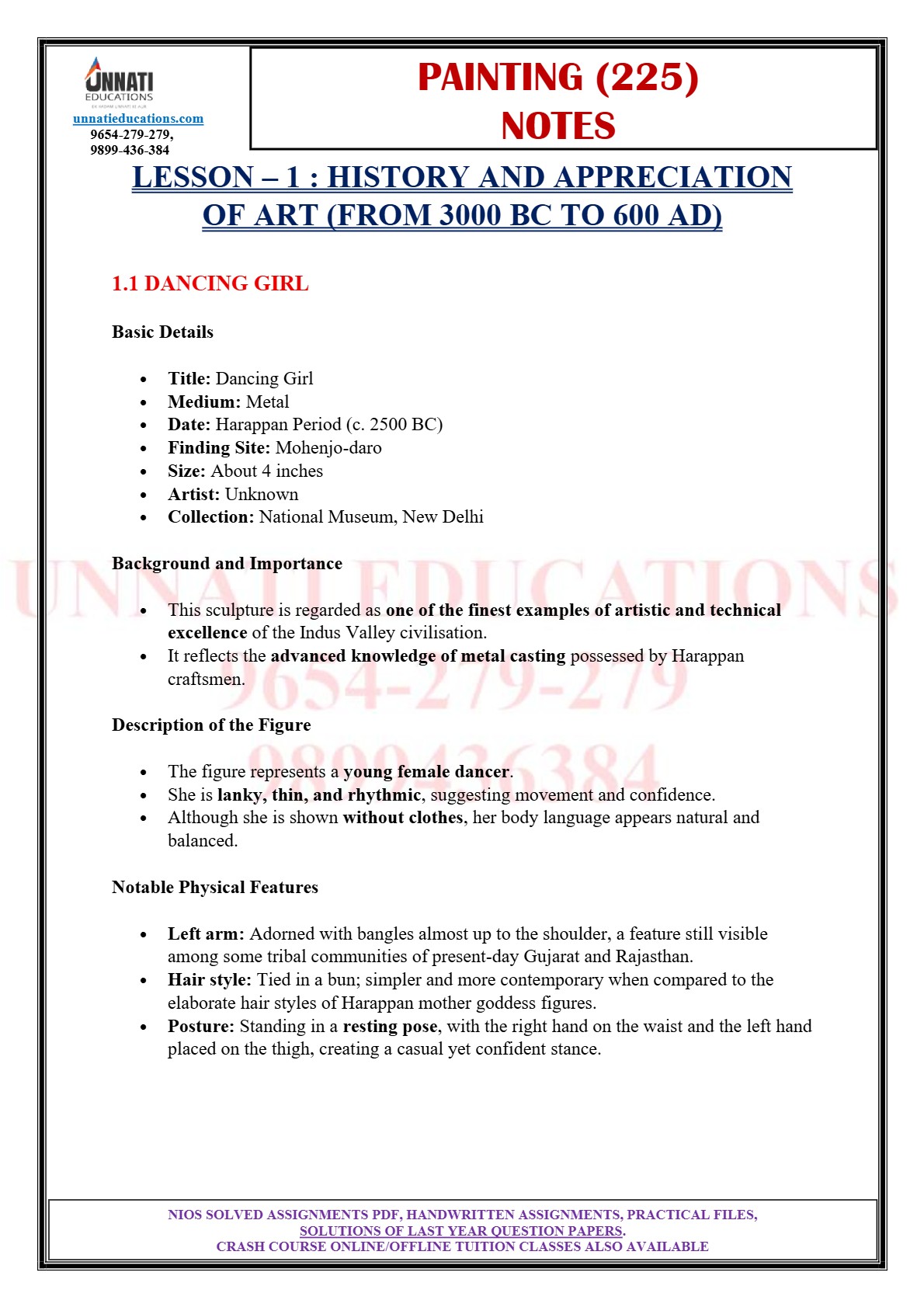
One of the oldest works in the course, the Dancing Girl is a small bronze figure from Mohenjo-daro, barely four inches tall yet full of presence. She stands in a relaxed pose with one hand on her waist and bangles running up her left arm. The notes bring out how Harappan metal casting and that quiet confidence make her unforgettable.
Quick fact: Medium metal, Harappan period, National Museum, New Delhi.
Sample 2: Mona Lisa (Lesson 5)
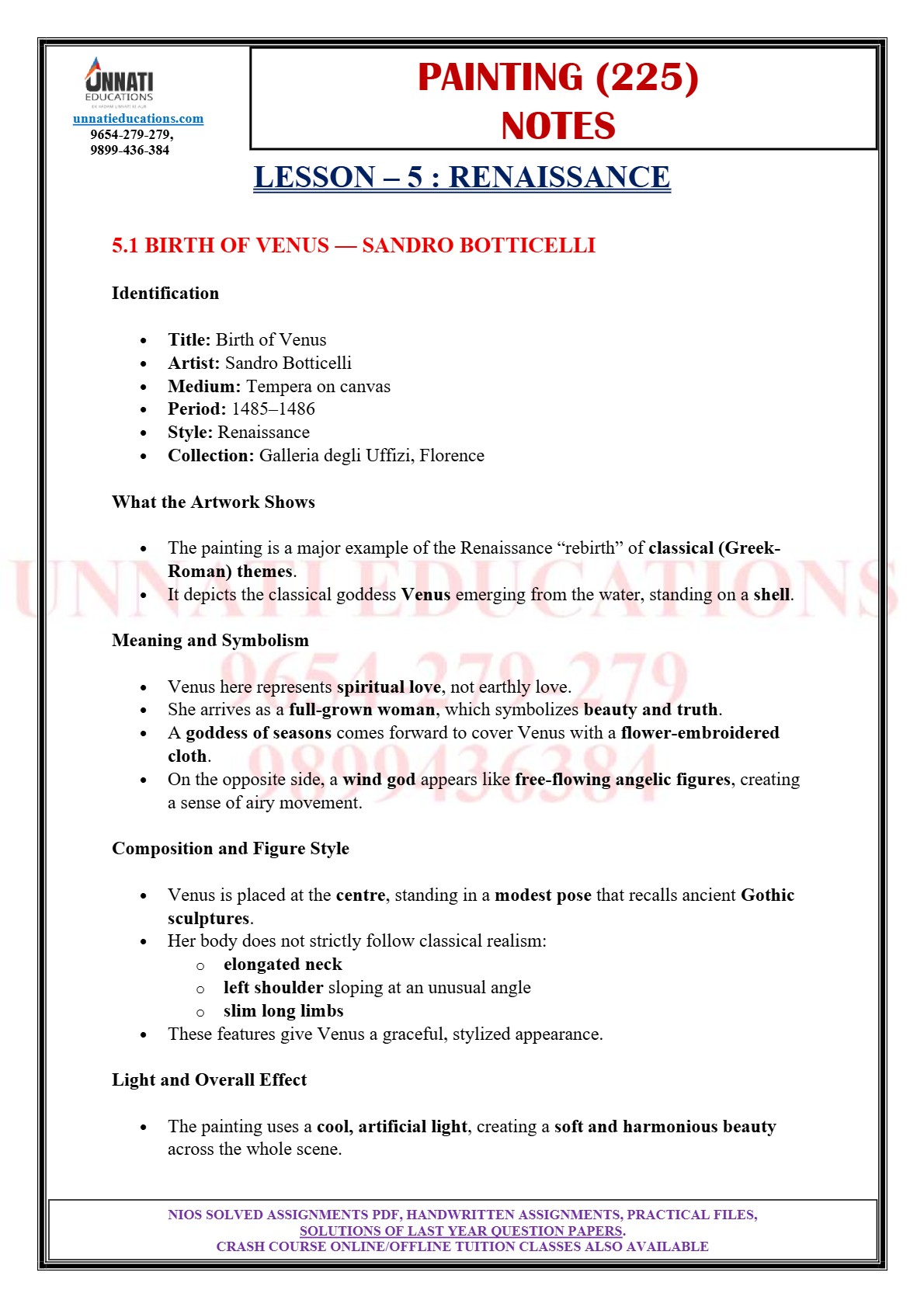
Leonardo da Vinci's Mona Lisa needs little introduction, and the notes zero in on what earns marks. The folded hands form a steady pyramid shape, the bright face stands out against hair and shadow, and a misty landscape of mountains and a winding river sits behind her, tying the figure to nature. That famous smile feels stronger when you look at her eyes.
Quick fact: Oil on poplar wood, Renaissance, Louvre Museum, Paris.
Sample 3: Man with Violin (Lesson 7)
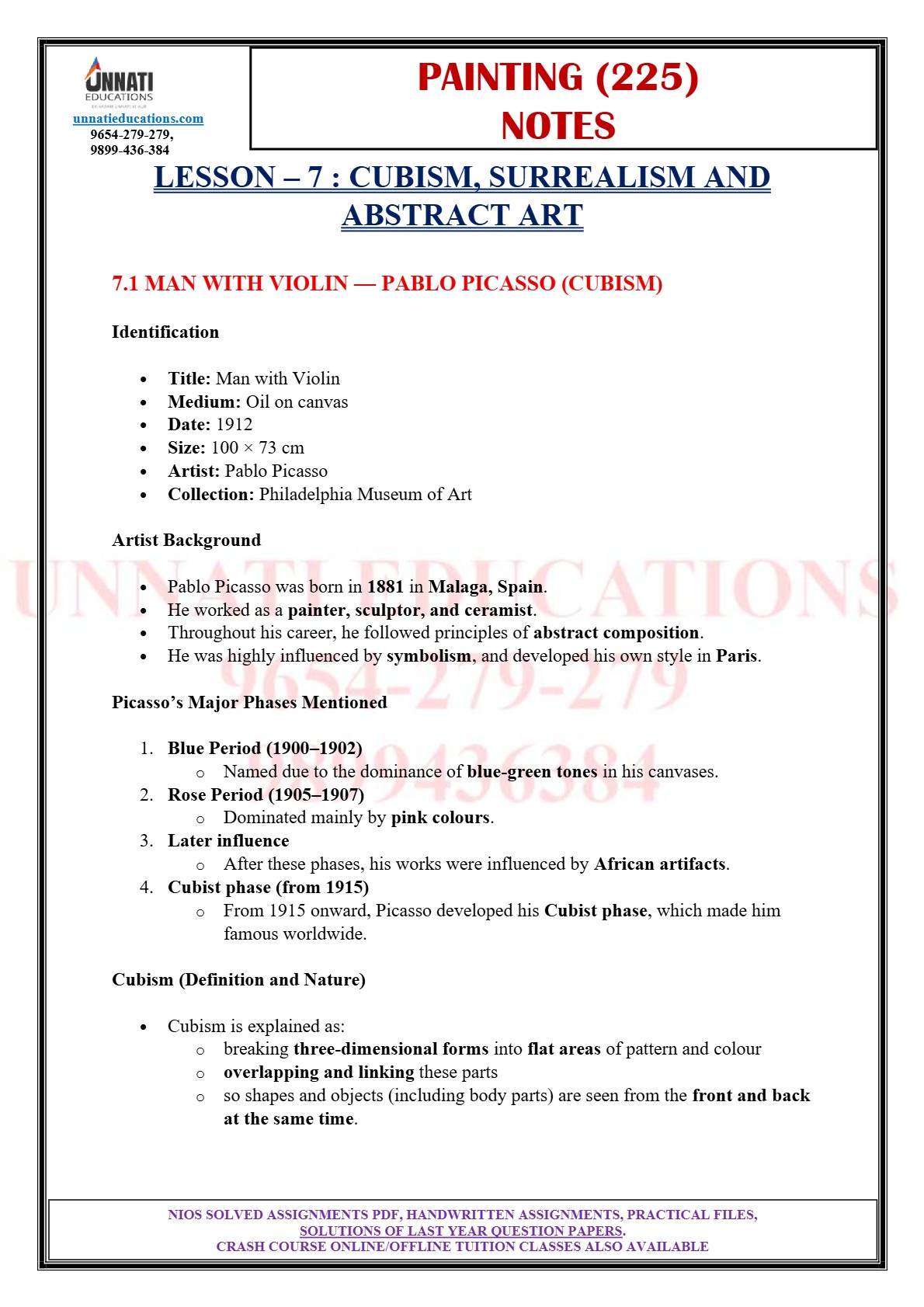
Picasso's Man with Violin is the notes' window into Cubism. The figure holding the violin is broken into cube-like pieces and shown from more than one angle at once, yet you can still sense the man and the instrument. The palette stays in quiet browns and greens, and the whole thing holds together as one structured design.
Quick fact: Oil on canvas, 1912, Analytical Cubism, Philadelphia Museum of Art.
Sample 4: Hamsa Damayanti (Lesson 8)
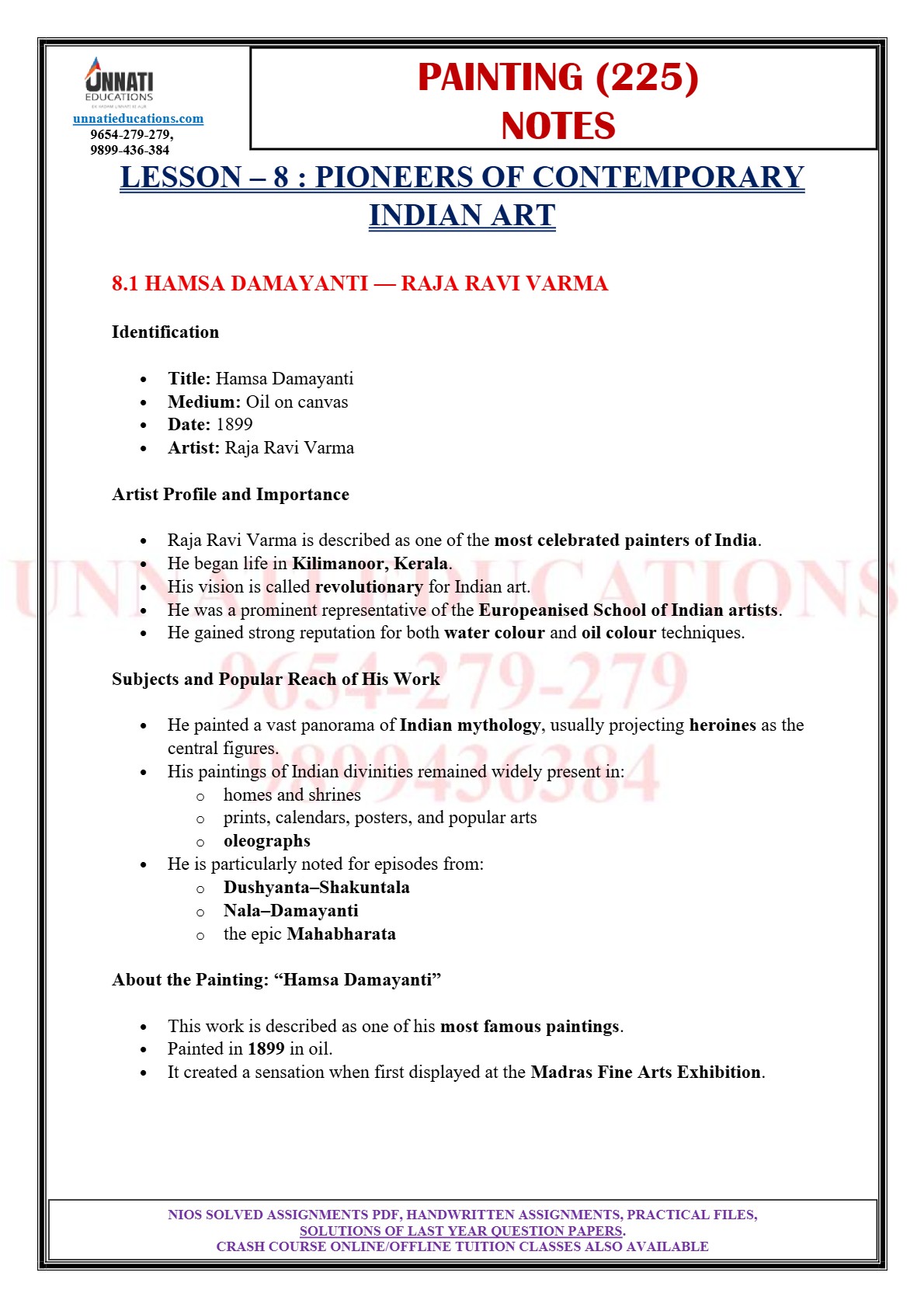
Raja Ravi Varma's Hamsa Damayanti shows his command of Western oil technique on an Indian theme. Damayanti, in a red sari, listens tenderly as the swan describes Nala's love for her. The sparkle in her eyes and the glow of her cheeks carry the mood, and the notes point out how this work bridges traditional Indian art and academic realism.
Quick fact: Oil on canvas, 1899, by Raja Ravi Varma.
That is the tone across every lesson. If these read clearly to you, the full set keeps the same simple, exam friendly style for each artwork in the course.
About NIOS Painting 225 and Why These Notes Help
Painting (225) is the secondary level art course under open schooling. The theory side asks you to know famous Indian and Western artworks, describe their style and technique, and explain why each one matters in the wider story of art.
For a lot of learners this is the tricky bit, since it is easy to mix up periods, artists and titles when everything is read in one long stretch. Well-sorted notes fix that by tying each artwork to a few memorable details you can recall under exam pressure.
These notes are lined up with the official course, so you study the right lessons in the right order. To confirm the units and the marking pattern while you revise, it helps to keep the current NIOS Class 10 Syllabus open next to them.
Art appreciation rewards clarity. Knowing the medium, the period and one or two standout features of a work is often enough to turn a blank pause into a solid, confident answer.
Why Students Choose These NIOS Painting 225 Notes
What makes this material work is that it was written for real revision of a visual subject, not to pad out a page. Each point below is shaped around how art appreciation is actually tested.
- Lesson summaries that place each period and movement in context.
- Artwork analysis covering medium, style, technique and meaning.
- Quick facts for every work, so titles, dates and sites are easy to recall.
- Simple English throughout, friendly for self study.
- Indian and Western art brought together in one connected set.
- PDF or handwritten, sent straight to you on WhatsApp.
It also pairs well with our wider NIOS Study Material, so your Painting 225 revision sits comfortably alongside the way you prepare for your other papers.
How These Painting 225 Notes Boost Your Marks
Marks in Painting (225) theory usually come from how precisely you describe an artwork, not from how much you write. These notes are built to sharpen exactly that.
The summaries give you a strong opening for long answers. The artwork analysis hands you ready points on style and technique, and the quick facts make sure you never blank on a title, a date or a collection when the paper is in front of you.
If you would rather keep every subject this tidy, you can pair this set with our wider NIOS Class 10 Notes, which keeps the whole revision plan in one place and takes the panic out of the final week.
Use it steadily and a subject that once felt like a blur of names and dates settles into a short, familiar set of points you can call up with ease.
Smart Ways to Revise NIOS Painting 225
A few small habits make Painting (225) far less daunting, especially when you are studying on your own schedule.
- Learn each artwork by its quick facts first, then read the fuller analysis.
- Group works by period or movement so the timeline stays clear in your head.
- Sketch a rough thumbnail of each piece to lock the image into memory.
- Write one full answer per major artwork to practise description and flow.
- Attempt past papers against a timer to build both speed and calm.
Before your final round of revision, run your eye over the official NIOS Syllabus once more to confirm the units and how the theory and practical marks are split, so nothing surprises you on the day.
Getting the Complete NIOS Painting 225 Notes
The samples here are only a slice of the material. The full set carries every lesson listed above with its summaries, artwork analysis and quick facts, ready to revise in PDF or handwritten form.
To get the complete notes for the 2026 session, send us a message on WhatsApp and mention Painting (225). We will share the price, the formats on offer and how soon you can start. Practical file guidance can be requested the same way.
The Team Behind These NIOS Painting 225 Notes
These notes come from the academic team at Unnati Educations, which has guided open schooling learners through their exams for years.
The material is put together by Prateek Talwar, Director of Unnati Educations, and reviewed by Jyoti Sharma, a Senior NIOS Counsellor who checks each lesson for accuracy and exam value. Every artwork is written up after working through the full Painting (225) book, not copied from generic sources.
If any sample or part of the full set ever feels unclear, the same team is only a quick WhatsApp message away.
FAQs About NIOS Painting 225 Notes
What are NIOS Class 10 Painting 225 Notes?
NIOS Class 10 Painting 225 Notes are compact study material for the secondary art course under open schooling, focused on the history and appreciation lessons. Each artwork is boiled down to a short analysis and a set of quick facts on its medium, period and site. The aim is faster revision and clearer answers, so you can walk into the theory paper feeling ready rather than rushed.
Are these NIOS Painting 225 Notes updated for the 2026 session?
Yes, these Painting 225 notes are prepared for the 2026 session and follow the current course. Every history and appreciation lesson is covered in the same plain, exam friendly style, with Indian and Western artworks explained side by side. We check the material against the official course, and we still suggest a quick look at the syllabus before your final revision, just in case anything shifts for your batch.
How many lessons do the NIOS Painting 225 Notes cover?
The current Painting 225 notes cover six history and appreciation lessons, from early Indian art right through to contemporary Indian painting. Between them they explain around twenty famous artworks, each with its own quick facts and analysis. You can see the full breakdown in the lesson table on this page, so you know exactly which works are included before you get in touch with us.
Can I see a sample of the Painting 225 notes before buying?
Yes, you can. Four sample pages sit right on this page, taken from the Dancing Girl, the Mona Lisa, Picasso's Man with Violin and Raja Ravi Varma's Hamsa Damayanti. They let you judge the tone, clarity and depth of the Painting 225 material before you spend anything. If the style suits you, the full set keeps the same format for every artwork in the course.
How do I get the full NIOS Painting 225 Notes?
Getting the full Painting 225 notes is simple. Message us on WhatsApp and mention the subject and the 2026 session, and we will reply with the price, the formats available and delivery details. The complete set reaches you as a PDF or in handwritten form, so you can start revising within a short time of first getting in touch with our team.
Do these Painting 225 notes follow the NIOS syllabus?
Yes, these Painting 225 notes are built straight from the official art course and keep to the same lesson order, so your revision stays in step with what the theory paper tests. We would still nudge you to keep the current syllabus nearby, since it lays out the units and shows how the theory and practical marks are divided across the subject.
Are the NIOS Painting 225 Notes handwritten or PDF?
You can choose either for the Painting 225 notes. Many learners go for the PDF so they can study artworks on a phone or laptop, while others prefer handwritten notes for that personal feel during revision. When you message us on WhatsApp, simply mention which format you would like and we will guide you on availability and delivery for the 2026 session.
Do the Painting 225 notes cover the practical part too?
These Painting 225 notes mainly cover the theory side, meaning the history and appreciation of art that the written paper tests. If you also need help with the practical file or studio work, just ask when you message us, and we will let you know what support is available for the 2026 session. That way your theory and practical preparation stay in one place.
Disclaimer
Disclaimer: Unnati Educations is an independent academic support platform and is not affiliated with, endorsed by, or officially connected to the National Institute of Open Schooling (NIOS). The subject name Painting (225) and related references are used only for identification and educational guidance. Learners should always confirm the current course structure and exam details on the official NIOS portal.
Sources: Official NIOS Painting (225) course material and the notes compiled by Unnati Educations. For syllabus and exam updates, refer to nios.ac.in.
Contact Unnati Educations - Your Academic Lifeline
If you're eager to begin your journey or need guidance in the NIOS admissions process, we're just a message away.