NIOS Class 10 Psychology 222 Notes 2026 – Lesson Wise Short Notes with Sample Pages
These NIOS Class 10 Psychology 222 Notes are prepared for the 2026 session after reading the complete NIOS textbook and mapping every lesson to the current examination pattern. The aim is simple. You get clear, short and reliable notes for Psychology code 222 that make revision fast and help you pass with confidence. Below you can preview a few sample pages and see how the full set is organised.
Our team studied each chapter line by line, removed the padding and kept only what the examiner actually rewards. The result is a focused study companion in easy language that works well for both first time learners and repeaters who need a quick, dependable revision path.
What Our Psychology 222 Notes Include
The complete set covers every unit of the syllabus in plain language, with the theory broken into small, memorable points. Each lesson opens with a clear definition, moves through the main concepts and closes with a compact recap you can revise the night before the paper. Nothing important is skipped and nothing extra is added.
You will find worked examples, key terms, comparison points and the kind of one line answers that examiners look for. Because these NIOS Psychology 222 notes double as a revision layer over your official NIOS Study Material, you can move between the textbook and the notes without losing your place.
The short format is deliberate. Long paragraphs slow revision, so we use tight bullet style summaries that let you cover a full chapter in minutes and return to weak areas quickly before the exam.
Chapter Wise Breakdown of the Psychology 222 Notes
The full notes follow the official lesson order so your revision stays aligned with the paper. Each of the sixteen lessons below is covered in the complete set, and the same order matches the current NIOS Class 10 Syllabus so you always know where you are.
| S. No. | Lesson | Chapter Name |
|---|---|---|
| 1 | Lesson 2 | Methods of Psychology |
| 2 | Lesson 3 | Individual Differences |
| 3 | Lesson 4 | Learning |
| 4 | Lesson 5 | Sensory Processes: Attention and Perception |
| 5 | Lesson 8 | Motivation and Emotion |
| 6 | Lesson 10 | Childhood |
| 7 | Lesson 11 | Adolescence and its Challenges |
| 8 | Lesson 12 | Adulthood and Ageing |
| 9 | Lesson 14 | Communication |
| 10 | Lesson 15 | Attitudes, Beliefs and Social Cognition |
| 11 | Lesson 18 | Mental Disorders and their Treatment |
| 12 | Lesson 19 | Mental Health and Hygiene |
| 13 | Lesson 20 | Aptitude, Interest and Job Requirements |
| 14 | Lesson 22 | The World of Organisations |
| 15 | Lesson 23 | Environmental Stress |
| 16 | Lesson 26 | Nurturing the Whole Being: An Indian Perspective |
This chapter map is the same one our students use to plan their revision week. It lets you pace your study lesson by lesson and tick off each topic as your confidence grows.
Sample Pages from Our Psychology 222 Notes
To help you judge the quality before you ask for the full set, here are a few sample pages taken straight from our notes. These extracts show the exact style, depth and language you can expect across all sixteen lessons.
Sample notes extract
Lesson 2: Methods of Psychology (Sample)
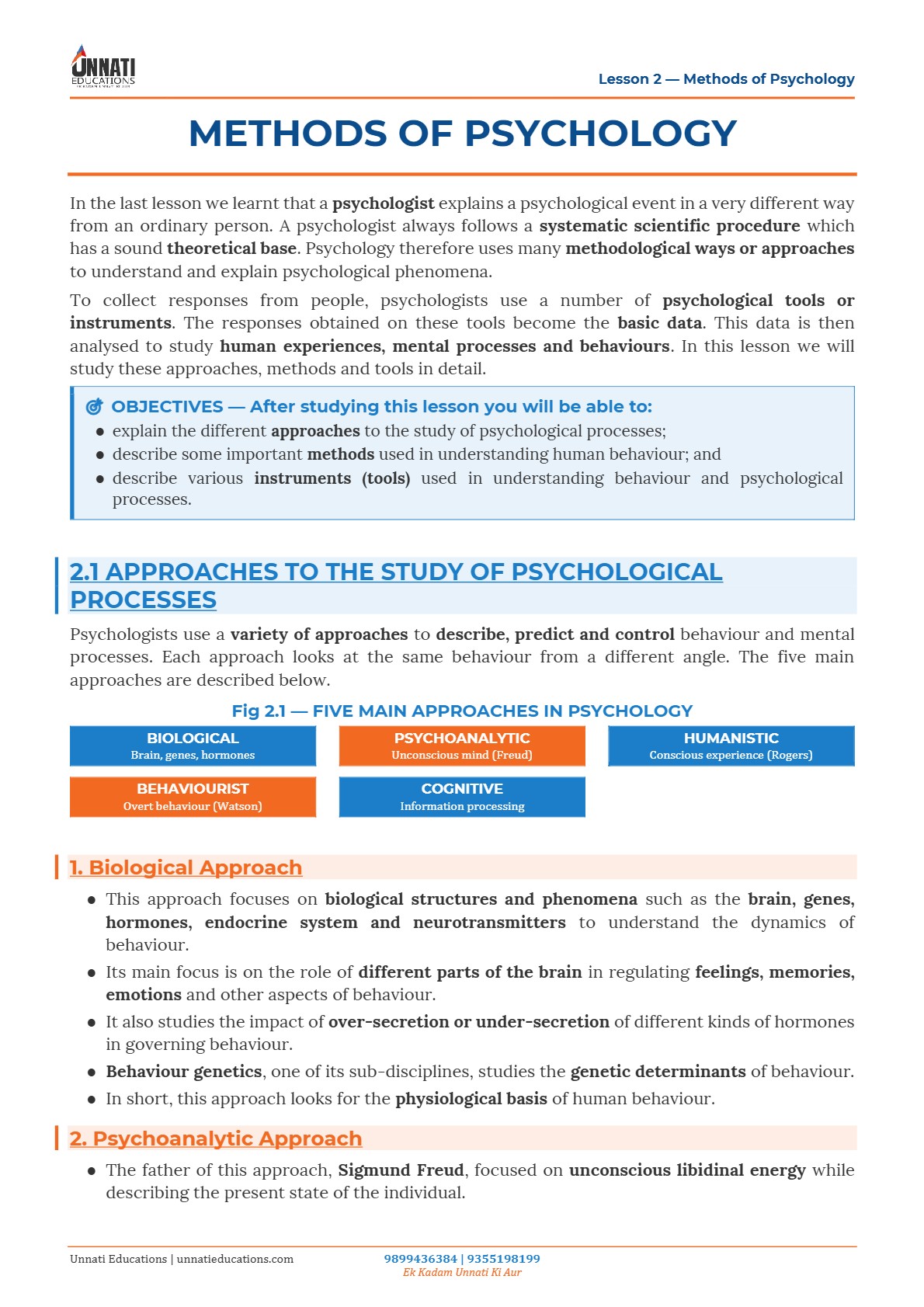
2.1 Approaches to the Study of Psychological Processes
Psychologists adopt different approaches to describe, predict, and control behaviour and mental processes. Each approach offers a unique perspective.
A. Biological Approach
- Focuses on biological structures and functions such as brain, genes, hormones, endocrine system, and neurotransmitters.
- Studies the role of different brain parts in controlling emotions, memories, and behaviour.
- Explores the impact of hormonal imbalance (over-secretion or under-secretion) on behaviour.
- Includes behaviour genetics which identifies genetic influences on behaviour.
B. Psychoanalytic Approach (Sigmund Freud)
- Emphasizes unconscious processes and libidinal energy.
- Explains mind in terms of conscious, preconscious, and unconscious levels.
- Suggests most human behaviour is driven by unconscious motivation.
C. Humanistic Approach (Carl Rogers)
- Focuses on conscious experiences of the present and role of interpersonal relationships.
- Views humans as active, self-actualizing agents with freedom of choice.
- In therapy, emphasises genuineness, unconditional positive regard, and empathy for growth.
Lesson 3: Individual Differences (Sample)
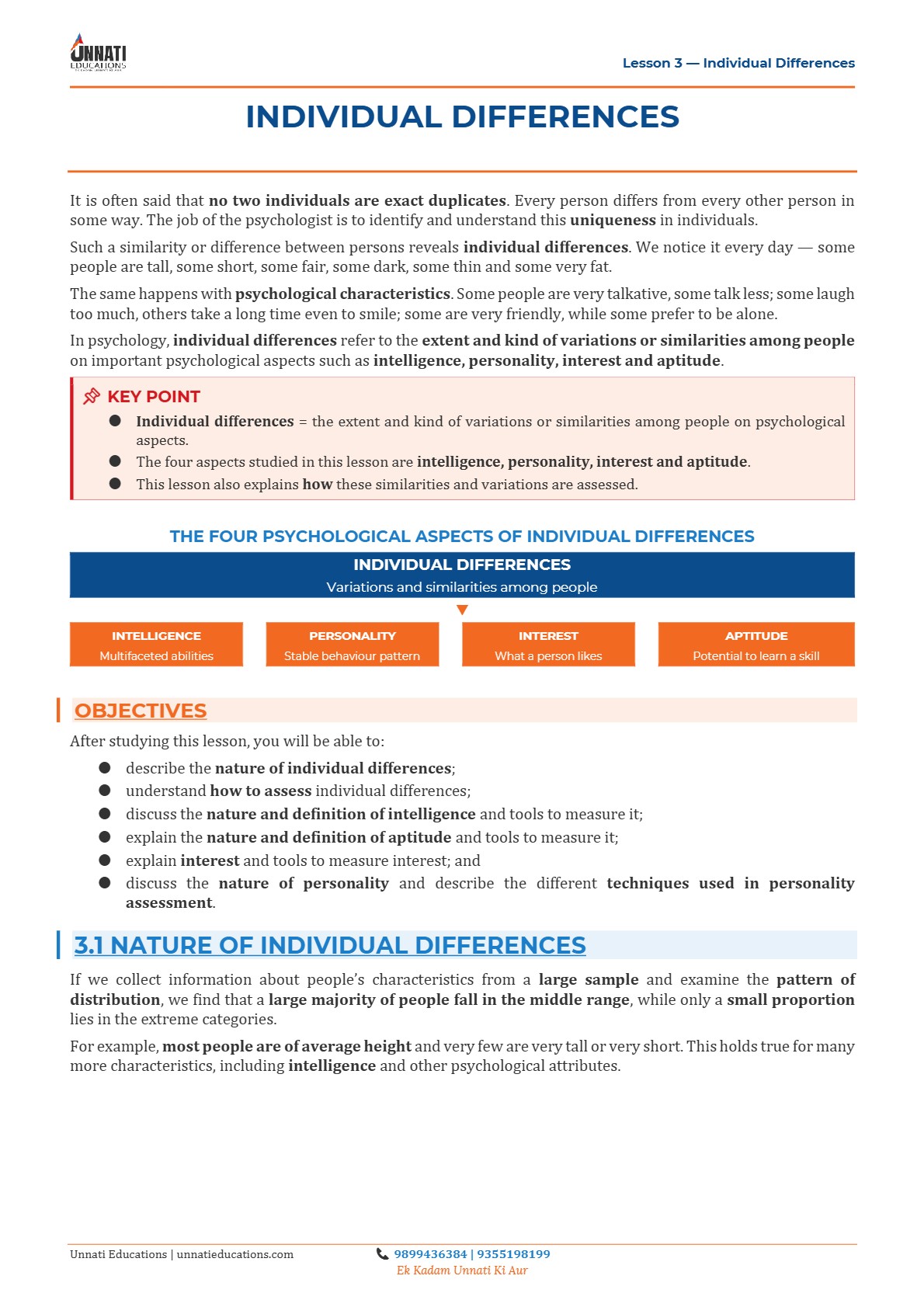
3.1 Nature of Individual Differences
- Most people fall in the middle or average range, and only a few lie at the extremes (very high or very low).
- Individual differences are common: No two people are exactly alike in their behaviour and psychological characteristics.
- Consistency: Psychological differences are stable and show regularity over time.
- Every person develops their own unique characteristics due to heredity and environment.
Causes: Genetic Factors (Heredity)
- We inherit traits from our parents through genetic codes.
- We also inherit some cognitive and emotional traits like creativity, love for sports, and intellectual abilities.
- However, we are not exact copies of our parents because environment also plays a role.
Lesson 4: Learning (Sample)
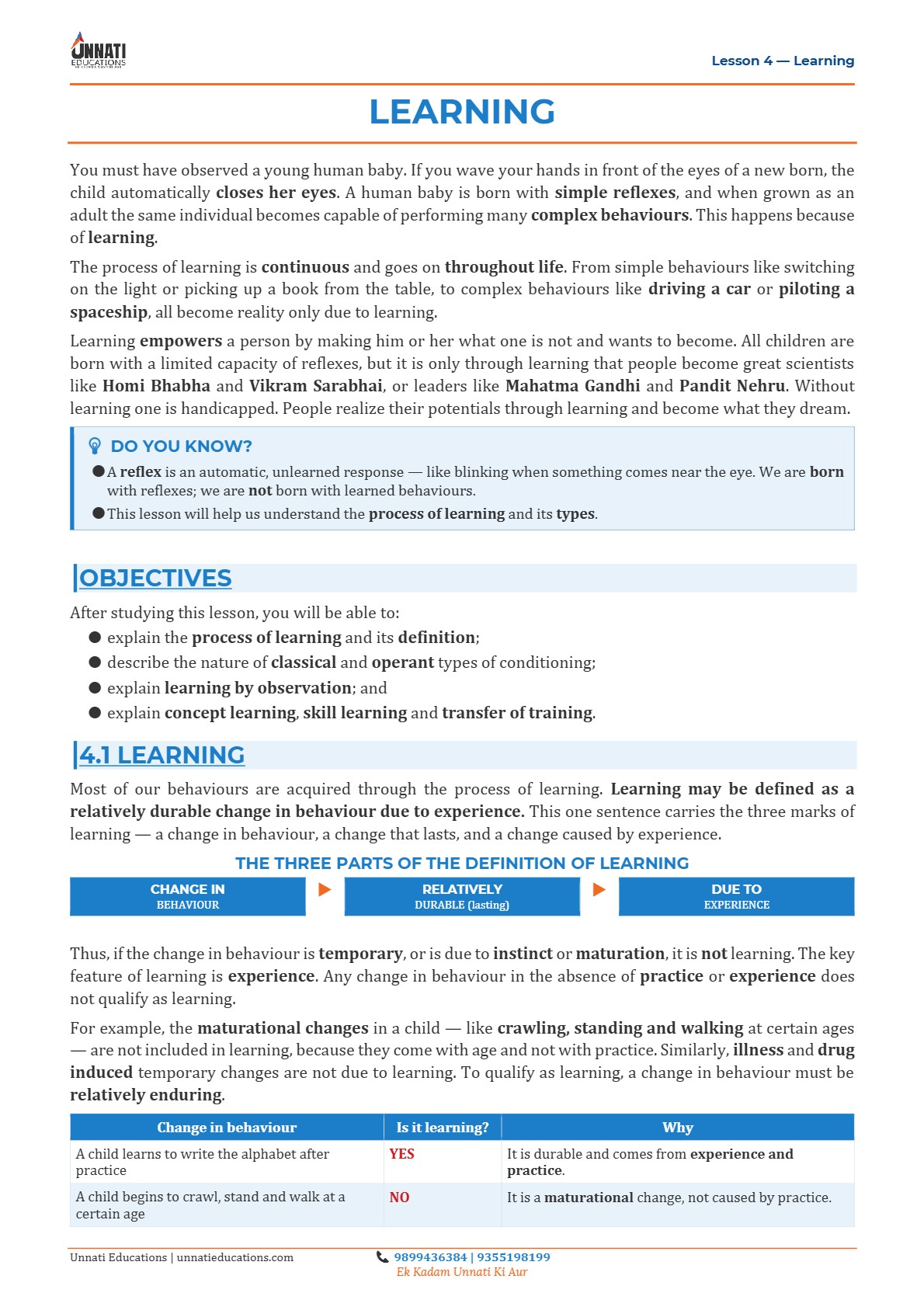
4.1 Definition of Learning
- Learning is defined as a relatively durable change in behaviour due to experience.
- If the change is temporary, it is not learning.
- If the change is due to instincts or maturation, it is not learning.
Classical Conditioning (Ivan P. Pavlov)
- He studied the stimulus-response relationship using dogs.
- Found that dogs could learn to salivate at a sound when it was associated with food.
- He then paired a neutral sound (bell or buzzer) with food repeatedly.
These extracts are a small preview only. The complete Psychology 222 notes carry every lesson at this same level of clarity, with full examples, diagrams described in words and end of chapter recaps.
How These Psychology 222 Notes Help You Score Better
Many students lose marks not because the subject is hard, but because the textbook is long and revision time is short. Our notes fix that by turning each lesson into a compact set of points you can actually remember on exam day. You revise the whole subject faster and retain more of it.
The notes are built around the way NIOS frames its questions, so the summaries line up with what the paper asks. Definitions are exam ready, examples are short and every difficult idea is explained in plain words, which is exactly what a repeater or a working student needs when time is tight.
Because the material is condensed and consistent, your final week of preparation becomes calm rather than rushed. You spend less time hunting through the book and more time locking in answers.
Who Should Use These Psychology 222 Notes
These notes suit first time NIOS learners who want a clean starting point, repeaters who need a fast and dependable revision route, and busy working students who cannot read the full textbook cover to cover. If any of these describe you, this set will save you real time.
They also work well as a companion to our wider NIOS Class 10 Notes collection, so students taking several subjects can keep a single, consistent revision style across every paper rather than switching formats.
Parents supporting a child through the secondary stage also find the short format useful, since it makes it easy to check progress lesson by lesson without needing a background in the subject.
Psychology 222 Notes Compared With the NIOS Textbook
The official textbook is complete and authoritative, and you should keep it. What it is not, is quick to revise from. A single lesson can run for many pages, which is difficult in the last days before a paper. Our notes sit on top of that book as a revision layer, not a replacement.
Use the textbook to understand a topic for the first time, then switch to the notes to lock it into memory and revise repeatedly. If you ever need to confirm the official structure, the current NIOS Syllabus lists the same lesson order we follow, so the two always stay in step.
In short, the textbook builds understanding and the notes build recall. Together they give you both depth and speed, which is the combination that produces a good result.
Get the Complete NIOS Class 10 Psychology 222 Notes
The sample pages above show our standard. To receive the full set for all sixteen lessons, message us on WhatsApp and our team will share the complete notes with you along with details of what is included. It is a quick, direct way to get exam ready material without any long process.
Get Full Psychology 222 Notes on WhatsApp
Prefer our alternate line? You can also reach us on the number below and ask for the complete Psychology 222 notes for the 2026 session.
Psychology 222 Notes Frequently Asked Questions
Are the Psychology 222 notes updated for the 2026 NIOS session?
Yes, these notes are prepared for the 2026 session and follow the current lesson order. Our team reviews the material against the latest syllabus so the content matches what the paper actually asks. You revise from an up to date set rather than an old edition, which keeps your preparation aligned with the examination pattern that applies to your attempt.
How can I get the full Psychology 222 notes for Class 10?
You can get the complete set by messaging us on WhatsApp using the numbers on this page. Once you contact us, our team shares the full notes for all sixteen lessons and explains what is included. The sample pages above let you check the quality first, so you know exactly the style and depth you will receive before you ask for the complete material.
Do the Psychology 222 notes cover every chapter of the subject?
Yes, the complete notes cover all sixteen lessons of the subject, from Methods of Psychology through to the Indian perspective on personality. Each lesson is condensed into short, exam ready points without skipping any important concept. The chapter table on this page shows the full list, so you can see the entire coverage before requesting the complete set of notes.
Can these Psychology 222 notes help me pass the NIOS exam?
These notes are built to make revision faster and answers sharper, which directly supports a pass. They condense long chapters into memorable points aligned with how NIOS frames its questions. Your own effort decides the result, but the short format is designed to help you revise the whole subject and recall answers more confidently on the day of the paper.
Are the sample Psychology 222 notes different from the complete set?
The sample pages are taken directly from the full notes, so the style and quality are identical. The difference is only coverage. The preview shows a few extracts, while the complete set carries every one of the sixteen lessons at the same level of clarity, with full examples and end of chapter recaps for thorough revision across the entire subject.
In which language are the Psychology 222 notes available?
The notes are written in simple, easy to read English so learners at every level can follow them. The language is kept clear and direct, which helps first time students and repeaters alike. If you need any clarification on the medium before requesting the full notes, you can ask our team directly on WhatsApp and we will guide you.
Sources and Disclaimer for the Psychology 222 Notes
The lesson names and syllabus structure referenced on this page are based on the official National Institute of Open Schooling material available at nios.ac.in. Students should always confirm the current syllabus and examination pattern on the official portal before their attempt.
Unnati Educations is an independent academic support provider and is not affiliated with, endorsed by, or associated with the National Institute of Open Schooling (NIOS). All institution names are used for identification and reference only.
Contact Unnati Educations - Your Academic Lifeline
If you're eager to begin your journey or need guidance in the NIOS admissions process, we're just a message away.